
Animal
Wild turkey
The wild turkey is a big bird that lives in forests and fields in North America. The boy turkeys puff up their feathers and say 'gobble, gobble!'
The wild turkey is a big, bronze-feathered bird of North American forests and clearings. It walks most of the time but can run, fly and even roost high in trees at night. By the early 1900s wild turkeys had become rare in many places, but people helped them come back, and now they live in every U.S. state except Alaska.
Meleagris gallopavo is a large ground-foraging gamebird of North American open forests, the wild ancestor of the domestic turkey, which people in Mexico domesticated centuries before Europeans arrived. After severe declines from hunting and habitat loss, transplanting wild-caught birds from the 1940s restored and expanded its range; Cornell notes that no other game bird has responded so well to game managers' efforts.
Photo: Judy Gallagher, CC BY 2.0, via Wikimedia Commons
Meet the wild turkey
The wild turkey is a very big bird.
It has dark, shiny feathers, a long neck and long legs. Its head has bare skin with no feathers. Boy turkeys have red flaps of skin on their heads.
The wild turkey is a very large bird, about 1.1 meters long from bill to tail, with a long neck and long legs. Its feathers are dark with a bronze-green shine, its wings are barred with white, and its tail feathers have rusty or white tips.
The head and neck have bare skin that can be red, blue or gray. Males have a small, bare head with blue skin and red wattles, flaps of skin on the neck. Females, like the one in our photo, are dark brown with even darker bars.
Meleagris gallopavo, of the pheasant family Phasianidae, is 110 to 115 centimeters long with a wingspan of 125 to 144 centimeters and a weight of 2.5 to 10.8 kilograms (Cornell). The plumage is dark with bronze-green iridescence; the wings are boldly barred with white and the rump and tail feathers broadly tipped with rust or white.
The bare skin of the head and neck varies from red to blue to gray. Males have a small, unfeathered head with blue skin and red wattles; females, such as the bird photographed here in Virginia, are dark brown with darker barring and a coppery sheen on the rump and tail.
Quick facts
- Group
- Bird
- Length
- 1.1 to 1.15 m
- Wingspan
- 1.25 to 1.44 m
- Weight
- 2.5 to 10.8 kg
Where it lives
Wild turkeys live in North America.
They like forests with open, grassy spaces. They sleep up in the trees at night.
Wild turkeys live in the United States, parts of Mexico and parts of southern Canada. They live in every U.S. state except Alaska.
They like open forests with clearings, especially forests with nut trees such as oaks and hickories. In the southwest, turkeys also live in grassy savannas with small oak trees. People have taken wild turkeys to other places too, including Hawaii, Australia and New Zealand.
The IUCN's 2018 global assessment lists the species as native to Canada, the United States and Mexico, and introduced to Australia, New Zealand and Hawaii. Cornell describes year-round populations in 49 U.S. states, parts of Mexico and parts of southern Alberta, Saskatchewan, Manitoba and Ontario.
Habitat is open forest interspersed with clearings. In the northeast turkeys use mature oak-hickory forests and humid forests of red oak, beech, cherry and white ash; southeastern birds use a great variety of pine and hardwood forests; southwestern birds favor open grassy savanna with small oaks; and in Alberta they live between pinyon-juniper and ponderosa pine forest.
Continent
Its habitats


Where can you find this animal?
- Brought here by people · Countries and seas named by a scientific source
- Lives here naturally · Countries and seas named by a scientific source
- Sightings recorded · Records of wild sightings (GBIF)
Brought here by people · Countries and seas named by a scientific source
Wild turkeys brought by people now breed in parts of Australia and New Zealand.
Places: Australia and New Zealand.
Source: iucn-red-list · checked October 2026
Lives here naturally · Countries and seas named by a scientific source
Open forests and clearings in every U.S. state except Alaska, parts of Mexico and parts of southern Canada. Many of today's populations were restored by moving wild turkeys to new areas. Turkeys in Hawaii were introduced.
Places: Canada, Mexico and United States.
Source: iucn-red-list · checked October 2026
Sightings recorded · Records of wild sightings (GBIF)
Counts of GBIF records of wild observations (human and machine) and preserved specimens. Records include introduced populations, vagrants, escaped or released animals and misidentifications, so a country with records is not necessarily part of the native range.
Wild sightings have been recorded in United States, Canada, New Zealand, Mexico, Australia, New Caledonia, Cuba, Netherlands and 84 more places.
Source: gbif · checked October 2026
Range maps show where scientists say an animal lives, often country by country. An animal may live in only part of a country shown, and sightings records can include animals that wandered far from home.
What it eats
Wild turkeys eat acorns, nuts, seeds and berries.
They scratch the ground with their feet to find food. Sometimes they eat snails and bugs.
Wild turkeys eat mostly plants. In fall, winter and early spring they scratch through dead leaves on the forest floor for acorns, beech nuts, pecans, hickory nuts, wild cherries and other seeds and berries.
In late spring and summer they strip seeds from grasses and sedges, and sometimes snap up salamanders, snails and beetles. When deep snow covers the ground, they eat buds, ferns and mosses. Like most birds, they swallow little bits of grit to help grind up their food.
The diet is mainly plant matter gathered in flocks, mostly on the ground. From autumn to early spring turkeys scratch the forest floor for acorns of red, white, chestnut and black oaks, along with beech nuts, pecans, hickory nuts, wild black cherries, white ash seeds and other seeds and berries.
In deep snow they switch to hemlock buds, evergreen ferns, club mosses and burdock; in spring they may dig bulbs if nuts are scarce; and in late spring and summer they strip seeds from sedges and grasses, adding salamanders, snails, ground beetles and other insects. Swallowed grit aids digestion.
Did you know?
People in Mexico kept turkeys long ago.
People in Mexico domesticated turkeys centuries before European explorers took them to Europe in the early 1500s.
The wild turkey and the Muscovy duck are the only two domesticated birds native to the New World; Mexican peoples domesticated turkeys centuries before 1500.
Walking, running and flying
Wild turkeys walk most of the time.
They can run fast and fly too! At night they fly up into trees to sleep.
Wild turkeys get around mostly by walking, but they can also run and fly. When something scares them, females tend to fly away while males tend to run.
At sunset, turkeys flap up into the low branches of a tree and climb from branch to branch to a high spot to sleep. They are heavy birds, so they take off with a flurry of loud wingbeats and fly only short distances. When they need to, turkeys can even swim, by tucking in their wings, spreading their tails and kicking.
Turkeys travel mainly on foot but can run and fly; when threatened, females tend to fly and males to run. Cornell describes these heavy birds taking flight with a flurry of loud, labored wingbeats over short distances. At sundown they fly into low limbs and move upward to roost high in trees, usually in flocks.
They can also swim, tucking the wings in, spreading the tail and kicking. Because of their large size and compact bones, and their long popularity as food, turkeys have a better known fossil record than most birds, with fossils from the southern United States and Mexico more than 5 million years old.
Hens and poults
The mother turkey makes a nest on the ground.
She lays lots of speckled eggs in dead leaves. The fluffy chicks follow her the day after they hatch.
The female turkey, called a hen, scratches a shallow dip in the ground at the foot of a tree or under thick bushes, using the dead leaves already there. She lays 4 to 17 pale tan eggs with reddish-brown spots and keeps them warm for 25 to 31 days.
The chicks hatch covered in fluffy down and leave the nest after about a day. They follow their mother, who feeds them for a few days until they learn to find food themselves. Male turkeys do not help raise the young.
Nests are shallow scrapes about 2.5 centimeters deep and 20 to 33 centimeters across, at the bases of trees, under brush or occasionally in hayfields, using only leaves already present. Cornell gives a clutch of 4 to 17 pale yellowish-tan eggs spotted reddish brown, incubation of 25 to 31 days and a nestling period of just one day; hatchlings are well developed and covered in tawny, brown, pinkish and gray down.
Males provide no parental care. The female feeds the young for a few days until they forage alone. Several hens and their broods then band together, and winter flocks sometimes exceed 200 turkeys.
Gobbling and strutting
Boy turkeys gobble very loudly.
They spread their tails like a fan and puff up their feathers to show off to the girls.
In spring, male turkeys gobble loudly to attract females and to warn other males. To show off, a male struts with his tail fanned out, his wings lowered and his feathers puffed up, making soft humming and 'chump' sounds.
Turkeys live in flocks. Outside the breeding season, males form all-male flocks, while females and their young travel together. Each flock has a pecking order, a ranking of who is in charge.
Courting males gobble to attract females and warn rivals, and display by strutting with the tail fanned and wings lowered while making nonvocal hums and 'chump' sounds. Males mate with multiple females and form all-male flocks outside the breeding season.
Family groups often merge into large flocks of young birds with two or more adult females. Each sex has its own pecking order: the female hierarchy is stable, while the male hierarchy constantly changes. Predators of adults include coyotes, bobcats, mountain lions and large owls, and many animals raid nests.

A great comeback
Long ago there were very few wild turkeys left.
People moved turkeys to new forests to help them. Now there are lots of wild turkeys again!
In the 1800s and early 1900s, hunting and the loss of forests made wild turkeys very rare. At first, people tried releasing farm turkeys, but they did not survive in the wild. Then, in the 1940s, people began catching wild turkeys and moving them to good forests in other places.
It worked! Today the wild turkey is listed as Least Concern, with about 6.9 million breeding birds, and it lives in more places than before. It is the second most popular animal for hunters in the United States, after deer.
The IUCN lists the wild turkey as Least Concern (2018). After drastic declines during the nineteenth and early twentieth centuries from hunting and habitat loss, one subspecies vanished from New England by the mid-1800s, surviving in small numbers in the Gulf States, Ozarks and Appalachian and Cumberland plateaus, and others declined in Texas and the Southwest.
Releasing farm turkeys failed, but transplanting wild-caught birds from the late 1940s succeeded; Cornell notes that no other game bird has responded so well to management. Breeding Bird Survey data show sharp increases from 1966 to 2019, and Partners in Flight estimates 6.9 million breeding birds. About 2.5 million U.S. hunters pursue turkeys.
IUCN Red List
How is the wild turkey doing in the wild?
- Least Concern (this animal)
- Near Threatened
- Vulnerable
- Endangered
- Critically Endangered
- Extinct in the Wild
- Extinct
Least Concern
Not at risk of disappearing from the wild right now.
See the IUCN Red List assessment · The IUCN Red List of Threatened Species 2021.3
Amazing facts
-
Wild turkeys can swim!
When they need to, wild turkeys can swim by tucking in their wings, spreading their tails and kicking.
Turkeys swim by tucking the wings, spreading the tail and kicking with the feet.
-
Turkeys sleep high up in trees.
At sunset, wild turkeys fly into low branches and climb up from branch to branch to roost high in the tree.
Birds fly into lower limbs at sundown and move upward limb by limb to a high roost, usually in flocks.
-
Turkey fossils are very, very old.
Some turkey fossils found in the southern United States and Mexico are more than 5 million years old.
Large, compact bones give turkeys a better known fossil record than most birds, with specimens over 5 million years old.
-
People in Mexico kept turkeys long ago.
People in Mexico domesticated turkeys centuries before European explorers took them to Europe in the early 1500s.
The wild turkey and the Muscovy duck are the only two domesticated birds native to the New World; Mexican peoples domesticated turkeys centuries before 1500.
Words to know
- gobble
- the loud, bubbly call of a male turkey
- hen
- a female turkey or chicken
- roost
- to rest or sleep in a high place, like a tree
- wattle
- a flap of bare skin that hangs from a bird's head or neck
- pecking order
- the ranking of who is in charge in a group of birds
- transplant
- to move animals to a new place where they can live
Discovery challenge
-
Where do wild turkeys sleep at night?
Where do wild turkeys roost at night?
Where do wild turkeys usually spend the night?
- High up in trees
- In underground burrows
- Floating on lakes
Show the answer
High up in trees
They fly up into trees to sleep.
At sunset they fly into trees and climb to a high roost.
They roost high in trees, usually in flocks.
-
Which turkeys gobble?
Which wild turkeys gobble loudly in spring?
Which turkeys gobble to attract mates and warn rivals?
- The males
- The chicks
- The eggs
Show the answer
The males
The boy turkeys gobble.
Males gobble to attract females and warn other males.
Courting males gobble and also strut with tails fanned.
-
Who takes care of turkey chicks?
Which parent raises wild turkey chicks?
Which parent provides care for wild turkey young?
- The mother
- The father
- Both parents
Show the answer
The mother
The mother turkey takes care of them.
Only the hen raises the chicks; males give no care.
Care is entirely by the female; males provide none.
-
How did people help wild turkeys come back?
What helped wild turkeys recover?
Which method restored wild turkey populations?
- Moving wild turkeys to new forests
- Releasing farm turkeys
- Feeding them candy
Show the answer
Moving wild turkeys to new forests
People moved wild turkeys to new forests.
From the 1940s, people moved wild-caught turkeys to good habitat; farm turkeys did not survive.
Transplanting wild-caught birds succeeded where releases of farm turkeys failed.
Places where you might see it
-
 Watch
 Country
United States
The United States is a large country in North America made of 50 states, from icy Alaska to the warm islands of Hawaii. It has the Grand Canyon, the Mississippi River and Yellowstone, and about 342 million people live there.
-
 Watch
 Country
Mexico
Mexico is a large country in southern North America, between the Pacific Ocean and the Gulf of Mexico. It has smoking volcanoes, ancient cities built by the Maya and other peoples, and about 132 million people, many of them in and around Mexico City.
Explore next
-
 Watch
3D
Animal
Chicken
The chicken is a domesticated bird: people raise it on farms and in backyards all over the world for eggs and meat. Its wild ancestor is the red junglefowl of the forests of southern and Southeast Asia, and scientists think chickens were first domesticated about 3,500 years ago near rice fields in Southeast Asia.
-
 Watch
3D
Animal
Indian peafowl
The Indian peafowl is a large bird of the pheasant family from South Asia. Males, called peacocks, have a bright blue neck and a long train of shimmering feathers decorated with eyespots, which they spread into a giant fan to impress females, called peahens. It is the national bird of India.
-
 Watch
Animal
White-tailed deer
White-tailed deer live in forests, fields and even towns from Canada down to South America. They are named for the white underside of the tail, which they hold up like a flag when they run. Males grow new antlers every year.
-
 Watch
Animal
Great horned owl
The great horned owl is a large, powerful owl with two long, earlike tufts of feathers on its head. It is one of the most common owls in North America and lives in almost any kind of semi-open place, from deserts and forests to city parks. It hunts mostly at night.
-
Watch
Country
United States
The United States is a large country in North America made of 50 states, from icy Alaska to the warm islands of Hawaii. It has the Grand Canyon, the Mississippi River and Yellowstone, and about 342 million people live there.
-
Watch
Country
Mexico
Mexico is a large country in southern North America, between the Pacific Ocean and the Gulf of Mexico. It has smoking volcanoes, ancient cities built by the Maya and other peoples, and about 132 million people, many of them in and around Mexico City.
-
 Watch
Animal
Common pheasant
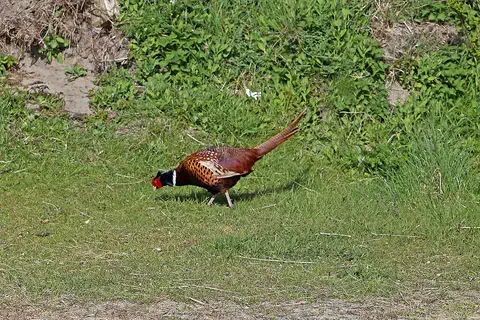
The common pheasant is a long-tailed ground bird. Its wild home is Asia, from the Caspian Sea to China and Korea, but people have taken it to Europe, North America, New Zealand and other places. Males are bright and coppery with a red face; females are mottled brown.
-
 Watch
Animal
Adélie penguin
The Adélie penguin is a medium-sized penguin, about 70 centimeters tall, with a black back, a white front and a bright white ring around each eye. It breeds in summer on rocky, ice-free ground all around Antarctica, building nests of pebbles, and spends the winter far out at sea among the pack ice.
For parents & teachers
What children will learn
- Describe the wild turkey's appearance and the differences between males and females.
- Explain what wild turkeys eat and how their diet changes through the year.
- Describe how wild turkey hens raise their young.
- Explain how people helped wild turkeys recover.
Recommended ages: 3 to 17 · About 15 minutes
Talk about it
- Why might moving wild turkeys work better than releasing farm turkeys?
- Why might a bird that feeds on the ground sleep up in a tree?
- How do you think a hen hides her nest on the forest floor?
Try at home or in class
- Go on a walk with an adult and look for acorns and other nuts that turkeys eat. How many kinds can you find?
- Trace your hand to make a turkey picture, then add white bars to the wings and rusty tips to the tail like a real wild turkey.
Key vocabulary: gobble, hen, roost, wattle, pecking order, transplant
Where these facts come from
- The IUCN Red List of Threatened Species , International Union for Conservation of Nature (IUCN terms of use (no redistribution of Red List data or range maps))
- GBIF Backbone Taxonomy and GBIF Occurrence Search , Global Biodiversity Information Facility (CC0 1.0 (backbone); occurrence counts are facts derived from records under CC0, CC BY and CC BY-NC)
- Wikidata , Wikimedia Foundation (CC0 1.0)
- Meleagris gallopavo (Wild Turkey), Red List global assessment 2018 , IUCN Red List of Threatened Species
- Wild Turkey overview , Cornell Lab of Ornithology, All About Birds
- Wild Turkey life history , Cornell Lab of Ornithology, All About Birds
- Wild Turkey identification , Cornell Lab of Ornithology, All About Birds
- Wikimedia Commons , Wikimedia Foundation (Per file: Public domain, CC0, CC BY or CC BY-SA only (credited on each page))
Checked, not yet human-reviewed. Last updated October 28, 2026. Spotted a mistake? Tell us.