
Animal
Jackson's chameleon
Jackson's chameleon is a green lizard from the mountains of Africa. The males have three horns on their heads!
Jackson's chameleon is a green chameleon from the highlands of Kenya and Tanzania, where it lives in trees and bushes above 1,500 meters. Males have three long horns, and females have none or only small ones. Instead of laying eggs, the mother gives birth to live babies, one at a time.
Trioceros jacksonii (family Chamaeleonidae) is a highland chameleon of Kenya and northern Tanzania, introduced in Hawaii. Tolley assessed it as Least Concern for the IUCN Red List (assessed 27 August 2013, published 2014, flagged as needing updating) because of its large range and tolerance of altered habitats, while noting concern about wild collection of the Mount Meru subspecies for the pet trade.
Photo: AMMuench, CC BY 4.0, via Wikimedia Commons
Meet Jackson's chameleon
Jackson's chameleon is a green lizard.
Boy chameleons have three horns.
Girl chameleons have no horns or tiny ones.
Jackson's chameleon is a chameleon from East Africa. It is usually green, and it can turn as dark as black when it is very upset. Most grown-ups are about 15 to 35 centimeters long.
Males and females look different. A male has three long, pointed horns on his head; the species is also called Jackson's three-horned chameleon. Females have no horns or only small ones. Both have a little crest on the back of the head and small spines along the back.
Trioceros jacksonii was described by Boulenger in 1896. The IUCN recognizes three subspecies, T. j. jacksonii, T. j. xantholophus and T. j. merumontana, though a phylogenetic study has not confirmed them as currently defined; only the isolated Mount Meru form appears distinct (Stipala 2014).
The Animal Diversity Web describes a sexually dimorphic chameleon of about 15 to 35 centimeters: males carry three long, pointed horns that are absent or poorly developed in females; there is a small crest on the back of the head and small spines along the vertebral line; color is usually green but can darken to nearly black under stress.
Quick facts
- Group
- Reptile
- Length
- 0.15 to 0.35 m
- Lifespan in the wild
- 10 years
Cool mountain forests
Jackson's chameleons live high up in the mountains.
They live in trees and bushes.
Some live in gardens!
In the wild, Jackson's chameleons live in the highlands of Kenya and northern Tanzania, between about 1,500 and 3,200 meters above sea level, around places such as Nairobi, Mount Kenya and Mount Meru. They live in trees and bushes in mountain forests, and also in hedges, gardens, plantations and along roadsides.
In 1972, people released pet chameleons on the island of O'ahu in Hawaii. They spread to other Hawaiian islands, where they are now an invasive species.
The IUCN gives a range above 1,500 meters in Kenya and Tanzania, up to 3,200 meters: T. j. jacksonii around Nairobi, Kimakia and southwest of Mount Kenya (with unconfirmed records from the West Usambara Mountains), T. j. xantholophus on the slopes of Mount Kenya, and T. j. merumontana only in the Arusha district and on Mount Meru. A large gap between the Kenyan highlands and Mount Meru inflates the calculated range by about 30%.
It matches the recent extent of moist and dry montane forest but tolerates hedges, small trees, gardens, plantations, forest edges and farmland, and can be common in urban and peri-urban areas (Tilbury 2010). Dozens of pet chameleons released on O'ahu in 1972 founded an invasive population that has spread to Maui, Hawai'i and Kaua'i (McKeown 1996).
Continent
Its habitat

Where can you find this animal?
- Brought here by people · Countries and seas named by a scientific source
- Lives here naturally · Countries and seas named by a scientific source
- Sightings recorded · Records of wild sightings (GBIF)
Brought here by people · Countries and seas named by a scientific source
An invasive population in the Hawaiian Islands only (O'ahu, Maui, Hawai'i and Kaua'i), started by pet chameleons released in 1972; not elsewhere in the United States.
Places: United States.
Source: iucn-red-list · checked October 2026
Lives here naturally · Countries and seas named by a scientific source
Highlands above 1,500 meters in central Kenya (around Nairobi and Mount Kenya) and northern Tanzania (Mount Meru and Arusha). It lives in only a small part of each country.
Places: Kenya and Tanzania.
Source: iucn-red-list · checked October 2026
Sightings recorded · Records of wild sightings (GBIF)
Counts of GBIF records of wild observations (human and machine) and preserved specimens. Records include introduced populations, vagrants, escaped or released animals and misidentifications, so a country with records is not necessarily part of the native range.
Wild sightings have been recorded in United States, Kenya, Tanzania, Denmark, Benin, Japan, DR Congo, Uganda and 7 more places.
Source: gbif · checked October 2026
Range maps show where scientists say an animal lives, often country by country. An animal may live in only part of a country shown, and sightings records can include animals that wandered far from home.
A tongue faster than a blink
Jackson's chameleons eat insects and spiders.
They shoot out a long, sticky tongue to catch them!
Jackson's chameleons eat mostly insects and spiders. A chameleon sits very still and watches. When it spots prey, it points both eyes at it and sways a little to judge how far away it is.
Then its tongue shoots out, longer than its own body, and the sticky tip grabs the insect. The tongue can stretch all the way out in about a sixteenth of a second. Chameleons drink by lapping drops of water from leaves.
The Animal Diversity Web describes a diet mainly of insects and spiders, taken by a sit-and-wait hunter that scans with independently moving eyes, then converges both eyes on the prey and sways to judge distance before projecting its tongue. The tongue, about one and a half times the lizard's length, has a fleshy, sticky tip and reaches full extension in about a sixteenth of a second; prey is then chewed and swallowed. Water is lapped from drops on leaves.
Did you know?
A chameleon's tongue is longer than its body!
A Jackson's chameleon's tongue is about one and a half times as long as the chameleon itself.
The tongue measures about 1.5 times the lizard's length (ADW).
Turret eyes and gripping feet
Each eye can look a different way.
Its feet hold on to branches like tongs.
Its tail curls around twigs.
A chameleon's eyes are covered with skin except for the pupil, and each eye can swivel on its own, so the chameleon can look in two different directions at once.
Its toes are split into two groups, two pointing one way and three the other, so each foot can grip a branch like a pair of tongs. Its tail can wrap around twigs and hold on like an extra hand.
The Animal Diversity Web notes that, like other chameleons, Jackson's chameleon has zygodactylous feet, with toes grouped two and three, specialized for gripping branches, and a prehensile tail. Only the pupil shows through the skin covering each eye; each eye rotates through about 180 degrees independently, and chameleons have unusually strong control over the curvature of the lens, which may let them magnify an image (Land 1995).
Babies born on a branch
The mother does not lay eggs in a nest.
Her babies are born one at a time on a branch.
Each baby wakes up and climbs out of a sticky sac.
Jackson's chameleon babies grow inside their mother for about 190 days. Then, usually in the morning, she gives birth to them one at a time onto a branch.
Each baby is wrapped in a sticky, jelly-like sac. When the sac touches the branch, the baby wakes up, stretches and breaks out. A newborn is only about 5.5 centimeters long and weighs about 0.6 grams. Young chameleons are ready to breed at just 9 or 10 months old.
The Animal Diversity Web (after Zimmermann 1986) describes a courtship that resembles the threat display: the male changes color, inflates his throat and raises his forelegs, and a receptive female answers weakly or not at all. Gestation lasts about 190 days. Young are usually born in the morning, delivered one at a time onto a branch inside a gelatinous sac; each stays still until the sac touches the substrate, then stretches and breaks free. Newborns measure about 5.5 centimeters and 0.6 grams, females can mate again about 20 days after giving birth, and young reach sexual maturity at 9 to 10 months.
Colors, horns and stillness
Jackson's chameleons move slowly and stay still.
They warm up in the morning sun.
They change color when they are upset.
Jackson's chameleons live in trees and bushes. In the morning they bask in the sun, turning one side to the light and flattening their bodies to soak up more warmth before they hunt.
Males defend their own areas. When two males meet, they turn sideways, puff themselves up, show bright colors, sway and bob, and may push with their horns. The loser fades to dull colors and backs away. Staying still and showing dull colors helps them hide from birds, snakes and other hunters.
The Animal Diversity Web describes morning basking with one flank turned to the light and the body flattened and neck stretched to increase surface area. Males are territorial: rivals turn sideways, flatten and inflate their bodies, curl their tails, thrust their heads forward, brighten, gape to show mouth colors, sway, bob and hiss softly, and may push with their horns; the submissive male fades and hides, freezes or leaves. Stillness and drab coloring protect against birds, snakes, shrews and lizards.
Did you know?
Jackson's chameleons can live in gardens.
Jackson's chameleons can be common in towns, living in hedges, gardens and small trees.
Can be common in urban and peri-urban areas, in hedges, small trees, gardens and plantations (Tilbury 2010, via IUCN).
Popular pets
Jackson's chameleons are not endangered.
But people catch some to sell as pets.
Jackson's chameleon is listed as least concern: it lives across a fairly large area and can live in gardens and farmland, not only forests. But it is very popular as a pet. More than 117,000 live Jackson's chameleons were exported from their native range in Africa between 1977 and 2011.
Today most chameleons sold from Kenya are bred on farms, but most from Tanzania are still caught in the wild, which may be too many for the Mount Meru population. Some live in protected areas such as Mount Kenya National Park.
Tolley assessed Trioceros jacksonii as Least Concern (Global; assessed 27 August 2013, published 2014; 'needs updating'; trend stable) for its large extent of occurrence and tolerance of habitat modification. It has been the second most heavily exported chameleon since 1972, more than 8% of the global chameleon trade (Jenkins et al. 2013): 117,024 live animals left the native range from 1977 to 2011, with a peak of 43,111 commercial exports in 1979.
Current exports from Kenya are captive-bred or farmed, but 91% of exports from Tanzania (T. j. merumontana) are wild-collected, so that harvest may not be sustainable; the assessor suggests investigating harvest from the invasive Hawaiian population instead. It occurs in the Aberdares, Mount Kenya and Arusha national parks, and is on CITES Appendix II.
IUCN Red List
How is the jackson's chameleon doing in the wild?
- Least Concern (this animal)
- Near Threatened
- Vulnerable
- Endangered
- Critically Endangered
- Extinct in the Wild
- Extinct
Least Concern
Not at risk of disappearing from the wild right now.
Amazing facts
-
A chameleon's tongue is longer than its body!
A Jackson's chameleon's tongue is about one and a half times as long as the chameleon itself.
The tongue measures about 1.5 times the lizard's length (ADW).
-
Baby Jackson's chameleons are born, not hatched from eggs in a nest.
The mother gives birth on a branch, and each baby breaks out of a sticky sac as soon as it touches the wood.
Young are delivered in gelatinous sacs and stay inactive until the sac touches the substrate (ADW).
-
Chameleons drink drops of water from leaves.
Jackson's chameleons get water by lapping drops off leaves.
Water is obtained by lapping drops from leaves (ADW).
-
Jackson's chameleons can live in gardens.
Jackson's chameleons can be common in towns, living in hedges, gardens and small trees.
Can be common in urban and peri-urban areas, in hedges, small trees, gardens and plantations (Tilbury 2010, via IUCN).
Words to know
- chameleon
- a tree lizard with swiveling eyes, a long sticky tongue and gripping feet
- prehensile
- able to wrap around and hold on to things
- highlands
- high, hilly or mountainous land
- invasive species
- a plant or animal brought to a new place, where it causes harm
- gestation
- the time young grow inside their mother before birth
- least concern
- not currently at serious risk of dying out in the wild
Discovery challenge
-
How many horns does a boy Jackson's chameleon have?
How many horns does a male Jackson's chameleon have?
How many cephalic horns do male Trioceros jacksonii carry?
- Three
- One
- Ten
Show the answer
Three
Three horns!
Males have three long horns; females have none or small ones.
Three long, pointed horns in males (ADW).
-
How are baby Jackson's chameleons born?
How do Jackson's chameleon babies come into the world?
Which reproductive mode does Trioceros jacksonii show?
- Born one at a time on a branch
- Hatched from eggs buried in sand
- Hatched from eggs in a bird's nest
Show the answer
Born one at a time on a branch
On a branch!
Each baby comes out in a sticky sac and breaks free on the branch.
Live young in gelatinous sacs after about 190 days of gestation (ADW).
-
What does a chameleon use to catch bugs?
How does a Jackson's chameleon catch insects?
How does Trioceros jacksonii capture prey?
- It shoots out its long, sticky tongue
- It chases them on the ground
- It catches them in a web
Show the answer
It shoots out its long, sticky tongue
Its sticky tongue!
The tongue shoots out in about a sixteenth of a second.
Ballistic tongue projection with a sticky, fleshy tip (ADW).
-
Where else do Jackson's chameleons live now?
Where were Jackson's chameleons released by people in 1972?
Where is there an invasive population of Trioceros jacksonii?
- Hawaii
- Antarctica
- Greenland
Show the answer
Hawaii
Hawaii!
Pet chameleons released on O'ahu spread to other Hawaiian islands.
The Hawaiian Islands, founded by pet releases on O'ahu in 1972 (IUCN).
Places where you might see it
-
 Watch
 Country
Kenya
Kenya is a country in East Africa, crossed by the equator. It has the snow-capped Mount Kenya, the deep Great Rift Valley, Lake Victoria and a long Indian Ocean coast, and about 54 million people live there, many of them speaking Swahili.
-
 Watch
 Country
Tanzania
Tanzania is a country in East Africa, just south of the Equator, on the Indian Ocean. It has Mount Kilimanjaro, Africa's highest mountain, deep lakes in the East African Rift, and the Serengeti, where huge herds of wildebeest travel each year.
Explore next
-
 Watch
Animal
Panther chameleon
The panther chameleon is a lizard famous for its brilliant colors. It lives on the island of Madagascar, grips branches with tong-shaped feet and a curling tail, looks two ways at once, and catches insects with a lightning-fast tongue. Males change their colors to send messages.
-
 Watch
3D
Animal
Veiled chameleon
The veiled chameleon lives in the dry mountains of Yemen and Saudi Arabia. It has a tall helmet-like casque on its head, eyes that can look two ways at once, feet that grip like hands and a super-fast sticky tongue. It changes color to show its mood, not to hide.
-
 Watch
Animal
Nile monitor
The Nile monitor is one of the biggest lizards in Africa, growing up to 2.4 meters long. It lives near rivers, lakes and swamps across most of Africa south of the Sahara, and along the Nile River in Egypt. It is a strong swimmer and a good climber, and it eats almost any animal it can catch.
-
Watch
Country
Kenya
Kenya is a country in East Africa, crossed by the equator. It has the snow-capped Mount Kenya, the deep Great Rift Valley, Lake Victoria and a long Indian Ocean coast, and about 54 million people live there, many of them speaking Swahili.
-
Watch
Country
Tanzania
Tanzania is a country in East Africa, just south of the Equator, on the Indian Ocean. It has Mount Kilimanjaro, Africa's highest mountain, deep lakes in the East African Rift, and the Serengeti, where huge herds of wildebeest travel each year.
-
 Watch
Animal
Aldabra giant tortoise
The Aldabra giant tortoise is one of the largest land tortoises on Earth. Wild ones live on Aldabra Atoll, a ring of coral islands in the Indian Ocean, where about 180,000 of them graze, browse and shape the land like elephants do in Africa. They can live for more than 100 years.
-
 Watch
Animal
Alligator snapping turtle
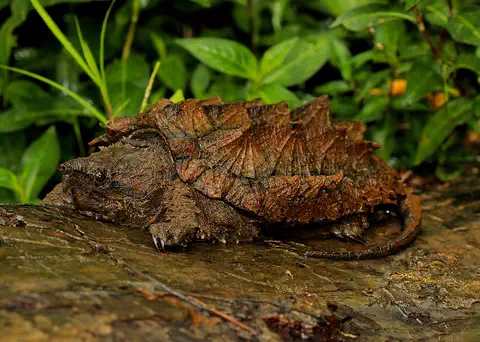
The alligator snapping turtle is the largest freshwater turtle in the United States. It lies still on the bottom of rivers and lakes with its mouth open, wiggling a worm-like lure on its tongue to trick fish into swimming close. Its numbers have fallen, and it is now endangered.
-
 Watch
3D
Animal
American alligator
The American alligator is a large, armored reptile of the swamps, marshes and lakes of the southeastern United States. Alligator mothers guard their nests and carry their babies to the water, and the holes alligators dig help many other animals survive dry seasons.
For parents & teachers
What children will learn
- Describe how a chameleon's eyes, tongue, feet and tail help it live in trees.
- Explain how male and female Jackson's chameleons differ.
- Explain what live birth means in a lizard.
- Explain why releasing pets can harm the places where they are released.
Recommended ages: 3 to 17 · About 15 minutes
Talk about it
- How could looking two ways at once help an animal that sits still to hunt?
- Why might it matter whether pet animals are bred by people or taken from the wild?
- What problems could a released pet cause on an island?
Try at home or in class
- Chameleon eyes: cup your hands around each eye like tubes and try to look at two different things at once. Then point both 'tubes' at one object, the way a chameleon aims before it shoots its tongue.
- Tong feet: make a 'chameleon foot' by holding two fingers together on one side and three on the other, and try to grip a pencil or stick.
Key vocabulary: chameleon, prehensile, highlands, invasive species, gestation, least concern
Where these facts come from
- GBIF Backbone Taxonomy and GBIF Occurrence Search , Global Biodiversity Information Facility (CC0 1.0 (backbone); occurrence counts are facts derived from records under CC0, CC BY and CC BY-NC)
- Wikidata , Wikimedia Foundation (CC0 1.0)
- The IUCN Red List of Threatened Species , International Union for Conservation of Nature (IUCN terms of use (no redistribution of Red List data or range maps))
- Trioceros jacksonii (Tolley, assessed 27 August 2013, published 2014) , IUCN Red List of Threatened Species
- Trioceros jacksonii: taxonomic notes, justification, range, population, habitat, threats, use and trade, and conservation text , IUCN Red List of Threatened Species
- Trioceros jacksonii: IUCN Red List global assessment record (Tolley 2014), IUCN checklist on GBIF , GBIF
- Chamaeleo jacksonii (Jackson's chameleon) , Animal Diversity Web, University of Michigan Museum of Zoology
- File:Female Jackson's Chameleon - Big Island Hawaii June 12 2025.jpg (12 June 2025, AMMuench) , Wikimedia Commons
- Wikimedia Commons , Wikimedia Foundation (Per file: Public domain, CC0, CC BY or CC BY-SA only (credited on each page))
Checked, not yet human-reviewed. Last updated November 1, 2026. Spotted a mistake? Tell us.