
Animal
Nile monitor
The Nile monitor is a very big lizard from Africa. It can swim, climb trees and dig.
The Nile monitor is one of the biggest lizards in Africa, growing up to 2.4 meters long. It lives near rivers, lakes and swamps across most of Africa south of the Sahara, and along the Nile River in Egypt. It is a strong swimmer and a good climber, and it eats almost any animal it can catch.
Varanus niloticus (family Varanidae) is a large, semi-aquatic monitor lizard found throughout sub-Saharan Africa and north along the Nile Valley to the Nile Delta, and introduced in Florida. Wilms and colleagues assessed it as Least Concern for the IUCN Red List (assessed 21 October 2019, published 2021): it is widespread, presumed abundant and probably stable, although it is heavily traded for leather and as a pet.
Photo: Charles J. Sharp, CC BY-SA 4.0, via Wikimedia Commons
Meet the Nile monitor
The Nile monitor is a very big lizard.
It has sharp claws and a forked tongue.
It lives near water in Africa.
The Nile monitor is a big, powerful lizard with a long, forked tongue, and it may be the largest lizard in Africa. A baby is about 30 centimeters long when it hatches, and a grown-up can reach 2.4 meters.
Its tough skin is covered in small, bead-like scales. Grown-ups are brownish or greenish gray with yellowish spots and stripes, and males and females look alike.
Varanus niloticus belongs to the monitor lizards (family Varanidae). The Animal Diversity Web describes it as possibly Africa's largest lizard, with hatchlings about 30 centimeters long and 26 grams and adults up to 2.4 meters, a powerful build, tough skin with bead-like scales and no sexual dimorphism.
The IUCN notes that the large forest water monitor of the Congo Basin, once raised to its own species (V. ornatus), was found by a molecular study to belong to V. niloticus (Dowell et al. 2015), and that V. niloticus is probably a species complex with three genetically distinct lineages in the west, north and south of Africa; its taxonomy is unresolved.
Quick facts
- Group
- Reptile
- Length
- 0.3 to 2.4 m
- Lifespan in the wild
- 10 to 20 years
Never far from water
Nile monitors live near rivers, lakes and swamps.
They like sunny places to warm up.
Nile monitors live in most of Africa south of the Sahara, and along the Nile River all the way to its delta in Egypt. They live in forests, savannas, woodlands, bushland and swamps, and even in towns, but they are usually near water such as rivers, lakes, pools and mangroves.
They need open, sunny spots for basking. People have also brought them to Florida in the United States, where they now live in the wild.
The IUCN gives a range throughout sub-Saharan Africa below about 18° latitude, north along the Nile Valley to the Delta, from sea level to 2,000 meters (Largen and Spawls 2006 call 1,950 meters in Ethiopia unusually high). It is absent from coastal Somalia and much of Namibia, occurs marginally in the southern Sahara only at waterbodies, and reaches its southern limit in South Africa's Eastern Cape; an introduced population is established in Florida.
It is a habitat generalist of forest, savanna, woodland, bushland, mangroves, lakes, rivers and many human-modified places, needing open areas to bask and usually near water, especially when young (Lenz 2004). The Animal Diversity Web adds that it digs or enlarges burrows in soft, sandy ground.
Continent
Its habitats


Where can you find this animal?
- Brought here by people · Countries and seas named by a scientific source
- Lives here naturally · Countries and seas named by a scientific source
- Sightings recorded · Records of wild sightings (GBIF)
Brought here by people · Countries and seas named by a scientific source
An introduced population is established in Florida, in the United States; it does not live wild elsewhere in the country.
Places: United States.
Source: iucn-red-list · checked October 2026
Lives here naturally · Countries and seas named by a scientific source
Countries where the IUCN lists the Nile monitor as resident: most of Africa south of the Sahara, and north along the Nile River into Egypt. At the edge of the Sahara in West Africa it lives only near water, in Namibia only along a few rivers, and in Somalia only in the south. The IUCN also lists Eritrea and Lesotho; they are not shaded because GBIF has no records of the species there.
Places: Angola, Benin, Botswana, Burkina Faso, Burundi, Cameroon, Central African Rep., Chad and 32 more places.
Source: iucn-red-list · checked October 2026
Sightings recorded · Records of wild sightings (GBIF)
Counts of GBIF records of wild observations (human and machine) and preserved specimens. Records include introduced populations, vagrants, escaped or released animals and misidentifications, so a country with records is not necessarily part of the native range.
Wild sightings have been recorded in South Africa, Tanzania, Gambia, Botswana, Kenya, Zambia, Uganda, Senegal and 40 more places.
Source: gbif · checked October 2026
Range maps show where scientists say an animal lives, often country by country. An animal may live in only part of a country shown, and sightings records can include animals that wandered far from home.
Snails, crabs and crocodile eggs
Nile monitors eat lots of different animals.
They crack open snail shells.
They even eat crocodile eggs!
Nile monitors eat almost any animal they can overpower: frogs, toads, fish, rodents, lizards, small turtles, birds and their eggs, insects, spiders, crabs, worms and snails. Grown-ups have blunt back teeth and a sturdy skull for crushing the hard shells of snails and other mollusks.
They also eat crocodile eggs and raid turtle nests. Sometimes two monitors may work together at a crocodile nest: one distracts the mother crocodile while the other grabs eggs.
The IUCN describes a predator of most animals it can overpower, vertebrate and invertebrate, including crocodile eggs and freshwater turtle nests; in southern Africa adults eat many freshwater crabs while juveniles take frogs and invertebrates, and in the dry season up to half the diet can be carrion (Lenz 2004). The Animal Diversity Web lists frogs, toads, rodents, fish, lizards, small turtles, birds and eggs, insects, crabs, spiders, millipedes, earthworms and slugs, notes reports of pairs raiding crocodile nests, and describes hard-shelled mollusks, especially land snails of the genus Achatina, as a major food: adults have a deep skull, blunt crushing back teeth and a bowed lower jaw, which juveniles lack, probably reflecting a shift from insects to mollusks.
Did you know?
Nile monitors can climb tall trees.
When alarmed, a Nile monitor can climb trees to a height of 5 or 6 meters.
Alarmed animals climb trees to 5 to 6 m using sharp claws and strong legs (ADW).
Claws, tongue and a flattened tail
It flicks out a long, forked tongue to smell.
Its strong claws help it climb.
Its tail is flat on the sides.
A Nile monitor flicks its long, forked tongue in and out to sense food, carrying smells to a special organ in the roof of its mouth. Its round nostrils sit a little closer to its eyes than to the tip of its snout, and its eyesight seems to be good.
Sharp claws and strong legs let it climb trees, and its tail is flattened from side to side with a low ridge along the top. Babies are black with yellow bands, spots and bars.
The Animal Diversity Web describes rounded nostrils set slightly nearer the eye than the snout tip, strong, moderately long toes with sharp claws, and a laterally compressed tail with a dorsal keel and a very low double-toothed crest. The long forked tongue supplies the vomeronasal organ in the roof of the mouth, and eyesight appears good. Adults are brownish or greenish gray with darker reticulation, yellowish spots or stripes on the back and limbs and yellowish-green spots on the head, with yellowish undersides crossed by blackish bands. Juveniles are black with yellow cross-lines on the head, yellow and black bars on the lips, yellow spots across the back and a black-and-yellow barred tail.
Eggs in a termite mound
The mother lays her eggs in the ground or in a termite mound.
The termites close up the hole.
The babies hatch many months later.
After the rains have softened the ground, a female Nile monitor digs a hole in the soil or in the side of a termite mound and lays her eggs. The termites quickly repair the hole, sealing the eggs safely inside their mound.
The eggs can take up to a year to hatch. The mother may come back to dig her babies out, but once they are free they look after themselves. Nile monitors are grown up at about 3 to 4 years old.
The IUCN gives clutches of 5 to 60 eggs, with breeding often timed to the end of the wet season, and sexual maturity at 3 to 4 years (Lenz 2004). The Animal Diversity Web gives 20 to 60 eggs (average 35), laid in a hole in the ground or in an active termite mound whose occupants repair the breach; incubation may take about 10 months or up to a year in the wild, though captive eggs have hatched in as few as 129 days. Hatchlings weigh about 26 grams; they may wait for rain to soften the nest, or the mother reportedly returns to open it, and they receive no further care. Most wild populations keep growing steadily throughout life.
Swimmer, climber and digger
Nile monitors swim very well.
They climb trees and rocks.
They lie in the sun to warm up.
Nile monitors are strong swimmers and good climbers. They usually live alone, and when they are resting they bask on logs, rocks, trees or plants by the water. Young ones often lie on branches over the water and drop in if something disturbs them.
Nile monitors are wary. If one is approached, it usually runs away or jumps into the water. If it is cornered, it puffs up its body, hisses loudly and lashes its tail to warn the enemy away, so it is best to leave them alone.
The IUCN describes an adult that is largely terrestrial but climbs trees and rocks and swims strongly and actively, basking on waterside vegetation, trees, logs or rocks when inactive; in parts of the range it may aestivate in the dry season (Trape et al. 2012). The Animal Diversity Web adds that it is usually solitary and wary, walks with its body held well off the ground while flicking its tongue, hibernates in rock cracks or burrows in the colder parts of South Africa, and, when cornered, arches its back, inflates its body, hisses and lashes its tail, which can give a painful blow, before biting and releasing a foul-smelling musk as a last resort.
Did you know?
Nile monitors love to eat snails.
Land snails are one of the Nile monitor's favorite foods; its blunt back teeth crush their shells.
Land snails of the genus Achatina are described as favored prey; adults have blunt, crushing posterior teeth (ADW).
Common, but much traded
There are still many Nile monitors.
But people catch many for their skins.
Some are sold as pets.
The Nile monitor is listed as least concern: it lives across a huge area and is still common in many places. But in parts of Africa it is hunted heavily for its skin, which is made into leather, and for its meat, and many are sold as pets around the world. It is less common where it is hunted and is declining in Egypt's Nile Valley below Aswan.
International trade in Nile monitors is controlled by CITES. New dams in East Africa have even given it more places to live.
Wilms, Wagner, Luiselli, Branch, Penner, Baha El Din, Beraduccii, Msuya, Howell and Ngalason assessed Varanus niloticus as Least Concern (Global; assessed 21 October 2019, published 2021; trend stable) for its wide range, presumed large population and unlikely rapid decline. It is naturally very common but scarcer where hunted for meat (Trape et al. 2012); common at Lake Nasser but declining in the Nile Valley below Aswan.
In parts of Africa it is heavily exploited for leather; between 2010 and 2018, 369,210 wild-sourced skins and 48,958 live animals were traded internationally (CITES trade database, via IUCN). Young animals are offered to tourists, and in Egypt it is threatened by the pet trade, water pollution and some persecution. It is listed on CITES Appendix II, occurs in many protected areas, and thrives in reservoirs created by dams in East Africa.
IUCN Red List
How is the nile monitor doing in the wild?
- Least Concern (this animal)
- Near Threatened
- Vulnerable
- Endangered
- Critically Endangered
- Extinct in the Wild
- Extinct
Least Concern
Not at risk of disappearing from the wild right now.
Amazing facts
-
Termites help keep Nile monitor eggs safe!
When a Nile monitor lays her eggs in a termite mound, the termites repair the hole and seal the eggs inside.
Eggs laid in active termite mounds are sealed in when the termites repair the breach (ADW).
-
Two monitors may team up to take crocodile eggs.
Nile monitors sometimes work in pairs at a crocodile nest: one distracts the mother while the other grabs eggs.
Pairs may occasionally raid crocodile nests, one distracting the guarding female (ADW).
-
Nile monitors can climb tall trees.
When alarmed, a Nile monitor can climb trees to a height of 5 or 6 meters.
Alarmed animals climb trees to 5 to 6 m using sharp claws and strong legs (ADW).
-
Nile monitors love to eat snails.
Land snails are one of the Nile monitor's favorite foods; its blunt back teeth crush their shells.
Land snails of the genus Achatina are described as favored prey; adults have blunt, crushing posterior teeth (ADW).
Words to know
- monitor
- a big lizard with a long neck, a long tail and a forked tongue
- forked tongue
- a tongue split into two tips, used to collect smells
- bask
- to lie in the sun to warm up
- carrion
- the meat of animals that are already dead
- termite mound
- a big, hard nest of earth built by termites
- least concern
- not currently at serious risk of dying out in the wild
Discovery challenge
-
Where can a Nile monitor lay its eggs?
Where does a Nile monitor sometimes lay its eggs?
Which unusual nest site do female Varanus niloticus use?
- Inside a termite mound
- In a bird's nest
- Under the sea
Show the answer
Inside a termite mound
In a termite mound!
The termites repair the hole and keep the eggs sealed inside.
Active termite mounds, repaired by the termites after laying (ADW).
-
What does a Nile monitor use to smell?
What does a Nile monitor flick out to sense food?
Which structure carries scent particles to the monitor's vomeronasal organ?
- A long, forked tongue
- Its tail
- Its claws
Show the answer
A long, forked tongue
Its forked tongue!
The tongue carries smells to an organ in the roof of its mouth.
The long, forked tongue supplies the vomeronasal organ (ADW).
-
What hard food can a Nile monitor crunch?
Which hard-shelled food are a grown-up Nile monitor's teeth good for?
Which prey are the adult's blunt posterior teeth and bowed jaw adapted to?
- Snails and clams
- Nuts
- Stones
Show the answer
Snails and clams
Snails!
Blunt back teeth crush the shells of snails and other mollusks.
Hard-shelled mollusks, especially Achatina land snails (ADW).
-
Where do Nile monitors live?
On which continent are Nile monitors native?
Which region is the native range of Varanus niloticus?
- Africa
- South America
- Australia
Show the answer
Africa
Africa!
Most of Africa south of the Sahara, and along the Nile in Egypt.
Sub-Saharan Africa and the Nile Valley; introduced in Florida (IUCN).
Places where you might see it
-
 Watch
 Country
Kenya
Kenya is a country in East Africa, crossed by the equator. It has the snow-capped Mount Kenya, the deep Great Rift Valley, Lake Victoria and a long Indian Ocean coast, and about 54 million people live there, many of them speaking Swahili.
-
 Watch
 Country
Egypt
Egypt is in the northeastern corner of Africa, and its Sinai Peninsula reaches into Asia. Almost all of it is desert, so most of its more than 100 million people live along the green banks of the Nile River, where one of the world's earliest civilizations grew.
Explore next
-
 Watch
Animal
Perentie
The perentie is Australia's largest lizard, a kind of monitor, also known as a goanna. It lives in the dry, rocky deserts of central and western Australia, hiding in deep cracks and burrows among the rocks and hunting across the open desert around them.
-
 Watch
3D
Animal
Komodo dragon
The Komodo dragon is the largest lizard alive today. It lives only on a handful of Indonesian islands, where it tracks food with its flicking yellow tongue, rests in burrows in the heat and spends its first years safely up in the trees.
-
 Watch
Animal
Nile crocodile
The Nile crocodile is Africa's largest crocodile. It lives in rivers, lakes and swamps across much of eastern, central and southern Africa and Madagascar. It eats mostly fish, basks on sunny banks and is a surprisingly caring parent.
-
Watch
Country
Kenya
Kenya is a country in East Africa, crossed by the equator. It has the snow-capped Mount Kenya, the deep Great Rift Valley, Lake Victoria and a long Indian Ocean coast, and about 54 million people live there, many of them speaking Swahili.
-
Watch
Country
Egypt
Egypt is in the northeastern corner of Africa, and its Sinai Peninsula reaches into Asia. Almost all of it is desert, so most of its more than 100 million people live along the green banks of the Nile River, where one of the world's earliest civilizations grew.
-
 Watch
Animal
Jackson's chameleon
Jackson's chameleon is a green chameleon from the highlands of Kenya and Tanzania, where it lives in trees and bushes above 1,500 meters. Males have three long horns, and females have none or only small ones. Instead of laying eggs, the mother gives birth to live babies, one at a time.
-
 Watch
Animal
Aldabra giant tortoise
The Aldabra giant tortoise is one of the largest land tortoises on Earth. Wild ones live on Aldabra Atoll, a ring of coral islands in the Indian Ocean, where about 180,000 of them graze, browse and shape the land like elephants do in Africa. They can live for more than 100 years.
-
 Watch
Animal
Alligator snapping turtle
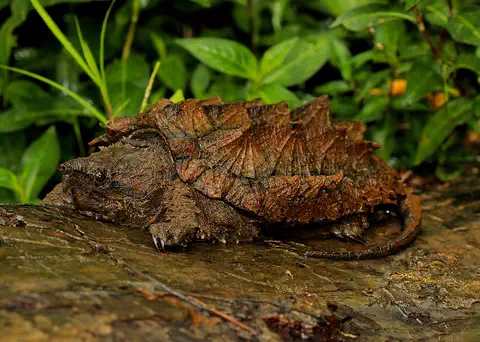
The alligator snapping turtle is the largest freshwater turtle in the United States. It lies still on the bottom of rivers and lakes with its mouth open, wiggling a worm-like lure on its tongue to trick fish into swimming close. Its numbers have fallen, and it is now endangered.
For parents & teachers
What children will learn
- Describe how a Nile monitor uses its tongue, claws and tail.
- Explain how termites end up protecting monitor eggs.
- Explain why a common animal can still be affected by trade.
- Describe what can happen when pet animals are released into a new place.
Recommended ages: 3 to 17 · About 15 minutes
Talk about it
- Why might an animal that eats almost anything be found in so many places?
- Why is it important not to release pets into the wild?
- Why is it best to leave wild lizards alone and watch them from a distance?
Try at home or in class
- Smell trail: with a grown-up, dab a little vanilla or lemon juice on a cotton ball, hide it in a room and follow your nose to find it, the way a monitor follows smells with its tongue.
- Sealed nest: press a small hole into a ball of play dough, put a bead inside and pinch the hole shut, like termites repairing their mound around monitor eggs.
Key vocabulary: monitor, forked tongue, bask, carrion, termite mound, least concern
Where these facts come from
- GBIF Backbone Taxonomy and GBIF Occurrence Search , Global Biodiversity Information Facility (CC0 1.0 (backbone); occurrence counts are facts derived from records under CC0, CC BY and CC BY-NC)
- Wikidata , Wikimedia Foundation (CC0 1.0)
- The IUCN Red List of Threatened Species , International Union for Conservation of Nature (IUCN terms of use (no redistribution of Red List data or range maps))
- Varanus niloticus (Wilms et al., assessed 21 October 2019, published 2021) , IUCN Red List of Threatened Species
- Varanus niloticus: taxonomic notes, justification, range, population, habitat, threats, use and trade, and conservation text , IUCN Red List of Threatened Species
- Varanus niloticus: IUCN Red List global assessment record (Wilms et al. 2021), IUCN checklist on GBIF , GBIF
- Varanus niloticus (Nile monitor) , Animal Diversity Web, University of Michigan Museum of Zoology
- File:Nile monitor lizard (Varanus niloticus) head.jpg (31 October 2016, Charles J. Sharp) , Wikimedia Commons
- Wikimedia Commons , Wikimedia Foundation (Per file: Public domain, CC0, CC BY or CC BY-SA only (credited on each page))
Checked, not yet human-reviewed. Last updated November 1, 2026. Spotted a mistake? Tell us.