
Animal
Little owl
The little owl is a small brown owl with white spots and bright yellow eyes. It lives in fields, orchards and rocky places. You can sometimes see it in the daytime.
The little owl is a small, dark brown owl covered in cream spots, with yellow eyes and a yellow beak. It lives across Europe, North Africa and much of Asia, in open country with places to perch and holes to nest in. It hunts mostly at dusk and dawn, but it is often seen sitting out in the daytime.
Athene noctua is a small, sedentary owl of semi-open habitats, from orchards and farmland to rocky semi-desert and steppe, across the Palearctic and into north-east Africa, from sea level to about 2,600 meters. It nests in cavities and feeds mainly on small rodents and large invertebrates. BirdLife International assessed it as Least Concern for the IUCN Red List (assessed 2018, published 2019), with a stable global trend, though its range has shrunk locally in many parts of Europe.
Photo: Frank Vassen from Brussels, Belgium, CC BY 2.0, via Wikimedia Commons
Meet the little owl
The little owl is a small owl.
It is brown with white spots. It has big yellow eyes and a yellow beak.
The little owl is small: its wings stretch only about 56 centimeters from tip to tip, and an average bird weighs about 164 grams. Females are a little larger than males.
An adult is dark brown with cream spots and streaks all over: on the crown, around the eyes, on the chest and on the back and tail. It has a pale chin, bright yellow eyes and a yellow beak. On the back of its head is a pale V-shaped mark.
The Animal Diversity Web account (Hunt 2011) gives an average wingspan of 557.67 millimeters in males and 565.64 millimeters in females, and a wild mass of 98 grams to about 270 to 280 grams (average 164 grams); females are generally larger. The British Trust for Ornithology calls it Britain's smallest owl.
Adults are dark brown with cream markings: streaks on the forehead and crown, rings around the eyes, a cream chin, spots and streaks on the breast and belly, round spots on the back and tail, and a distinct V-shaped mark on the back of the head. The bill and iris are bright yellow and the eyelids dark; the sexes look alike, though males tend to have a lighter face. Young birds are grayer, with less contrast.
Quick facts
- Group
- Bird
- Wingspan
- 0.55 to 0.57 m
- Weight
- 0.1 to 0.28 kg
- Lifespan in the wild
- up to 15.6 years
Orchards, steppes and stony ground
Little owls live in Europe, Asia and North Africa.
They like fields, old trees and rocky places.
Little owls live across much of Europe, North Africa, the Middle East and Asia as far east as China and Korea. People brought them to Britain in the late 1800s and to New Zealand.
They like semi-open country: parks, orchards, farmland with hedges, rocky semi-deserts and steppes. They need places to perch, holes to nest in and open ground where they can hunt. Little owls do not migrate. Most stay close to where they hatched for their whole lives.
IUCN lists the species across Europe, North Africa, the Middle East and Central and East Asia, from boreal to tropical areas, up to 2,600 meters. The Animal Diversity Web account (2011) describes a range in 84 countries of the Palearctic and north-east Africa, north to about the 56th parallel. Europe makes up about a quarter of the global range (IUCN). It was introduced to Britain in the late 1800s, where it colonized England and parts of Wales (BTO), and IUCN lists it as introduced in New Zealand.
It uses semi-open habitats, from parkland, orchards and cultivated fields with hedges to rocky semi-desert and steppe (Mikkola 1983, cited by IUCN), and nests in tree and rock cavities, cliff crevices, buildings and other animals' burrows (ADW). It is sedentary, though large movements do occur.
Continents
Its habitats


Where can you find this animal?
- Brought here by people · Countries and seas named by a scientific source
- Lives here naturally · Countries and seas named by a scientific source
- Sightings recorded · Records of wild sightings (GBIF)
Brought here by people · Countries and seas named by a scientific source
Introduced to Britain in the late 1800s, where it colonized England and parts of Wales (British Trust for Ornithology), and to New Zealand (IUCN).
Places: New Zealand and UK.
Source: https://www.bto.org/learn/about-birds/birdfacts/little-owl · checked October 2026
Lives here naturally · Countries and seas named by a scientific source
Semi-open country (parkland, orchards, farmland with hedges, rocky semi-desert and steppe) across Europe, North Africa, the Middle East and Central and East Asia, from sea level to about 2,600 meters; resident all year.
Places: Afghanistan, Albania, Algeria, Azerbaijan, Austria, Armenia, Belgium, Bosnia & Herz. and 67 more places.
Source: iucn-red-list · checked October 2026
Sightings recorded · Records of wild sightings (GBIF)
Counts of GBIF records of wild observations (human and machine) and preserved specimens. Records include introduced populations, vagrants, escaped or released animals and misidentifications, so a country with records is not necessarily part of the native range.
Wild sightings have been recorded in Netherlands, Spain, France, UK, Belgium, Portugal, Italy, Germany and 79 more places.
Source: gbif · checked October 2026
Range maps show where scientists say an animal lives, often country by country. An animal may live in only part of a country shown, and sightings records can include animals that wandered far from home.
Beetles, worms and voles
Little owls eat beetles, crickets, worms and mice.
They can run and hop on the ground to catch them!
Little owls eat many kinds of small animals, mostly small rodents such as voles and mice, and big insects and earthworms. In spring and summer, when they have chicks, birds and frogs become important food too.
A little owl watches from a perch and catches prey on the ground in a low flight. It can also run and hop along the ground after insects, and it sometimes catches prey in the air. It may hide extra food in a hole to eat later.
IUCN describes a diet of insects, small rodents and plant matter, with birds and frogs important during the nesting season (Mikkola 1983). The Animal Diversity Web account (2011) calls it an opportunistic carnivore whose diet mainly consists of small rodents and large invertebrates such as earthworms and insects; 544 prey species have been recorded in the Palearctic, and indigestible parts are coughed up as pellets.
It hunts from a perch, runs and hops after prey on the ground, catches prey in low flight and even in the air, and can take prey as heavy as itself. It stores surplus food in holes. The bird in this page's photo was seen catching large green bush crickets in meadows near a village in Montenegro.
Did you know?
A little owl has been seen taking a bath in chimney smoke!
Little owls take dust and sand baths, and one has even been seen bathing in smoke from a chimney.
Little owls take regular dust or sand baths and have been seen bathing in smoke rising from chimneys (ADW).
A day-watching owl
Little owls often sit out in the daytime.
When a little owl is worried, it bobs its head up and down.
Little owls are busiest at dusk and dawn, and you can often see one sitting out in daylight on a branch, a telegraph pole or a rock. When it is alarmed, it bobs its head up and down.
In flight it has rounded wings and fast wingbeats, and it flies with a slight bounce, usually low over the ground.
The ADW account describes the little owl as crepuscular: it hunts and calls by day and by night, but is most active at dusk and dawn. The RSPB notes that it can be seen in daylight, usually perched on a branch, telegraph pole or rock, that it bobs its head when alarmed, and that it flies on rounded wings with rapid wingbeats and a slight bounce. It usually flies low, although birds have been seen at 20 to 30 meters and higher.
When it sleeps, it can hold itself so that all its light feathers are hidden, which camouflages it well; to close its eyes, it raises its lower eyelids. It preens often, takes dust or sand baths, and has even been seen bathing in smoke rising from chimneys (ADW).
A nest in a hole
Little owls nest in holes in trees, rocks or walls.
The mother lays a few eggs. The father brings food.
Little owls nest in holes: in old trees, rocks, walls and buildings, and in nest boxes. A pair usually stays together. The male shows the female possible nest holes, and she picks one.
In Britain, the female usually lays 3 or 4 eggs, which hatch after about a month. While she sits on the eggs and keeps the chicks warm, the male brings food. The chicks leave the nest after about five weeks, and their parents keep feeding them for a while after that.
Little owls are monogamous and breed from March to August, nesting in a cavity that is cleaned and scraped, or in a nest box; clutches are usually 3 to 6 eggs (Holt et al. 2014, cited by IUCN). For Britain, the BTO gives a typical clutch of 3 to 4, incubation of 29 to 30 days, fledging at 36.5 to 39.5 days, usually one brood a year, and breeding at 1 year old.
ADW (2011) describes the male showing the female nest sites until she chooses one and feeding her through laying and incubation. The female stays with the nestlings for about 16 days, then also hunts for them. Parents keep feeding and protecting the young for about a month after they fledge, and parental care ends between early September and early November. Young birds settle on average about 2.7 kilometers from the nest where they hatched.
A chatty little owl
Little owls make lots of different calls.
Mates sit close together and clean each other's feathers.
Little owls are very vocal. Scientists have described between 22 and 40 different calls, used to attract a mate, defend a territory and warn of danger. When one little owl gives a warning call, other little owls hide.
Pairs often stay together. Mates fly and hunt near each other, sleep side by side and preen each other's feathers.
The ADW account (2011) describes a repertoire of 22 to 40 different calls, used for contact, attracting mates, territorial defense and alarm; calling peaks before and during courtship. In spring, a male patrols and calls along the borders of his territory. When other little owls hear the defense call given at a predator, they hide.
Little owls show high mate fidelity: partners fly together, hunt near each other, sleep in body contact and preen and scratch each other, and these contacts outside the breeding season are believed to reduce aggression between mates. After the young fledge, some pairs separate, but not all.
Did you know?
To close its eyes, a little owl lifts its bottom eyelids.
When a little owl closes its eyes to sleep, it raises its lower eyelids.
To close its eyes, the little owl raises its lower eyelids (ADW).
Common, but losing old trees
There are many little owls.
People help them by putting up nest boxes.
The little owl is listed as Least Concern. There are millions of them, and their number is thought to be steady overall. But in many parts of Europe they have disappeared from some local areas.
Little owls lose their nest holes when old hollow trees are cut down and old buildings are repaired. Modern farming can leave fewer voles and earthworms to eat. In Belgium and Germany, nest boxes and the careful trimming of old trees have helped.
BirdLife International assessed Athene noctua as Least Concern for the IUCN Red List (assessed 9 August 2018, published 2019 as an amended version), with a stable trend. Europe's breeding population was estimated at 618,000 to 1,170,000 pairs (2015), and a very preliminary global estimate is 5 to 10 million mature individuals.
IUCN notes that numbers can drop sharply after severe winters and that the range has contracted locally in many parts of Europe, mainly through habitat change and loss of nest sites (felling of old hollow trees, restoration of old buildings), less often pesticides; intensive farming reduces prey such as voles and earthworms, and road traffic kills birds. Nest boxes and pollarding of old trees have offset declines in Belgium and Germany. The species was listed as endangered on the Dutch national Red List (2004), and the RSPB reports that the UK population fell by about 24% between 1995 and 2008.
IUCN Red List
How is the little owl doing in the wild?
- Least Concern (this animal)
- Near Threatened
- Vulnerable
- Endangered
- Critically Endangered
- Extinct in the Wild
- Extinct
Least Concern
Not at risk of disappearing from the wild right now.
See the IUCN Red List assessment · The IUCN Red List of Threatened Species 2021.3
Amazing facts
-
Little owls can run and hop on the ground to catch bugs!
A little owl can run and hop along the ground to catch insects and worms.
Besides hunting from perches and in flight, little owls run and hop after prey on the ground (ADW).
-
A little owl has been seen taking a bath in chimney smoke!
Little owls take dust and sand baths, and one has even been seen bathing in smoke from a chimney.
Little owls take regular dust or sand baths and have been seen bathing in smoke rising from chimneys (ADW).
-
To close its eyes, a little owl lifts its bottom eyelids.
When a little owl closes its eyes to sleep, it raises its lower eyelids.
To close its eyes, the little owl raises its lower eyelids (ADW).
-
A little owl bobs its head when it is worried.
When a little owl is alarmed, it bobs its head up and down.
Head-bobbing is a sign of alarm (RSPB).
Words to know
- cavity
- a hole or hollow space, such as a hole in a tree
- crepuscular
- most active at dusk and dawn
- sedentary
- staying in the same area all year
- pellet
- a small bundle of fur, bones and other hard bits that an owl coughs up
- preen
- to clean and tidy feathers with the beak
- introduced
- brought by people to a place where it did not live before
Discovery challenge
-
What color are a little owl's eyes?
What color are a little owl's eyes?
What color is the little owl's iris?
- Yellow
- Blue
- Red
Show the answer
Yellow
Bright yellow.
Bright yellow, with dark eyelids around them.
Bright yellow, like the bill (ADW).
-
Where do little owls make their nests?
Where do little owls usually nest?
What kind of nest site does the little owl use?
- In holes
- On floating plants
- In the open on snow
Show the answer
In holes
In holes in trees, rocks or walls.
In holes in old trees, rocks, walls and buildings, and in nest boxes.
Cavities in trees, rocks, cliffs, buildings and burrows, and nest boxes.
-
When are little owls busiest?
At what time of day are little owls most active?
What is the little owl's main activity pattern?
- At dusk and dawn
- Only at midday
- Only in winter
Show the answer
At dusk and dawn
At dusk and dawn, but you may see them in the day too.
At dusk and dawn, though they are often seen perched in daylight.
Crepuscular: active by day and night, with peaks at dusk and dawn (ADW).
-
How did little owls get to Britain?
How did little owls come to live in Britain?
How did the little owl's British population begin?
- People brought them
- They swam there
- They have always lived there
Show the answer
People brought them
People brought them there long ago.
People brought them from mainland Europe in the late 1800s.
It was introduced in the late 1800s and colonized England and parts of Wales (BTO).
Places where you might see it
-
 Watch
 Country
Spain
Spain covers most of the Iberian Peninsula in southwestern Europe. Its middle is a high, flat plateau, the Pyrenees mountains stand between it and France, and almost 50 million people live there, with Madrid as the capital.
-
 Watch
 Country
France
France is a country in northwestern Europe, between the Atlantic Ocean and the Mediterranean Sea. It has high mountains such as the Alps and the Pyrenees, long rivers such as the Loire and the Seine, and about 69.1 million people (2026). Its capital is Paris.
Explore next
-
 Watch
Animal
Barn owl
The barn owl is a pale, ghostly owl with a heart-shaped face that works like a dish to collect sound. It hunts mice and voles at night over fields and grassland, finding them by hearing alone if it has to. Barn owls live on every continent except Antarctica.
-
 Watch
Animal
Burrowing owl
The burrowing owl is a small, sandy-brown owl with long legs and bright yellow eyes. Unlike most owls, it lives underground, in burrows dug by prairie dogs, ground squirrels or tortoises, or sometimes by the owls themselves. It lives in open grasslands and deserts from Canada to the tip of South America.
-
 Watch
Animal
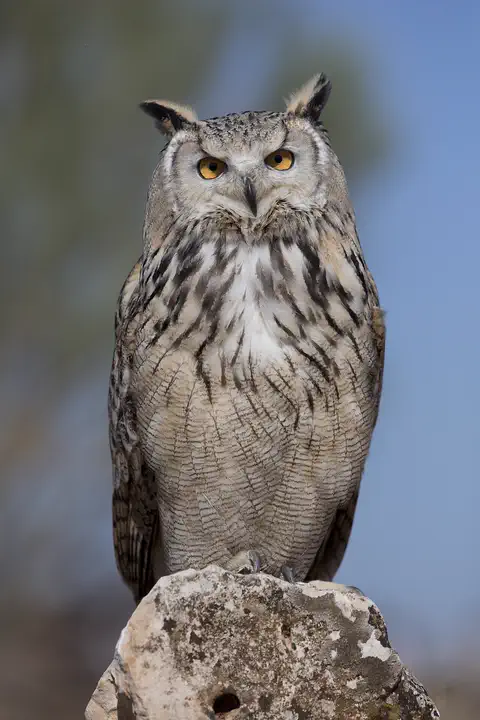
Eurasian eagle-owl
The Eurasian eagle-owl is one of the biggest owls in the world, with wings up to about 2 meters across, big orange eyes and two tall ear tufts. It lives across Europe and Asia, nests on rocky ledges and flies silently at night to catch rats, voles, hares and birds.
-
 Watch
Animal
Red kite
The red kite is a graceful bird of prey with a reddish-brown body, a pale gray head, long angled wings and a deeply forked tail. It lives only in Europe and nearby parts of Africa and Asia, where it soars over woods and farmland looking for dead animals, small mammals, birds and worms. People wiped it out in some places, such as England, Scotland and Ireland, but its numbers have grown again.
-
Watch
Country
Spain
Spain covers most of the Iberian Peninsula in southwestern Europe. Its middle is a high, flat plateau, the Pyrenees mountains stand between it and France, and almost 50 million people live there, with Madrid as the capital.
-
Watch
Country
France
France is a country in northwestern Europe, between the Atlantic Ocean and the Mediterranean Sea. It has high mountains such as the Alps and the Pyrenees, long rivers such as the Loire and the Seine, and about 69.1 million people (2026). Its capital is Paris.
-
 Watch
Animal
Eastern screech owl
The eastern screech owl is a small, robin-sized owl with feather 'ear' tufts, yellow eyes and patterned feathers that can be gray, brown or reddish. It lives in eastern North America, from Canada to Mexico, in woods, farm groves, city parks and shady suburbs, where many people never know an owl lives nearby. Despite its name, its usual calls are trills and whinnies, not screeches.
-
 Watch
Animal
Elf owl
The elf owl is a tiny owl, only 12 to 14 centimeters long and weighing 37 to 55 grams. Audubon and the Animal Diversity Web both call it the smallest owl in the world. It lives in the deserts and canyons of the south-western United States and Mexico, nests in old woodpecker holes in giant saguaro cactus and trees, and hunts insects at night.
For parents & teachers
What children will learn
- Identify the little owl's main features.
- Explain why cavity-nesting birds need old trees or nest boxes.
- Describe what an introduced species is.
- Compare night-active and dusk-and-dawn animals.
Recommended ages: 3 to 17 · About 15 minutes
Talk about it
- Why might cutting down old hollow trees affect little owls?
- How could a farmer help little owls?
- Why might an owl that is active at dusk be easier to see than one that is active only at night?
Try at home or in class
- Use a kitchen scale to put together small objects that weigh about 164 grams, the weight of an average little owl.
- Draw a little owl with its cream spots, then list three places nearby where a small owl could find a hole to nest in.
Key vocabulary: cavity, crepuscular, sedentary, pellet, preen, introduced
Where these facts come from
- GBIF Backbone Taxonomy and GBIF Occurrence Search , Global Biodiversity Information Facility (CC0 1.0 (backbone); occurrence counts are facts derived from records under CC0, CC BY and CC BY-NC)
- Wikidata , Wikimedia Foundation (CC0 1.0)
- The IUCN Red List of Threatened Species , International Union for Conservation of Nature (IUCN terms of use (no redistribution of Red List data or range maps))
- Athene noctua (BirdLife International, assessed 9 August 2018, published 2019, amended version) , IUCN Red List of Threatened Species
- Athene noctua: population, habitat, ecology, threats and conservation text , IUCN Red List of Threatened Species
- Athene noctua: IUCN Red List global assessment record (BirdLife International 2019), IUCN checklist on GBIF , GBIF
- Athene noctua (Hunt, K. 2011) , Animal Diversity Web, University of Michigan Museum of Zoology
- Little Owl (BirdFacts) , British Trust for Ornithology
- Little Owl , RSPB
- File:Athene noctua, Ambula, Montenegro 1.jpg (Ambula, south-east Montenegro, 5 November 2011, Frank Vassen) , Wikimedia Commons
- Wikimedia Commons , Wikimedia Foundation (Per file: Public domain, CC0, CC BY or CC BY-SA only (credited on each page))
Checked, not yet human-reviewed. Last updated November 1, 2026. Spotted a mistake? Tell us.