Animal
Eurasian eagle-owl
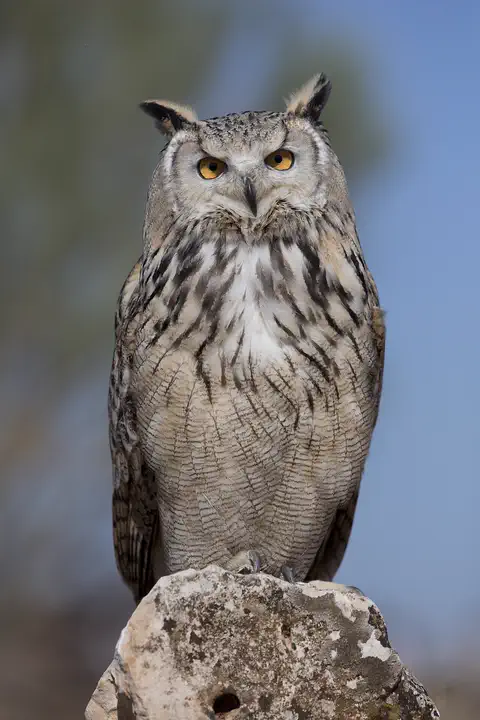
The Eurasian eagle-owl is a very big owl with bright orange eyes and two feather tufts on its head. It hunts at night in rocky places and forests.
The Eurasian eagle-owl is one of the biggest owls in the world, with wings up to about 2 meters across, big orange eyes and two tall ear tufts. It lives across Europe and Asia, nests on rocky ledges and flies silently at night to catch rats, voles, hares and birds.
Bubo bubo is a large horned owl of Europe and Asia, related to North America's great horned owl. It nests in rock crevices, cliffs and caves, hunts mostly at twilight and night, and takes prey from beetles to hares. It is listed as Least Concern, though the IUCN's global assessment describes a decreasing population.
Photo: Carlos Delgado, CC BY-SA 4.0, via Wikimedia Commons
Meet the Eurasian eagle-owl
The Eurasian eagle-owl is a very big owl.
It has huge orange eyes and two feather tufts on its head, like ears. Its feathers are brown, buff and black, with lots of streaks.
The Eurasian eagle-owl is one of the largest owls in the world: about 58 to 71 centimeters long, with wings 1.5 to 2 meters across. Its most famous features are its big orange eyes and the two tufts of feathers on its head, called ear tufts.
Its feathers are tawny and brown, streaked and barred with black, with a white throat. It looks very different from a barn owl, which has a white heart-shaped face, or a snowy owl, a large white owl with yellow eyes. Its relative in North America is the great horned owl.
Bubo bubo is a horned owl of the family Strigidae, closely related to the great horned owl (Bubo virginianus) of the Americas. Animal Diversity Web gives lengths of 58 to 71 centimeters, weights of 1.6 to 4.2 kilograms and wingspans of 1.5 to 2 meters, placing it among the largest living owls.
The plumage is tawny-buff to brown-black, darker above, with black streaks on the breast, a heavily marked facial disk and a white throat. Color and size vary across the huge range: birds become paler toward the northeast and darker toward the Pacific, and smaller from north to south. The prominent ear tufts, or plumicorns, are feathers, not ears, and can be raised or lowered.
Quick facts
- Group
- Bird
- Length
- 0.58 to 0.71 m
- Wingspan
- 1.5 to 2 m
- Weight
- 1.6 to 4.2 kg
Where it lives
Eurasian eagle-owls live in Europe and Asia.
They like rocky cliffs, mountains and forests. Some live in deserts and on farmland.
Eurasian eagle-owls live across a huge area of Europe and Asia, from Portugal, Spain and Norway in the west to China, Korea and Japan in the east, and south to the Middle East and India.
They can live in many kinds of places: conifer forests, mountains, rocky valleys, riverbanks, warm deserts and even farmland and grassland with few trees. What they need most is a safe rocky spot to nest and plenty of food nearby. They do not migrate.
The IUCN's global assessment (published 2017) lists the species as resident in about sixty countries across Europe, the Middle East and Asia, up to about 4,500 meters; it is only a vagrant in Bahrain and Gibraltar and, according to Britannica, only a straggler in most of Great Britain.
Animal Diversity Web lists coniferous forest, warm deserts, mountain ranges and riverbeds among its habitats, with a strong preference for rocky landscapes for nesting; it also uses open farmland and grassland. The IUCN classes it as not a migrant.
Continents
Its habitats


Where can you find this animal?
- Lives here naturally · Countries and seas named by a scientific source
- Sightings recorded · Records of wild sightings (GBIF)
Lives here naturally · Countries and seas named by a scientific source
Rocky places, forests, mountains and deserts across Europe and Asia, from Portugal and Norway to China, Korea and Japan, and south to the Middle East and India. Owls live in only part of many countries shown; Andorra, Liechtenstein and Hong Kong have no separate map shape.
Places: Afghanistan, Albania, Armenia, Austria, Azerbaijan, Belarus, Belgium, Bosnia & Herz. and 50 more places.
Source: iucn-red-list · checked October 2026
Sightings recorded · Records of wild sightings (GBIF)
Counts of GBIF records of wild observations (human and machine) and preserved specimens. Records include introduced populations, vagrants, escaped or released animals and misidentifications, so a country with records is not necessarily part of the native range.
Wild sightings have been recorded in France, Spain, Finland, Sweden, Netherlands, Germany, Denmark, Russia and 68 more places.
Source: gbif · checked October 2026
Range maps show where scientists say an animal lives, often country by country. An animal may live in only part of a country shown, and sightings records can include animals that wandered far from home.
What it eats
Eurasian eagle-owls hunt at night.
They catch rats, mice, voles, rabbits and hares. They also catch birds and even beetles. They fly so quietly that their food does not hear them coming.
Eagle-owls are carnivores. They mostly hunt at dusk and at night, catching almost anything they can, from beetles, mice and voles to rats, rabbits, hares and birds such as crows and ducks. They can even take animals as big as young deer and foxes.
An eagle-owl often watches from a branch at twilight, then swoops onto prey on the ground or catches it in the air. It prefers to hunt in open spaces rather than deep in thick forest.
The eagle-owl is a generalist carnivore. Britannica names rodents, hares, rabbits and large game birds as its main prey; Animal Diversity Web adds beetles, crows and ducks and notes that it can take prey as large as deer fawns and foxes. Tracy Aviary lists occasional reptiles, fish and insects.
It hunts mainly at twilight and at night, typically scanning from a perch and taking prey on the ground or in flight, and favors open areas over dense forest. Keen eyesight and hearing locate prey, and its wings make very little noise in flight.
Did you know?
Eagle-owls often lay their eggs on rocky ledges.
Eagle-owls lay their eggs on bare rock ledges, in caves or in old nests built by other big birds.
Eggs are laid in rock crevices, on cliff ledges, at cave entrances or in abandoned nests of other large birds.
A silent night hunter
The eagle-owl's big orange eyes see well at night.
Its round face helps it hear tiny sounds. Its wings make almost no noise. Its sharp talons catch its food.
The eagle-owl's huge orange eyes see well in dim light, and its excellent hearing helps it find prey. Its round facial disk, the dish of feathers around its face, frames its eyes and beak.
Owl wings are built to be very quiet, so prey usually does not hear an eagle-owl coming. Strong feet with sharp talons catch and hold prey. The ear tufts are not ears at all: they are feathers the owl can raise or lower to show its mood or to look like a broken branch.
Adaptations for nocturnal hunting include very large orange eyes, acute hearing and wing feathers that make flight almost silent, which Animal Diversity Web credits for the owl's success at surprising prey. The facial disk is heavily marked with black, gray and white.
The feet are powerful, with sharp talons used to capture prey. The ear tufts (plumicorns) carry no hearing function; Tracy Aviary notes that they help with camouflage, making the owl look like a tree branch, and with body language, since the owl can move them. Females are larger than males.
Growing up
Eagle-owls nest on rocky ledges or in caves.
The mother lays one to four white eggs. She sits on them, and the father brings her food. The fluffy chicks can fly when they are about two months old.
The female lays her white eggs in a sheltered spot such as a crack between rocks, a cliff ledge, a cave entrance or an old nest of another big bird. She usually lays one to four eggs, depending on how much food there is.
The mother keeps the eggs warm for about 35 days while the father hunts and brings her food. The chicks are covered in whitish-gray fluff. By five weeks they walk around near the nest, and they begin to fly at about seven to nine weeks.
Pairs form in early autumn, and egg laying usually begins in late winter. Nest sites are rock crevices, sheltered cliff ledges, cave entrances or the abandoned nests of large birds. Clutches are typically one to four white eggs, with more laid when food is plentiful; incubation, by the female alone, lasts about 35 days while the male feeds her.
Chicks are covered in whitish-gray down and are brooded for about two weeks; at about three weeks they begin feeding themselves on prey brought to the nest. By five weeks they walk around the nest area, at about 60 days they make their first short flights, and they become independent at about 20 weeks, leaving their parents' territory in the autumn. Wild eagle-owls typically live 10 to 20 years; captive birds have lived more than 60.

Calls in the night
Eagle-owls like to be alone.
But each owl has a partner for life. They call to each other at night with deep hoots and soft clucks.
Eurasian eagle-owls are mostly solitary, except when they pair up to breed, and a pair is thought to stay together for life. They defend their territory fiercely against other owls.
Partners keep track of each other by calling, and people often hear them at night. To show a good nest site, an owl scrapes a shallow hollow in the ground and calls with short notes and clucking sounds.
Eagle-owls are largely solitary outside the breeding season and strongly territorial, defending their range against other owls. Pairs are thought to be lifelong.
Animal Diversity Web describes how they advertise potential nest sites by scraping a shallow depression and giving staccato notes and clucking calls, the same sounds partners use to keep track of each other. Breeding is sensitive to food supply: when prey is scarce, pairs breed later and raise fewer young. Adults have no regular natural predators.
Did you know?
Eagle-owls can live a very long time.
Wild eagle-owls usually live 10 to 20 years, but some in zoos have lived more than 60 years.
Typical wild life spans are 10 to 20 years, and captive birds have exceeded 60 years.
Eagle-owls and people
There are still many Eurasian eagle-owls.
But in some places there are fewer than before. Keeping wild rocky places and forests helps them.
The Eurasian eagle-owl is listed as Least Concern, so it is not in danger of disappearing soon. The IUCN's global assessment estimates about 100,000 to 500,000 adult birds.
Even so, its numbers are going down overall. Animal Diversity Web says the main reason is habitat loss as people build on and farm the places where the owls live. International trade in eagle-owls is controlled by an agreement called CITES.
The IUCN's global assessment (assessed 2016, amended version published 2017) lists Bubo bubo as Least Concern with 100,000 to 499,999 mature individuals and a decreasing trend. Animal Diversity Web describes the species as rare but not threatened and attributes its decline to habitat loss from human encroachment. It is listed on CITES Appendix II.
A newer IUCN assessment exists for Europe only; the figures here come from the global assessment, which covers the whole range. Animal Diversity Web notes that wild birds live about 20 years, while captive eagle-owls can live more than 60.
IUCN Red List
How is the eurasian eagle-owl doing in the wild?
- Least Concern (this animal)
- Near Threatened
- Vulnerable
- Endangered
- Critically Endangered
- Extinct in the Wild
- Extinct
Least Concern
Not at risk of disappearing from the wild right now.
See the IUCN Red List assessment · The IUCN Red List of Threatened Species 2021.3
Amazing facts
-
An eagle-owl's ear tufts are feathers, not ears.
The two tufts on an eagle-owl's head are feathers. The owl can move them to show its mood or to look like a stick.
The plumicorns are display and camouflage feathers; they carry no hearing function.
-
Eagle-owls often lay their eggs on rocky ledges.
Eagle-owls lay their eggs on bare rock ledges, in caves or in old nests built by other big birds.
Eggs are laid in rock crevices, on cliff ledges, at cave entrances or in abandoned nests of other large birds.
-
Eagle-owls can live a very long time.
Wild eagle-owls usually live 10 to 20 years, but some in zoos have lived more than 60 years.
Typical wild life spans are 10 to 20 years, and captive birds have exceeded 60 years.
-
Eagle-owls fly without making a sound.
Owl wings are built to make very little noise, so an eagle-owl's prey usually does not hear it coming.
Wing feathers adapted to reduce noise give eagle-owls near-silent flight, a key advantage when hunting at night.
Words to know
- nocturnal
- active at night
- ear tufts
- feathers on an owl's head that look like ears but are not
- facial disk
- the round dish of feathers around an owl's face
- talons
- the long, sharp, curved claws of a bird of prey
- territory
- an area an animal lives in and defends from others
- subspecies
- a group within a species that looks a little different and lives in a particular area
Discovery challenge
-
What are the tufts on an eagle-owl's head?
What are an eagle-owl's ear tufts made of?
What are the eagle-owl's plumicorns?
- Ears
- Feathers
- Horns
Show the answer
Feathers
They are feathers, not ears!
They are just feathers. The owl can raise or lower them.
Feather tufts used for camouflage and body language, with no role in hearing.
-
When do eagle-owls hunt?
When do Eurasian eagle-owls do most of their hunting?
When is the Eurasian eagle-owl mainly active as a hunter?
- At dusk and at night
- Only at noon
- Only in snowstorms
Show the answer
At dusk and at night
They hunt at dusk and at night.
Mostly at twilight and at night, using sharp eyes, good hearing and silent wings.
Mainly crepuscular and nocturnal, hunting from perches and taking prey on the ground or in flight.
-
Where do eagle-owls lay their eggs?
Where does a Eurasian eagle-owl usually lay its eggs?
Which nest site is typical of the Eurasian eagle-owl?
- On rocky ledges or in caves
- Floating on water
- Buried in sand on a beach
Show the answer
On rocky ledges or in caves
On rocky ledges, in caves or in old nests.
In cracks between rocks, on cliff ledges, at cave entrances or in old nests of other big birds.
Rock crevices, sheltered ledges, cave entrances or abandoned nests of large birds.
-
Which owl has orange eyes and ear tufts?
Which of these owls has orange eyes and tall ear tufts?
Which of these owls is a horned owl of the genus Bubo with orange eyes?
- Barn owl
- Eurasian eagle-owl
- Snowy owl
Show the answer
Eurasian eagle-owl
The eagle-owl has orange eyes and feather tufts.
The Eurasian eagle-owl. Barn owls have white heart-shaped faces and dark eyes, and snowy owls are white with yellow eyes.
The Eurasian eagle-owl; barn owls are in a different family with white heart-shaped faces, and snowy owls are white with yellow eyes.
Explore next
-
 Watch
Animal
Great horned owl
The great horned owl is a large, powerful owl with two long, earlike tufts of feathers on its head. It is one of the most common owls in North America and lives in almost any kind of semi-open place, from deserts and forests to city parks. It hunts mostly at night.
-
 Watch
Animal
Tawny owl
The tawny owl is a medium-sized woodland owl, about the size of a pigeon, with a round head, big dark eyes and brown, streaky feathers that hide it against tree bark. It hunts mice and voles at night on silent wings, and its hoots are a familiar sound at night.
-
 Watch
Animal
Barn owl
The barn owl is a pale, ghostly owl with a heart-shaped face that works like a dish to collect sound. It hunts mice and voles at night over fields and grassland, finding them by hearing alone if it has to. Barn owls live on every continent except Antarctica.
-
 Watch
Animal
Snowy owl
The snowy owl is a large white owl that nests on the Arctic tundra. Unlike most owls it hunts in daylight, and in the endless light of an Arctic summer it may hunt at any hour. Lemmings are its favorite food.
-
 Watch
3D
Animal
European rabbit
The European rabbit is the wild rabbit that all pet and farm rabbits come from. It lives in groups in big underground tunnel homes called warrens. Its numbers have fallen in its first home in Spain, Portugal and France, but people have carried it to many other places, where it became a pest.
-
 Watch
Animal
Burrowing owl
The burrowing owl is a small, sandy-brown owl with long legs and bright yellow eyes. Unlike most owls, it lives underground, in burrows dug by prairie dogs, ground squirrels or tortoises, or sometimes by the owls themselves. It lives in open grasslands and deserts from Canada to the tip of South America.
-
 Watch
Animal
Adélie penguin
The Adélie penguin is a medium-sized penguin, about 70 centimeters tall, with a black back, a white front and a bright white ring around each eye. It breeds in summer on rocky, ice-free ground all around Antarctica, building nests of pebbles, and spends the winter far out at sea among the pack ice.
-
 Watch
Animal
African fish eagle
The African fish eagle is a big eagle of Africa's lakes, rivers and coasts, with a white head, chest and tail and a chestnut-brown body. It snatches fish from the surface of the water, and its loud, ringing call is one of the best-known sounds of Africa.
For parents & teachers
What children will learn
- Describe how the eagle-owl's eyes, hearing, wings and talons suit hunting at night.
- Locate the eagle-owl's range across Europe and Asia and describe its rocky nest sites.
- Tell the eagle-owl apart from barn owls and snowy owls.
- Describe the eagle-owl's life cycle from egg to independence.
Recommended ages: 3 to 17 · About 15 minutes
Talk about it
- Why might silent wings be useful for a hunter that works at night?
- Why do you think eagle-owls choose rocky ledges and caves for their eggs?
- How could people keep space for big owls near farms and towns?
Try at home or in class
- Flap a piece of stiff card and then a soft feather or scarf near your ear, and compare the sounds to think about silent owl flight.
- Measure 2 meters on the floor with tape to see how wide a big eagle-owl's wings can be.
Key vocabulary: nocturnal, ear tufts, facial disk, talons, territory, subspecies
Where these facts come from
- The IUCN Red List of Threatened Species , International Union for Conservation of Nature (IUCN terms of use (no redistribution of Red List data or range maps))
- GBIF Backbone Taxonomy and GBIF Occurrence Search , Global Biodiversity Information Facility (CC0 1.0 (backbone); occurrence counts are facts derived from records under CC0, CC BY and CC BY-NC)
- Wikidata , Wikimedia Foundation (CC0 1.0)
- Bubo bubo (Eurasian Eagle-owl), Red List global assessment 2016 (amended version published 2017) , IUCN Red List of Threatened Species
- Bubo bubo (Eurasian eagle owl) , Animal Diversity Web, University of Michigan Museum of Zoology
- Eagle owl , Encyclopaedia Britannica
- Eurasian Eagle-Owl , Tracy Aviary
- Barn Owl identification , Cornell Lab of Ornithology, All About Birds
- Snowy Owl identification , Cornell Lab of Ornithology, All About Birds
- Wikimedia Commons , Wikimedia Foundation (Per file: Public domain, CC0, CC BY or CC BY-SA only (credited on each page))
Checked, not yet human-reviewed. Last updated October 28, 2026. Spotted a mistake? Tell us.