
Animal
Barn owl
The barn owl is a pale owl with a white, heart-shaped face. It flies silently at night and listens for mice in the grass.
The barn owl is a pale, ghostly owl with a heart-shaped face that works like a dish to collect sound. It hunts mice and voles at night over fields and grassland, finding them by hearing alone if it has to. Barn owls live on every continent except Antarctica.
Barn owls (Tyto alba in the broad sense) are found on every continent except Antarctica, and many ornithologists split them into western, American and eastern species in 2024. Their asymmetrical ears and facial disc let them catch prey in total darkness by sound alone, and soft feathers make their flight almost silent.
Photo: User:Alun Williams333, CC BY-SA 4.0, via Wikimedia Commons
Meet the barn owl
The barn owl is a pale, beautiful owl.
It has a white, heart-shaped face and dark eyes. Its back is golden brown and its front is white. It does not hoot. It screeches!
The barn owl is a medium-sized owl, pale and lanky, with a white heart-shaped face, dark eyes, a white or pale front and golden-buff and gray upperparts. Seen in car headlights at night, it can look completely white.
Unlike many owls, barn owls do not hoot. They make eerie screeches and hisses. They often live up to their name by nesting and roosting in barns and old buildings, which is how many people first meet them.
Barn owls belong to the family Tytonidae, separate from the 'typical' owls (Strigidae). For a long time all barn owls worldwide were treated as one species, Tyto alba. In 2024 many ornithologists split it into three: the western barn owl of Europe, Africa and western Asia, the American barn owl, and the eastern barn owl from South Asia to Australia. The IUCN Red List still assesses barn owls broadly, as here.
They are pale and long-legged, with a heart-shaped facial disc and dark eyes. Females are often darker, with more spotting on the chest and a darker rim to the face, and are slightly heavier than males.
Quick facts
- Group
- Bird
- Length
- 0.32 to 0.4 m
- Wingspan
- 0.9 to 1.25 m
- Weight
- 0.33 to 0.7 kg
- Lifespan in the wild
- 1.5 to 4 years
Where it lives
Barn owls live in many countries around the world.
They like fields, meadows and farmland. They sleep in barns, hollow trees and old buildings in the day.
Barn owls live on every continent except Antarctica. They hunt over open country: grassland, meadows, marshes, farm fields, desert edges and even the outskirts of towns.
In the daytime they hide in quiet, dark places to roost. They nest in hollow trees, caves, cliff crevices, barns, church towers, haystacks and nest boxes. In the Andes mountains they have been found as high as about 4,000 meters.
The 2025 IUCN global assessment, treating barn owls broadly, lists native populations in more than 140 countries across the Americas, Europe, Africa, the Middle East, South and Southeast Asia, Australia and Pacific islands.
Habitat is open country with plenty of small mammals: grassland, rough pasture, marsh, farmland, scrub, woodland edges and suburbs. Because they nest in cavities, barn owls readily use barns, church steeples, haystacks and nest boxes as well as hollow trees, cliffs and caves. Cornell notes records up to about 4,000 meters in the Andes.
Continents
Its habitat

Where can you find this animal?
- Lives here naturally · Countries and seas named by a scientific source
- Sightings recorded · Records of wild sightings (GBIF)
Lives here naturally · Countries and seas named by a scientific source
Open country on every continent except Antarctica: grassland, farmland, marshes and towns. Some scientists now split these barn owls into western, American and eastern species. Owls live in only part of many countries shown.
Places: Albania, Algeria, Angola, Argentina, Australia, Austria, Bahamas, Bangladesh and 138 more places.
Source: iucn-red-list · checked October 2026
Sightings recorded · Records of wild sightings (GBIF)
Counts of GBIF records of wild observations (human and machine) and preserved specimens. Records include introduced populations, vagrants, escaped or released animals and misidentifications, so a country with records is not necessarily part of the native range.
Wild sightings have been recorded in France, UK, Netherlands, Spain, South Africa, Belgium, Portugal, Germany and 140 more places.
Source: gbif · checked October 2026
Range maps show where scientists say an animal lives, often country by country. An animal may live in only part of a country shown, and sightings records can include animals that wandered far from home.
What it eats
Barn owls eat mice, voles and rats.
They swallow them whole. Later they cough up a ball of fur and bones called a pellet.
Barn owls hunt mostly small mammals that come out at night: voles, mice, rats, shrews and sometimes bats or rabbits. In Britain, field voles are their main food.
A barn owl swallows its prey whole, bones and fur and all. About twice a day it coughs up a neat pellet of the parts it cannot digest. Scientists open these pellets to find tiny skulls and bones that show exactly what the owl has been eating.
The diet is dominated by small nocturnal mammals, especially voles, mice, rats, lemmings and shrews, with occasional bats, rabbits and birds; diurnal mammals such as squirrels are rarely taken. In Britain the field vole is the key prey.
Prey is swallowed whole, and the indigestible fur and bones are regurgitated as pellets about twice a day. Pellet analysis is a standard research tool for studying both the owls and the small-mammal communities of an area. During incubation, nesting owls sometimes store dozens of prey items at the nest to feed the young once they hatch.
Did you know?
Barn owls can find a mouse in the dark just by listening.
Barn owls can catch prey in complete darkness using only their hearing.
Laboratory experiments show barn owls capturing prey in total darkness by sound alone; the Barn Owl Trust calls their hearing one of the most sensitive of any animal ever tested.
Super hearing and silent wings
A barn owl's heart-shaped face catches sounds, like a dish.
Its ears are at different heights. That helps it find a mouse in the dark. Its soft feathers make its flight silent.
The barn owl's heart-shaped face, called a facial disc, collects sounds and directs them to its ears. Its ear openings are at different heights, one higher than the other, so each ear hears a sound slightly differently. Its brain uses this to pinpoint exactly where a mouse is rustling, even in total darkness.
Its feathers are very soft, with a fine, hair-like surface and a row of tiny hooks along the front edge of the wing that hush the sound of air. Silent flight lets the owl hear its prey and sneak up on it without being heard.
Asymmetrical ear openings, one higher than the other, sit inside the facial disc, which funnels sound toward them. Because a sound reaches the two ears differently, the owl's brain can work out the exact position of its source, above or below as well as left or right. Barn owls can catch prey in complete darkness by hearing alone; the Barn Owl Trust calls their hearing one of the most sensitive of any animal tested.
Very low wing loading allows slow flight and hovering. The soft plumage, hair-like surface on the flight feathers and a comb of tiny hooks on the leading primary reduce flight noise, but the feathers are not very waterproof, so barn owls avoid hunting in rain. Their eyes are about twice as light-sensitive as ours.
Growing up
A mother barn owl lays her eggs in a dark hole or a barn.
The chicks hatch covered in fluffy white down. Mom and Dad bring them lots of mice.
Barn owls usually pair for life. Before the eggs are laid, the male brings the female lots of food. She lays her eggs on a soft layer of shredded pellets inside a cavity, a barn or a nest box.
The eggs hatch after about a month into helpless chicks covered in white down. The parents bring mice and voles day after day, and the young owls leave the nest after about 50 to 55 days. Sadly, most barn owls die in their first year, often from starvation.
Pairs are usually monogamous and often mate for life. Courtship includes display flights such as the 'moth flight', in which the male hovers before the female, and the male feeds the female heavily for about a month before laying. The nest is a cup of shredded pellets; Cornell gives clutch sizes of 2 to 18 eggs and one to three broods a year.
Incubation lasts 29 to 34 days and nestlings fledge after about 50 to 55 days. Mortality is high: in Britain average life expectancy is only about 18 months, though a Swiss study found that owls surviving their first year live about 4 years on average. Cornell's oldest known American barn owl was at least 15 years and 5 months old.
Hunting in the dark
Barn owls hunt at night.
They fly low and slow over the fields. When they hear a mouse, they drop down and grab it with their long legs.
Barn owls are mostly nocturnal. At dusk they glide slowly back and forth over fields with light, buoyant wingbeats, listening and watching. Because their wings are large for their light bodies, they can fly very slowly and even hover.
When it hears a mouse in the grass, the owl drops onto it with long legs and very sharp talons that reach deep into the grass. Barn owls defend the area around their nest, but several pairs may hunt over the same fields.
Hunting typically involves slow quartering flight low over open ground, with brief hovers, followed by a drop onto prey located by sound and movement. Low wing loading makes this slow, energy-efficient search possible.
Long legs, toes and talons let the owl strike prey at the base of dense vegetation; prey is probably killed by the clenching feet rather than the bill. Barn owl vision is highly sensitive to movement in low light, so still, silent prey is often missed. Pairs defend nest sites but not hunting areas.

Helping barn owls
Barn owls need fields full of mice and safe places to nest.
People help by putting up nest boxes. Barn owls help farmers by eating lots of mice and rats.
Worldwide, barn owls are listed as Least Concern, but in many places they face problems. They lose nest sites when old barns and hollow trees disappear, and they lose hunting grounds when rough grassland is turned into towns or intensive farms.
Because they fly low, many barn owls are hit by cars and trains. Some die after eating rodents that were poisoned. People help by putting up nest boxes, keeping strips of rough grass for voles, and planting hedges along roads, which can help keep owls from being hit.
The IUCN lists barn owls (broad sense) as Least Concern. Key pressures include loss of nest sites such as old buildings and large hollow trees, conversion of farmland and grassland to development or intensive agriculture, collisions with vehicles and trains, drowning in water troughs, overhead wires and secondary poisoning from rodenticides. DDT-type pesticides also harmed them in the past.
Starvation is the main natural cause of death, especially for young birds and in hard winters. Well-designed nest boxes have helped populations recover where natural sites were scarce, and in the United Kingdom, where barn owls are on Schedules 1 and 9 of wildlife law, it is illegal to intentionally or recklessly disturb them.
IUCN Red List
How is the barn owl doing in the wild?
- Least Concern (this animal)
- Near Threatened
- Vulnerable
- Endangered
- Critically Endangered
- Extinct in the Wild
- Extinct
Least Concern
Not at risk of disappearing from the wild right now.
See the IUCN Red List assessment · The IUCN Red List of Threatened Species 2021.3
Amazing facts
-
Barn owls can find a mouse in the dark just by listening.
Barn owls can catch prey in complete darkness using only their hearing.
Laboratory experiments show barn owls capturing prey in total darkness by sound alone; the Barn Owl Trust calls their hearing one of the most sensitive of any animal ever tested.
-
Barn owls screech instead of hooting.
Barn owls do not hoot. They make eerie screeches and hisses.
Calls are harsh screeches and hisses; a regularly hooting owl in Britain is far more likely to be a tawny owl.
-
Owl pellets have tiny bones inside.
Barn owls cough up about two pellets a day, full of fur and tiny bones from the animals they ate.
Pellet analysis reveals both the owl's diet and the local small-mammal community.
-
A barn owl's ears are at different heights.
One of a barn owl's ear openings is higher than the other, which helps it work out exactly where a sound comes from.
Asymmetric ear openings create differences in how sounds reach each ear, giving precise localization in elevation as well as direction.
Words to know
- nocturnal
- active at night
- facial disc
- the flat, round or heart-shaped face of an owl that collects sound
- pellet
- a ball of fur and bones that an owl coughs up
- talons
- the sharp, curved claws of a bird of prey
- roost
- a place where a bird rests or sleeps
- rodenticide
- a poison used to kill rats and mice
Discovery challenge
-
What shape is a barn owl's face?
What does a barn owl's heart-shaped face do?
What is the function of the barn owl's facial disc?
- It collects sounds
- It keeps rain off
- It scares other birds
Show the answer
It collects sounds
Its heart-shaped face catches sounds, like a dish.
The facial disc collects sounds and sends them to the owl's ears.
It funnels sound toward asymmetrically placed ear openings for precise localization.
-
What sound does a barn owl make?
How is a barn owl's call different from many owls?
Which describes barn owl calls?
- A screech
- A hoot
- A quack
Show the answer
A screech
Barn owls screech. They don't hoot.
Barn owls make eerie screeches and hisses instead of hoots.
Harsh, raspy screeches and hisses, unlike the hoots of many other owls.
-
What does a barn owl cough up?
What is an owl pellet?
Why do scientists study barn owl pellets?
- A ball of fur and bones
- A seed
- An egg
Show the answer
A ball of fur and bones
It coughs up a pellet of fur and bones.
A pellet is the fur and bones the owl could not digest, coughed up about twice a day.
Pellets record what the owl ate, revealing its diet and the small mammals living nearby.
-
How can people help barn owls?
What has helped barn owls where nest sites are scarce?
What has helped barn owl populations recover where natural nest sites were scarce?
- Putting up nest boxes
- Cutting all the long grass
- Using more rat poison
Show the answer
Putting up nest boxes
Nest boxes give barn owls safe homes.
Well-designed nest boxes have helped barn owls where old barns and hollow trees are gone.
Cornell notes that nest boxes of the correct size have helped populations recover where natural sites were scarce. Rat poison and cutting rough grassland harm owls: poisoned rodents can poison the owls that eat them, and cutting rough grass removes cover for the voles they hunt.
Experiments to try
- Watch What If? Lab What if every animal slept at night? Night is busy. Barn owls hunt by sound in the dark, moths and bats take over the night shift of pollination, and fennec foxes leave their burrows once the hottest hours have passed. Imagine every animal sleeping at night: who would go hungry, who would overheat, and what jobs would be left undone?
- Watch What If? Lab What if you could see in the dark? Your eyes need light to see. Cats need only about a sixth as much light as people, thanks to a shiny mirror layer at the back of their eyes. And special cameras can 'see' infrared light, the invisible glow of warm bodies. Imagine having night vision and find out how it really works.
Explore next
-
 Watch
Animal
Tawny owl
The tawny owl is a medium-sized woodland owl, about the size of a pigeon, with a round head, big dark eyes and brown, streaky feathers that hide it against tree bark. It hunts mice and voles at night on silent wings, and its hoots are a familiar sound at night.
-
 Watch
Animal
Snowy owl
The snowy owl is a large white owl that nests on the Arctic tundra. Unlike most owls it hunts in daylight, and in the endless light of an Arctic summer it may hunt at any hour. Lemmings are its favorite food.
-
 Watch
Animal
Great horned owl
The great horned owl is a large, powerful owl with two long, earlike tufts of feathers on its head. It is one of the most common owls in North America and lives in almost any kind of semi-open place, from deserts and forests to city parks. It hunts mostly at night.
-
 Watch
3D
Animal
House mouse
House mice are small rodents that first lived in Europe, Asia and North Africa. By living alongside people, they have spread to every continent except Antarctica. They are quick runners and can have babies when only a few weeks old.
-
 Watch
Animal
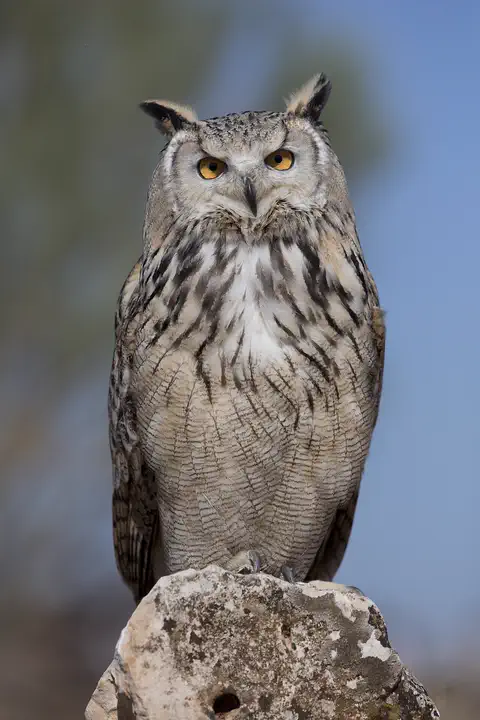
Eurasian eagle-owl
The Eurasian eagle-owl is one of the biggest owls in the world, with wings up to about 2 meters across, big orange eyes and two tall ear tufts. It lives across Europe and Asia, nests on rocky ledges and flies silently at night to catch rats, voles, hares and birds.
-
 Watch
Animal
Burrowing owl
The burrowing owl is a small, sandy-brown owl with long legs and bright yellow eyes. Unlike most owls, it lives underground, in burrows dug by prairie dogs, ground squirrels or tortoises, or sometimes by the owls themselves. It lives in open grasslands and deserts from Canada to the tip of South America.
-
 Watch
3D
Animal
Brown rat
Brown rats are large rodents that came from East Asia and spread around the world with people, mainly on ships. They are smart, strong swimmers with a superb sense of smell. Wild rats can carry germs that make people sick, so they are best left alone.
- Watch What If? Lab What if every animal slept at night? Night is busy. Barn owls hunt by sound in the dark, moths and bats take over the night shift of pollination, and fennec foxes leave their burrows once the hottest hours have passed. Imagine every animal sleeping at night: who would go hungry, who would overheat, and what jobs would be left undone?
For parents & teachers
What children will learn
- Explain how the barn owl's face, ears and feathers help it hunt at night.
- Describe what barn owls eat and what owl pellets are.
- Describe the barn owl life cycle and why many young owls do not survive.
- Explain how nest boxes, grassland and safer roads help barn owls.
Recommended ages: 3 to 17 · About 15 minutes
Talk about it
- Why would silent flight help an owl that hunts by listening?
- What can an owl pellet tell us about a place?
- How might a farmer and a barn owl help each other?
Try at home or in class
- Cup your hands behind your ears and listen to a quiet sound, then compare without them, to feel how a facial disc helps.
- With an adult, examine a sterilized owl pellet (sold for schools) and sort the tiny bones you find.
Key vocabulary: nocturnal, facial disc, pellet, talons, roost, rodenticide
Where these facts come from
- The IUCN Red List of Threatened Species , International Union for Conservation of Nature (IUCN terms of use (no redistribution of Red List data or range maps))
- GBIF Backbone Taxonomy and GBIF Occurrence Search , Global Biodiversity Information Facility (CC0 1.0 (backbone); occurrence counts are facts derived from records under CC0, CC BY and CC BY-NC)
- Wikidata , Wikimedia Foundation (CC0 1.0)
- Tyto alba (Barn Owl), Red List assessment 2025 , IUCN Red List of Threatened Species
- American Barn Owl overview , Cornell Lab of Ornithology, All About Birds
- American Barn Owl life history , Cornell Lab of Ornithology, All About Birds
- American Barn Owl identification , Cornell Lab of Ornithology, All About Birds
- Barn Owl facts , Barn Owl Trust
- Barn Owl Adaptations , Barn Owl Trust
- Barn Owl life expectancy , Barn Owl Trust
- Barn owl , RSPB
- Wikimedia Commons , Wikimedia Foundation (Per file: Public domain, CC0, CC BY or CC BY-SA only (credited on each page))
Checked, not yet human-reviewed. Last updated October 28, 2026. Spotted a mistake? Tell us.