
Animal
Perentie
The perentie is the biggest lizard in Australia. It lives in the hot, dry middle of the country.
The perentie is Australia's largest lizard, a kind of monitor, also known as a goanna. It lives in the dry, rocky deserts of central and western Australia, hiding in deep cracks and burrows among the rocks and hunting across the open desert around them.
Varanus giganteus (family Varanidae) is a very large ground-dwelling monitor of Australia's arid interior, from the central coast of Western Australia to far western Queensland. Shea, Ellis, Wilson and Oliver assessed it as Least Concern for the IUCN Red List (assessed 23 February 2017, published 2018): it is uncommon but wide-ranging, with a stable population and no known major threats.
Photo: Christopher Watson (http://www.comebirdwatching.blogspot.com/), CC BY-SA 3.0, via Wikimedia Commons
Meet the perentie
The perentie is a very big lizard.
It lives in Australia.
It has a forked tongue and a strong tail.
The perentie is a monitor lizard. Monitors are also known as goannas, and Perth Zoo says the perentie is Australia's largest lizard. It is a relative of the even bigger Komodo dragon.
Perth Zoo gives a body length of 2.3 to 2.5 meters, while the Reptile Database describes it as up to about 2 meters long. Either way, a big perentie is longer than a grown-up person is tall!
Varanus giganteus was described by Gray in 1845 as Hydrosaurus giganteus; the species name presumably comes from the Greek gigas, giant, for its size (G. Shea, via the Reptile Database). It is a very large ground monitor: the Reptile Database (after Storr 1980) gives up to 2 meters, while Perth Zoo gives 2.3 to 2.5 meters, so the sources differ on its maximum size.
Perth Zoo notes that Australia has about 25 of the world's 56 known monitor species and calls the perentie Australia's largest lizard. Storr (1980) separates it from other large Australian monitors such as Varanus gouldii, V. panoptes and V. rosenbergi by its narrow, parallel-sided snout, its nostril set close to the snout tip, and its higher counts of midbody scale rows and toe lamellae.
Quick facts
- Group
- Reptile
- Length
- 2 to 2.5 m
Rocky outcrops in the desert
Perenties live in hot, dry places.
They hide in cracks in big rocks.
Perenties live in the dry middle of Australia, from the central coast of Western Australia to far western Queensland, in the Northern Territory, South Australia, Western Australia and Queensland.
They make their homes in rocky outcrops, sheltering in deep cracks and burrows in the rocks. From there they wander widely across the surrounding desert and flat claypans to find food.
The IUCN lists the perentie as resident in Australia's Northern Territory, Queensland, South Australia and Western Australia, throughout the arid interior from the central coast of Western Australia to far western Queensland (Horn and King 2004; Cogger 2014). Its habitats are rocky areas and desert: it shelters in deep crevices and burrows in rocky outcrops and forages widely over the adjacent desert and claypans. It occurs in several conservation reserves across its range (Atlas of Living Australia 2015).
Continent
Its habitat

Where can you find this animal?
- Lives here naturally · Countries and seas named by a scientific source
- Sightings recorded · Records of wild sightings (GBIF)
Lives here naturally · Countries and seas named by a scientific source
The IUCN lists the perentie in the Northern Territory, Queensland, South Australia and Western Australia, through the dry interior from the central coast of Western Australia to far western Queensland. It lives in only part of the country shaded.
Places: Australia.
Source: iucn-red-list · checked October 2026
Sightings recorded · Records of wild sightings (GBIF)
Counts of GBIF records of wild observations (human and machine) and preserved specimens. Records include introduced populations, vagrants, escaped or released animals and misidentifications, so a country with records is not necessarily part of the native range.
Wild sightings have been recorded in Australia.
Source: gbif · checked October 2026
Range maps show where scientists say an animal lives, often country by country. An animal may live in only part of a country shown, and sightings records can include animals that wandered far from home.
A desert hunter
Perenties eat insects, birds and other lizards.
They find food with their eyes and their tongue.
Perenties are meat eaters. They eat insects, other reptiles, birds, small mammals and marsupials, turtle eggs, and even animals that are already dead.
A perentie finds its prey by looking for it and by sensing it with its forked tongue. Then it swallows its catch whole.
The IUCN lists insects, smaller reptiles, birds, small mammals and carrion in the diet (Horn and King 2004; Cogger 2014); Perth Zoo adds turtle eggs and marsupials and notes that perenties track prey by sight or by sensing with the tongue, then swallow it whole.
Did you know?
Its name may come from a word that means giant.
Its scientific name, giganteus, presumably comes from the Greek word gigas, meaning giant.
Etymology presumably from Greek gigas, giant, for its size (G. Shea, pers. comm. 2024, via the Reptile Database).
Spots, teeth and a strong tail
A perentie is brown with big cream spots.
It has sharp teeth and a forked tongue.
Each foot has five claws.
A perentie's body is rich brown with large cream or yellow markings, set in rows across its back. Its belly has a dark, net-like pattern.
It has a forked tongue and many very sharp, slightly curved teeth. Its legs are powerful, with five clawed toes on each foot, and its tail is strong and flattened from side to side.
Perth Zoo describes a rich brown body with large cream or yellow markings, a forked tongue, numerous very sharp, slightly curved teeth, a strong tail and powerful legs with five clawed toes. The Reptile Database (Storr 1980) gives the diagnosis: a strongly compressed tail, transverse rows of large pale spots on the back, a dark reticulum on the underside, and a narrow, parallel-sided snout with the nostril about twice as far from the eye as from the snout tip.
A long wait for eggs
The mother lays about 10 to 15 eggs.
The eggs take many months to hatch.
Perenties hatch from eggs. Perth Zoo, which keeps perenties, says a female lays about 10 to 15 eggs, and that the eggs take about 8 months to hatch. Eight months is two-thirds of a whole year!
When they hatch, baby perenties are small, but over the years they grow into the biggest lizards in Australia, more than 2 meters long.
Perentie reproduction is oviparous (Reptile Database). Perth Zoo gives clutches of 10 to 15 eggs and an incubation of about 8 months. Bredl and Horn (1987) published an early account of breeding the species in captivity (cited by the Reptile Database). Adults reach up to about 2 meters (Storr 1980) or 2.3 to 2.5 meters (Perth Zoo).
Standing tall
When a perentie is scared, it stands up tall.
Its throat puffs up and it hisses.
Perenties live on the ground and roam widely to hunt. When a perentie feels threatened, it rises up on its legs, puffs out its throat and hisses. If that does not scare the other animal away, it runs. It can also use its strong tail to defend itself, so wild perenties are best watched from a distance.
The IUCN describes a ground-dwelling species that shelters in rock crevices and burrows and forages widely. Perth Zoo describes the threat display: the perentie rises up, swells its throat and hisses; if this fails it runs away, and its powerful tail can also be used in defense. Dingoes sometimes eat perenties (Perth Zoo).
Did you know?
Australia has about 25 kinds of monitor lizards.
About 25 of the world's 56 known kinds of monitor lizards live in Australia.
Australia holds about 25 of the 56 known monitor species (Perth Zoo).
Least concern in the outback
Perenties are not endangered.
They live across a huge part of Australia.
The perentie is listed as least concern. It lives across a huge area, its numbers seem stable, and the IUCN knows of no major threats to it. It is uncommon, but it is spread across a very wide range.
Perenties live in several protected areas. Some are kept as pets, and nearly all of those were bred in captivity. International trade in perenties is controlled by CITES.
Shea, Ellis, Wilson and Oliver assessed Varanus giganteus as Least Concern (Global; assessed 23 February 2017, published 2018; trend stable), citing its wide distribution, the absence of major threats and an unlikely decline. It is described as uncommon but wide-ranging. It is listed as of least or no conservation concern in every Australian state where it occurs, so there are no species-specific actions, but it occurs in several reserves. Aboriginal people eat it, and the individuals in the pet trade are nearly all captive-bred; it is listed on CITES Appendix II (IUCN).
IUCN Red List
How is the perentie doing in the wild?
- Least Concern (this animal)
- Near Threatened
- Vulnerable
- Endangered
- Critically Endangered
- Extinct in the Wild
- Extinct
Least Concern
Not at risk of disappearing from the wild right now.
Amazing facts
-
Monitor lizards are also called goannas.
Monitor lizards are also known as goannas, and the perentie is Australia's biggest lizard.
Monitors are also known as goannas; the perentie is described as Australia's largest lizard (Perth Zoo).
-
Australia has about 25 kinds of monitor lizards.
About 25 of the world's 56 known kinds of monitor lizards live in Australia.
Australia holds about 25 of the 56 known monitor species (Perth Zoo).
-
Perentie eggs take about 8 months to hatch.
Perentie eggs take about 8 months to hatch, according to Perth Zoo.
Incubation of about 8 months, clutch 10 to 15 (Perth Zoo).
-
Its name may come from a word that means giant.
Its scientific name, giganteus, presumably comes from the Greek word gigas, meaning giant.
Etymology presumably from Greek gigas, giant, for its size (G. Shea, pers. comm. 2024, via the Reptile Database).
Words to know
- goanna
- another name for a monitor lizard
- monitor
- a big lizard with a long neck, a long tail and a forked tongue
- outback
- the dry, thinly populated inland part of Australia
- claypan
- a flat, hard area of clay in a dry land that may hold water after rain
- incubation
- the time eggs need to develop before they hatch
- least concern
- not currently at serious risk of dying out in the wild
Discovery challenge
-
Where do perenties live?
In which country do perenties live?
To which country is Varanus giganteus endemic?
- Australia
- Brazil
- Canada
Show the answer
Australia
Australia!
They live in the dry middle and west of Australia.
Australia's arid interior, in four states and territories (IUCN).
-
What is another name for a monitor lizard?
What is another name for a monitor lizard like the perentie?
Which common name is also used for monitors such as the perentie?
- Goanna
- Gecko
- Iguana
Show the answer
Goanna
Goanna!
Monitors are also known as goannas.
Goanna (Perth Zoo).
-
What does a scared perentie do?
What does a perentie do when it feels threatened?
Describe the perentie's threat display.
- Rises up, puffs its throat and hisses
- Changes color to bright blue
- Rolls into a ball
Show the answer
Rises up, puffs its throat and hisses
It stands up tall and hisses!
If that does not work, it runs away.
Rising, throat inflation and hissing, then flight; the tail may be used in defense (Perth Zoo).
-
Where does a perentie hide?
Where do perenties shelter?
Which shelters does Varanus giganteus use?
- In deep cracks and burrows in rocks
- In tree holes high above the ground
- In nests made of leaves
Show the answer
In deep cracks and burrows in rocks
In the rocks!
They hide in rocky outcrops and hunt across the desert around them.
Deep crevices and burrows in rocky outcrops (IUCN).
Places where you might see it
-
 Watch
 Country
Australia
Australia is a country and the smallest continent, surrounded by ocean in the Southern Hemisphere. Much of its middle is dry and flat, most people live near the coast, and its animals include kangaroos, koalas and the platypus, a mammal that lays eggs.
-
 Watch
Natural wonder
Simpson Desert
The Simpson Desert covers 176,500 square kilometers where South Australia, Queensland and the Northern Territory meet, Geoscience Australia says. Its parallel sand dunes can stretch for up to 200 kilometers, and South Australia's parks service calls its national park one of the world's best examples of a parallel dune desert.
Explore next
-
 Watch
Animal
Nile monitor
The Nile monitor is one of the biggest lizards in Africa, growing up to 2.4 meters long. It lives near rivers, lakes and swamps across most of Africa south of the Sahara, and along the Nile River in Egypt. It is a strong swimmer and a good climber, and it eats almost any animal it can catch.
-
 Watch
3D
Animal
Komodo dragon
The Komodo dragon is the largest lizard alive today. It lives only on a handful of Indonesian islands, where it tracks food with its flicking yellow tongue, rests in burrows in the heat and spends its first years safely up in the trees.
-
 Watch
Animal
Thorny devil
The thorny devil is a small Australian desert lizard covered in spikes from head to tail. Despite its fierce name it is slow and harmless, it eats nothing but ants, and tiny channels in its skin carry water to its mouth.
-
Watch
Country
Australia
Australia is a country and the smallest continent, surrounded by ocean in the Southern Hemisphere. Much of its middle is dry and flat, most people live near the coast, and its animals include kangaroos, koalas and the platypus, a mammal that lays eggs.
-
 Watch
Animal
Shingleback skink
The shingleback is a big, slow, chunky skink from the dry parts of southern and inland Australia. It has a large head, a short, blunt tail and big rough scales like the shingles on a roof. It sticks out a bright blue tongue to scare enemies, gives birth to big live babies, and the same male and female often pair up year after year.
-
Watch
Natural wonder
Simpson Desert
The Simpson Desert covers 176,500 square kilometers where South Australia, Queensland and the Northern Territory meet, Geoscience Australia says. Its parallel sand dunes can stretch for up to 200 kilometers, and South Australia's parks service calls its national park one of the world's best examples of a parallel dune desert.
-
 Watch
Animal
Aldabra giant tortoise
The Aldabra giant tortoise is one of the largest land tortoises on Earth. Wild ones live on Aldabra Atoll, a ring of coral islands in the Indian Ocean, where about 180,000 of them graze, browse and shape the land like elephants do in Africa. They can live for more than 100 years.
-
 Watch
Animal
Alligator snapping turtle
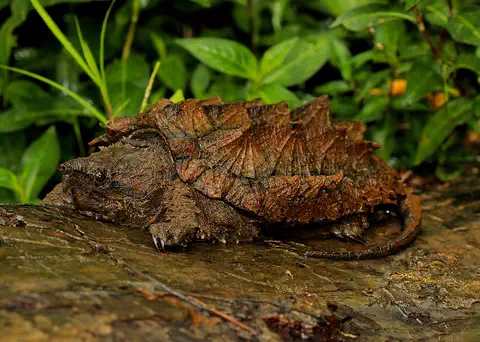
The alligator snapping turtle is the largest freshwater turtle in the United States. It lies still on the bottom of rivers and lakes with its mouth open, wiggling a worm-like lure on its tongue to trick fish into swimming close. Its numbers have fallen, and it is now endangered.
For parents & teachers
What children will learn
- Describe where perenties live and how they use rocky outcrops.
- Describe the perentie's body: its spots, claws, tongue and tail.
- Explain how a threat display helps an animal avoid a fight.
- Explain why scientists sometimes give different sizes for the same animal.
Recommended ages: 3 to 17 · About 15 minutes
Talk about it
- Why might cracks in rocks make good shelters in a hot desert?
- Why do you think two sources might give different sizes for the same animal?
- Why is it best to watch big wild lizards from a distance?
Try at home or in class
- Measure a perentie: with a grown-up, use a tape measure to mark 2 meters on the floor and compare it with the height of people in your family.
- Shade test: on a sunny day, feel a stone in the sun and a stone in the shade of a crack or wall, and talk about why desert lizards hide in rock cracks.
Key vocabulary: goanna, monitor, outback, claypan, incubation, least concern
Where these facts come from
- GBIF Backbone Taxonomy and GBIF Occurrence Search , Global Biodiversity Information Facility (CC0 1.0 (backbone); occurrence counts are facts derived from records under CC0, CC BY and CC BY-NC)
- Wikidata , Wikimedia Foundation (CC0 1.0)
- The IUCN Red List of Threatened Species , International Union for Conservation of Nature (IUCN terms of use (no redistribution of Red List data or range maps))
- Varanus giganteus (Shea, Ellis, Wilson and Oliver, assessed 23 February 2017, published 2018) , IUCN Red List of Threatened Species
- Varanus giganteus: justification, range, population, habitat, threats, use and trade, and conservation text , IUCN Red List of Threatened Species
- Varanus giganteus: IUCN Red List global assessment record (Shea et al. 2018), IUCN checklist on GBIF , GBIF
- Perentie , Perth Zoo
- Varanus giganteus , The Reptile Database
- File:Varanus giganteus 14 - Christopher Watson.jpg (Christopher Watson) , Wikimedia Commons
- Wikimedia Commons , Wikimedia Foundation (Per file: Public domain, CC0, CC BY or CC BY-SA only (credited on each page))
Checked, not yet human-reviewed. Last updated November 1, 2026. Spotted a mistake? Tell us.