
Animal
Peacock mantis shrimp
The peacock mantis shrimp is a rainbow-colored sea animal. It has two little hammers that it uses to crack open shells.
The peacock mantis shrimp is one of the most colorful animals on coral reefs in the Indian and Pacific Oceans. It is famous for its club-shaped arms, which strike so fast that they can smash snail shells, and for its amazing eyes on movable stalks.
Odontodactylus scyllarus is a stomatopod, not a true shrimp: a reef-dwelling "smasher" whose spring-loaded raptorial appendages strike at up to 23 meters per second. Its mineralized clubs, extreme strike forces and polarization-sensitive eyes make it a model species in biomechanics, materials science and vision research.
Photo: Cédric Péneau, CC BY-SA 4.0, via Wikimedia Commons
Meet the peacock mantis shrimp
The peacock mantis shrimp is green, blue, red and orange.
It lives in the sea near coral reefs. It has big round eyes on stalks and two strong arms shaped like little hammers.
The peacock mantis shrimp is one of the most brightly colored mantis shrimps, with a green body, red-fringed paddles and deep blue on its tail. Despite its name, it is not a true shrimp. Mantis shrimps are a separate group of crustaceans, distant relatives of shrimps and lobsters.
It is a "smasher." Its front arms end in hard clubs that it swings at incredible speed to break the shells of its food. Scientists study it to learn about fast movement, tough materials and unusual eyes.
Odontodactylus scyllarus belongs to the order Stomatopoda (family Odontodactylidae), crustaceans that are only distant relatives of true shrimps and lobsters. SeaLifeBase, following the FAO identification guide, describes it as one of the most brightly colored stomatopods, with deep blue uropods and appendages fringed with bright red setae, and calls it the largest "smasher".
Smashers break hard-shelled prey with a hammer-like dactyl club on their raptorial appendages, while other mantis shrimps spear soft prey such as fish. This species has become a laboratory model: Patek and colleagues used it to describe the spring mechanism behind the strike, and materials scientists have copied the structure of its damage-tolerant clubs to make tougher carbon-fiber composites (Grunenfelder et al. 2014).
Quick facts
- Group
- Invertebrate
- Length
- up to 17 cm
- Top speed
- 50 to 83 km/h
Where it lives
Peacock mantis shrimps live in warm seas.
They live near coral reefs, on sandy and rocky sea floors. Each one has a burrow where it can hide.
Peacock mantis shrimps live in the warm, tropical waters of the Indian Ocean and the western Pacific Ocean. They live on the sea floor near coral reefs, from shallow water down to at least 36 meters.
They like rough bottoms covered with rubble and sand. Each mantis shrimp lives in a burrow, often one that was already there, and darts out to find food. The one in the photo was seen near Réunion, an island in the Indian Ocean.
SeaLifeBase gives an Indo-West Pacific distribution and describes the species as reef-associated and tropical, living in existing burrows in shallow, rough-bottom habitats, often on or near coral reefs, from the intertidal zone into the subtidal; one record places it on reef flats at 36 meters, and the database's depth range runs to 100 meters.
The map shades the Indian and Pacific Oceans because the sources give the range only as the Indo-West Pacific, not as a list of countries. The species is not found throughout the eastern Pacific, so the shading is broader than the true range.
Its habitat

Where can you find this animal?
- Lives here naturally · Countries and seas named by a scientific source
- Sightings recorded · Records of wild sightings (GBIF)
Lives here naturally · Countries and seas named by a scientific source
Tropical reefs and rubble bottoms of the Indo-West Pacific. The sources name the region, not countries, so whole oceans are shaded; the species does not live in the eastern Pacific or in cold water.
Places: Indian Ocean and Pacific Ocean.
Source: https://www.sealifebase.se/summary/SpeciesSummary.php?id=83452 · checked October 2026
Sightings recorded · Records of wild sightings (GBIF)
Counts of GBIF records of wild observations (human and machine) and preserved specimens. Records include introduced populations, vagrants, escaped or released animals and misidentifications, so a country with records is not necessarily part of the native range.
Wild sightings have been recorded in Indonesia, Philippines, Australia, Malaysia, Thailand, Taiwan, Tanzania, Papua New Guinea and 22 more places.
Source: gbif · checked October 2026
Range maps show where scientists say an animal lives, often country by country. An animal may live in only part of a country shown, and sightings records can include animals that wandered far from home.
What it eats
Peacock mantis shrimps eat animals with hard shells.
They crack the shells with their hammer arms. Then they eat the soft food inside.
Peacock mantis shrimps hunt animals with hard shells, such as snails, crabs and clams. A shell that would stop most hunters is no problem for them: they hit it with their clubs again and again until it breaks.
In the lab, scientists filmed a peacock mantis shrimp breaking open a snail shell. Its club moved so fast that tiny bubbles formed in the water and then popped, adding an extra blow.
As a smasher, O. scyllarus feeds on heavily mineralized, hard-shelled prey; SeaLifeBase lists slipper lobsters (scyllarids), and the UC Berkeley team describes mantis shrimp smashing crabs, clams and snails, and Patek described snails as its preferred food. It is active during the day.
Patek and Caldwell (2005) found that each strike produces two force peaks about 390 to 480 microseconds apart: the first from the club's impact, the second from the collapse of cavitation bubbles. Impact forces reached 400 to 1,501 newtons, and cavitation forces up to 504 newtons, thousands of times the animal's body weight.
Did you know?
Each strike hits a shell twice.
Each strike hits twice: first the club, then the pop of tiny bubbles made by the club's speed.
Patek and Caldwell (2005) recorded two force peaks per strike, impact then cavitation-bubble collapse, about 390 to 480 microseconds apart.
Hammers and super eyes
Its arms fold up like a pocketknife. When it strikes, they shoot out super fast!
Its big eyes sit on stalks. They can move in many different directions.
The peacock mantis shrimp keeps its hammer arms folded under its head. Inside each arm is a curved part shaped like a potato chip. It works like a spring: it stores energy when the arm is pulled back, then lets go, and the club shoots out at up to 23 meters per second.
The club is very tough. It is made of hard minerals and fibers arranged in twisting layers, so it can deliver thousands of blows without breaking. The eyes are amazing too: each one moves on its own stalk, and they can see kinds of light that people cannot.
Patek, Korff and Caldwell (2004) showed that a saddle-shaped region of exoskeleton, a hyperbolic paraboloid, acts as a spring that stores elastic energy when the appendage is cocked and latched; release drives peak club speeds of 14 to 23 meters per second with accelerations of 6,300 to 8,000 times gravity. Weaver and colleagues (2012) found the club is a multiphase composite of oriented crystalline hydroxyapatite with amorphous calcium phosphate and carbonate, over a helicoidal chitin matrix, giving several lines of defense against failure under repeated high-energy impacts.
The stalked compound eyes can rotate in yaw, pitch and torsion (Daly et al. 2018). In the mid-band of the eye, Kleinlogel and Marshall (2009) found photoreceptors sensitive to linearly polarized ultraviolet light, and Chiou and colleagues (2012) showed that the red antennal scale uses the pigment astaxanthin to produce polarized light for visual signaling.
Growing up
A mother mantis shrimp looks after lots of eggs.
The babies that hatch are tiny and float in the sea for about three months. Then they settle down on the sea floor and grow.
A female peacock mantis shrimp looks after her eggs until they hatch. SeaLifeBase says female mantis shrimps can brood as many as 50,000 eggs.
The babies that hatch, called larvae, look nothing like their parents. They drift in the open sea as part of the plankton for about three months before settling on the sea floor. Like all crustaceans, a mantis shrimp grows by molting, and after each molt it forms a brand-new club.
SeaLifeBase notes that stomatopods vary in their mating systems, some pairing for life and others meeting only to mate; males produce sperm ducts rather than spermatophores, and females can brood up to 50,000 eggs. Its account adds that the eggs hatch into planktonic zoea larvae that last about three months before settling.
Growth requires molting, and the club is rebuilt each time. Chua and colleagues (2023) tracked new clubs in O. scyllarus at set times after molting and found that they form on a thin, bromine-rich organic membrane, with crystalline apatite present from the very start and becoming more important as the club matures.
A fast and clever hunter
The peacock mantis shrimp hunts in the daytime.
It peeks out of its burrow with its big eyes. Then it zips out to find food and zips back home.
Peacock mantis shrimps are active during the day. They watch the world from their burrows, then dart out to hunt on the sea floor.
Their strike is one of the fastest movements of any animal. When scientists first tried to film it, their camera was too slow! With a high-speed camera filming 5,000 pictures a second, they finally saw how it works. Mantis shrimps can even make signals with a kind of light that people cannot see.
SeaLifeBase describes O. scyllarus as diurnal. The UC Berkeley team reported that their first video system could not capture the strike; with a high-speed camera recording at 5,000 frames per second they measured speeds well above an earlier estimate of 10 meters per second for another mantis shrimp species, and compared it with the trap-jaw ant at 17 meters per second.
Communication includes polarized-light signals: the astaxanthin-based polarizer in the antennal scale (Chiou et al. 2012) is the first known use of a carotenoid to make a polarizing signal. Daly and colleagues (2018) found that the eyes hold a steady side-to-side gaze even while they roll, and suggested that the brain's motion-detecting network may be organized in a way likely unique to stomatopods.
Did you know?
A mantis shrimp's arm has a spring inside, shaped like a chip.
A saddle-shaped part of the arm, shaped a bit like a potato chip, works as a spring that powers the strike.
The spring is a hyperbolic paraboloid in the exoskeleton; the researchers knew of no other biological example of this shape used as a spring.
Reefs and mantis shrimps
Peacock mantis shrimps need healthy coral reefs.
When we look after reefs, we help mantis shrimps and many other sea animals.
The peacock mantis shrimp has not been checked by the IUCN Red List, so there is no official count of how it is doing. It is collected for home aquariums, and it depends on habitats on and near coral reefs.
It is also helping people. Engineers have copied the twisting layers of its tough club to make carbon-fiber materials that resist damage when they are hit.
The species has not been evaluated by the IUCN Red List (SeaLifeBase, citing Red List version 2025-2), is not listed by CITES, and is used in the commercial aquarium trade. SeaLifeBase rates its vulnerability to fishing as low.
It is also important to science. Grunenfelder and colleagues (2014) copied the helicoidal arrangement of mineralized fiber layers in the club, which they describe as built to withstand thousands of high-velocity blows, into carbon fiber-epoxy panels and found that it reduced damage from impacts and increased toughness.
Did you know?
A mantis shrimp's red paddles can make a light signal that people cannot see.
The red paddles near a peacock mantis shrimp's head can make polarized light, a kind of light signal people cannot see.
Astaxanthin in the antennal scale acts as a dichroic polarizer, the first known case of a carotenoid used to produce a polarization signal (Chiou et al. 2012).
Amazing facts
-
Scientists' first camera was too slow to film the mantis shrimp's strike.
When scientists first tried to film a peacock mantis shrimp's strike, their camera was too slow. They needed one that filmed 5,000 pictures a second.
The strike outpaced the UC Berkeley team's original video system; a high-speed camera recording 5,000 frames per second finally resolved it.
-
Each strike hits a shell twice.
Each strike hits twice: first the club, then the pop of tiny bubbles made by the club's speed.
Patek and Caldwell (2005) recorded two force peaks per strike, impact then cavitation-bubble collapse, about 390 to 480 microseconds apart.
-
A mantis shrimp's arm has a spring inside, shaped like a chip.
A saddle-shaped part of the arm, shaped a bit like a potato chip, works as a spring that powers the strike.
The spring is a hyperbolic paraboloid in the exoskeleton; the researchers knew of no other biological example of this shape used as a spring.
-
A mantis shrimp's red paddles can make a light signal that people cannot see.
The red paddles near a peacock mantis shrimp's head can make polarized light, a kind of light signal people cannot see.
Astaxanthin in the antennal scale acts as a dichroic polarizer, the first known case of a carotenoid used to produce a polarization signal (Chiou et al. 2012).
Words to know
- crustacean
- an animal with a hard outer shell and jointed legs, like a crab, shrimp or lobster
- stomatopod
- a mantis shrimp, a group of crustaceans with strong folding front arms
- cavitation
- bubbles that form in water when something moves through it very fast
- polarized light
- light whose waves all vibrate in the same direction
- larva
- a young animal that looks very different from its parents
- molt
- to shed an old shell or skin so the body can grow
Discovery challenge
-
What does the mantis shrimp use its hammer arms for?
What does a peacock mantis shrimp use its clubs for?
What is the main function of the dactyl club in this smasher species?
- Swimming fast
- Cracking hard shells
- Digging for water
Show the answer
Cracking hard shells
It cracks open shells to get the food inside.
It strikes snails, crabs and clams with its clubs to break their shells.
Fracturing heavily mineralized prey, with impact and cavitation forces combined.
-
Is a mantis shrimp a real shrimp?
Is the peacock mantis shrimp a true shrimp?
Is Odontodactylus scyllarus a true (decapod) shrimp?
- No, it belongs to a different group called stomatopods
- Yes, it is a true shrimp
- No, it is a kind of fish
Show the answer
No, it belongs to a different group called stomatopods
No. It is a crustacean, but not a true shrimp.
No. Mantis shrimps are stomatopods, a separate group of crustaceans.
Stomatopoda, distinct from the decapod shrimps and lobsters.
-
What powers the mantis shrimp's fast strike?
What inside the arm helps power the mantis shrimp's strike?
Which structure stores elastic energy for the strike, according to Patek and colleagues (2004)?
- A tiny motor
- Air from its gills
- A spring shaped like a saddle
Show the answer
A spring shaped like a saddle
A spring in its arm! It is shaped like a saddle.
A saddle-shaped part of the exoskeleton works like a spring, storing energy and releasing it.
A saddle-shaped (hyperbolic paraboloid) region of the exoskeleton acts as an elastic spring.
-
Where does the peacock mantis shrimp live?
In which waters does the peacock mantis shrimp live?
What is the distribution of Odontodactylus scyllarus?
- Icy Arctic waters
- Warm seas of the Indian and western Pacific Oceans
- Freshwater rivers
Show the answer
Warm seas of the Indian and western Pacific Oceans
It lives in warm seas near coral reefs.
The tropical Indian Ocean and western Pacific, near coral reefs.
The tropical Indo-West Pacific, in burrows on rough bottoms on or near reefs.
Explore next
-
 Watch
Animal
American lobster
The American lobster is a big crustacean that lives on the rocky sea floor of the northwest Atlantic Ocean. It has two very different claws, one for crushing and one for tearing, and it must climb out of its hard shell again and again to grow.
-
 Watch
Animal
Mimic octopus
The mimic octopus is a long-armed, brown-and-white octopus that lives on sandy sea floors in Southeast Asia. Scientists first filmed it in 1998 and were amazed: it changes its shape, colors and movements to look like other animals, including a flatfish, a lionfish and a sea snake.
-
 Watch
3D
Animal
Antarctic krill
Antarctic krill are small, shrimp-like crustaceans about 6 centimeters long that live in the icy Southern Ocean around Antarctica. They gather in enormous swarms, and almost all the bigger animals of the Antarctic, from penguins to blue whales, depend on them for food.
-
 Watch
Animal
Army ant
Army ants hunt together in giant swarms and never build a permanent nest. This page is about the best-studied kind, Eciton burchellii, of Central and South American forests. Each night of its traveling phase the colony moves, and the workers link their legs to build a living camp around their queen and young.
-
 Watch
3D
Animal
Atlantic blue crab
The Atlantic blue crab is a swimming crab with bright blue claws and back legs shaped like paddles. It lives along the Atlantic coast of the Americas, especially in bays where rivers meet the sea, like the Chesapeake Bay. A mother crab carries up to two million eggs in a spongy orange mass under her body.
-
 Watch
3D
Animal
Atlantic ghost crab
The Atlantic ghost crab is a sand-colored crab of beaches along the Atlantic coast of the Americas. It is so pale that it almost disappears on the sand, like a ghost. It digs deep burrows, comes out mostly at night, and runs very fast on its long legs.
-
 Watch
3D
Animal
Atlantic horseshoe crab
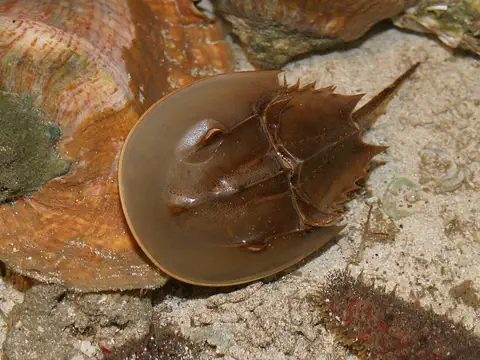
The Atlantic horseshoe crab is a living fossil: its relatives have looked much the same for hundreds of millions of years. Despite its name, it is more closely related to spiders and scorpions than to crabs. Each spring, thousands crawl onto beaches to lay eggs, feeding hungry shorebirds, and its blue blood helps keep medicines safe.
-
 Watch
Animal
Atlas moth
The atlas moth is one of the largest moths in the world, with wings up to about 24 centimeters across. It lives in tropical and subtropical forests of southern and Southeast Asia. Its caterpillars eat a lot and spin silk cocoons, and the adults cannot eat at all: they live for only about a week.
For parents & teachers
What children will learn
- Explain how a spring can store energy and release it quickly.
- Describe how the mantis shrimp's club is built to survive repeated impacts.
- Describe the mantis shrimp's life cycle, from brooded eggs to planktonic larvae.
- Understand how scientists learn from animals to design new materials.
Recommended ages: 3 to 17 · About 15 minutes
Talk about it
- Why might a fast strike be useful for breaking a shell?
- How do engineers learn from animals like the mantis shrimp?
- What might an animal gain from seeing kinds of light that others cannot?
Try at home or in class
- Bend a ruler back gently and let it go to feel how a spring stores and releases energy, the idea behind the mantis shrimp's strike.
- Look at a computer screen through polarized sunglasses and tilt your head to see how polarized light changes what you see.
Key vocabulary: crustacean, stomatopod, cavitation, polarized light, larva, molt
Where these facts come from
- GBIF Backbone Taxonomy and GBIF Occurrence Search , Global Biodiversity Information Facility (CC0 1.0 (backbone); occurrence counts are facts derived from records under CC0, CC BY and CC BY-NC)
- Odontodactylus scyllarus (Linnaeus, 1758) , SeaLifeBase
- Mantis shrimp may have swiftest kick in the animal kingdom (news release, 21 April 2004, on Patek, Korff and Caldwell, Nature 428: 819–820) , University of California, Berkeley
- Extreme impact and cavitation forces of a biological hammer: strike forces of the peacock mantis shrimp Odontodactylus scyllarus (Patek and Caldwell 2005, Journal of Experimental Biology 208: 3655–3664), abstract , PubMed, US National Library of Medicine
- The stomatopod dactyl club: a formidable damage-tolerant biological hammer (Weaver et al. 2012, Science 336: 1275–1280), abstract , PubMed, US National Library of Medicine
- Ultraviolet polarisation sensitivity in the stomatopod crustacean Odontodactylus scyllarus (Kleinlogel and Marshall 2009), abstract , PubMed, US National Library of Medicine
- A novel function for a carotenoid: astaxanthin used as a polarizer for visual signalling in a mantis shrimp (Chiou et al. 2012), abstract , PubMed, US National Library of Medicine
- Complex gaze stabilization in mantis shrimp (Daly et al. 2018), abstract , PubMed, US National Library of Medicine
- Biomineralization of mantis shrimp dactyl club following molting (Chua et al. 2023), abstract , PubMed, US National Library of Medicine
- Bio-inspired impact-resistant composites (Grunenfelder et al. 2014, Acta Biomaterialia 10: 3997–4008), abstract , PubMed, US National Library of Medicine
- Wikidata , Wikimedia Foundation (CC0 1.0)
- Wikimedia Commons , Wikimedia Foundation (Per file: Public domain, CC0, CC BY or CC BY-SA only (credited on each page))
Checked, not yet human-reviewed. Last updated October 27, 2026. Spotted a mistake? Tell us.