
Animal
European mantis
The European mantis is a green or brown insect. It holds its front legs together, as if it is praying. It is a patient hunter that catches other insects.
The European mantis is the best-known praying mantis. It sits very still with its spiky front legs folded, then snatches insects that come close. It is native to Europe, Africa and much of Asia, and people brought it to North America more than 100 years ago.
Mantis religiosa is an ambush predator native to Europe, much of Africa and large parts of Asia, introduced to North America by 1899. It seizes prey with spined raptorial forelegs, hears ultrasound through a single ear on the underside of its thorax, and is famous among scientists for sexual cannibalism, which field studies show happens in a minority of matings.
Photo: Alvesgaspar, CC BY-SA 3.0, via Wikimedia Commons
Meet the European mantis
The European mantis is a long, thin insect.
It can be green or brown. It folds its front legs as if it is praying. Its head is shaped like a triangle, with a big eye at each side.
The European mantis is one of the best-known mantises. When it rests, it folds its front legs in front of its body, as if it is praying. That is how it got its scientific name, Mantis religiosa: religiosa refers to that praying pose.
It grows up to about 7.5 centimeters long, as long as a crayon. Its color ranges from tan to bright green, which helps it blend in with leaves and dry grass. Its head is shaped like a triangle, with two big eyes at the corners.
Mantis religiosa belongs to the family Mantidae. The University of Colorado Museum of Natural History notes that the genus name Mantis means prophet in Greek and that religiosa refers to the pious-looking posture of the folded forelegs.
Adults measure about 50 to 60 millimeters including the wings, according to Tennessee State University, and up to about three inches (7.6 centimeters) in Colorado. Color varies from tan to bright green, providing camouflage. The species is recognized by its triangular head and raptorial forelegs, and it is among the largest and most common of the seven mantis species found in Colorado.
Quick facts
- Group
- Invertebrate
- Length
- 5 to 7.6 cm
Where it lives
European mantises live in sunny meadows and gardens.
They first lived in Europe, Africa and Asia. Now they live in North America too.
The European mantis is native to Europe, much of Africa and large parts of Asia, from Türkiye to Japan. It likes meadows, fields and gardens where tall plants give it places to hide and hunt.
It also lives in North America, but it is not native there. In 1899, a man near Rochester, New York, found several large mantises in his garden. They had probably arrived by accident with plants from Europe. Today European mantises live in much of the United States and in southern Canada.
A 2026 study in The Canadian Entomologist describes the species as native to Europe, parts of northern and central Asia and North Africa, broadly distributed across northern temperate regions. The IUCN Red List's global assessment (2016) lists a wider native range, from Portugal east to Japan and south through much of Africa to South Africa and Madagascar. It was first documented in North America in 1899 near Rochester, New York, probably arriving through the nineteenth-century horticultural trade; in the 1930s, mantises from Ontario were released in British Columbia as a biological control agent.
DNA barcodes in that study point to France as the origin of introduced populations in southern Quebec and Ontario, though the authors note that other introductions may have occurred, because egg cases are easily transported. The species is now established in southwestern and southeastern Canada and much of the United States, where it favors meadows and other open, vegetated places.
Continents
Its habitat

Where can you find this animal?
- Brought here by people · Countries and seas named by a scientific source
- Lives here naturally · Countries and seas named by a scientific source
- Sightings recorded · Records of wild sightings (GBIF)
Brought here by people · Countries and seas named by a scientific source
Introduced to North America: first documented in 1899 near Rochester, New York; now established in much of the United States and in southwestern and southeastern Canada.
Places: United States and Canada.
Source: https://www.cambridge.org/core/journals/canadian-entomologist/article/french-con · checked October 2026
Lives here naturally · Countries and seas named by a scientific source
Native across Europe, much of Africa and large parts of Asia, from Portugal to Japan and south to South Africa and Madagascar (IUCN global assessment, 2016, countries of occurrence), plus Italy, where the 2026 Canadian Entomologist study sampled native populations. Mantises live in open, sunny places, so they are patchy within each country. Countries the IUCN lists but with no GBIF records of the
Places: Afghanistan, Albania, Algeria, Armenia, Austria, Azerbaijan, Bangladesh, Belarus and 91 more places.
Source: iucn-red-list · checked October 2026
Sightings recorded · Records of wild sightings (GBIF)
Counts of GBIF records of wild observations (human and machine) and preserved specimens. Records include introduced populations, vagrants, escaped or released animals and misidentifications, so a country with records is not necessarily part of the native range.
Wild sightings have been recorded in France, Germany, United States, Spain, Canada, Italy, Switzerland, Austria and 112 more places.
Source: gbif · checked October 2026
Range maps show where scientists say an animal lives, often country by country. An animal may live in only part of a country shown, and sightings records can include animals that wandered far from home.
A patient hunter
The mantis eats other insects.
It waits without moving. When a bug comes close, it grabs it with its spiky front legs. Snap!
The European mantis is a carnivore: it eats other animals, mostly insects. It is an ambush hunter. Instead of chasing its food, it stays perfectly still, hidden by its color, and waits for an insect to come close.
Then it strikes fast with its front legs, which are lined with sharp spikes that hold the prey tight. Grasshoppers are a favorite, and it can even grab insects as they fly past. It also eats caterpillars, butterflies, moths and flies.
Mantis religiosa is a voracious ambush predator. It waits motionless, relying on camouflage, then strikes with raptorial forelegs whose inner surfaces carry rows of spines that pierce and hold prey. It can seize flying insects, and grasshoppers are a frequent catch; Tennessee State University also lists caterpillars, butterflies, flies and moths.
Its diet is broad enough that it has been used against pests: it has been released for biological control, and studies have examined it as a predator of the red-legged grasshopper. It will also eat other mantises, including its own kind.
Did you know?
The name mantis comes from a Greek word meaning prophet.
The name Mantis comes from a Greek word meaning prophet, a person who tells what will happen.
The genus name Mantis means prophet in Greek, and the species name religiosa refers to the pious-looking folded forelegs.
Spiky arms and a hidden ear
A mantis has big eyes on a triangle head.
Its front legs are spiky, for grabbing. It has four more legs for walking, and wings folded on its back.
A mantis has six legs, but they do different jobs. The front two are raptorial, which means made for grabbing. They fold up tight and have rows of spikes. The other four legs are for walking and climbing.
Its triangular head sits on a long, thin neck-like part of the thorax, and it has two large eyes and two thin antennae. Here is a surprise: a mantis has just one ear, and it is on the underside of its body, between its back legs.
The forelegs are raptorial, folding shut on prey with spines on their inner faces. The head is triangular, carrying large compound eyes and slender antennae, and it is set on an elongated prothorax. In adults the wings extend past the end of the abdomen.
Unusually, the European mantis has a single midline ear on the ventral side of the metathorax. Yager and Hoy (1988) described this structure, which the University of Colorado Museum notes can detect high and low frequencies as well as ultrasound. The museum notes that this hearing aids predation, letting the mantis wait as prey moves toward it before striking.
From egg case to adult
A mother mantis lays lots of eggs in a foamy case.
The eggs wait all winter. In spring, tiny mantises hatch. They look like small grown-ups without wings.
In late summer or fall, a female lays more than 100 eggs in a flat case stuck to a twig or leaf. The case protects the eggs through the winter.
In late spring, the eggs hatch into tiny mantises called nymphs. Nymphs look like small adults without wings. They do not make a cocoon or chrysalis. Instead, they grow by shedding their skin several times, getting bigger each time, until they are winged adults by late summer.
Mantids undergo incomplete metamorphosis: there is no pupa. The female lays more than 100 eggs in an ootheca, a flat egg mass attached to twigs or leaves, where the eggs remain dormant through winter; overwintering success of the ootheca is critical when the species is introduced to colder places.
Nymphs hatch in late spring. They resemble adults except in size and lack of wings, and some are dispersed by wind or eaten by their siblings. They mature in late summer, when the solitary adults seek mates. The University of Colorado Museum notes that the eggs in an egg sac laid after mating hatch the following summer.
Still, quiet and solitary
Mantises like to be alone.
They sit very, very still among the plants. When they do move, they move slowly and carefully.
European mantises live alone. Adults meet only to mate in late summer. Most of the time a mantis sits very still among plants, almost invisible.
When a male finds a female, he moves toward her very slowly and freezes whenever she notices him. Mantises also have a sense many people never guess: a single ear that can hear very high sounds, even ones too high for people to hear.
Adults are solitary and interact mainly to mate in late summer. Mating is cautious: the University of Colorado Museum describes males approaching slowly and freezing when noticed, then mounting the female from a distance.
The species is well known for sexual cannibalism, in which a female sometimes eats the male during or after courtship. In a field study, Lawrence (1992) found that this happened in about 30 percent of matings, so most males survive. Scientists have studied mantis mating behavior at least since Kenneth Roeder's experiments, published in 1935.
Did you know?
European mantises traveled to America more than 100 years ago.
In 1899 a gardener near Rochester, New York, found big mantises in his garden: the first European mantises recorded in North America.
DNA barcodes published in 2026 suggest that introduced populations in southern Quebec and Ontario came from France.
Common here, rare there
There are lots of European mantises.
They live in many countries. Sunny meadows with tall plants are good homes for them.
The European mantis is widespread and common in many places, including much of North America. But in some parts of Europe it has become rare. In Germany it is listed as endangered, probably because the meadows and grasslands it needs have been lost.
In North America it is not native, but scientists say it does not seem to cause much harm. It has even been used to help control insect pests.
The IUCN Red List assesses the species as Least Concern worldwide (assessed in 2015, published in 2016), and it is common in much of its introduced North American range. Yet the University of Colorado Museum notes that it is listed as endangered in Germany, likely because of habitat loss.
In North America it is an introduced species. Tennessee State University's invasive species database considers it to pose no current ecological threat, as it is solitary and does little or no damage to plants, and it has been used in biological control. Researchers continue to study how and when it arrived, and how cold winters limit where its egg cases can survive.
IUCN Red List
How is the european mantis doing in the wild?
- Least Concern (this animal)
- Near Threatened
- Vulnerable
- Endangered
- Critically Endangered
- Extinct in the Wild
- Extinct
Least Concern
Not at risk of disappearing from the wild right now.
See the IUCN Red List assessment · The IUCN Red List of Threatened Species 2022.2
Amazing facts
-
A mantis has only one ear, under its tummy.
A European mantis has just one ear, in the middle of the underside of its body, between its back legs.
The single midline ear on the ventral metathorax detects high and low frequencies and ultrasound (Yager and Hoy 1988).
-
The name mantis comes from a Greek word meaning prophet.
The name Mantis comes from a Greek word meaning prophet, a person who tells what will happen.
The genus name Mantis means prophet in Greek, and the species name religiosa refers to the pious-looking folded forelegs.
-
European mantises traveled to America more than 100 years ago.
In 1899 a gardener near Rochester, New York, found big mantises in his garden: the first European mantises recorded in North America.
DNA barcodes published in 2026 suggest that introduced populations in southern Quebec and Ontario came from France.
-
A mantis's ear can hear sounds too high for people to hear.
A mantis's single ear can hear high sounds, low sounds and even ultrasound, which is too high for people to hear.
The midline ear detects high and low frequencies and ultrasound, helping the mantis wait in ambush as prey approaches.
Words to know
- raptorial
- made for grabbing and holding prey
- ambush
- to wait in hiding and then attack by surprise
- nymph
- a young insect that looks like a small adult without wings
- ootheca
- the egg case a mantis makes to protect its eggs
- introduced species
- a living thing that people brought, on purpose or by accident, to a place where it did not live before
- camouflage
- colors or shapes that help an animal blend in
Discovery challenge
-
How does a mantis catch its food?
How does a European mantis usually catch its food?
Which hunting strategy does Mantis religiosa use?
- It waits and grabs
- It digs for roots
- It builds a web
Show the answer
It waits and grabs
It waits very still, then grabs bugs with its spiky legs.
It is an ambush hunter: it waits, hidden, then grabs insects with its spiky front legs.
Sit-and-wait ambush predation with camouflage and a rapid strike of the raptorial forelegs.
-
How many ears does a mantis have?
How many ears does a European mantis have?
How many ears does Mantis religiosa have?
- One
- Two
- Six
Show the answer
One
Just one! It is under its body.
Just one, on the underside of its body between its back legs.
One midline ear on the ventral metathorax, sensitive to ultrasound.
-
What hatches from a mantis egg case?
What hatches from a European mantis egg case in spring?
What emerges from the ootheca, given that mantids have incomplete metamorphosis?
- Caterpillars
- Tiny mantises without wings
- Tadpoles
Show the answer
Tiny mantises without wings
Tiny mantises hatch. They look like small grown-ups without wings.
Nymphs hatch: small, wingless mantises that grow by shedding their skin.
Wingless nymphs resembling adults; there is no larval or pupal stage as in butterflies.
-
Where did European mantises first live?
Where is the European mantis native?
Which describes the native range of Mantis religiosa?
- Europe, Africa and Asia
- Only Australia
- Only Antarctica
Show the answer
Europe, Africa and Asia
They first lived in Europe, Africa and Asia.
It is native to Europe, Africa and Asia, and was brought to North America.
Europe, much of Africa and large parts of Asia (IUCN 2016); introduced to North America by 1899.
Places where you might see it
-
 Watch
 Country
France
France is a country in northwestern Europe, between the Atlantic Ocean and the Mediterranean Sea. It has high mountains such as the Alps and the Pyrenees, long rivers such as the Loire and the Seine, and about 69.1 million people (2026). Its capital is Paris.
-
 Watch
 Country
United States
The United States is a large country in North America made of 50 states, from icy Alaska to the warm islands of Hawaii. It has the Grand Canyon, the Mississippi River and Yellowstone, and about 342 million people live there.
Explore next
-
 Watch
3D
Animal
European stag beetle
The European stag beetle is one of Europe's biggest beetles. Males have giant jaws shaped like a stag's antlers, which they use to wrestle other males. Stag beetles spend most of their lives underground as larvae, eating rotting wood for about four years, and live only a few weeks as adults.
-
 Watch
3D
Animal
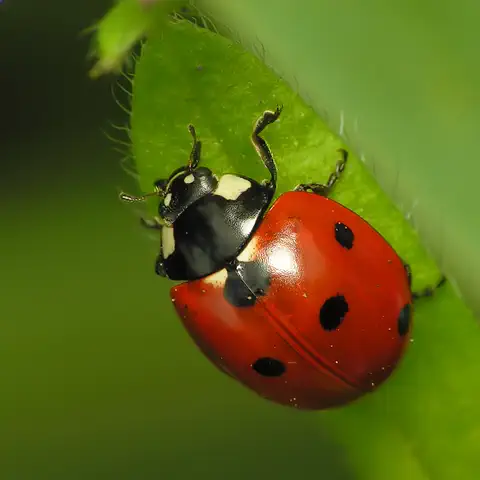
Seven-spot ladybird
The seven-spot ladybird, or ladybug, is a domed red beetle with seven black spots. Both the young and the adults hunt aphids, small insects that suck plant juices, so gardeners and farmers are glad to see them. Its bright colors warn predators that it tastes horrible.
-
 Watch
3D
Animal
Northern giant hornet
The northern giant hornet, once called the Asian giant hornet, is the world's largest hornet. It lives in forests of eastern Asia, where each colony is started by one queen in an underground nest. Its workers hunt other insects, including honey bees, to feed the young hornets.
-
Watch
Country
France
France is a country in northwestern Europe, between the Atlantic Ocean and the Mediterranean Sea. It has high mountains such as the Alps and the Pyrenees, long rivers such as the Loire and the Seine, and about 69.1 million people (2026). Its capital is Paris.
-
Watch
Country
United States
The United States is a large country in North America made of 50 states, from icy Alaska to the warm islands of Hawaii. It has the Grand Canyon, the Mississippi River and Yellowstone, and about 342 million people live there.
-
 Watch
Animal
Orchid mantis
The orchid mantis is a praying mantis from the rainforests of Southeast Asia that looks like a flower. Its white and pink colors fool bees and other insects that visit flowers, and the mantis catches them. Its leg flaps look like petals, and scientists recently found that they also help young mantises glide through the air.
-
 Watch
3D
Animal
Periodical cicada
The periodical cicada spends 17 years underground as a nymph, sipping juice from tree roots. Then, in late spring, millions of them dig out on the same few nights, turn into winged adults and fill the trees with their loud songs, all within a few weeks.
-
 Watch
Animal
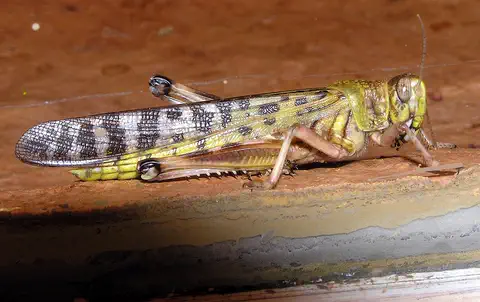
Desert locust
The desert locust is a large grasshopper of the deserts of Africa, the Middle East and Southwest Asia. Most of the time it lives alone. But after good rains, when locusts become crowded, they change their color and behavior and can gather into enormous swarms that fly long distances and eat farmers' crops.
For parents & teachers
What children will learn
- Describe how a mantis's body is adapted for ambush hunting.
- Compare incomplete metamorphosis (egg, nymph, adult) with a butterfly's complete metamorphosis.
- Explain what an introduced species is, using the mantis's arrival in North America.
- Describe how camouflage helps both predators and prey.
Recommended ages: 3 to 17 · About 15 minutes
Talk about it
- Why might waiting still be a better way to hunt than chasing, for a mantis?
- How could a mantis egg case travel across an ocean by accident?
- Why might a species be common in one country and endangered in another?
Try at home or in class
- Play a still-as-a-mantis game: one person freezes among plants or furniture while others try to spot them, then talk about camouflage.
- Measure 7 centimeters on a ruler and draw a mantis at real size, labeling the grabbing legs and walking legs.
Key vocabulary: raptorial, ambush, nymph, ootheca, introduced species, camouflage
Where these facts come from
- GBIF Backbone Taxonomy and GBIF Occurrence Search , Global Biodiversity Information Facility (CC0 1.0 (backbone); occurrence counts are facts derived from records under CC0, CC BY and CC BY-NC)
- Wikidata , Wikimedia Foundation (CC0 1.0)
- European Mantis , University of Colorado Museum of Natural History
- The French connection: DNA barcodes reveal the geographic origin of introduced populations of Mantis religiosa in southern Quebec and Ontario, Canada , The Canadian Entomologist (Cambridge University Press)
- European Mantis (Mantis religiosa) , Tennessee State University, Invasive Species Database
- Mantis religiosa (global assessment, Battiston 2016) , IUCN Red List of Threatened Species
- The IUCN Red List of Threatened Species , International Union for Conservation of Nature (IUCN terms of use (no redistribution of Red List data or range maps))
- Wikimedia Commons , Wikimedia Foundation (Per file: Public domain, CC0, CC BY or CC BY-SA only (credited on each page))
Checked, not yet human-reviewed. Last updated October 28, 2026. Spotted a mistake? Tell us.