Animal
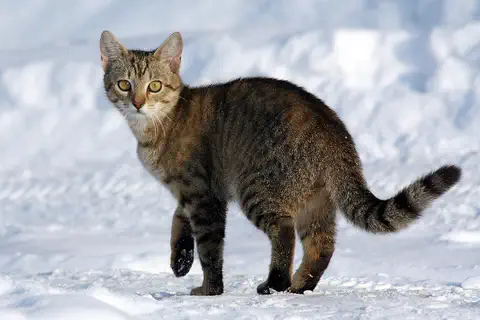
Domestic cat
The cat is a small, furry animal that lives with people. Cats purr, play and love to nap. Their wild great-great-grandparents were wildcats.
The domestic cat is one of the world's favorite pets. Cats live with people in homes, farms and towns in almost every country on Earth. Long ago they came from a small wildcat of the Middle East and Africa, and they still have the sharp senses and soft paws of a wild hunter.
Felis catus is a small felid descended from the African wildcat (Felis silvestris lybica), with which it is still genetically almost identical. Its partnership with people probably began as farming spread in the Middle East, when cats hunted rodents in grain stores. Today it lives alongside people on every inhabited continent, and feral cats live wild in many places.
Photo: Von.grzanka, CC BY-SA 3.0, via Wikimedia Commons
Meet the cat
A cat is a small, soft animal with whiskers and a long tail.
Many families have a pet cat. Cats like to play, purr and sleep in warm, cozy places.
The domestic cat, or house cat, is a small member of the cat family, the same family as lions and tigers. A typical pet cat weighs about 2.7 to 4.5 kilograms, about as much as a newborn baby, though some big cats weigh much more.
Cats come in many colors and patterns: black, white, ginger, gray, striped tabby, spotted and patched. Some have long, fluffy coats and others short, sleek ones. Unlike dog breeds, most cat breeds look quite similar in size and shape.
Felis catus belongs to the subfamily Felinae, the 'purring' cats, rather than the roaring Pantherinae. Britannica gives typical household weights of 2.7 to 4.5 kilograms, with mixed-breed cats of up to 12.7 kilograms not uncommon; Animal Diversity Web gives an average total length of about 76 centimeters.
Compared with dogs, cats have changed remarkably little through domestication: their bodies, abilities and temperaments remain close to those of their wild ancestor. Breeds are usually told apart by coat color, pattern, hair length and general body type, from stocky, round 'cobby' cats like the Persian to slender, 'svelte' cats like the Siamese.
Quick facts
- Group
- Mammal
- Length
- 0.76 m
- Weight
- 2.7 to 4.5 kg
- Lifespan in the wild
- 14 years
Where cats live
Cats live with people all around the world.
They live in houses, apartments and on farms. Some cats live outside on their own.
Domestic cats live with people worldwide, on every continent except Antarctica. They live in city apartments, suburban houses, villages and farms, and people have carried them to islands all over the world on boats.
Some cats live without owners. These are called feral cats. Most feral cats still live close to people, around towns, farms and places where people used to live.
The domestic cat is not a wild species with a natural range: Animal Diversity Web attributes its nearly global distribution to people, who have taken cats to most regions and many oceanic islands. Cats primarily live in and around human settlements, and the map therefore shows the continents where cats live with people rather than a wild range.
Because cats readily return to living on their own, large feral populations exist worldwide, most of them near current or past settlements. Britannica notes that this is one reason experts do not consider the cat a fully domesticated animal.
Continents
Did you know?
When a cat stares at nothing, it may hear a tiny sound.
When a cat suddenly stares at an empty spot, it has probably heard a sound too faint or high for you to hear.
Cats detect sounds too faint or high-pitched for human hearing, which explains much apparently mysterious staring.
Where can you find this animal?
- Kept by people · Countries and seas named by a scientific source
- Sightings recorded · Records of wild sightings (GBIF)
Kept by people · Countries and seas named by a scientific source
Domestic cats live with people worldwide, on every continent except Antarctica, and on many islands. This is not a wild range: cats are here because people keep them. Feral cats also live on their own, mostly near towns and farms. Their wild ancestor, the African wildcat, comes from the Middle East and Africa.
Places: Africa, Asia, Europe, North America, South America and Australia and Oceania.
Source: https://animaldiversity.org/accounts/Felis_catus/ · checked October 2026
Sightings recorded · Records of wild sightings (GBIF)
Counts of GBIF records of wild observations (human and machine) and preserved specimens. Records include introduced populations, vagrants, escaped or released animals and misidentifications, so a country with records is not necessarily part of the native range.
Wild sightings have been recorded in Australia, United States, Netherlands, Belgium, Spain, Norway, South Korea, Germany and 151 more places.
Source: gbif · checked October 2026
Range maps show where scientists say an animal lives, often country by country. An animal may live in only part of a country shown, and sightings records can include animals that wandered far from home.
From wildcat to house cat
Long ago, all cats were wild.
Wildcats came to farms to catch mice in the grain. People liked that. Slowly, cats and people became friends.
The cat's wild ancestor is the African wildcat, a small, sandy-striped cat of the Middle East and Africa. When people began farming more than 10,000 years ago, they stored grain, and mice and rats came to eat it. Wildcats came to catch the mice, and people were glad to have them.
Scientists found a grave on the island of Cyprus, about 9,500 years old, where a person and a cat were buried together. Cats are not native to Cyprus, so people must have brought them by boat, already as companions.
Genetic and archaeological evidence points to the African wildcat, Felis silvestris lybica, of the Middle East and Africa as the ancestor; it is genetically almost identical to domestic cats and still interbreeds with them. The partnership probably began with early agriculture in the Middle East, about 15,000 to 10,000 years ago, when rodents in grain stores drew wildcats to settlements.
A burial of a person with a cat in southern Cyprus, about 9,500 years old, shows cats were carried to the island and already kept close. Britannica describes two later lineages: one in Asia Minor from about 6,400 years ago that spread into Europe, and one in Egypt that spread around the Mediterranean, both still mixing with wildcats.
Did you know?
A cat can turn its ears to listen.
A cat's ear has more than a dozen muscles, so it can swivel to catch tiny sounds.
Over a dozen muscles let each outer ear swivel about 180 degrees, and cat hearing is tuned to high-pitched prey sounds.
What cats eat
Cats eat meat.
Pet cats eat cat food from a bowl. Cats still love to pounce on toys, like they are hunting.
Cats are carnivores, built to eat meat. Pet cats get most of their food from their owners, but they still have a hunter's instincts. They stalk, pounce and chase toys the same way a wildcat chases mice.
A cat's tongue is covered in tiny hooks that point backward. In the wild these scrape meat from bones. They also help a cat lap up water and comb its fur clean.
Britannica describes cats as highly specialized, adaptable carnivores. The rough center of the tongue carries backward-pointing papillae that rasp meat from bones and help scoop water while drinking; taste receptors sit on the front, sides and back of the tongue.
Hunting behavior is learned early: Animal Diversity Web notes that kittens learn by copying their mother and are not allowed to tackle large prey, such as rats, straight away. Even well-fed pet cats keep the full predatory sequence of stalk, pounce and bite, which is why play with moving toys is so attractive to them.
Did you know?
People and cats have been friends for a very long time.
A person and a cat were buried together on the island of Cyprus about 9,500 years ago.
Because cats are not native to Cyprus, the 9,500-year-old burial shows that people were already carrying cats by boat as companions.
Super senses
Cats have big eyes that see well in dim light.
Their ears turn to catch tiny sounds. Their whiskers help them feel. Cats can land on their feet when they fall.
Cats' eyes are big, and their pupils can open wide in the dark or close to thin slits in bright light. A special layer at the back of the eye makes it extra sensitive to light, which is why cats' eyes shine when a light hits them at night.
Their ears have more than a dozen muscles and can swivel to catch faint, high sounds like a mouse squeaking. Whiskers are touch sensors that help cats hunt and feel their way. A flexible spine and good balance let cats twist and usually land on their feet.
The cat's retina is made extra sensitive by a reflective layer, so the eye shines in a strong light at night, and the pupils range from wide circles to narrow slits. Hearing is acute and tuned to higher frequencies, matching the squeaks of rodent prey; more than a dozen muscles let each outer ear swivel through about 180 degrees.
Whiskers (vibrissae) are touch receptors vital to hunting. Claws are retractable and usually stay sheathed while walking, keeping them sharp. Britannica explains that the self-righting reflex in a fall depends on the sense of balance and the flexible spine, with the tail acting as a counterweight.
Growing up
Baby cats are called kittens.
A mother cat has her kittens about two months after they start growing. Kittens drink milk, then learn to eat food and play.
A mother cat is pregnant for about two months, 60 to 67 days. Kittens are born blind and helpless and drink their mother's milk. She purrs to them, which may help keep them calm.
Kittens grow their first baby teeth at about two weeks old and stop drinking milk at seven or eight weeks. They learn to hunt by copying their mother. Pet cats often live about 14 years.
Gestation lasts 60 to 67 days. Females can breed throughout the year, ovulation is induced by mating, and litters have been recorded of up to 18 kittens, though no average is documented by Animal Diversity Web. Milk teeth appear at about two weeks, weaning is complete at seven to eight weeks, and sexual maturity comes at about six months in females and eight in males.
Mothers raise kittens with essentially no help from fathers, though unrelated females occasionally nurse another's litter. Purring by the mother is thought to reduce kittens' stress. Kittens learn hunting by imitation; pet cats are expected to live about 14 years.

How cats talk
Cats purr when they are happy.
They rub their cheeks on things. That leaves their smell and says, this is mine! Cats scratch to keep their claws sharp.
Cats purr, a soft, rattling hum. Purring often means a cat is content, but cats also purr when they are hurt or unwell, so it is not always a happy sound. Scientists think a special pad in the vocal cords helps make the purr.
Cats also talk with smells. They have scent glands on their cheeks, head and paws. When a cat rubs against you or scratches a post, it leaves its scent. That is a gentle way of saying, this is part of my home.
Purring, a continuous rattling hum, is shared by Felis species. Britannica reports recent research suggesting it comes from a special fatty pad within the folds of the vocal cords that lets them vibrate at low frequencies. It accompanies contentment but also pain or injury, so it is better read as a signal than as a simple sign of pleasure.
Scent marking is central to cat communication. Glands near the ears, neck and head deposit scent when cats rub on objects or people, and glands in the paws release scent when they scratch. Animal Diversity Web describes rubbing and scratching as gentle marking, while urine spraying sets firmer territorial boundaries.
Did you know?
A cat's tongue is rough, like a brush.
Tiny backward-pointing hooks on a cat's tongue help it drink and comb its fur.
Hooked papillae in the center of the tongue rasp meat from bones and scoop water when the cat drinks.
Cats and their wild relatives
Pet cats are not in danger. There are cats all over the world.
But their wild cousin, the wildcat, needs help in some places.
Domestic cats are not endangered: they live with people almost everywhere. Because they are domestic animals, they do not have a wild conservation status.
Their wild relatives are a different story. House cats and wildcats can have kittens together, and in some places so much mixing has happened that pure wildcats are becoming rare.
As a domestic animal, Felis catus has no IUCN Red List assessment. Its success has consequences for its relatives: Britannica notes that domestic cats interbreed so readily with the African wildcat that in some areas the wildcat is in danger of ceasing to exist as a pure species.
Large feral populations also live wild across the world, most near human settlements (Animal Diversity Web). Britannica points out that because cats can thrive on their own as predators, feral cats abound, and it is this independence, together with interbreeding with wildcats, that keeps the line between pet and wild animal blurred.
Amazing facts
-
A cat can turn its ears to listen.
A cat's ear has more than a dozen muscles, so it can swivel to catch tiny sounds.
Over a dozen muscles let each outer ear swivel about 180 degrees, and cat hearing is tuned to high-pitched prey sounds.
-
A cat's tongue is rough, like a brush.
Tiny backward-pointing hooks on a cat's tongue help it drink and comb its fur.
Hooked papillae in the center of the tongue rasp meat from bones and scoop water when the cat drinks.
-
People and cats have been friends for a very long time.
A person and a cat were buried together on the island of Cyprus about 9,500 years ago.
Because cats are not native to Cyprus, the 9,500-year-old burial shows that people were already carrying cats by boat as companions.
-
When a cat stares at nothing, it may hear a tiny sound.
When a cat suddenly stares at an empty spot, it has probably heard a sound too faint or high for you to hear.
Cats detect sounds too faint or high-pitched for human hearing, which explains much apparently mysterious staring.
Words to know
- domestic
- living with people, not wild
- ancestor
- a relative that lived long ago, from whom an animal is descended
- feral
- a domestic animal that lives on its own without owners
- whiskers
- long, stiff hairs on the face that sense touch
- carnivore
- an animal that eats meat
- retractable
- able to be pulled back in, like a cat's claws
Discovery challenge
-
Where did house cats come from long ago?
Which wild animal is the house cat's ancestor?
Which animal is generally thought to be the domestic cat's closest ancestor?
- The African wildcat
- The lion
- The fox
Show the answer
The African wildcat
House cats came from small wildcats.
The African wildcat of the Middle East and Africa is the house cat's ancestor.
Felis silvestris lybica is genetically almost identical to domestic cats and still interbreeds with them.
-
Why did wildcats first come to farms?
Why did wildcats first come to live near people?
What drew wildcats to early farming settlements?
- To catch mice
- To eat the grain
- To pull carts
Show the answer
To catch mice
They came to catch the mice that ate the grain.
Mice and rats came to eat farmers' grain, and wildcats came to hunt them.
Rodents feeding on stored grain gave wildcats a reliable food source near people.
-
What do whiskers help a cat do?
What are a cat's whiskers for?
What are vibrissae?
- Feel things around it
- Hear music
- Taste food
Show the answer
Feel things around it
Whiskers help a cat feel things near its face.
Whiskers are touch sensors that help a cat feel its way and hunt.
Vibrissae are specialized touch receptors, vital to the cat's hunting ability.
-
Where do pet cats live?
On how many continents do cats live with people?
Why is the cat's 'range' different from a wild animal's?
- All continents except Antarctica
- Only in Africa
- Only in the Arctic
Show the answer
All continents except Antarctica
Cats live with people all over the world.
Cats live with people on every continent except Antarctica.
People carried cats worldwide, so their distribution follows people, not a natural range.
Experiments to try
- Watch What If? Lab What if cats had no whiskers? A cat's whiskers are not just for looks. They are touch sensors that feel air moving, things brushing past, and the edges of gaps. Imagine a cat with no whiskers: how would it find its way in the dark or know if it fits through a hole?
- Watch What If? Lab What if you could see in the dark? Your eyes need light to see. Cats need only about a sixth as much light as people, thanks to a shiny mirror layer at the back of their eyes. And special cameras can 'see' infrared light, the invisible glow of warm bodies. Imagine having night vision and find out how it really works.
Explore next
-
 Watch
Animal
Sand cat
The sand cat is a small wild cat of the deserts of North Africa, Arabia and Central Asia. Its sandy coat hides it on the dunes, its big ears hear prey moving under the sand, and thick fur on the soles of its feet protects it from scorching days and freezing nights.
-
 Watch
3D
Animal
Lion
The lion is the only big cat that lives in a family group, called a pride. Lionesses hunt together, males guard the pride's land, and their roar can be heard about 8 kilometers away. Wild lions live in Africa, plus one small group in western India.
-
 Watch
3D
Animal
Domestic dog
The domestic dog has lived with people for more than 12,000 years. Dogs came from gray wolves, and today there are more than 400 breeds, from tiny Chihuahuas to giant Irish wolfhounds. They live with people all over the world as pets, helpers and friends.
-
 Watch
3D
Animal
House mouse
House mice are small rodents that first lived in Europe, Asia and North Africa. By living alongside people, they have spread to every continent except Antarctica. They are quick runners and can have babies when only a few weeks old.
- Watch What If? Lab What if cats had no whiskers? A cat's whiskers are not just for looks. They are touch sensors that feel air moving, things brushing past, and the edges of gaps. Imagine a cat with no whiskers: how would it find its way in the dark or know if it fits through a hole?
- Watch What If? Lab What if you could see in the dark? Your eyes need light to see. Cats need only about a sixth as much light as people, thanks to a shiny mirror layer at the back of their eyes. And special cameras can 'see' infrared light, the invisible glow of warm bodies. Imagine having night vision and find out how it really works.
-
 Watch
Animal
Aardvark
The aardvark is a shy night digger of African savannas. It sniffs out ant and termite nests, rips them open with its spade-like claws and laps up the insects with a sticky tongue about 30 centimeters long. Its name means 'earth pig' in Afrikaans.
-
 Watch
Animal
African buffalo
The African buffalo is a huge, cow-like grazer with heavy, curving horns. It lives in herds that can number in the thousands, and a herd will rush to protect a calf in danger. It lives across much of Africa south of the Sahara, from open savannas to rainforests.
For parents & teachers
What children will learn
- Explain that domestic cats descend from the African wildcat and how they came to live with people.
- Describe the cat's senses and body features and how they help it hunt.
- Understand that cats live with people worldwide and what a feral cat is.
- Describe a cat's life cycle from kitten to adult.
Recommended ages: 3 to 17 · About 15 minutes
Talk about it
- How is a pet cat still like a wild hunter?
- Why might farmers long ago have been happy to have cats around?
- What does a cat need from the people who look after it?
Try at home or in class
- Watch a cat (or a video of one) for five minutes and note what its ears and whiskers do when it hears or explores something.
- Roll a small ball or drag a string slowly across the floor and observe the stalk, pounce and chase moves a cat uses.
Key vocabulary: domestic, ancestor, feral, whiskers, carnivore, retractable
Where these facts come from
- GBIF Backbone Taxonomy and GBIF Occurrence Search , Global Biodiversity Information Facility (CC0 1.0 (backbone); occurrence counts are facts derived from records under CC0, CC BY and CC BY-NC)
- Wikidata , Wikimedia Foundation (CC0 1.0)
- Cat , Encyclopaedia Britannica
- Felis catus (domestic cat) , Animal Diversity Web, University of Michigan Museum of Zoology
- Wikimedia Commons , Wikimedia Foundation (Per file: Public domain, CC0, CC BY or CC BY-SA only (credited on each page))
Checked, not yet human-reviewed. Last updated October 28, 2026. Spotted a mistake? Tell us.