
Animal
Shingleback skink
The shingleback is a chunky lizard from Australia. Its short, fat tail looks a bit like a second head!
The shingleback is a big, slow, chunky skink from the dry parts of southern and inland Australia. It has a large head, a short, blunt tail and big rough scales like the shingles on a roof. It sticks out a bright blue tongue to scare enemies, gives birth to big live babies, and the same male and female often pair up year after year.
Tiliqua rugosa (family Scincidae) is the bulkiest of the blue-tongued skinks, endemic to southern and inland Australia west of the Great Dividing Range. Sanderson, Lloyd, Craig and Gaikhorst assessed it as Least Concern for the IUCN Red List (assessed 21 February 2017, published 2017): it is common, adaptable and extremely widespread, though the Rottnest Island subspecies faces illegal collection and is listed as Vulnerable in Western Australia.
Photo: Bäras, CC BY-SA 3.0, via Wikimedia Commons
Meet the shingleback
The shingleback is a chunky lizard.
Its scales look like the tiles on a roof.
Its tail is short and fat.
The shingleback is a skink and a member of the blue-tongue lizard group (genus Tiliqua). The Australian Museum calls it the bulkiest of the blue-tongues. It has a very large head, a very short, blunt tail and large, rough scales.
It has lots of names: stumpy-tailed lizard, bobtail, sleepy lizard, two-headed lizard and pinecone lizard. A grown-up is up to 41 centimeters long, and 34 centimeters of that is head and body.
Tiliqua rugosa belongs to the blue-tongued skink genus Tiliqua (family Scincidae). The IUCN recognizes four subspecies: T. r. rugosa in the southwest, T. r. konowi only on Rottnest Island, T. r. aspera from the Nullarbor Plain to eastern Queensland, and T. r. palarra on the mid-west coast from Shark Bay to Carnarvon (Wilson and Swan 2013).
The Australian Museum gives a total length of up to 410 millimeters, 340 of them head and body, and describes a very large head, a very short, blunt tail and large rough scales. Males have proportionally larger heads and stockier bodies, but females grow slightly bigger. In New South Wales, shinglebacks are usually dark brown, with or without yellow spots.
Quick facts
- Group
- Reptile
- Length
- 0.34 to 0.41 m
Dry, open country
Shinglebacks live in dry parts of Australia.
They hide under bushes, logs and rocks.
Shinglebacks live only in Australia: from the southwest of Western Australia, across the south of the country, to western New South Wales, Victoria and Queensland. They are common on the dry plains west of the Great Dividing Range, but they do not live naturally in Sydney.
They like dry, open country with ground cover such as grass tussocks and fallen leaves: mallee woodland, shrubland, coastal dunes and eucalypt forest. They can also live on farmland and at the edges of towns.
The IUCN describes an Australian endemic ranging from southwestern Western Australia across the Great Australian Bight to western New South Wales, Victoria and Queensland, with its eastern and southern limit at the Great Dividing Range, and lists it in the Australian Capital Territory, New South Wales, Queensland, South Australia, Victoria and Western Australia. It occupies dry to arid open habitats, including mallee woodlands, shrublands, coastal dunes and eucalypt forests, sheltering under dome-shaped, low-foliaged or thorny bushes (Kerr et al. 2003), and also degraded farmland and peri-urban areas. The Australian Museum adds that it favors open country with ground cover such as tussock grasses or leaf litter.
Continent
Did you know?
Shinglebacks have lots of names.
Shinglebacks are also called stumpy-tailed lizards, bobtails, sleepy lizards, two-headed lizards and pinecone lizards.
Common names include stumpy-tailed lizard, boggi, sleepy lizard, bobtail, two-headed lizard and pinecone lizard (Australian Museum).
Where can you find this animal?
- Lives here naturally · Countries and seas named by a scientific source
- Sightings recorded · Records of wild sightings (GBIF)
Lives here naturally · Countries and seas named by a scientific source
The IUCN lists the shingleback in Western Australia, South Australia, Victoria, New South Wales, Queensland and the Australian Capital Territory, across southern and inland Australia west of the Great Dividing Range. It lives in only part of the country shaded.
Places: Australia.
Source: iucn-red-list · checked October 2026
Sightings recorded · Records of wild sightings (GBIF)
Counts of GBIF records of wild observations (human and machine) and preserved specimens. Records include introduced populations, vagrants, escaped or released animals and misidentifications, so a country with records is not necessarily part of the native range.
Wild sightings have been recorded in Australia and Peru.
Source: gbif · checked October 2026
Range maps show where scientists say an animal lives, often country by country. An animal may live in only part of a country shown, and sightings records can include animals that wandered far from home.
Plants, snails and beetles
Shinglebacks eat plants and small animals.
They crunch snails and beetles with strong jaws.
Shinglebacks eat both plants and animals, and they eat more plants than other blue-tongue lizards do. They are not very fast, so the animals they eat are mostly slow-moving ones, like snails and beetles.
Their big teeth and strong jaw muscles let them crush snail shells and hard beetles.
The Australian Museum describes an omnivore that eats a wide variety of plants and animals, with more plant food than other blue-tongues. Because shinglebacks are not very agile, their animal prey is mostly slow-moving, and large teeth and strong jaw muscles let them crush snail shells and beetles. In its care, the museum feeds them chopped vegetables, kangaroo mince and insects and snails on different days, changing the order to imitate natural conditions.
Did you know?
A baby shingleback can weigh up to 200 grams!
A newborn shingleback can weigh up to 200 grams and be up to 22 centimeters long.
Newborns reach 220 mm total length and 200 g (Australian Museum).
A blue tongue and a fake head
Its tongue is bright blue!
The inside of its mouth is pink.
Its short tail looks like a second head.
A shingleback's tongue is dark blue and the inside of its mouth is bright pink. Its eyes are small and reddish-brown to gray, and like other blue-tongues its belly is usually pale with darker patches.
Its large, rough scales look a bit like the shingles on a roof, or the scales of a pine cone. Its tail is very short and blunt, and one of its other names is the two-headed lizard.
The Australian Museum describes a dark blue tongue, a bright pink mouth lining, a small reddish-brown to gray eye and (as in blue-tongues generally) a pale belly with darker variegations, along with the very large head, very short blunt tail and large rough scales. Thick bony scales protect adults from many animal bites (Australian Museum).
Big babies, born alive
The mother has two or three big babies.
They are born, not hatched from eggs.
The babies look after themselves right away.
Shinglebacks pair up between September and November. Three to five months after mating, between December and April, the female gives birth to live babies. Inside her, the babies develop with the help of a placenta, as well developed as that of many mammals.
She usually has only two or three babies, but they are big: up to 22 centimeters long and as heavy as 200 grams. Right after birth they eat the membranes they grew in, shed their skin within a few days, and soon wander off on their own.
The Australian Museum describes live birth three to five months after mating, between December and April. Embryos develop in the oviduct with a placenta as well-developed as that of many mammals; at birth the young eat the placental membranes, shed their skin for the first time within a few days, and are independent from birth, dispersing within days. Litters are usually only two or three young of up to 220 millimeters total length and 200 grams.
Partners for life
Shinglebacks warm up in the morning sun.
Every year, a male and a female pair up.
Often it is the same pair for many years!
Early in the morning, shinglebacks come out to bask in the sun before they look for food in the warmer part of the day. At night they shelter under leaves, rocks or logs, and in cold weather they stay buried in their shelters.
Shinglebacks live alone for most of the year, but between September and November a male and female pair up, and he follows her around. The same pairs often get back together year after year. When it is threatened, a shingleback opens its mouth wide, sticks out its blue tongue and may hiss.
The Australian Museum describes morning basking before foraging in the warmer part of the day, night shelter in leaf litter or under rocks and logs, an active body temperature of about 30 to 35°C, and inactivity in cold weather. Shinglebacks are solitary for most of the year but reunite as monogamous pairs from September to November, often seen with the male following the female, and the same pairs may re-form over several years; the IUCN describes the species as monogamous and mating for life. When threatened, a shingleback faces the threat with a wide-open pink mouth and broad blue tongue, may hiss and flatten its body, and may bite if picked up.
Common, but sought after
There are lots of shinglebacks.
But on one island, people take them illegally to sell.
The shingleback is listed as least concern: it is common, adaptable and found across a huge area. People can keep shinglebacks as pets with the right licence, and they are also in the international pet trade.
One kind, which lives only on Rottnest Island in Western Australia, is listed as vulnerable there. Some people collect it illegally to sell, and cats may also have reduced its numbers. In towns, young shinglebacks are easy prey for dogs and cats.
Sanderson, Lloyd, Craig and Gaikhorst assessed Tiliqua rugosa as Least Concern (Global; assessed 21 February 2017, published 2017; trend stable) because it is common, adaptable and extremely widespread with no major threats to most subspecies. The Rottnest Island subspecies, T. r. konowi, may be declining or may have declined because of cat predation and ongoing illegal collection, is excluded from legal collection and is listed as Vulnerable in Western Australia.
The species can be kept as a pet under licence and is in the international pet trade; the Australian Museum describes it as highly trafficked and smuggled and reports research on its odor profiles to help identify trafficked animals. Its range overlaps protected areas such as the Rottnest Island Nature Reserve.
IUCN Red List
How is the shingleback skink doing in the wild?
- Least Concern (this animal)
- Near Threatened
- Vulnerable
- Endangered
- Critically Endangered
- Extinct in the Wild
- Extinct
Least Concern
Not at risk of disappearing from the wild right now.
Amazing facts
-
Shingleback pairs often stay together for years.
Shinglebacks pair up each year, and the same male and female often get back together year after year.
Monogamous pairs may re-form over several years (Australian Museum); the IUCN states that the species mates for life.
-
A baby shingleback can weigh up to 200 grams!
A newborn shingleback can weigh up to 200 grams and be up to 22 centimeters long.
Newborns reach 220 mm total length and 200 g (Australian Museum).
-
Shinglebacks have lots of names.
Shinglebacks are also called stumpy-tailed lizards, bobtails, sleepy lizards, two-headed lizards and pinecone lizards.
Common names include stumpy-tailed lizard, boggi, sleepy lizard, bobtail, two-headed lizard and pinecone lizard (Australian Museum).
-
Shinglebacks eat more plants than other blue-tongues.
Of all the blue-tongue lizards, shinglebacks eat the most plant food.
Shinglebacks eat more plant food than other blue-tongues (Australian Museum).
Words to know
- skink
- a member of a large family of lizards, the Scincidae
- shingle
- a flat tile of wood or other material used to cover a roof
- placenta
- a body part that passes food from a mother to the babies growing inside her
- monogamous
- having one partner
- omnivore
- an animal that eats both plants and animals
- least concern
- not currently at serious risk of dying out in the wild
Discovery challenge
-
What color is a shingleback's tongue?
What color tongue does a shingleback show when it is threatened?
Which tongue color does Tiliqua rugosa display against its pink mouth?
- Blue
- Green
- Yellow
Show the answer
Blue
Blue!
A dark blue tongue in a bright pink mouth.
A broad, dark blue tongue against the pink mouth lining (Australian Museum).
-
How are baby shinglebacks born?
How do shingleback babies come into the world?
How do shingleback embryos get nourishment?
- They are born live after growing inside the mother
- They hatch from eggs in a nest
- They hatch from eggs in water
Show the answer
They are born live after growing inside the mother
Born live!
They grow inside their mother, helped by a placenta.
Via a placenta as well-developed as many mammals' (Australian Museum).
-
What is a shingleback's tail like?
What is unusual about a shingleback's tail?
How does the Australian Museum describe the tail of Tiliqua rugosa?
- It is very short and blunt
- It is longer than its whole body
- It is covered in feathers
Show the answer
It is very short and blunt
Short and fat!
Its tail is very short and blunt, so the two ends of the lizard look a little alike.
Very short and blunt (Australian Museum).
-
Where do shinglebacks live?
In which country do shinglebacks live?
To which country is Tiliqua rugosa endemic?
- Australia
- Mexico
- Japan
Show the answer
Australia
Australia!
In the dry south and inland parts of Australia.
Southern and inland Australia, west of the Great Dividing Range (IUCN).
Places where you might see it
Explore next
-
 Watch
Animal
Thorny devil
The thorny devil is a small Australian desert lizard covered in spikes from head to tail. Despite its fierce name it is slow and harmless, it eats nothing but ants, and tiny channels in its skin carry water to its mouth.
-
 Watch
Animal
Perentie
The perentie is Australia's largest lizard, a kind of monitor, also known as a goanna. It lives in the dry, rocky deserts of central and western Australia, hiding in deep cracks and burrows among the rocks and hunting across the open desert around them.
-
 Watch
Animal
Frilled lizard
The frilled lizard is a dragon lizard of the warm woodlands of northern Australia and southern New Guinea. It spends most of its life in trees, and when it is cornered it pops open a huge frill around its neck, opens its bright mouth and hisses, a bluff that makes it look much bigger than it is.
-
 Watch
 Country
Australia
Australia is a country and the smallest continent, surrounded by ocean in the Southern Hemisphere. Much of its middle is dry and flat, most people live near the coast, and its animals include kangaroos, koalas and the platypus, a mammal that lays eggs.
-
 Watch
Animal
Eastern blue-tongued skink
The eastern blue-tongued skink is one of the larger skinks in Australia. It has a wide head, a thick body with smooth, shiny scales, and short legs. When something scares it, it opens its mouth wide and shows its broad blue tongue. It eats snails, insects, flowers and fruit, lives in forests, grasslands and even town gardens, and the mother gives birth to about ten live babies at a time.
-
 Watch
Animal
Aldabra giant tortoise
The Aldabra giant tortoise is one of the largest land tortoises on Earth. Wild ones live on Aldabra Atoll, a ring of coral islands in the Indian Ocean, where about 180,000 of them graze, browse and shape the land like elephants do in Africa. They can live for more than 100 years.
-
 Watch
Animal
Alligator snapping turtle
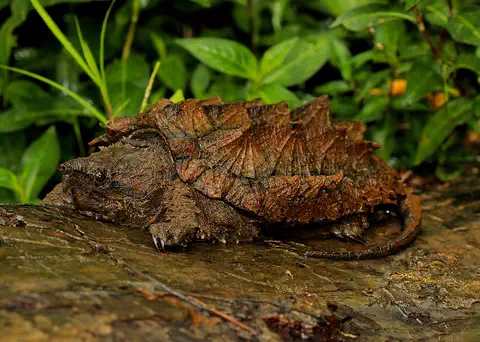
The alligator snapping turtle is the largest freshwater turtle in the United States. It lies still on the bottom of rivers and lakes with its mouth open, wiggling a worm-like lure on its tongue to trick fish into swimming close. Its numbers have fallen, and it is now endangered.
-
 Watch
3D
Animal
American alligator
The American alligator is a large, armored reptile of the swamps, marshes and lakes of the southeastern United States. Alligator mothers guard their nests and carry their babies to the water, and the holes alligators dig help many other animals survive dry seasons.
For parents & teachers
What children will learn
- Describe how a shingleback's tongue, head and tail help it.
- Explain how shingleback babies grow before they are born.
- Describe how shinglebacks pair up year after year.
- Explain why a common animal can still need protection in one place.
Recommended ages: 3 to 17 · About 15 minutes
Talk about it
- Why might a bright blue tongue scare away a hungry bird?
- Why might having only two or three big babies work well for a shingleback?
- Why should pet dogs and cats be kept away from lizards in gardens?
Try at home or in class
- Roof shingles: look at a picture of a tiled or shingled roof and compare it with the shingleback's scales in the photo.
- Two heads: draw a shingleback with its head and tail, then cover the legs and ask someone to guess which end is the head.
Key vocabulary: skink, shingle, placenta, monogamous, omnivore, least concern
Where these facts come from
- GBIF Backbone Taxonomy and GBIF Occurrence Search , Global Biodiversity Information Facility (CC0 1.0 (backbone); occurrence counts are facts derived from records under CC0, CC BY and CC BY-NC)
- Wikidata , Wikimedia Foundation (CC0 1.0)
- The IUCN Red List of Threatened Species , International Union for Conservation of Nature (IUCN terms of use (no redistribution of Red List data or range maps))
- Tiliqua rugosa (Sanderson, Lloyd, Craig and Gaikhorst, assessed 21 February 2017, published 2017) , IUCN Red List of Threatened Species
- Tiliqua rugosa: justification, range, population, habitat, threats, use and trade, and conservation text , IUCN Red List of Threatened Species
- Tiliqua rugosa: IUCN Red List global assessment record (Sanderson et al. 2017), IUCN checklist on GBIF , GBIF
- Shingleback Lizard , Australian Museum
- File:Tannenzapfenskink (cropped).jpg (7 August 2006, Bäras) , Wikimedia Commons
- Wikimedia Commons , Wikimedia Foundation (Per file: Public domain, CC0, CC BY or CC BY-SA only (credited on each page))
Checked, not yet human-reviewed. Last updated November 1, 2026. Spotted a mistake? Tell us.