
Animal
Frilled lizard
The frilled lizard has a big flap of skin around its neck. When it is scared, it opens the frill like an umbrella to look big.
The frilled lizard is a dragon lizard of the warm woodlands of northern Australia and southern New Guinea. It spends most of its life in trees, and when it is cornered it pops open a huge frill around its neck, opens its bright mouth and hisses, a bluff that makes it look much bigger than it is.
Chlamydosaurus kingii is an arboreal agamid of the savanna woodlands of northern Australia and the Trans-Fly region of New Guinea. Its neck frill, a thin fold of skin up to about 30 centimeters across, is raised in a famous defensive bluff. The IUCN lists it as Least Concern, though its assessment needs updating.
Photo: Matt from Melbourne, Australia, CC BY 2.0, via Wikimedia Commons
Meet the frilled lizard
The frilled lizard has a frill, a big flap of skin around its neck.
Most of the time the frill lies flat, like a cape. When the lizard is scared, it opens the frill wide and opens its mouth.
The frilled lizard is one of Australia's most famous dragon lizards. It has long legs and a long tail, and from head to tail the bigger adults can be about 90 centimeters long.
Its amazing feature is the frill: a thin fold of skin around its neck. Usually it lies over the shoulders like a cape. When the lizard is cornered, the frill springs open into a wide, colorful collar almost 30 centimeters across, and the lizard opens its bright pink or yellow mouth.
Chlamydosaurus kingii is a large dragon lizard (family Agamidae). Males are much bigger than females: Animal Diversity Web gives a snout-vent length of up to about 290 millimeters and a mass of at least 870 grams for males, and 235 millimeters and 400 grams for females. National Geographic gives about 0.9 meters head to tail for larger adults.
The frill is an extensive fold of skin around the throat, nearly 30 centimeters across when fully raised; many authors report that the lizard cannot raise it without also opening its mouth. Only one species is recognized, but color differences between Queensland populations and those of Western Australia and the Northern Territory have led some scientists to suspect there may be two.
Quick facts
- Group
- Reptile
- Length
- up to 0.9 m
- Weight
- 0.4 to 0.87 kg
Where it lives
Frilled lizards live in northern Australia and on the island of New Guinea.
They live in warm, open woods. They spend most of their time up in the trees.
Frilled lizards live across the warm north of Australia, from the Kimberley in Western Australia across the Northern Territory to Cape York in Queensland and south to around Brisbane. They also live in the far south of New Guinea, in both Papua New Guinea and Indonesia.
Their homes are open woodlands and dry forests, and sometimes the edges of towns. They do not live in thick rainforest. Most of the time they cling to tree trunks and branches.
The IUCN assessment (made in 2014, published in 2017) lists the species in Australia (Western Australia, the Northern Territory and Queensland, including Torres Strait islands), and in the southern Trans-Fly region of New Guinea in Papua New Guinea's Western Province and Indonesia's Papua Province. As a savanna species it does not enter forested regions, so it is not expected farther north in New Guinea.
In Australia it inhabits dry sclerophyll forest, open woodland and even disturbed urban areas; in New Guinea, seasonally flooded savanna woodland of Melaleuca and Eucalyptus. It is mostly arboreal: Animal Diversity Web estimates it spends about 90 percent of its time in trees, coming down mainly to feed.
Continent
Its habitat

Where can you find this animal?
- Lives here naturally · Countries and seas named by a scientific source
- Sightings recorded · Records of wild sightings (GBIF)
Lives here naturally · Countries and seas named by a scientific source
Savanna woodlands and dry open forests of northern Australia (the Kimberley to Cape York and south to about Brisbane) and the southern Trans-Fly region of New Guinea. In Indonesia it lives only in southern Papua, and in Australia only in the north and northeast.
Places: Australia, Papua New Guinea and Indonesia.
Source: iucn-red-list · checked October 2026
Sightings recorded · Records of wild sightings (GBIF)
Counts of GBIF records of wild observations (human and machine) and preserved specimens. Records include introduced populations, vagrants, escaped or released animals and misidentifications, so a country with records is not necessarily part of the native range.
Wild sightings have been recorded in Australia, Papua New Guinea, Indonesia, United States, Japan, Germany, New Zealand, Denmark and 2 more places.
Source: gbif · checked October 2026
Range maps show where scientists say an animal lives, often country by country. An animal may live in only part of a country shown, and sightings records can include animals that wandered far from home.
What it eats
Frilled lizards eat bugs.
They watch from a tree. When they see a caterpillar, ant or beetle on the ground, they climb down and catch it.
Frilled lizards are sit-and-wait hunters. A lizard clings to a tree trunk, watching the ground. When it spots food, it scampers down to catch it, then goes back up a tree.
They mostly eat insects such as caterpillars, ants, termites and beetles. They also eat spiders, cicadas, small lizards and, now and then, small mammals.
The IUCN describes it as a diurnal sit-and-wait predator that spends most of its time on branches and descends to forage, interact with other lizards or move between trees. The diet is mainly insects, chiefly caterpillars, ants, termites and beetles, and National Geographic adds spiders, cicadas, small lizards and small mammals.
Diet and activity shift with the seasons of the tropical north. In the wet season the lizards are active and often seen low on trunks; in the dry season they become much less active and are rarely seen.
Did you know?
Frilled lizards rarely open their frills in zoos.
Frilled lizards seldom show their frills in zoos, so the best place to see the display is in the wild.
Animal Diversity Web notes that the species rarely displays its frill in captivity and is best observed in its natural habitat.
The famous frill
When a frilled lizard is scared, it opens its frill wide.
It opens its mouth and hisses. It looks very big! Then it runs to a tree.
Look at the photo: this frilled lizard has its frill fully open and its mouth wide. This is a bluff, a way of pretending to be bigger and scarier than it really is. It can also stand up on its back legs and hiss.
If the bluff does not work, the lizard turns and runs on its two back legs, frill still open, all the way to the nearest tree. Running upright like this is called bipedal running. Often, though, a disturbed frilled lizard simply freezes and keeps perfectly still.
When disturbed, a frilled lizard usually dashes to a tree, hides under low vegetation or freezes. If cornered, it turns to face the threat, opens its brightly colored mouth and raises the frill, sometimes hissing, standing on its hind legs and lunging (Animal Diversity Web). The sudden increase in apparent size is a bluff; if it fails, the lizard flees bipedally to the nearest tree.
The body is gray-brown with an obscurely striped tail ending in a dark gray tip, and the mouth lining is pink or yellow. Males are territorial and seem to use the frill in courtship, though there is no clear evidence that females choose mates by frill size.
Growing up
Frilled lizards lay their eggs in sunny, sandy ground.
The sun shines on the nest. When the babies hatch, they can look after themselves and even open their tiny frills.
Frilled lizards breed in the wet season, from about October or November to February or March. The female digs a nest in flat, sandy ground with no plants right above it, so the sun shines on it most of the day. She lays about 8 eggs.
The eggs take about 70 days to hatch. The temperature of the nest affects whether the babies are male or female, and how big they are. Babies hatch ready to look after themselves: they can hunt and even open their frills.
The mating season corresponds to the wet season, beginning in October or November and running to February or March, and eggs are laid during the wet season (Animal Diversity Web). Clutches range from 4 to 13 eggs, averaging 8, with notable regional differences; National Geographic gives 8 to 23. Nests are dug in flat, coarse, sandy soil with sparse grass and no vegetation directly overhead, so they receive sun most of the day, and incubation takes about 70 days.
Incubation temperature affects both the sex and the body size of hatchlings (IUCN, citing Harlow and Shine 1999), which is one reason a warming climate could matter for this species. Hatchlings are independent at once, able to hunt and to use their frills (National Geographic).
Life in the trees
Frilled lizards are awake in the daytime.
In the rainy season they sit low on tree trunks. In the dry season they climb high into the trees and are hard to find.
Frilled lizards are active in the daytime and spend most of their lives on tree trunks and branches. Their lives follow the wet and dry seasons of northern Australia.
In the dry season they stay high in big trees and hardly move. In the wet season they become active, perch about 1 to 2 meters up on rough-barked trees, and often come down to the ground after rain. Each lizard has its own home area, and males' areas are bigger than females'.
The species is diurnal and arboreal. In the dry season it is rarely encountered, presumably staying in the canopy of large trees; in the wet season it is often seen perching 1 to 2 meters up on rough-barked trunks and descends to the ground after rain (IUCN).
Radio-tracking studies in Australia (Brown and colleagues, 2005) found female home ranges almost unchanged between seasons, about 0.63 hectares in the dry season and 0.68 in the wet, while male home ranges grew from about 1.96 to 2.53 hectares in the wet season, when males are territorial and breeding.
Did you know?
A frilled lizard was on an Australian coin.
The frilled lizard appeared on Australia's two-cent coin.
The frilled lizard featured on the Australian two-cent coin, and after a 1980s car commercial it became famous in Japan as a symbol of Australia (Animal Diversity Web).
Staying common
There are many frilled lizards.
But cats, cane toads and big fires can harm them in some places. Many live safely in national parks.
Frilled lizards are listed as least concern because they live across a huge area and many live in national parks such as Kakadu. They are not in danger overall.
In some places, though, they face problems. Feral cats catch them, local numbers have dropped after cane toads arrived, and very hot fires late in the dry season can kill many lizards. In New Guinea, people catch some to sell as pets.
The IUCN lists Least Concern (assessed 2014, published 2017, flagged as needing an update), citing a large range, tolerance of modified habitat and presence in protected areas; the population trend is unknown. Localized threats include predation by cats, declines after cane toads arrived, and late dry season fires, which killed about 30 percent of a small monitored population in Kakadu National Park, while early dry season fires caused no recorded deaths.
In the Trans-Fly region of New Guinea the lizard is sought after for the pet trade. Export is banned from Australia and Papua New Guinea, but trade from Indonesian New Guinea continues, and because the species is hard to breed in captivity, many animals sold as captive-bred are believed to be wild-caught. The IUCN recommends monitoring harvest and trade.
IUCN Red List
How is the frilled lizard doing in the wild?
- Least Concern (this animal)
- Near Threatened
- Vulnerable
- Endangered
- Critically Endangered
- Extinct in the Wild
- Extinct
Least Concern
Not at risk of disappearing from the wild right now.
See the IUCN Red List assessment · The IUCN Red List of Threatened Species 2022.2
Amazing facts
-
A frilled lizard can run on just its back legs.
When a frilled lizard runs away, it often stands up and sprints on its two back legs to the nearest tree.
The species is well known for bipedal running, usually toward the nearest tree when a bluff display fails (Animal Diversity Web).
-
A frilled lizard was on an Australian coin.
The frilled lizard appeared on Australia's two-cent coin.
The frilled lizard featured on the Australian two-cent coin, and after a 1980s car commercial it became famous in Japan as a symbol of Australia (Animal Diversity Web).
-
Baby frilled lizards can open their frills right away.
Frilled lizard babies hatch ready to hunt, and they can already open their tiny frills.
Hatchlings are fully independent from emergence, able to hunt and to use their frills (National Geographic).
-
Frilled lizards rarely open their frills in zoos.
Frilled lizards seldom show their frills in zoos, so the best place to see the display is in the wild.
Animal Diversity Web notes that the species rarely displays its frill in captivity and is best observed in its natural habitat.
Words to know
- frill
- a wide fold of skin around a lizard's neck
- bluff
- pretending to be bigger or stronger than you are
- bipedal
- moving on two legs
- arboreal
- living mostly in trees
- wet season
- the rainy part of the year in the tropics
- insectivore
- an animal that eats mostly insects
Discovery challenge
-
What does a frilled lizard do when it is scared?
What does a frilled lizard do when it is cornered?
What is the frilled lizard's defensive display?
- Opens its frill and mouth wide
- Changes into a ball
- Digs a deep hole
Show the answer
Opens its frill and mouth wide
It opens its big frill and its mouth to look big.
It opens its frill and bright mouth and may hiss and stand up, a bluff to look bigger.
It erects the frill, gapes to show the bright mouth lining, may hiss and rear up, then flees bipedally if needed.
-
Where does a frilled lizard spend most of its time?
Where does a frilled lizard spend most of its time?
Where do frilled lizards spend about 90 percent of their time?
- Underground
- In trees
- In the ocean
Show the answer
In trees
It lives up in the trees.
It clings to tree trunks and branches and comes down mainly to catch food.
It is arboreal, descending mainly to forage, interact with other lizards or change trees.
-
What do frilled lizards eat?
What do frilled lizards mostly eat?
What is the main food of frilled lizards?
- Grass
- Insects
- Fish
Show the answer
Insects
They eat bugs like caterpillars and ants.
Mostly insects such as caterpillars, ants, termites and beetles.
Chiefly insects (caterpillars, ants, termites, beetles), with occasional spiders, small lizards and small mammals.
-
When do frilled lizards lay their eggs?
In which season do frilled lizards breed?
When do frilled lizards breed?
- In the dry season
- In the wet season
- In the snow
Show the answer
In the wet season
They lay eggs in the rainy season.
They breed in the wet season, from about October to March.
Mating and egg-laying fall in the wet season, from October or November to February or March.
Places where you might see it
Explore next
-
 Watch
Animal
Central bearded dragon
The central bearded dragon is a lizard of the dry woodlands, scrub and deserts of eastern inland Australia. It eats plants and small animals, basks on fence posts and logs, waves its arm and bobs its head to talk to other dragons, and puffs out a spiky beard to look big. It is also a very popular pet lizard.
-
 Watch
Animal
Thorny devil
The thorny devil is a small Australian desert lizard covered in spikes from head to tail. Despite its fierce name it is slow and harmless, it eats nothing but ants, and tiny channels in its skin carry water to its mouth.
-
 Watch
 Country
Australia
Australia is a country and the smallest continent, surrounded by ocean in the Southern Hemisphere. Much of its middle is dry and flat, most people live near the coast, and its animals include kangaroos, koalas and the platypus, a mammal that lays eggs.
-
 Watch
Animal
Short-beaked echidna
The short-beaked echidna is a spiny mammal that lays eggs. It lives all over Australia and in parts of New Guinea, digs into ant and termite nests with strong claws, and licks up the insects with a long, sticky tongue. It has no teeth at all.
-
 Watch
Animal
Sulphur-crested cockatoo
The sulphur-crested cockatoo is a large white parrot with a bright yellow crest. It lives in forests and towns in northern and eastern Australia and New Guinea. Cockatoos live in noisy flocks, take turns keeping watch while others feed, and in Sydney some have learned to open garbage bins by watching each other.
-
 Watch
Animal
Aldabra giant tortoise
The Aldabra giant tortoise is one of the largest land tortoises on Earth. Wild ones live on Aldabra Atoll, a ring of coral islands in the Indian Ocean, where more than 100,000 of them graze, browse and shape the land like elephants do in Africa. They can live for more than 100 years.
-
 Watch
Animal
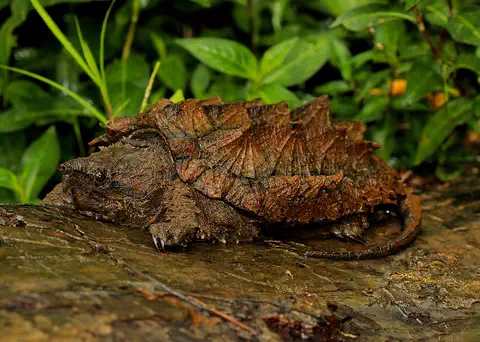
Alligator snapping turtle
The alligator snapping turtle is the largest freshwater turtle in the United States. It lies still on the bottom of rivers and lakes with its mouth open, wiggling a worm-like lure on its tongue to trick fish into swimming close. Its numbers have fallen, and it is now endangered.
-
 Watch
3D
Animal
American alligator
The American alligator is a large, armored reptile of the swamps, marshes and lakes of the southeastern United States. Alligator mothers guard their nests and carry their babies to the water, and the holes alligators dig help many other animals survive dry seasons.
For parents & teachers
What children will learn
- Describe the frilled lizard's frill and explain how a bluff display works.
- Explain how wet and dry seasons shape the frilled lizard's behavior and breeding.
- Describe its diet as a sit-and-wait insect hunter.
- Understand local threats such as feral cats, cane toads and fire.
Recommended ages: 3 to 17 · About 15 minutes
Talk about it
- Why might looking suddenly bigger help an animal escape?
- What other animals do you know that bluff or pretend to be scarier than they are?
- Why might the temperature of a nest matter for baby lizards?
Try at home or in class
- Make a paper fan frill: fold a paper plate into pleats, cut a hole for your face, and practice opening it quickly to see how much bigger you look.
- Measure 30 centimeters with a ruler to see how wide an open frill can be.
Key vocabulary: frill, bluff, bipedal, arboreal, wet season, insectivore
Where these facts come from
- The IUCN Red List of Threatened Species , International Union for Conservation of Nature (IUCN terms of use (no redistribution of Red List data or range maps))
- GBIF Backbone Taxonomy and GBIF Occurrence Search , Global Biodiversity Information Facility (CC0 1.0 (backbone); occurrence counts are facts derived from records under CC0, CC BY and CC BY-NC)
- Chlamydosaurus kingii (Frilled Lizard), global Red List assessment 2017 , IUCN Red List of Threatened Species
- Chlamydosaurus kingii (Frilled Lizard) , Animal Diversity Web, University of Michigan Museum of Zoology
- Frilled lizard , National Geographic
- Wikidata , Wikimedia Foundation (CC0 1.0)
- Wikimedia Commons , Wikimedia Foundation (Per file: Public domain, CC0, CC BY or CC BY-SA only (credited on each page))
Checked, not yet human-reviewed. Last updated October 27, 2026. Spotted a mistake? Tell us.