
Animal
Common chuckwalla
The chuckwalla is a big, flat lizard that lives on desert rocks. When it is scared, it squeezes into a crack and puffs itself up!
The common chuckwalla is a large lizard of the rocky deserts of the southwestern United States and northwestern Mexico. It eats plants, such as the leaves and fruit of the creosote bush. When a predator comes near, it hides in a rock crack, fills its lungs and puffs up its skin, so it is wedged in tight.
Sauromalus ater (family Iguanidae) lives in rocky desert from southern Nevada, southern Utah, southeastern California and western Arizona to southern Baja California and west-central Sonora. In 2004 the ICZN ruled that the name S. ater has precedence over S. obesus. Hammerson listed it as Least Concern for the IUCN Red List (assessed 1 March 2007, published 2007; marked as needing an update), with an adult population probably above 100,000.
Photo: Kaldari, public domain, via Wikimedia Commons
Meet the chuckwalla
The chuckwalla is a big lizard.
It has a fat tail and rough skin.
It lives on desert rocks.
The common chuckwalla is a big lizard: grown chuckwallas are more than 38 centimeters long, and about half of that is tail. San Francisco Zoo calls it the second largest lizard native to the United States.
Its skin is covered in small, rough scales that feel like sandpaper. Its tail is thick at the base and narrow at the tip.
San Francisco Zoo describes adults over 15 inches (38 cm) long, half of it tail, males slightly larger than females, and calls the species the second largest lizard native to the United States. Zoo New England notes small, coarse, sandpaper-like scales, a tail thick at the base and tapering to the tip, and femoral pores on the inside of males' legs. The name has a history: in 2004 the International Commission on Zoological Nomenclature ruled that Sauromalus ater has precedence over the well-used name S. obesus (IUCN).
Quick facts
- Group
- Reptile
- Length
- from 0.38 m
- Lifespan in the wild
- 15 years
Rocky deserts
Chuckwallas live in hot, rocky deserts.
They hide in cracks between rocks.
Chuckwallas live in rocky deserts: on lava flows, hillsides and rock outcrops, where there are plenty of cracks to hide in and plants to eat. They are found in southeastern California, southern Nevada, southern Utah, western Arizona and northwestern Mexico.
They live from sea level up to about 4,500 feet, which is about 1,370 meters.
The IUCN gives a range from southern Nevada, southern Utah, southeastern California and western Arizona south to southern Baja California and west-central Sonora, mostly away from the Pacific coast in Baja California. Habitat is rocky desert, lava flows, hillsides and outcrops, with creosote bush across most of the range and subtropical thornforest in the south; individuals shelter in rock crevices, or in burrows on islands in the Gulf of California. San Francisco Zoo gives an elevation range of sea level to 4,500 feet.
Continent
Its habitat

Where can you find this animal?
- Lives here naturally · Countries and seas named by a scientific source
- Sightings recorded · Records of wild sightings (GBIF)
Lives here naturally · Countries and seas named by a scientific source
Southwestern United States (southern Nevada, southern Utah, southeastern California and western Arizona) and northwestern Mexico (Baja California, mostly away from the Pacific coast, and west-central Sonora), including islands in the Gulf of California (IUCN). It lives only in these parts of the two countries.
Places: United States and Mexico.
Source: iucn-red-list · checked November 2026
Sightings recorded · Records of wild sightings (GBIF)
Counts of GBIF records of wild observations (human and machine) and preserved specimens. Records include introduced populations, vagrants, escaped or released animals and misidentifications, so a country with records is not necessarily part of the native range.
Wild sightings have been recorded in United States, Mexico and Panama.
Source: gbif · checked October 2026
Range maps show where scientists say an animal lives, often country by country. An animal may live in only part of a country shown, and sightings records can include animals that wandered far from home.
A plant-eating lizard
Chuckwallas eat leaves, flowers and fruit.
Sometimes they eat a bug.
Chuckwallas are plant eaters. They eat the leaves and fruit of the creosote bush, a common desert shrub, and other desert plants such as browneyes and ragweed. Once in a while they eat an insect.
In the dry desert, they get the water they need from their food. They can also store water in pouches under the folds of skin along their sides.
San Francisco Zoo lists leaves and fruit of creosote bush, browneyes, ragweed and other vegetation, with occasional insects, and notes that chuckwallas obtain their water from their food. Zoo New England describes water stored in lymph sacs beneath the skin folds on the sides of the body, and a tail that enlarges when resources are plentiful. Creosote bush occurs throughout most of the range (IUCN, after Stebbins 2003).
Did you know?
The chuckwalla used to have a different name.
For many years the chuckwalla was called Sauromalus obesus, but in 2004 the international commission that decides animal names ruled that the older name Sauromalus ater should be used.
ICZN 2004: Sauromalus ater Duméril, 1856 has precedence over S. obesus (Baird, 1858) (IUCN).
Black, red and rough
This chuckwalla is black with a red tail.
Its skin is rough, like sandpaper.
Male and female chuckwallas look different. Zoo New England describes grown males with rusty colors and a black head and legs, while females keep the grayish-yellow colors of the young. Their colors also vary with temperature, place, surroundings and mood.
The chuckwalla in this page's photo is a male near Phoenix, Arizona: black from his head to his back legs, with a reddish tail.
Zoo New England: males rusty with black head and limbs; females keep juvenile grayish-yellow; males larger, with femoral pores. San Francisco Zoo: coloration varies with temperature, geography, surroundings and mood, and helps camouflage; females have a slightly narrower head and snout. The IUCN notes that the South Mountain subpopulation near Phoenix has a unique color pattern (Gergus et al. 1998); the photo here is of a male near Phoenix, but its exact site is not recorded.
Eggs under the ground
The mother lays eggs under the ground.
The babies look after themselves.
Chuckwallas mate in spring, after their winter rest. Males head-butt each other to win the chance to mate. In summer, the female lays 5 to 16 eggs in an underground nest, every other year.
When the babies hatch, they are on their own: the parents do not look after them. Young chuckwallas are ready to breed when they are 1 to 3 years old.
Mating takes place in spring after hibernation; males court with head-bobbing, licking, nudging and jaw-rubbing and compete by head-butting (San Francisco Zoo). Females lay 5 to 16 eggs every other year in an underground nest in summer; there is no parental care after hatching; sexual maturity at 1 to 3 years (Zoo New England). Eggs are laid underground (IUCN).
Puffing up in a crack
A chuckwalla likes to sit in the sun.
If it is scared, it hides in a crack and puffs up!
Chuckwallas are active by day. They stay close to their shelters, basking in the sun or looking for food, and they can warm up to about 105°F (about 40°C). They live alone except in the breeding season, and they show off with head bobs, push-ups and open mouths to defend their patch.
When a rattlesnake, coyote or hawk comes near, a chuckwalla hides in a crack, fills its lungs and puffs up its skin. Wedged in tight, it is very hard to pull out. In winter it rests in an underground burrow.
Diurnal; solitary outside the breeding season; basks near its burrow and forages by day (San Francisco Zoo); basking body temperatures can reach 105°F; territorial displays include color, head bobbing, push-ups and mouth gaping; brumates underground in winter (Zoo New England). Predators include rattlesnakes, coyotes, kestrels and red-tailed hawks; when threatened it retreats into a crevice or burrow and inflates its lungs and skin to wedge itself in place (San Francisco Zoo; Zoo New England).
Did you know?
Chuckwallas get water from the plants they eat.
Chuckwallas get the water they need from their food, and they can store water under the folds of skin on their sides.
Water from food (San Francisco Zoo); lymph sacs beneath the lateral skin folds (Zoo New England).
Rocks, collectors and parks
There are lots of chuckwallas.
In some places, too many are taken from the wild for pets.
The common chuckwalla is listed as least concern: it lives across a wide area, and there are probably more than 100,000 adults. But in some places, people have collected too many for the pet trade, sometimes breaking rocks to get at them, which also wrecks their hiding places. Damming the Colorado River reduced or wiped out some old populations in the Glen Canyon area of Utah.
Chuckwallas live in several national parks and other protected places.
Hammerson assessed Sauromalus ater as Least Concern (Global; assessed 1 March 2007, published 2007; needs updating): total adult population probably more than 100,000 and area of occupancy apparently stable. Local threats: excessive collecting, including microhabitat destruction when collectors move or break rocks; the easily reached South Mountain subpopulation near Phoenix is in demand in the pet trade; damming of the Colorado River reduced or eliminated historical populations in the Glen Canyon area of Utah; grazing by goats, sheep and burros is a potential threat. Habitat is protected in several US national parks, monuments and wilderness areas and in protected sites in Sonora (IUCN).
IUCN Red List
How is the common chuckwalla doing in the wild?
- Least Concern (this animal)
- Near Threatened
- Vulnerable
- Endangered
- Critically Endangered
- Extinct in the Wild
- Extinct
Least Concern
Not at risk of disappearing from the wild right now.
Amazing facts
-
A scared chuckwalla puffs up like a balloon in a crack!
When a chuckwalla is in danger, it squeezes into a rock crack and puffs up its lungs and skin, so a predator cannot pull it out.
Inflates its lungs and skin to wedge itself in a crevice (Zoo New England; San Francisco Zoo).
-
Chuckwallas get water from the plants they eat.
Chuckwallas get the water they need from their food, and they can store water under the folds of skin on their sides.
Water from food (San Francisco Zoo); lymph sacs beneath the lateral skin folds (Zoo New England).
-
Chuckwallas can warm up very hot in the sun.
A basking chuckwalla's body can warm up to about 105°F (about 40°C).
Basking temperatures to 105°F (Zoo New England).
-
The chuckwalla used to have a different name.
For many years the chuckwalla was called Sauromalus obesus, but in 2004 the international commission that decides animal names ruled that the older name Sauromalus ater should be used.
ICZN 2004: Sauromalus ater Duméril, 1856 has precedence over S. obesus (Baird, 1858) (IUCN).
Words to know
- crevice
- a narrow crack in a rock
- basking
- lying in the sun to warm up
- herbivore
- an animal that eats plants
- creosote bush
- a tough shrub common in the deserts of the southwestern United States and Mexico
- brumation
- a long winter rest of reptiles, a bit like hibernation
- least concern
- not currently at serious risk of dying out in the wild
Discovery challenge
-
What does a scared chuckwalla do?
How does a chuckwalla escape from a predator?
What is the chuckwalla's main anti-predator behavior?
- Hides in a crack and puffs up
- Swims away
- Climbs a tall tree
Show the answer
Hides in a crack and puffs up
It hides in a crack and puffs up!
It wedges itself into a rock crack by filling its lungs and puffing up its skin.
Crevice wedging by inflating the lungs and skin (Zoo New England; San Francisco Zoo).
-
What does a chuckwalla eat?
What kind of food do chuckwallas mostly eat?
What is the main diet of Sauromalus ater?
- Plants
- Fish
- Other lizards
Show the answer
Plants
Plants!
Leaves and fruit of the creosote bush and other desert plants, and sometimes an insect.
Herbivorous, with occasional insects (San Francisco Zoo).
-
Where do chuckwallas live?
What kind of place do chuckwallas live in?
What is the typical habitat of Sauromalus ater?
- Rocky deserts
- Rainforests
- Snowy mountains
Show the answer
Rocky deserts
Rocky deserts!
Rocky deserts, lava flows and rocky hillsides.
Rocky desert, lava flows, hillsides and outcrops (IUCN).
-
Where do chuckwallas lay their eggs?
Where does a female chuckwalla lay her eggs?
Where are Sauromalus ater eggs laid?
- In an underground nest
- In a tree
- In water
Show the answer
In an underground nest
Under the ground!
In an underground nest, 5 to 16 eggs at a time.
Underground (IUCN); clutch 5 to 16 (Zoo New England).
Places where you might see it
-
 Watch
 Country
United States
The United States is a large country in North America made of 50 states, from icy Alaska to the warm islands of Hawaii. It has the Grand Canyon, the Mississippi River and Yellowstone, and about 342 million people live there.
-
 Watch
 Country
Mexico
Mexico is a large country in southern North America, between the Pacific Ocean and the Gulf of Mexico. It has smoking volcanoes, ancient cities built by the Maya and other peoples, and about 132 million people, many of them in and around Mexico City.
Explore next
-
 Watch
Animal
Texas horned lizard
The Texas horned lizard is a wide, flat lizard covered in pointed scales, with big horns at the back of its head. It lives in dry, open country in the south-central United States and northern Mexico, where it eats mostly ants, especially harvester ants. It hides by blending in with the soil, and it can even catch rainwater on its back to drink.
-
 Watch
Animal
Green anole
The green anole is a slim, climbing lizard from the southeastern United States. It can change color from bright green to brown or gray, and it has sticky toe pads for climbing walls and trees. Males show off a pink or red throat fan called a dewlap and bob their heads up and down to defend their space and attract females.
-
Watch
Country
United States
The United States is a large country in North America made of 50 states, from icy Alaska to the warm islands of Hawaii. It has the Grand Canyon, the Mississippi River and Yellowstone, and about 342 million people live there.
-
Watch
Country
Mexico
Mexico is a large country in southern North America, between the Pacific Ocean and the Gulf of Mexico. It has smoking volcanoes, ancient cities built by the Maya and other peoples, and about 132 million people, many of them in and around Mexico City.
-
 Watch
Animal
Sidewinder
The sidewinder is a small rattlesnake of the sandy deserts of the southwestern United States and northwestern Mexico. It is named for the way it moves: it throws its body sideways across the sand, leaving J-shaped tracks. It has a pointed scale like a little horn above each eye. Like all rattlesnakes it is venomous, so people should keep a safe distance.
-
 Watch
Animal
Aldabra giant tortoise
The Aldabra giant tortoise is one of the largest land tortoises on Earth. Wild ones live on Aldabra Atoll, a ring of coral islands in the Indian Ocean, where about 180,000 of them graze, browse and shape the land like elephants do in Africa. They can live for more than 100 years.
-
 Watch
Animal
Alligator snapping turtle
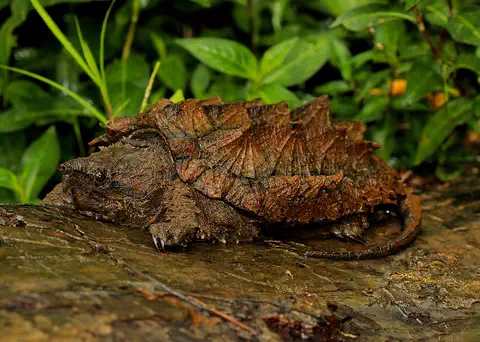
The alligator snapping turtle is the largest freshwater turtle in the United States. It lies still on the bottom of rivers and lakes with its mouth open, wiggling a worm-like lure on its tongue to trick fish into swimming close. Its numbers have fallen, and it is now endangered.
-
 Watch
3D
Animal
American alligator
The American alligator is a large, armored reptile of the swamps, marshes and lakes of the southeastern United States. Alligator mothers guard their nests and carry their babies to the water, and the holes alligators dig help many other animals survive dry seasons.
For parents & teachers
What children will learn
- Describe how a chuckwalla protects itself from predators.
- Explain how a desert lizard can get water without drinking much.
- Describe how male and female chuckwallas look different.
- Explain why collecting wild animals can harm a population and its home.
Recommended ages: 3 to 17 · About 15 minutes
Talk about it
- Why might a plant-eating lizard live where creosote bushes grow?
- How does puffing up help a lizard stay in a crack?
- Why is it better to leave wild lizards, and their rocks, where they are?
Try at home or in class
- Balloon wedge: put a deflated balloon inside a cardboard tube, then blow it up. Try to pull it out. What happens?
- Desert snack: look at a fruit and a leafy vegetable. Which one do you think holds more water?
Key vocabulary: crevice, basking, herbivore, creosote bush, brumation, least concern
Where these facts come from
- GBIF Backbone Taxonomy and GBIF Occurrence Search , Global Biodiversity Information Facility (CC0 1.0 (backbone); occurrence counts are facts derived from records under CC0, CC BY and CC BY-NC)
- Wikidata , Wikimedia Foundation (CC0 1.0)
- The IUCN Red List of Threatened Species , International Union for Conservation of Nature (IUCN terms of use (no redistribution of Red List data or range maps))
- Sauromalus ater (Hammerson, assessed 1 March 2007, published 2007) , IUCN Red List of Threatened Species
- Sauromalus ater: taxonomy, justification, range, population, habitat, threats and conservation text , IUCN Red List of Threatened Species
- Sauromalus ater: IUCN Red List global assessment record (Hammerson 2007), IUCN checklist on GBIF , GBIF
- Common chuckwalla , San Francisco Zoo & Gardens
- Chuckwalla , Zoo New England (Stone Zoo)
- File:Sauromalus ater Phoenix.jpg (Kaldari, 22 April 2009) , Wikimedia Commons
- Wikimedia Commons , Wikimedia Foundation (Per file: Public domain, CC0, CC BY or CC BY-SA only (credited on each page))
Checked, not yet human-reviewed. Last updated November 1, 2026. Spotted a mistake? Tell us.
Picture credits
- Photo: Kaldari, public domain, via Wikimedia Commons · source