
Animal
Thomson's gazelle
Thomson's gazelle is a small, fast animal with a black stripe on its side. It lives on grassy plains in Africa. It eats grass.
Thomson's gazelle is a small, slim antelope of the grassy plains of Kenya and Tanzania. A bold black stripe runs along its side, between its reddish-brown back and white belly. It eats mostly short grass and can run at up to 70 kilometers per hour. Herds in the Serengeti travel with the seasons, like the wildebeest and zebras. It is listed as Least Concern, but its numbers have fallen.
Eudorcas thomsonii is a small, drought-tolerant grazer of the short grasslands of southern Kenya and northern Tanzania. It is listed as Least Concern (IUCN; assessed 2018, published 2018) with a decreasing trend: the global population was estimated at about 207,000 in 2010–2014, down from roughly 439,000 in the late 1990s, and the Serengeti migratory population has fallen steeply since the early 1980s.
Photo: Diego Delso, CC BY-SA 4.0, via Wikimedia Commons
Meet Thomson's gazelle
Thomson's gazelle is small and fast.
Its back is reddish brown. Its belly is white. A black stripe runs along its side.
Thomson's gazelle is a small antelope that weighs 15 to 35 kilograms and stands 55 to 82 centimeters tall at the shoulder. Males are bigger than females.
Its coat is easy to spot: a reddish-brown back, a white belly and a bold black stripe along each side between them. Its rump is white and its short tail is black. On its face, a white stripe runs from each eye to the nose, with a black stripe below it. It is also known as the 'tommie'.
Thomson's gazelle weighs 15 to 35 kilograms (males 20 to 35, females 15 to 25), with a head and body length of 80 to 120 centimeters, a tail of 15 to 27 centimeters and a shoulder height of 55 to 82 centimeters (Animal Diversity Web). The pelage combines a reddish-brown back, white belly, a bold black lateral band, a white rump and a black tail; a broad white facial stripe from eye to nose is bordered below by black.
It resembles Grant's gazelle, which is larger, has horns that curve outward and has white on the rump that extends above the tail. The species belongs to the family Bovidae.
Quick facts
- Group
- Mammal
- Length
- 0.8 to 1.2 m
- Height
- 0.55 to 0.82 m
- Weight
- 15 to 35 kg
- Top speed
- up to 70 km/h
- Lifespan in the wild
- up to 10.5 years
Short-grass plains
Thomson's gazelles live in Africa.
They live on wide, grassy plains in Kenya and Tanzania.
Thomson's gazelles live only in southern Kenya and northern Tanzania. They live on high, open plains with short grass and in savannas dotted with acacia trees.
They cope well with dry weather, so they can stay out on the dry plains long after many other grazing animals have moved away to find wetter places. Big herds live in the Serengeti, the Masai Mara and the rangelands of Laikipia and Kajiado.
The IUCN assessment lists Kenya and Tanzania as the only range countries. The species occupies a relatively small range in southern Kenya and northern Tanzania, largely restricted to high plains and acacia savannas above 500 meters, and now holds only about half of its former range in Tanzania.
It lives in short grasslands. Being relatively drought resistant, it can remain on the dry plains long after most other hoofed animals have left for wetter habitats. The largest Kenyan populations are in the Mara ranches, the Masai Mara National Reserve and the Laikipia and Kajiado rangelands. The Serengeti population migrates with the seasons on a pattern broadly like the wildebeest's and zebras', but it stays longer on the southeastern plains in the wet season and does not travel as far north as the Masai Mara in the dry season (IUCN).
Continent
Its habitats


Where can you find this animal?
- Lives here naturally · Countries and seas named by a scientific source
- Sightings recorded · Records of wild sightings (GBIF)
Lives here naturally · Countries and seas named by a scientific source
Short grasslands and acacia savannas above about 500 meters in southern Kenya and northern Tanzania, including the Serengeti, Ngorongoro and the Masai Mara. It lives in only part of each country shown.
Places: Kenya and Tanzania.
Source: iucn-red-list · checked October 2026
Sightings recorded · Records of wild sightings (GBIF)
Counts of GBIF records of wild observations (human and machine) and preserved specimens. Records include introduced populations, vagrants, escaped or released animals and misidentifications, so a country with records is not necessarily part of the native range.
Wild sightings have been recorded in Kenya, Tanzania, United States, Sudan, India, Uganda, Ethiopia, Poland and 9 more places.
Source: gbif · checked October 2026
Range maps show where scientists say an animal lives, often country by country. An animal may live in only part of a country shown, and sightings records can include animals that wandered far from home.
Short grass
Thomson's gazelles eat plants.
They nibble short grass. In dry times they eat leaves and seeds too.
Thomson's gazelles are grazers: they mostly eat short grasses. In the dry season, they add leaves, twigs, seeds and fruit to their meals.
Because they are small and can cope with drought, they can live on dry grasslands that cannot feed bigger grazing animals. Their grazing also changes which plants grow on the plains.
The species is primarily a grazer of short grasses, adding more forbs and fruits in the dry season (IUCN); Animal Diversity Web also lists twigs, seeds and tree leaves, especially in the dry season. Its small body size and drought tolerance let it persist on arid grasslands that cannot support larger hoofed mammals.
Competition may play a part: the decline in the Serengeti has been suggested to be linked to the rise in wildebeest numbers, since wildebeest compete with gazelles for food (IUCN, citing Foley and colleagues 2014). By grazing, the gazelles also change plant communities.
Did you know?
Gazelles jump high to warn their friends.
When they spot danger, Thomson's gazelles stot: they bounce high with stiff legs and their heads held up.
Stotting, a series of high, stiff-legged jumps, is used as an alarm signal to other gazelles.
Stripes, horns and speed
Thomson's gazelles have ringed horns.
They have long, thin legs. They run very fast.
Males have long horns with rings around them. The horns curve backward and then forward at the tips. Some females have horns too, but theirs are much smaller, and some have none.
Thomson's gazelles are very fast runners on long, thin legs. They can reach about 70 kilometers per hour. A cheetah can keep up its top speed only for a short time, so a gazelle that dodges it long enough can get away.
Males, and some females, carry horns marked by a series of prominent rings (annulations); in males they curve backward and then forward at the tips, while females' horns, when present, are smaller in length and girth. Large preorbital glands in front of the eyes are used for scent marking (Animal Diversity Web).
The species is built for running (cursorial) and reaches about 70 kilometers per hour. It can outrun a cheetah if it evades it long enough, because cheetahs can sustain high speeds only briefly. Thomson's gazelles are fairly silent and communicate mostly by sight.
A calf hidden in the grass
A mother gazelle has one baby.
The baby hides in the grass. Its mom comes back to feed it milk.
A Thomson's gazelle mother is pregnant for about six months. Most babies are born just after the rainy season. She has one calf, which weighs only 2 to 3 kilograms.
The calf can stand and walk soon after birth, but for its first days it lies hidden and still in the tall grass. Its mother comes back a few times a day to feed it milk. After that, it follows her. Females can breed twice a year.
Gestation lasts about six months (Animal Diversity Web; Grzimek gives 5 to 6 months). A single calf of 2 to 3 kilograms is born; most births fall right after the rainy season, although they can happen at any time of year, and females can breed twice a year.
Calves are precocial, able to stand and walk soon after birth, yet spend their first days lying motionless in high grass while the mother returns several times a day to nurse; afterwards they follow her. About half of calves die in their first year, and young calves are taken by many predators. The typical lifespan in the wild is about 10.5 years, and the IUCN uses a generation length of 4.2 years.
Herds and high jumps
Thomson's gazelles live in groups.
When they see danger, they jump high with stiff legs.
Thomson's gazelles live in loose herds of about 5 to 60 animals, and sometimes hundreds gather for a while. Animals join and leave the herd freely. They often mix with impalas and Grant's gazelles.
When a gazelle spots danger, it may start stotting: bouncing high into the air with stiff legs and its head held high, which alerts the others. In the breeding season, males guard small territories and mark them with dung and with scent from glands in front of their eyes.
Groups are fluid associations of 5 to 60 individuals, sometimes temporarily hundreds, with no permanent membership or social hierarchy; they also join mixed herds with impalas and Grant's gazelles (Animal Diversity Web). In the breeding season, males hold small territories in good grazing, mark them with preorbital-gland secretions on grass stems and with dung piles, chase rival males and sometimes herd females to keep them longer. Outside the season, males form small bachelor herds or join loose groups with females.
Alarmed gazelles stot, a stereotyped series of high, stiff-legged jumps with the head held high, which signals to other gazelles. Predators include lions, spotted hyenas, African wild dogs, cheetahs, leopards and jackals; calves are also taken by baboons and pythons.
Did you know?
Gazelles can live where it is very dry.
Thomson's gazelles stay on dry plains long after bigger grazing animals have left.
Drought tolerance and small size let the species persist on arid grasslands.
Fewer gazelles than before
There are still many Thomson's gazelles.
But there are fewer than before. Big parks help keep them safe.
Thomson's gazelle is listed as Least Concern, but its numbers are going down. In the early 1980s about 500,000 lived in the Serengeti; a 2010 survey estimated about 166,000 there. In Kenya, numbers fell from about 147,000 around 1980 to about 44,000 in 2011–2013.
People hunt gazelles for meat and illegal hunting is a problem in parts of the Serengeti–Mara. Many gazelles live in protected areas, such as Serengeti National Park and the Masai Mara National Reserve, where wildlife tourism is the only land use allowed.
The IUCN lists Eudorcas thomsonii as Least Concern (IUCN SSC Antelope Specialist Group; assessed 16 February 2018, published 2018) with a decreasing trend. The global population fell from about 438,650 (1996–1999) to about 225,689 (2002/2003), then levelled off at an estimated 207,361 in 2010–2014, about 145,000 of them mature.
The Serengeti migratory population, Africa's largest gazelle population, was estimated at 165,973 in 2010, down from 500,000 in the early 1980s; Kenya's fell from about 147,000 (1977–80) to about 44,000 (2011–13). No major current threats are known, but declines in some areas have been linked to illegal hunting, water availability, tourism, invasive plants, fire management, roads and competition with wildebeest. Core areas are protected by Serengeti National Park and the Masai Mara National Reserve, surrounded by buffer zones.
IUCN Red List
How is the thomson's gazelle doing in the wild?
- Least Concern (this animal)
- Near Threatened
- Vulnerable
- Endangered
- Critically Endangered
- Extinct in the Wild
- Extinct
Least Concern
Not at risk of disappearing from the wild right now.
See the IUCN Red List assessment · The IUCN Red List of Threatened Species 2022.2
Amazing facts
-
Gazelles jump high to warn their friends.
When they spot danger, Thomson's gazelles stot: they bounce high with stiff legs and their heads held up.
Stotting, a series of high, stiff-legged jumps, is used as an alarm signal to other gazelles.
-
Thomson's gazelles can run very fast.
A Thomson's gazelle can reach about 70 kilometers per hour and can outlast a sprinting cheetah.
Top speed is about 70 kilometers per hour; cheetahs can hold high speeds only briefly.
-
Baby gazelles hide very still in the grass.
For its first days, a calf lies hidden and still in the grass, and its mother comes back a few times a day to nurse it.
Calves go through a hiding phase, lying motionless in high grass between nursing visits.
-
Gazelles can live where it is very dry.
Thomson's gazelles stay on dry plains long after bigger grazing animals have left.
Drought tolerance and small size let the species persist on arid grasslands.
Words to know
- gazelle
- a small, slender, fast-running antelope
- grazer
- an animal that eats mostly grass
- stotting
- jumping high with stiff legs to signal danger
- territory
- an area an animal guards against others of its kind
- migrate
- to move from one area to another as the seasons change
- drought
- a long time with little or no rain
Discovery challenge
-
What color is the stripe on a Thomson's gazelle's side?
What color is the bold stripe along a Thomson's gazelle's side?
What color is the lateral band of Eudorcas thomsonii?
- Black
- Green
- Blue
Show the answer
Black
Black. It runs between the brown back and the white belly.
Black, dividing the reddish-brown back from the white belly.
Black, separating the reddish-brown dorsum from the white venter.
-
What do Thomson's gazelles mostly eat?
What do Thomson's gazelles mostly eat?
What is the main food of Thomson's gazelle?
- Short grass
- Fish
- Insects
Show the answer
Short grass
Short grass.
Short grass, plus leaves, seeds and fruit in the dry season.
Short grasses; more forbs and fruit in the dry season.
-
What does a baby gazelle do in its first days?
What does a newborn Thomson's gazelle do for its first days?
How does a Thomson's gazelle calf spend its first days?
- It hides still in the grass
- It climbs a tree
- It swims in a river
Show the answer
It hides still in the grass
It hides still in the grass. Its mom comes back to feed it.
It lies hidden and still in the grass, and its mother returns to nurse it.
It lies motionless in high grass while the mother returns several times a day to nurse.
-
In which two countries do Thomson's gazelles live?
In which two countries do Thomson's gazelles live?
Which two countries make up the IUCN range of Eudorcas thomsonii?
- Kenya and Tanzania
- Egypt and Morocco
- Brazil and Peru
Show the answer
Kenya and Tanzania
Kenya and Tanzania, in Africa.
Kenya and Tanzania, in East Africa.
Kenya and Tanzania only, above about 500 meters.
Places where you might see it
-
 Watch
 Country
Kenya
Kenya is a country in East Africa, crossed by the equator. It has the snow-capped Mount Kenya, the deep Great Rift Valley, Lake Victoria and a long Indian Ocean coast, and about 54 million people live there, many of them speaking Swahili.
-
 Watch
 Country
Tanzania
Tanzania is a country in East Africa, just south of the Equator, on the Indian Ocean. It has Mount Kilimanjaro, Africa's highest mountain, deep lakes in the East African Rift, and the Serengeti, where huge herds of wildebeest travel each year.
Explore next
-
 Watch
3D
Animal
Cheetah
The cheetah is the fastest land animal. It can go from standing still to 72 kilometers per hour in about two and a half seconds, and its top speed is around 100 kilometers per hour, as fast as a car on a highway. Cheetahs live mostly in Africa, with a very small group in Iran.
-
 Watch
Animal
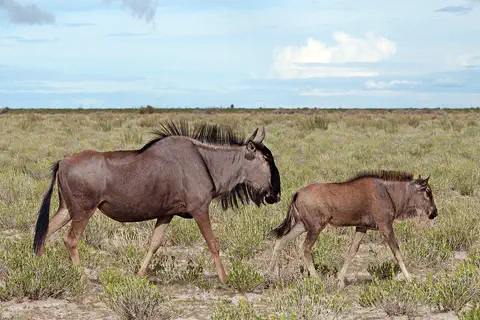
Blue wildebeest
The blue wildebeest, or gnu, is a big antelope with a box-like head, curved horns, a mane and a beard. It grazes the savannas of eastern and southern Africa, and in the Serengeti huge herds travel in a giant circle every year following the rains.
-
 Watch
Animal
Impala
The impala is a slender, reddish-brown antelope of the savannas of eastern and southern Africa. It can both graze on grass and browse on leaves, lives in herds, and when startled the whole herd bursts into spectacular leaps. Only males have the long, curving horns.
-
 Watch
Animal
Springbok
The springbok is a slim, brown and white antelope of the dry plains of southern Africa. When it is excited or alarmed, it pronks: it bounces high with stiff legs and can lift a hidden crest of white hair on its back. It can live on plants without drinking. There are millions of springbok, and their numbers are growing.
-
 Watch
3D
Animal
Lion
The lion is the only big cat that lives in a family group, called a pride. Lionesses hunt together, males guard the pride's land, and their roar can be heard about 8 kilometers away. Wild lions live in Africa, plus one small group in western India.
-
Watch
Country
Kenya
Kenya is a country in East Africa, crossed by the equator. It has the snow-capped Mount Kenya, the deep Great Rift Valley, Lake Victoria and a long Indian Ocean coast, and about 54 million people live there, many of them speaking Swahili.
-
Watch
Country
Tanzania
Tanzania is a country in East Africa, just south of the Equator, on the Indian Ocean. It has Mount Kilimanjaro, Africa's highest mountain, deep lakes in the East African Rift, and the Serengeti, where huge herds of wildebeest travel each year.
-
 Watch
Animal
Aardvark
The aardvark is a shy night digger of African savannas. It sniffs out ant and termite nests, rips them open with its spade-like claws and laps up the insects with a sticky tongue about 30 centimeters long. Its name means 'earth pig' in Afrikaans.
For parents & teachers
What children will learn
- Describe the markings and body of Thomson's gazelle.
- Explain how stotting and hiding calves help gazelles survive predators.
- Understand that a Least Concern species can still be declining.
- Find Kenya and Tanzania on a map of Africa.
Recommended ages: 3 to 17 · About 15 minutes
Talk about it
- Why might a gazelle calf lie still in the grass instead of running?
- Why could jumping high be a useful thing to do when a predator is near?
- Thomson's gazelles are Least Concern, but their numbers have fallen. Should people still worry about them?
Try at home or in class
- Mark out 70 meters in a park; that is about how far a running Thomson's gazelle goes in under 4 seconds.
- Make a bar chart of the Serengeti gazelle count in the early 1980s (500,000) and in 2010 (166,000).
Key vocabulary: gazelle, grazer, stotting, territory, migrate, drought
Where these facts come from
- GBIF Backbone Taxonomy and GBIF Occurrence Search , Global Biodiversity Information Facility (CC0 1.0 (backbone); occurrence counts are facts derived from records under CC0, CC BY and CC BY-NC)
- The IUCN Red List of Threatened Species , International Union for Conservation of Nature (IUCN terms of use (no redistribution of Red List data or range maps))
- Eudorcas thomsonii (IUCN SSC Antelope Specialist Group, assessed 16 February 2018, published 2018) , IUCN Red List of Threatened Species
- Eudorcas thomsonii: range, population, habitat and threats text , IUCN Red List of Threatened Species
- Eudorcas thomsonii (Thomson's gazelle) , Animal Diversity Web, University of Michigan
- File:Gacela de Thomson (Eudorcas thomsonii), parque nacional de Amboseli, Kenia, 2024-05-23, DD 11.jpg (Diego Delso) , Wikimedia Commons
- Wikidata , Wikimedia Foundation (CC0 1.0)
- Wikimedia Commons , Wikimedia Foundation (Per file: Public domain, CC0, CC BY or CC BY-SA only (credited on each page))
Checked, not yet human-reviewed. Last updated November 1, 2026. Spotted a mistake? Tell us.