
Landmark Asia
Topkapı Palace
Topkapı Palace is a huge old palace in Istanbul, Türkiye. Sultans lived and ruled there for hundreds of years. Today it is a museum with gardens, courtyards and treasures.
Topkapı Palace sits on a point of land where the Bosphorus Strait meets the sea in Istanbul. Sultan Mehmed II built it between 1460 and 1478, and for nearly 400 years it was the home of the Ottoman sultans and the center of their government. In 1924 it became a museum.
Built by Mehmed II in 1460 to 1478 on the Sarayburnu headland, the former site of the Eastern Roman acropolis, Topkapı was the Ottoman sultans' residence and seat of government until the mid-19th century. Its courtyards, pavilions and roughly 300,000 archive documents have formed a museum since 1924.
Photo: Bjørn Christian Tørrissen, CC BY-SA 3.0, via Wikimedia Commons
Discover Topkapı Palace
Topkapı Palace is in Istanbul, a big city in Türkiye.
It sits on a hill by the water. Inside its walls are courtyards, gardens, fountains and many buildings with domes. Long ago, rulers called sultans lived here.
Topkapı Palace stands on a hilly point of land in the oldest part of Istanbul, where the Bosphorus Strait, the Sea of Marmara and an inlet called the Golden Horn meet. The point is called Sarayburnu.
For nearly four centuries this was the home of the Ottoman sultans and the center of their government. It is not one big building but a group of buildings around four great courtyards, with gardens, fountains and pools. Today the palace and its grounds cover nearly 350,000 square meters, and it is a museum full of treasures and old documents.
The palace occupies Sarayburnu, the headland of Istanbul's historic peninsula between the Sea of Marmara, the Bosphorus and the Golden Horn, once the site of the Eastern Roman acropolis. The Directorate of National Palaces records that it was the center of Ottoman government, education and art and the sultans' official residence for nearly four centuries, until the reign of Abdülmecid (1839 to 1861). The palace area once covered 700,000 square meters; today the palace and grounds cover nearly 350,000, excluding Gülhane Park, once part of the palace gardens.
UNESCO includes Topkapı in the Historic Areas of Istanbul (inscribed 1985), describing it, with the Süleymaniye complex, as a supreme example of the palace and religious ensembles of the Ottoman period, continually extended until the 19th century.
- Where
- Sarayburnu headland, Istanbul, Türkiye
- Built
- 1460 to 1478, by Sultan Mehmed II
- A museum since
- April 3, 1924
- Grounds today
- nearly 350,000 square meters
Home of the sultans
Long ago, a sultan named Mehmed began building this palace.
Later sultans added more and more buildings. After about 400 years, the sultans moved to a new palace. Then Topkapı became a museum for everyone.
After the Ottoman sultan Mehmed II took Istanbul, he built this palace between 1460 and 1478. The land was once an olive grove. Workers first laid out gardens and pavilions, then built walls around them. Over the centuries, other sultans added new buildings.
At first it was called the New Royal Palace. Later it was named Topkapı, after a gate called the Cannon Gate. By the 1840s the old palace no longer suited big state ceremonies, so the sultans moved to the new Dolmabahçe Palace. On April 3, 1924, soon after the Republic of Türkiye was founded, Topkapı became a museum.
Mehmed II (reigned 1444 to 1445 and 1451 to 1481) built the palace in 1460 to 1478, after the conquest of Istanbul, on a site called Zeytinlik (Olive Grove): work began with gardens and pavilions, and the site was then enclosed by walls, the Sûr-ı Sultânî. Long called the New Royal Palace, to distinguish it from an earlier palace in Beyazıt, it took the name Top Kapısı from a pavilion known as Toplu Kapı (Cannon Gate).
It remained the sultan's main residence and seat of government until the mid-19th century. By the 1840s it had become inadequate for state protocol, and Dolmabahçe Palace was built in 1843 to 1856 as the new official residence and administrative center; Topkapı kept its historical and symbolic importance. On April 3, 1924, shortly after the Republic was established on October 29, 1923, it became the first museum of the Republican period.
Stone, wood and lead-covered domes
The palace has many low buildings around big courtyards.
Some are made of stone with tall domes. The homes were made of stone and wood. Their domes are covered with gray metal called lead.
Topkapı was built around a series of large courtyards, each surrounded by covered walkways with columns. The plan copied ideas from an earlier royal palace in Edirne, the old Ottoman capital.
The service buildings, like the bakeries, were made of stone, mostly one story high, with tall domes. The rooms where people lived were mostly built of stone and wood, with domes covered in lead, a heavy gray metal. Around the palace and its gardens are fountains, pools and many water tanks.
The palace proper is a series of large courtyards surrounded by colonnades, a plan influenced by the earlier royal palace at Edirne, the former capital. The service buildings are of stone, mostly single-story with high domes, while the residential buildings are mostly of stone and wood with lead-covered domes; the inner parts and gardens have many fountains and pools and numerous water reservoirs.
Organizationally, the palace had four parts: the Bîrun, or Outer Palace, of service buildings and guard posts; the Dîvân-ı Hümâyun, the State Council building and administrative center of the empire; the Enderûn, or Palace School; and the Harem, the sultan's private home. Its walls, which adjoin the Byzantine city walls, have three main gates, the Royal Gate, the Iron Gate and the Hay Gate, and five small service gates. The last buildings added were the Mecidiye Pavilion and the Wardrobe Chamber.
Gates, courtyards and pavilions
To get inside, you walk through one big gate after another.
Each gate leads to a new courtyard. In one, the sultan's council met to run the empire. In the last one, there are pretty pavilions and a tulip garden.
Visitors pass through a chain of gates. The Royal Gate leads into the first courtyard, a big open square. The Gate of Greeting leads into the second courtyard, where the Imperial Council met under a dome and where a tall Tower of Justice rises. The Gate of Felicity leads into the third courtyard, with the Palace School and the sultan's Audience Chamber.
The fourth courtyard has terraced gardens and elegant pavilions, like the Baghdad and Revan pavilions, and a Tulip Garden. One small tower there was once the palace pharmacy.
The monumental two-story Bâb-ı Hümâyun, signed by the calligrapher Ali b. Yahyâ es-Sûfî, opens onto the first court, the Alay Meydanı or Procession Square, ringed by the Church of Saint Eirene, the Mint, bakeries, a hospital and the workshop of the reed mat makers who wove the palace's floor mats. The Bâbüsselâm (Gate of Greeting) leads to the second court, Divan Square, with the Kubbealtı council chamber, the treasury, the Tower of Justice, the Harem entrance and the Royal Stables.
The Bâbüssaâde (Gate of Felicity) opens onto the third, Enderun court, with the Audience Chamber, the halls of the palace school and the treasury called the Pavilion of the Conqueror. The fourth court holds royal pavilions: the Baghdad and Revan pavilions, examples of classical Ottoman pavilion architecture, the wooden Sofa Pavilion beside the Tulip Garden, inscribed with couplets by the poet Hâkânî Mehmed Bey, and the Stone Tower, once the palace pharmacy.
- Courtyards
- 4, entered through a series of gates
- Main entrance
- Bâb-ı Hümâyun (Royal Gate)
- Archive documents
- nearly 300,000
- Sultans' home until
- the mid-19th century
Topkapı today
Today, Topkapı is a museum.
Visitors walk through its courtyards and gardens. They see old treasures and documents from the days of the sultans.
Topkapı Palace became a museum in 1924, the first museum of the new Republic of Türkiye. Today it is run by the Directorate of National Palaces. With its buildings, collections and nearly 300,000 old documents, the Directorate calls it one of the largest palace-museums in the world.
Part of the old palace gardens is now Gülhane Park, a public park. The palace is part of UNESCO's Historic Areas of Istanbul, which has been a World Heritage Site since 1985, together with buildings like Hagia Sophia.
The Directorate of National Palaces, to which Topkapı was attached by a resolution in the Official Gazette of September 6, 2019, describes it, with its historic buildings, collections and nearly 300,000 archive documents, as one of the largest museum-palaces in the world. Gülhane Park, once part of the palace gardens, is now a public park outside the museum grounds.
UNESCO's Historic Areas of Istanbul, inscribed in 1985, lists the 15th-century Topkapı Palace within the Archaeological Park at the tip of the historic peninsula, and notes that planning measures preserve the skyline of Topkapı, Hagia Sophia and Süleymaniye.

Amazing facts
-
The palace is named after a gate.
The name Topkapı comes from a pavilion called the Cannon Gate.
First called the New Royal Palace, it became known as Top Kapısı Palace after a pavilion called Toplu Kapı, the Cannon Gate.
-
The palace was built in an olive grove.
The land where the palace stands was once called the Olive Grove.
The site was originally known as Zeytinlik, the Olive Grove; work began with gardens and pavilions.
-
The palace had workers who made floor mats.
In the first courtyard worked the reed mat makers, who wove the mats that covered floors all over the palace.
The first court housed the Company of Reed Mat Makers, who wove the mats covering floors throughout the palace.
-
A little tower in the palace was a pharmacy.
In the fourth courtyard, a room called the Stone Tower was once the palace pharmacy.
The Stone Tower on a terrace of the fourth court once served as the palace pharmacy.
Words to know
- sultan
- the title of the rulers of the Ottoman Empire
- palace
- a large, grand home for a ruler
- courtyard
- an open space surrounded by walls or buildings
- pavilion
- a small, often decorated building in a garden
- strait
- a narrow stretch of sea joining two larger seas
- archive
- a collection of old documents and records
Discovery challenge
-
Which city is Topkapı Palace in?
In which city does Topkapı Palace stand?
Which city's historic peninsula ends at Sarayburnu, the site of Topkapı?
- Istanbul
- Madrid
- Tokyo
Show the answer
Istanbul
Istanbul! It is a big city in Türkiye.
It stands on a point of land in the oldest part of Istanbul.
Istanbul; Sarayburnu lies between the Sea of Marmara, the Bosphorus and the Golden Horn.
-
Who lived in Topkapı Palace?
Who lived and ruled in Topkapı Palace for nearly four centuries?
Whose residence and seat of government was Topkapı until the mid-19th century?
- The Ottoman sultans
- The kings of France
- The Roman emperors
Show the answer
The Ottoman sultans
The sultans, the rulers of the Ottoman Empire.
The Ottoman sultans lived and ruled here until they moved to Dolmabahçe Palace.
The Ottoman sultans, until the reign of Abdülmecid; Dolmabahçe was built in 1843 to 1856.
-
The palace is named after a gate. What was it called?
Topkapı Palace takes its name from a pavilion. What was that pavilion called?
After which structure was the New Royal Palace renamed Top Kapısı?
- Cannon Gate
- Golden Door
- Sea Window
Show the answer
Cannon Gate
The Cannon Gate!
It was called the Cannon Gate, and the palace was named after it.
A pavilion known as Toplu Kapı, the Cannon Gate.
-
What is Topkapı Palace today?
What has Topkapı Palace been since 1924?
What did Topkapı become on April 3, 1924?
- A museum
- A school for pilots
- A train station
Show the answer
A museum
A museum that everyone can visit.
It has been a museum since 1924.
The first museum established in the Republican period.
Nearby places
-
 Watch
Landmark
Hagia Sophia
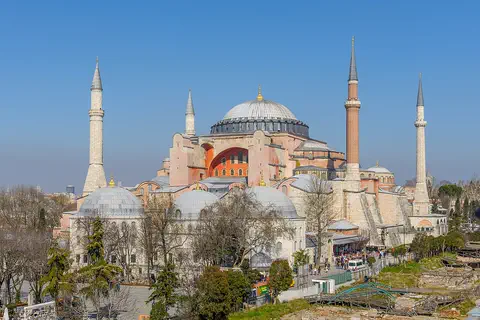
Hagia Sophia in Istanbul was built in under six years, from 532 to 537, for the emperor Justinian. Its enormous dome seems to float on a ring of 40 windows. Over almost 1,500 years it has been a church, a mosque and a museum, and since 2020 it has been a mosque.
-
 Watch
Landmark
Sultan Ahmed Mosque
The Sultan Ahmed Mosque in Istanbul was built between 1609 and about 1616 for the Ottoman ruler Sultan Ahmed I. Its central dome is ringed by half-domes and smaller domes, and six slender minarets rise around it. Many people call it the Blue Mosque because of the blue and green tiles and painted decoration inside. It is still a working mosque, where Muslims come to pray.
-
Watch
City
Istanbul
Istanbul is the biggest city in Türkiye, built on both sides of the Bosporus, the narrow strait between Europe and Asia. Once called Byzantium and then Constantinople, it was the capital of two great empires. About 15.7 million people lived in Istanbul province in 2023.
-
 Watch
Natural wonder
Pamukkale
Pamukkale, in southwestern Türkiye, is a hillside of bright white terraces and pools built by warm spring water. The water is full of a dissolved mineral called calcium carbonate, and as it flows over the slope it leaves the mineral behind as a rock called travertine. Its name means "cotton castle". On top stand the ruins of Hierapolis, an ancient spa town.
-
 Watch
City
Ankara
Ankara is the capital of Türkiye, in the interior of Anatolia, about 200 kilometers from the Black Sea. People have lived here since the Stone Age, and Romans, Byzantines, Seljuks and Ottomans all left buildings behind. It became the capital in 1923, and today it is a city of government, universities and museums.
-
 Watch
Landmark
Temple of Artemis at Ephesus
The Temple of Artemis at Ephesus was one of the Seven Wonders of the ancient world. It was rebuilt several times, and its 6th-century BCE version was more than 300 feet long. After a fire in 356 BCE it was built again just as big. Today only scattered stones and one column remain.
-
 Watch
Landmark
Ephesus
Ephesus was a great Greek and Roman city on the west coast of what is now Türkiye. Its ruins include ancient streets, a theater for nearly 25,000 people and the Library of Celsus, whose two-story front has been rebuilt. Archaeologists have been digging there since 1895.
-
 Watch
City
Bucharest
Bucharest, the capital of Romania, lies on a wide plain beside the Dâmbovița River. First written about in 1459, it became the capital of Walachia in 1659 and of Romania in 1862. Today it is a city of broad boulevards, a huge parliament palace, the Romanian Athenaeum concert hall and an open-air Village Museum.
Explore next
-
 Watch
 Country
Türkiye (Turkey)
Türkiye, also called Turkey, lies partly in Asia and partly in Europe. A narrow waterway called the Bosporus runs through its biggest city, Istanbul, and its land is mostly mountains and high plains. About 86 million people live there.
-
Watch
City
Istanbul
Istanbul is the biggest city in Türkiye, built on both sides of the Bosporus, the narrow strait between Europe and Asia. Once called Byzantium and then Constantinople, it was the capital of two great empires. About 15.7 million people lived in Istanbul province in 2023.
-
Watch
Landmark
Hagia Sophia
Hagia Sophia in Istanbul was built in under six years, from 532 to 537, for the emperor Justinian. Its enormous dome seems to float on a ring of 40 windows. Over almost 1,500 years it has been a church, a mosque and a museum, and since 2020 it has been a mosque.
-
Watch
Landmark
Sultan Ahmed Mosque
The Sultan Ahmed Mosque in Istanbul was built between 1609 and about 1616 for the Ottoman ruler Sultan Ahmed I. Its central dome is ringed by half-domes and smaller domes, and six slender minarets rise around it. Many people call it the Blue Mosque because of the blue and green tiles and painted decoration inside. It is still a working mosque, where Muslims come to pray.
-
 Watch
Landmark
Forbidden City
The Forbidden City in Beijing was built between 1406 and 1420 as the palace of China's emperors. Over about 500 years, 24 emperors came to the throne there. High walls and a wide moat surround it. Since 1925 it has been the Palace Museum, and it became a World Heritage Site in 1987.
-
 Watch
Landmark
Palace of Versailles
The Palace of Versailles began as a small royal hunting lodge. King Louis XIV turned it into a vast palace, and from 1682 it was the center of the French government. Today it has 2,300 rooms, the famous Hall of Mirrors and enormous gardens.
-
 Watch
Landmark
Agra Fort
Agra Fort is a huge red sandstone fortress beside the Yamuna River in Agra, India. The Mughal emperor Akbar began it in 1565. Its walls, about 2.5 kilometers around, protect palaces, halls and mosques added by later emperors. It was both an army base and a royal home.
-
 Watch
Landmark
Al-Aqsa Mosque
Al-Aqsa Mosque stands at the southern end of a huge raised plaza in the Old City of Jerusalem. Built in the early 700s, it has a silver-gray dome, and the golden Dome of the Rock stands nearby. The plaza is important to Muslims and to Jews.
For parents & teachers
What children will learn
- Locate Istanbul and the Bosphorus and explain where Topkapı Palace stands.
- Explain that Topkapı was the Ottoman sultans' home and seat of government for nearly four centuries.
- Describe how the palace is organized as courtyards entered through a chain of gates.
- Discuss how a palace can become a museum.
Recommended ages: 3 to 17 · About 15 minutes
Talk about it
- Why might a palace be built as many buildings around courtyards instead of one big building?
- The palace was home, office and school all at once. What would it be like to live where the government works?
- Why do you think the new republic turned the palace into a museum?
Try at home or in class
- Draw a map of the palace as four courtyards in a row, joined by gates, and label what happened in each one.
- Collect a few family documents or photos, put them in order by date, and make your own small archive with labels.
Key vocabulary: sultan, palace, courtyard, pavilion, strait, archive
Where these facts come from
- Wikidata , Wikimedia Foundation (CC0 1.0)
- Topkapı Palace , Presidency of the Republic of Türkiye, Directorate of National Palaces
- Historic Areas of Istanbul , UNESCO World Heritage Centre
- Wikimedia Commons , Wikimedia Foundation (Per file (public domain, CC0, CC BY or CC BY-SA); see each media record)
Checked, not yet human-reviewed. Last updated October 27, 2026. Spotted a mistake? Tell us.