
City Europe
Gdańsk
Gdańsk is a port city in Poland, by the Baltic Sea. Tall, colorful old houses line its river.
Gdańsk is a port city on Poland's Baltic coast and the capital of the Pomeranian Voivodeship. From the 13th to the 17th century it was one of Europe's great trading places. Statistics Poland estimated 489,328 people in the city at the end of 2025.
Gdańsk, capital of the Pomeranian Voivodeship, grew rich from the 13th to the 17th century as a trading hub between eastern, northern and western Europe, joining the Hanseatic League in 1361. Statistics Poland's estimate for 31 December 2025 is 489,328 residents; the Tricity metropolitan area it belongs to has about 1.5 million.
Photo: Diego Delso, CC BY-SA 3.0, via Wikimedia Commons
Discover Gdańsk
Gdańsk is a city in Poland. It is by the Baltic Sea, and ships have come here for hundreds of years.
Its old houses are tall and painted in many colors.
Gdańsk is a port city on the Baltic Sea in northern Poland. Wikidata describes it as the capital of the Pomeranian Voivodeship, one of Poland's regions.
Statistics Poland (GUS) estimated 489,328 people in the city on 31 December 2025, as listed by City Population. Gdańsk is part of the Tricity, with Gdynia and Sopot; UrbanRail.Net puts the whole metropolitan area at about 1.5 million people.
Census and estimate figures from Statistics Poland, as listed by City Population, for the city (an urban county): 461,334 in 2002, 460,276 in 2011, 486,022 in 2021 and an estimated 489,328 on 31 December 2025.
Universalis gives the city's German name as Danzig (Dantzig in French) and calls Gdańsk a port city on the edge of the Baltic Sea.
- Country and region
- Poland; capital of the Pomeranian Voivodeship
- People in Gdańsk (estimate, 31 December 2025)
- 489,328
- People at the 2021 census
- 486,022
- Tricity metropolitan area
- about 1.5 million people
Along the Long Embankment
Look at the row of tall old houses beside the river! They are red, yellow, green and brown, with pointy roofs and towers.
An old-style sailing ship floats on the water.
The photo looks along Długie Pobrzeże, a riverside street in Gdańsk, beside the Motława River. Tall, narrow houses in red, yellow, green and brown stand shoulder to shoulder, with steep roofs, pointed gables and small towers. People stroll along the embankment, and white umbrellas stand by the water.
Farther along stands the Żuraw, a tall dark building with an orange roof, which the photo's Commons page lists as a registered heritage building. On the right, an old-style sailing ship sits on the river.
The Commons file (Diego Delso, May 2013, a quality image) is filed under Długie Pobrzeże Street, Żuraw in Gdańsk and the ship Czarna Perła (built 1974). It notes that the Żuraw is in the Pomeranian Voivodeship's heritage register as number A-132, entered on 18 December 1959.
Wikidata lists the Green Gate as an old watergate about 0.3 km south-southwest of the Żuraw, and the Long Market, a square, about 0.3 km to the southwest.
- Photo
- Długie Pobrzeże (the Long Embankment), May 2013
- Żuraw
- historic building on the embankment, registered heritage A-132 (1959)
- Green Gate
- old watergate, about 0.3 km south-southwest of the Żuraw
A great trading port
Long ago, ships from many lands came to Gdańsk. People bought and sold goods here.
The city grew rich from this trade.
Universalis says Gdańsk was the capital of the dukes of Pomerelia from 1148 and gained the status of a town in 1254. From the 13th to the 17th century it was one of the most important places for trading goods between eastern, northern and western Europe, and in 1361 it joined the Hanseatic League, a network of trading towns.
Under the Privilegium Casimiranum, the city ran its own affairs almost like an independent state, and Universalis says it drew to itself all of Poland's export trade.
Universalis (on its Gdańsk page) says trade fell back in the 17th century, partly because Dutch and English traders entered the Baltic. From 1814 the city was Prussian and became the main import and export port of East and West Prussia and a great industrial center.
The settlement of 1919 separated the port and its surroundings (1,951 km², 4 towns and 255 villages) from Germany. On 15 December 1920 an assembly declared the Free City of Danzig, whose independence the League of Nations guaranteed; it had its own flag, currency and parliament.
- Town status
- 1254
- Joined the Hanseatic League
- 1361
- Declared a free city
- 15 December 1920
Trams and fast trains
In Gdańsk you can ride a tram, or take a fast train to the next towns, Sopot and Gdynia. There is an airport too.
UrbanRail.Net lists about 60 kilometers of tram track in Gdańsk, with 11 lines. A rapid railway, the SKM, links Gdańsk, Gdynia and Sopot, with a train about every 10 minutes.
Wikidata dates Gdańsk Główny railway station to 1900. It stands about 1 kilometer northwest of the Żuraw. Gdańsk Lech Wałęsa Airport opened in 1974, about 13 kilometers west-northwest of the Żuraw.
Newer tram sections listed by UrbanRail.Net: Sikorskiego–Łostowice Świętokrzyska (2.9 km, 11 May 2012), Siedlce–Brętowo/Migowo (4 km, 31 August 2015), Migowo–Lawendowe Wzgórze (3.2 km, 30 June 2020) and Ujeścisko–Przemyska (1.7 km, 4 March 2023).
The SKM runs on its own separate tracks along most of its route between Gdańsk and Gdynia, similar to a typical S-Bahn, UrbanRail.Net says; other suburban and regional lines are called PKM.
- Tram network
- about 60 km, 11 lines, standard gauge (1,435 mm)
- Rapid Railway (SKM)
- Gdańsk, Gdynia and Sopot, a train about every 10 minutes
- Gdańsk Główny railway station
- opened 1900
- Gdańsk Lech Wałęsa Airport
- opened 1974
Cold winters, mild summers
Winters in Gdańsk are cold, and nights are often below freezing. Summers are mild.
Rain or snow falls on many days of the year.
The World Meteorological Organization's table for Gdańsk (1981–2010) gives July and August days an average high of about 22 °C. In January, days average about 1 °C and nights about −4 °C, below freezing.
About 569 millimeters of precipitation fall in an average year, spread over about 176 days with at least 0.1 millimeters. August is the wettest month, with about 69 millimeters, and February the driest, with about 23.
The WMO table for Gdańsk (1981–2010) gives average highs from 1.4 °C in January to 22.2 °C in July and August, and average lows from −3.8 °C in January to 13.6 °C in July. Average lows stay below 0 °C from December to March.
The monthly precipitation averages add up to 569.1 mm on 176.0 days with 0.1 mm or more. June to September bring 269.5 mm, nearly half the year; December has the most wet days (18.1).
- July and August, average high (WMO, 1981–2010)
- 22.2 °C
- January, average low (same table)
- −3.8 °C
- Precipitation in a year (sum of the monthly averages)
- about 569 mm
Port city of the Tricity
Gdańsk has two neighbor cities, Sopot and Gdynia. Together they are called the Tricity, which means three cities.
People like to walk by the river.
Gdańsk, Gdynia and Sopot together form the Tricity (Trójmiasto in Polish), a metropolitan area of about 1.5 million people according to UrbanRail.Net. Statistics Poland's figures put Gdynia at an estimated 238,712 people at the end of 2025, about half the size of Gdańsk.
In the photo, the riverside is busy with people walking, white umbrellas and a sailing ship on the river.
City Population's table of Statistics Poland figures shows Gdańsk growing from 460,276 (2011 census) to 486,022 (2021 census), while neighboring Gdynia shrank from 249,139 to 245,222 in the same years and to an estimated 238,712 by 31 December 2025.
Universalis traces Gdańsk's wealth to its trade: as a Hanseatic port it linked the east, north and west of Europe, and later it served as a main port and industrial center for East and West Prussia.
- The Tricity
- Gdańsk, Gdynia and Sopot
- Gdynia (estimate, 31 December 2025)
- 238,712
- Pomorskie (Pomerania) voivodeship
- the region around Gdańsk
Gdańsk on the map
Find Poland on the globe. Look at its coast, by the Baltic Sea. Gdańsk is there!
Gdańsk lies at about 54.4° north on the Baltic coast of northern Poland. Wikidata puts a point of the Motława, a river in Poland, about 0.3 kilometers north-northeast of the Żuraw.
Measured from the Żuraw, the Green Gate is about 0.3 kilometers to the south-southwest, the Long Market about 0.3 kilometers to the southwest, the main railway station about 1 kilometer to the northwest and the airport about 13 kilometers to the west-northwest.
Gdańsk lies at about 54.35° N and 18.65° E. Measured from the Żuraw (Wikidata points): Green Gate 0.31 km south-southwest, Long Market 0.34 km southwest, Gdańsk Główny 1.00 km northwest and Gdańsk Lech Wałęsa Airport 12.76 km west-northwest.
Universalis says that in 1920 the Free City's territory covered 1,951 km² around the port; today Gdańsk is a city of Poland and capital of its Pomeranian Voivodeship, as Wikidata records.
- Latitude
- about 54.4° north
- Longitude
- about 18.6° east
- Żuraw to Gdańsk Główny station
- about 1.0 km northwest
Amazing facts
-
Gdańsk and two neighbor cities are called the Tricity.
Gdańsk, Gdynia and Sopot together are called the Tricity, or Trójmiasto in Polish.
UrbanRail.Net puts the Tricity metropolitan area (Trójmiasto) at about 1.5 million people, linked by the SKM rapid railway with a train about every 10 minutes.
-
Long ago, Gdańsk was part of a big club of trading towns.
In 1361 Gdańsk joined the Hanseatic League, a network of trading towns.
Universalis says Gdańsk, a Hanseatic member from 1361, was from the 13th to the 17th century one of the most important places for trade between eastern, northern and western Europe.
-
In Gdańsk, rain or snow falls on about half the days of the year.
The WMO's Gdańsk table lists about 176 days a year with at least 0.1 millimeters of precipitation.
WMO Gdańsk (1981–2010): 176.0 days a year with 0.1 mm or more, from 12.2 in April to 18.1 in December, yet only 569.1 mm in total.
-
Gdańsk has an old building on its river that is on a special list of protected buildings.
The Żuraw on the Długie Pobrzeże riverside is in the Pomeranian Voivodeship's heritage register.
The photo's Commons page records the Żuraw as heritage register entry A-132 of 18 December 1959.
Words to know
- port
- a town or city with a harbor where ships load and unload
- Hanseatic League
- a group of trading towns around the Baltic and North Seas that worked together in the Middle Ages
- voivodeship
- one of the regions that Poland is divided into
- embankment
- a raised bank or wall along a river, often with a street on top
- gable
- the pointed top part of a wall under a sloping roof
- precipitation
- water that falls from the sky as rain, snow, sleet or hail
Discovery challenge
-
Which sea is Gdańsk beside?
Gdańsk is a port on which sea?
Gdańsk lies on the coast of which sea, in northern Poland?
- The Baltic Sea
- The Black Sea
- The Mediterranean Sea
Show the answer
The Baltic Sea
The Baltic Sea!
The Baltic Sea.
The Baltic Sea.
-
What are Gdańsk and its two neighbor cities called together?
Gdańsk, Gdynia and Sopot together are called what?
What is the metropolitan area of Gdańsk, Gdynia and Sopot (about 1.5 million people) called?
- The Tricity
- The Twin Towns
- The Big Five
Show the answer
The Tricity
The Tricity!
The Tricity (Trójmiasto).
The Tricity, Trójmiasto in Polish.
-
In which year did Gdańsk join a group of trading towns?
In which year did Gdańsk join the Hanseatic League?
Universalis dates Gdańsk's entry into the Hanseatic League to which year?
- 1148
- 1361
- 1920
Show the answer
1361
In 1361!
1361.
1361.
-
Which month is the coldest in Gdańsk?
In the WMO's Gdańsk table, which month has the lowest average low?
Which month averages a low of −3.8 °C in the WMO's Gdańsk table?
- January
- July
- October
Show the answer
January
January!
January, about −4 °C at night.
January.
-
What is the tall old building on the river in the photo called?
Which heritage-listed building stands on Długie Pobrzeże, beside the Motława?
Which building on Długie Pobrzeże is heritage register entry A-132?
- The Żuraw
- The Green Gate
- Gdańsk Główny
Show the answer
The Żuraw
The Żuraw!
The Żuraw.
The Żuraw, entered on 18 December 1959.
Nearby places
-
 Watch
Landmark
Malbork Castle
Malbork Castle is a huge castle made of brick, beside the Nogat River in northern Poland. It was built in the Middle Ages by the Teutonic Order and became the seat of the order's leader, the Grand Master. Today it is a museum and a World Heritage Site.
-
 Watch
City
Warsaw
Warsaw is the capital of Poland, on the Vistula River. Much of the city was destroyed in World War II, and afterward its people rebuilt the Old Town so carefully that UNESCO made it a World Heritage Site. About 1.86 million people lived there in 2024.
-
 Watch
Natural wonder
Białowieża Forest
Białowieża Forest is a forest of conifers and broadleaved trees in Poland and Belarus. UNESCO calls it an immense range of primary forest, and it is home to the largest free-roaming population of European bison.
-
 Watch
Landmark
Øresund Bridge
The Øresund Bridge links Denmark and Sweden across a strait called the Øresund. It is part of a 15.9-kilometer crossing: a bridge, an artificial island called Peberholm, and a tunnel under the sea. Cars drive on its upper deck and trains run on the lower deck. It opened on July 1, 2000.
-
 Watch
Landmark
Berlin TV Tower (Fernsehturm)
The Berlin TV Tower, or Fernsehturm, is a tall concrete tower in the center of Berlin, Germany. It was built from 1965 to 1969 to send television and radio across the city. A steel ball 32 meters across, near the top, holds a viewing platform and a restaurant that slowly turns around.
-
 Watch
City
Berlin
Berlin, the capital of Germany, grew from two small trading towns on the Spree River. From 1961 to 1989 the Berlin Wall divided it. Today about 3.7 million people live there (2025), among lakes, forests, museums and the Brandenburg Gate.
-
Watch
Landmark
Brandenburg Gate
The Brandenburg Gate is a grand sandstone gateway in the center of Berlin, built from 1788 to 1791 with 12 columns and five passages. On top, a statue called the Quadriga shows a chariot pulled by four horses. From 1961 to 1989 the Berlin Wall shut it off, so the gate became a symbol first of a divided Germany and then of its reunification.
-
 Watch
Natural wonder
Baltic Sea
The Baltic Sea is a small, shallow sea in northern Europe, only 54 meters deep on average. Rivers pour in fresh water and only narrow, shallow straits connect it to the ocean, so its water is brackish: much less salty than the ocean. Part of it freezes every winter.
Explore next
-
Watch
 Country
Poland
Poland lies near the center of Europe, between the Baltic Sea and the Carpathian Mountains. Most of it is low, flat land shaped by Ice Age glaciers, and about 37 million people live there. Its capital, Warsaw, stands on the Vistula River.
-
Watch
City
Warsaw
Warsaw is the capital of Poland, on the Vistula River. Much of the city was destroyed in World War II, and afterward its people rebuilt the Old Town so carefully that UNESCO made it a World Heritage Site. About 1.86 million people lived there in 2024.
-
 Watch
City
Kraków
Kraków is a city in southern Poland on the Vistula River. For almost three centuries it was the capital of Poland, where kings were crowned and buried at Wawel Hill. Its historic center is a UNESCO World Heritage Site, and about 816,600 people lived in the city at the end of 2025.
-
 Watch
City
Riga
Riga is the capital of Latvia, on the Daugava River about 15 kilometers from the Gulf of Riga. Founded in 1201, it grew rich as a trading port, and UNESCO lists its historic center for its Art Nouveau buildings. Latvia's statistics bureau gives 588,911 people at the start of 2026.
-
 Watch
City
Amsterdam
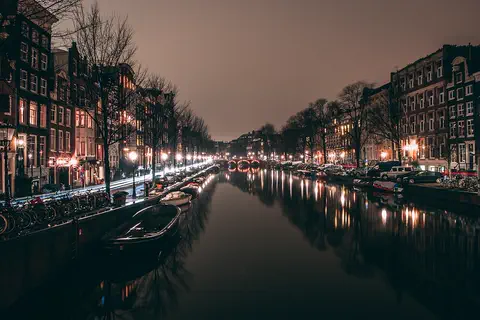
Amsterdam is the capital of the Netherlands. It began as a fishing village beside a dam on the Amstel River, which gave the city its name. Today about 942,000 people live among its rings of canals, hundreds of bridges, houseboats and bicycles.
-
 Watch
City
Antwerp
Antwerp is a city in Belgium on the Scheldt river, and Universalis calls it the second port of continental Europe, after Rotterdam. Belgium's statistics office estimated 565,615 people in the city on 1 January 2026. In the 1500s it was one of Europe's great trading cities.
-
 Watch
City
Athens
Athens is the capital of Greece and one of the oldest cities in the world. Above it rises the Acropolis, a rocky hill crowned by the marble Parthenon, built about 2,500 years ago. Ancient Athens was home to early democracy, great thinkers and theater.
-
 Watch
City
Barcelona
Barcelona, the capital of Catalonia in northeastern Spain, lies on the Mediterranean between mountains and the sea. It is famous for the buildings of the architect Antoni Gaudí, including the Sagrada Família, a giant church begun in 1882. About 1.7 million people live in the city (2025).
For parents & teachers
What children will learn
- Locate Gdańsk on Poland's Baltic coast.
- Explain what the Hanseatic League was and why ports joined it.
- Describe how three neighboring cities can work as one metropolitan area.
- Read a climate with cold winters, mild summers and many wet days.
Recommended ages: 3 to 17 · About 15 minutes
Talk about it
- Merchants made Gdańsk rich long ago. What do you think ships carried in and out of a busy port?
- Gdańsk, Gdynia and Sopot are linked by fast trains. How would your day change if a train came every ten minutes?
- Gdańsk gets rain or snow on about half the days of the year but not much in total. How can that be?
Try at home or in class
- Weather chart: plot Gdańsk's monthly highs and lows, and shade the months below freezing.
- House facades: draw a row of tall gabled houses from the photo and color each one differently.
- Tricity map: mark Gdańsk, Sopot and Gdynia on a map of the Baltic coast and draw the railway between them.
Key vocabulary: port, Hanseatic League, voivodeship, embankment, gable, precipitation
Where these facts come from
- Wikidata , Wikimedia Foundation (CC0 1.0)
- Natural Earth vector data , Natural Earth (NACIS) (Public domain)
- Pomorskie (Poland): counties, census results and estimates , City Population (Thomas Brinkhoff), from Statistics Poland
- Gdańsk , Encyclopaedia Universalis
- Gdańsk Tram , UrbanRail.Net (Robert Schwandl)
- World Weather Information Service: Gdansk climatological information , World Meteorological Organization
- File:Calle Dlugie Pobrzeze, Gdansk, Polonia, 2013-05-20, DD 05.jpg (Diego Delso, May 2013) , Wikimedia Commons
- Wikimedia Commons , Wikimedia Foundation (Per file (public domain, CC0, CC BY or CC BY-SA); see each media record)
Checked, not yet human-reviewed. Last updated November 1, 2026. Spotted a mistake? Tell us.