
Landmark Europe
Brandenburg Gate
The Brandenburg Gate is a big stone gate in Berlin, Germany. A statue of four horses pulling a chariot stands on top. For many years, a wall kept people away from it.
The Brandenburg Gate is a grand sandstone gateway in the center of Berlin, built from 1788 to 1791 with 12 columns and five passages. On top, a statue called the Quadriga shows a chariot pulled by four horses. From 1961 to 1989 the Berlin Wall shut it off, so the gate became a symbol first of a divided Germany and then of its reunification.
Commissioned by Frederick William II and built in 1788 to 1791 to designs by Carl Gotthard Langhans, after the Propylaea in Athens, Berlin's only surviving town gate carries Gottfried Schadow's Quadriga of 1793. Taken to Paris by Napoleon, wrecked in World War II, walled off from 1961 and reopened on December 22, 1989, it now stands for German unity.
Photo: Thomas Wolf, CC BY-SA 3.0, via Wikimedia Commons
Discover the Brandenburg Gate
The Brandenburg Gate is in Berlin, the capital city of Germany.
It is a giant gate made of stone, with tall columns. On top is a statue of four horses pulling a chariot. Lots of visitors come to take pictures there.
The Brandenburg Gate stands on Pariser Platz, a square in the center of Berlin, at the western end of a grand avenue called Unter den Linden. It is the only town gate of old Berlin still standing.
The gate is made of sandstone, a stone made of sand grains pressed together. Twelve columns form five passages, and the middle one was once used only by the royal family. Britannica gives its size as about 20 meters high and 65 meters wide. On top stands the Quadriga, a statue of a chariot pulled by four horses side by side. Berlin's official website calls the gate the city's most famous landmark.
Britannica calls the Brandenburg Gate the only remaining town gate of Berlin, standing at the western end of Unter den Linden; Berlin's official site places it on Pariser Platz and calls it the city's most famous landmark, once a symbol of division and now a national symbol of peace and unity.
The sandstone structure has 12 Doric columns forming five passages, the middle one originally reserved for royalty, and measures about 20 m high, 65 m wide and 11 m deep. Two small buildings beside it, Haus Liebermann and Haus Sommer, were built in the late 1990s by Josef Paul Kleihues to replace pavilions destroyed in World War II. The Quadriga, a two-wheeled chariot drawn by four horses abreast, crowns the attic.
- Built
- 1788 to 1791
- Architect
- Carl Gotthard Langhans
- Size
- about 20 m high, 65 m wide, 11 m deep
- Quadriga added
- 1793
A gate through history
A king had the gate built long ago.
Later, a French ruler named Napoleon took the horse statue away. It came back years later. Then a war badly damaged the gate. People fixed it again.
King Frederick William II of Prussia ordered the gate as a grand entrance to Unter den Linden, the avenue that led to the royal palace. It was built from 1788 to 1791, and the Quadriga was added in 1793.
In 1806 the French emperor Napoleon defeated Prussia and took the Quadriga to Paris. It was brought back in 1814. In World War II, bombs badly damaged the gate and the statue. The gate was repaired in the late 1950s, and a copy of the Quadriga was made from the original molds.
Frederick William II commissioned the gate as the entrance to Unter den Linden, which led to the Prussian palace. After Prussia's defeat in 1806, Napoleon carried the Quadriga off to Paris, where it remained until 1814, when the allied victory allowed its return. The Nazi regime later used the gate heavily in propaganda, holding a parade there when Hitler came to power in 1933.
World War II bombing severely damaged the gate and its sculpture. Britannica dates the restoration to 1957 to 1958, with the Quadriga recast from the original molds; Berlin's official site says the old sculpture was removed in 1956 during the reconstruction and replaced by a copy. Berlin.de counts three occasions on which the Quadriga has been taken down from the gate.
A gateway from ancient Greece
The gate's design came from ancient Greece.
Its builder copied the grand entrance of an old hilltop in Athens. He made the gate from sandstone. Its thick columns are very tall.
The architect, Carl Gotthard Langhans, based his design on the Propylaea, the grand gateway to the Acropolis in Athens, Greece. This style, copying ancient Greek and Roman buildings, is called classicism, and Berlin's official website calls the gate one of the most beautiful buildings of that style.
Langhans used thick Doric columns, the plainest kind of Greek column, with simple round tops. A sculptor named Johann Gottfried Schadow designed the decorations, carved pictures called reliefs, and the Quadriga on top.
Langhans modeled the gate on the Propylaea of the Athenian Acropolis, and Berlin's official site calls it widely considered one of the most beautiful buildings of classicism. Its 12 Doric columns, the plainest of the Greek orders, divide the gate into five passages.
Johann Gottfried Schadow designed the reliefs and sculptures, and the Quadriga placed on the roof in 1793. Berlin's official site says the chariot group was meant to symbolize peace entering the city; Britannica says its figure carries a symbol of peace. The figure driving the horses is an allegory of victory, a way of showing an idea as a person.
The Quadriga and the passages
On top of the gate are four metal horses.
They pull a chariot, a cart with two wheels. A figure with wings drives them. Under the gate are five ways through. The middle way was only for the royal family.
The Quadriga is the gate's most famous part. Quadriga means a chariot pulled by four horses running side by side. A winged figure stands in the chariot, holding the reins and a tall pole with a wreath and an eagle on top.
Below it, a band of carved pictures runs across the top of the gate. Between the columns are five passages. Long ago, only the royal family could use the wide middle passage. On each side of the gate stand smaller buildings with their own columns.
The Quadriga is a two-wheeled chariot drawn by four horses abreast, its driver a winged allegory of victory bearing a symbol of peace; in the photo, the staff she holds is topped by an eagle and a wreath. Berlin's official site says the group has been taken down three times: it went to Paris in 1806, was replaced by a copy in 1956, and had to be restored after the reunification celebrations of 1989 damaged it.
Beneath it run carved relief panels designed by Schadow. Of the five passages between the 12 Doric columns, the central and widest was originally reserved for royal use. Lower buildings with their own colonnades flank the gate on either side.
- Columns
- 12 Doric columns
- Passages
- 5; the middle one once only for royalty
- Quadriga taken down
- 3 times
From division to unity
For many years, a wall split the city of Berlin in two.
The gate was stuck next to the wall. Nobody could walk through it. Then the wall came down. A huge crowd cheered when the gate opened again!
After World War II, Germany was split into two countries, East and West, and in August 1961 the Berlin Wall was built across the city. The gate ended up in a closed zone by the wall, and neither East nor West Berliners could visit it.
In 1989 the Wall fell. On December 22, 1989, the gate was opened again, as more than 100,000 people cheered. It became a symbol of Germany coming together again. After almost two years of repairs, it was unveiled again on October 3, 2002, and today cars no longer drive through it.
From 1961 to 1989 the gate stood in the restricted zone of the Berlin Wall, closed to East and West Germans alike, and it came to symbolize a divided Germany. In 1987 U.S. President Ronald Reagan gave his speech calling on the Soviet leader Mikhail Gorbachev to tear down the wall with the gate as a backdrop.
On December 22, 1989, West German Chancellor Helmut Kohl walked through the reopened gate to meet East German Prime Minister Hans Modrow, with more than 100,000 people cheering; Britannica sees the event as heralding reunification. Sandstone in a city center weathers, and New Year's Eve fireworks caused lasting damage, so after a restoration of almost two years the gate was unveiled again on October 3, 2002. It remains closed to vehicles.
Amazing facts
-
The horse statue once went on a trip to Paris!
In 1806 Napoleon took the Quadriga from the top of the gate to Paris. It came back to Berlin eight years later.
Napoleon removed the Quadriga to Paris after defeating Prussia in 1806; it returned to the gate in 1814.
-
Long ago, only the royal family could use the middle way through the gate.
The gate's middle passage, the widest of the five, was once kept for the royal family only.
The central of the five passages was originally reserved for royal use.
-
When the gate opened again, a huge crowd cheered.
More than 100,000 people cheered when the gate was opened again on December 22, 1989.
The reopening of December 22, 1989, drew more than 100,000 people, and the celebrations damaged the Quadriga so badly that it had to be restored.
-
Fireworks hurt the gate's stones.
New Year's Eve fireworks over the gate damaged its sandstone, so it needed almost two years of repairs before 2002.
Weathering and the annual New Year's Eve fireworks caused lasting damage, prompting a restoration of almost two years completed on October 3, 2002.
Words to know
- quadriga
- a chariot pulled by four horses side by side, or a statue of one
- sandstone
- a rock made of grains of sand pressed and stuck together
- Doric column
- the plainest kind of ancient Greek column, with a simple round top
- classicism
- a style of art and building that copies ancient Greece and Rome
- relief
- a carved picture that stands out from a flat surface
- reunification
- joining back together something that was split apart
Discovery challenge
-
What stands on top of the Brandenburg Gate?
What is the statue on top of the Brandenburg Gate?
Which sculpture by Schadow crowns the gate?
- A lion
- Four horses pulling a chariot
- A giant clock
Show the answer
Four horses pulling a chariot
Four horses pulling a chariot! It is called the Quadriga.
The Quadriga, a chariot pulled by four horses side by side, added in 1793.
The Quadriga of 1793, a two-wheeled chariot drawn by four horses abreast.
-
Who took the horse statue to Paris?
Who carried the Quadriga off to Paris in 1806?
After defeating Prussia in 1806, who removed the Quadriga to Paris?
- Napoleon
- A museum
- A king of England
Show the answer
Napoleon
Napoleon! It came back years later.
The French emperor Napoleon. The statue came back to Berlin in 1814.
Napoleon; the allied victory allowed its return in 1814.
-
What kept people away from the gate for many years?
What closed off the Brandenburg Gate from 1961 to 1989?
What left the gate in a restricted zone from 1961 until December 1989?
- A river
- The Berlin Wall
- A forest
Show the answer
The Berlin Wall
A wall! It split the city in two.
The Berlin Wall. The gate opened again on December 22, 1989.
The Berlin Wall; the gate's reopening is seen as heralding German reunification.
-
How many ways through does the gate have?
How many passages do the gate's 12 columns make?
Into how many passages do the 12 Doric columns divide the gate?
- Two
- Five
- Twelve
Show the answer
Five
Five! The middle one is the widest.
Five. The middle one was once only for the royal family.
Five, the central one originally reserved for royalty.
Nearby places
-
Watch
City
Berlin
Berlin, the capital of Germany, grew from two small trading towns on the Spree River. From 1961 to 1989 the Berlin Wall divided it. Today about 3.7 million people live there (2025), among lakes, forests, museums and the Brandenburg Gate.
-
 Watch
City
Hamburg
Hamburg, in northern Germany, is the country's second-biggest city and one of Europe's largest ports. It grew from a castle built about 825 into a rich trading city on the Elbe River, with canals, a big lake and brick warehouses. About 1.9 million people lived there in 2025.
-
 Watch
City
Prague
Prague, the capital of the Czech Republic, lies on the Vltava River in the heart of Europe. With Prague Castle on its hill, the 14th-century Charles Bridge and so many church towers that it is called the 'City of a Hundred Spires', its historic center is a UNESCO World Heritage Site. About 1.4 million people lived there in 2025.
-
 Watch
City
Copenhagen
Copenhagen, the capital of Denmark, grew from a small harbor town into a royal city of palaces, canals and towers. Its name means "Merchants' Harbor." It has the Tivoli Gardens, opened in 1843, and the Little Mermaid statue, and about 673,000 people lived there in 2026.
-
 Watch
City
Munich
Munich is the capital of Bavaria, a state in southern Germany, and the country's third-biggest city. It began in 1158 as a market by a bridge over the Isar River, and its name means "Home of the Monks." Today it is famous for its palaces, art museums, the huge Deutsches Museum and its autumn Oktoberfest.
-
 Watch
City
Warsaw
Warsaw is the capital of Poland, on the Vistula River. Much of the city was destroyed in World War II, and afterward its people rebuilt the Old Town so carefully that UNESCO made it a World Heritage Site. About 1.86 million people lived there in 2024.
-
 Watch
City
Vienna
Vienna is the capital of Austria, on the Danube River. For centuries it was the home of emperors, and composers such as Haydn, Mozart and Beethoven lived and worked there. About 2 million people lived in the city at the start of 2026.
-
 Watch
City
Amsterdam
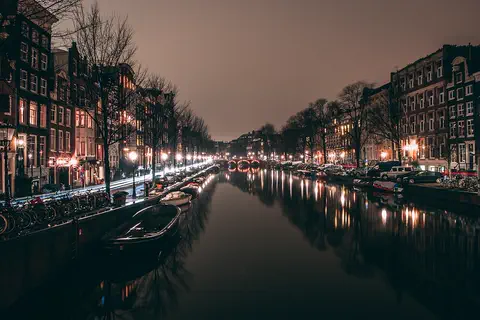
Amsterdam is the capital of the Netherlands. It began as a fishing village beside a dam on the Amstel River, which gave the city its name. Today about 942,000 people live among its rings of canals, hundreds of bridges, houseboats and bicycles.
Explore next
-
 Watch
 Country
Germany
Germany is a country in north-central Europe. The land rises from flat plains by the North Sea and the Baltic Sea to forested hills and, in the far south, the Alps. About 83.5 million people (2025) live there, and its capital is Berlin.
-
Watch
City
Berlin
Berlin, the capital of Germany, grew from two small trading towns on the Spree River. From 1961 to 1989 the Berlin Wall divided it. Today about 3.7 million people live there (2025), among lakes, forests, museums and the Brandenburg Gate.
-
 Watch
Landmark
Arc de Triomphe
The Arc de Triomphe is a huge stone arch at the top of the Champs-Élysées in Paris. Napoleon ordered it in 1806, but it took 30 years to finish. It is about 50 meters high and 45 meters wide, covered in giant carvings, and under it lies France's Tomb of the Unknown Soldier, with a flame that is rekindled every evening.
-
 Watch
Landmark
Parthenon
The Parthenon is an ancient Greek temple on the Acropolis, a rocky hill in Athens. Built of marble between 447 and 438 BCE, it has 46 outer columns and was decorated with carvings. It has been a temple, a church and a mosque, and today experts are restoring it.
-
 Watch
Landmark
Acropolis of Athens
The Acropolis is a steep, flat-topped rock in the middle of Athens. Walls have ringed its top for more than 3,300 years. In the 400s BCE, the Athenians built a grand gateway and three temples there, including the Parthenon. Restorers are still repairing them today.
-
 Watch
Landmark
Alhambra
The Alhambra is a palace and fortress above the city of Granada, in Spain. The Nasrid rulers built most of it between 1238 and 1358. It is famous for its courtyards, fountains, carved plaster and tiles, and the gardens of the Generalife next door.
-
 Watch
Landmark
Big Ben
Big Ben is the nickname of the Great Bell inside the clock tower of the Houses of Parliament in London. The tower, 96 meters tall, was begun in 1843, and its clock started keeping time in 1859. Since 2012 the tower has been called the Elizabeth Tower.
-
 Watch
Landmark
British Museum
The British Museum in London was founded in 1753 and opened in 1759. It holds treasures from all over the world, like the Rosetta Stone, which helped people learn to read Egyptian hieroglyphs. Its grand building with columns was built from 1823 to 1847, and in 2025 it had more than 6.4 million visits.
For parents & teachers
What children will learn
- Locate the Brandenburg Gate in Berlin and describe its columns, passages and Quadriga.
- Explain that its design copies an ancient Greek gateway.
- Describe how the gate was closed off by the Berlin Wall and reopened in 1989.
- Discuss how one monument can stand for division and then for unity.
Recommended ages: 3 to 17 · About 15 minutes
Talk about it
- The gate was once a symbol of a divided city and is now a symbol of unity. How can the meaning of a place change?
- Why do you think the middle passage was kept for the royal family?
- Fireworks and city air damage old stone. How should a city balance celebrations with protecting its monuments?
Try at home or in class
- Build a gate from six cardboard tubes in a row with a strip of card across the top, and count the passages between them.
- Rub a piece of sandstone, brick or sandpaper and look at the grains with a magnifying glass to see what sandstone is made of.
Key vocabulary: quadriga, sandstone, Doric column, classicism, relief, reunification
Where these facts come from
- Wikidata , Wikimedia Foundation (CC0 1.0)
- Brandenburg Gate , Encyclopaedia Britannica
- Brandenburg Gate , Berlin.de, the official website of Berlin
- Wikimedia Commons , Wikimedia Foundation (Per file (public domain, CC0, CC BY or CC BY-SA); see each media record)
Checked, not yet human-reviewed. Last updated October 27, 2026. Spotted a mistake? Tell us.