
Natural wonder Europe
Białowieża Forest
Białowieża Forest is a natural forest in Poland and Belarus. European bison live there.
Białowieża Forest is a forest of conifers and broadleaved trees in Poland and Belarus. UNESCO calls it an immense range of primary forest, and it is home to the largest free-roaming population of European bison.
Białowieża Forest is a World Heritage forest complex in Poland and Belarus: 141,885 ha of lowland forest of the Central European mixed forests ecoregion, on the watershed between the Baltic Sea and the Black Sea. UNESCO values its extensive old-growth stands, its dead wood and fungi, and the largest free-roaming population of European bison.
Photo: Henryk Kotowski at English Wikipedia, CC BY-SA 3.0, via Wikimedia Commons
Discover Białowieża Forest
Białowieża Forest is in Poland and Belarus, in Europe. It is one of the places where European bison live.
In this photo, a European bison walks across green grass, with a tree trunk behind it.
Białowieża Forest lies in Poland and Belarus. UNESCO describes it as an immense range of primary forest, with conifers and broadleaved trees, covering 141,885 hectares as a World Heritage site.
This photo by Henryk Kotowski shows a European bison, also called a wisent or żubr, in Białowieża, Poland. It walks across the grass with a tree trunk behind it.
UNESCO's World Heritage site covers 141,885 ha of primary forest, conifers and broadleaved trees, on the watershed of the Baltic Sea and the Black Sea, with a buffer zone of 166,708 ha. It was first listed in 1979 and enlarged in 1992 and 2014.
The hero photo (Henryk Kotowski, GFDL and CC BY-SA 3.0) shows a European bison (Bison bonasus) photographed in Białowieża, Poland, walking across grass.
- World Heritage area
- 141,885 ha
- Trees
- conifers and broadleaved trees
- Symbol
- the European bison
A forest left to grow naturally
People have protected this forest for a very long time.
Dead trees stay in the forest, standing up or lying down.
UNESCO says that, thanks to protection over several ages, the forest has survived in its natural state. Its extensive undisturbed areas let natural processes carry on.
In these areas, dead trees stay where they are, standing or lying on the ground. All this dead wood feeds many kinds of fungi and invertebrates (animals without backbones).
The Białowieża National Park says the forest was a royal hunting area for centuries and so avoided the logging that removed other forests; in its strictly protected area, natural processes only slightly disturbed by people have never been interrupted. UNESCO credits several ages of protection for its natural state.
UNESCO describes extensive undisturbed areas where natural processes are ongoing; one result is the richness of dead wood, standing and on the ground, and a high diversity of fungi and saproxylic (dead-wood-dependent) invertebrates.
Wolves, lynx and thousands of other species
Wolves, lynx and otters live in the forest.
Beavers and many kinds of birds live here too.
UNESCO counts 59 kinds of mammals, more than 250 kinds of birds, 13 amphibians, 7 reptiles and more than 12,000 kinds of invertebrates. UNESCO says the forest supports complete food webs, including wolves, lynx and otters.
On the park's Wolf's Trail, visitors may see beavers and birds of prey over the Narewka River valley, and an oak about 350 years old.
UNESCO lists 59 mammal species, over 250 birds, 13 amphibians, 7 reptiles and over 12,000 invertebrates, plus a diverse flora and notable fungi; several new species have been described here. Besides forest it protects wet meadows, river valleys and other wetlands, and its integral forest area supports complete food webs, including large carnivores (wolf, lynx and otter).
Along the national park's Wolf's Trail, the park mentions beavers and birds of prey over the Narewka valley, a raised bog and an oak more than five and a half meters around that has grown for about 350 years.
Home of the European bison
The European bison is the biggest land mammal in Europe.
People brought bison back to this forest, and now many walk free here.
The Białowieża National Park calls the European bison the largest land mammal in Europe and the park's symbol. The forest was the lowland bison's last refuge, and it was here that people began returning bison to the wild.
The park says the Polish part of the forest now has the largest free population of European bison in the world, about 800 animals.
The national park calls the forest the lowland European bison's last refuge and the place where its restitution (return to nature) began. The European Bison Pedigree Book, published by the park, has its origins in the 1930s, when international work began to restore a species already extinct in the wild; a census of the surviving pure-bred animals in zoos and private collections was made in 1931.
Today the park reports about 800 free-living bison in the Polish part of the forest (about 62,000 ha). UNESCO gives about 900 in the whole World Heritage site: almost 25% of the world's population and over 30% of free-living bison.
Visiting safely
Stay on the paths in the forest.
Do not go into the forest at night or in a storm or strong wind.
The Białowieża National Park asks visitors to stay on its designated trails and paths. It does not allow visits to the forest at night, from half an hour after sunset to half an hour before sunrise, or during storms and strong wind.
The most strictly protected part can be visited only with a guide licensed by the park, in groups of up to 10 people.
Park rules forbid being in the forest at night (half an hour after sunset to half an hour before sunrise, with a September exception at the Kosy Most bison viewing area), during storms and strong wind, and off the designated routes, trails and nature paths.
The strictly protected zone (the former Strict Reserve) is open only on a set route with a guide licensed by the park director, in groups of at most 10. The park says bison are easiest to see from the Wolf's Trail viewing point in autumn and winter.
Amazing facts
-
The European bison is the biggest land mammal in Europe.
The Białowieża National Park calls the European bison the largest land mammal in Europe, and it is the park's symbol.
The national park's logo is the European bison, which it calls the largest terrestrial mammal in Europe.
-
More than 12,000 kinds of insects and other animals without backbones live here.
UNESCO counts more than 12,000 kinds of invertebrates in Białowieża Forest.
UNESCO lists over 12,000 invertebrate species; the forest's standing and fallen dead wood supports a high diversity of saproxylic (dead-wood-dependent) invertebrates.
-
One oak tree in the park is about 350 years old.
On the park's Wolf's Trail grows an oak about 350 years old, more than five and a half meters around.
The Wolf's Trail passes an oak with a circumference of more than 5.5 m that has been growing for about 350 years.
Words to know
- old-growth forest
- a forest that has grown for a very long time without being cut down
- primary forest
- a forest that has stayed natural and was never cleared by people
- European bison
- Europe's largest land mammal, also called the wisent or żubr
- fungi
- living things such as mushrooms and molds that break down dead plants and wood
- invertebrate
- an animal without a backbone, such as an insect, spider or snail
Discovery challenge
-
Which big animal is the symbol of Białowieża Forest?
Which animal is the symbol of the Białowieża National Park?
Which species does the Białowieża National Park use as its symbol and call Europe's largest land mammal?
- The European bison
- The polar bear
- The camel
Show the answer
The European bison
The European bison.
The European bison, also called the wisent or żubr.
The European bison (Bison bonasus).
-
What happens to trees that die in this forest?
What happens to dead trees in Białowieża Forest's undisturbed areas?
What does UNESCO say results from the forest's undisturbed natural processes?
- They stay, standing or on the ground, and feed fungi
- They are all taken away at once
- They turn into stone
Show the answer
They stay, standing or on the ground, and feed fungi
They stay and feed mushrooms and bugs.
They stay, standing or lying down, and feed many fungi and invertebrates.
A richness of dead wood, standing and on the ground, and a high diversity of fungi and saproxylic invertebrates.
-
In which two countries is Białowieża Forest?
Which two countries is Białowieża Forest in?
Which two countries does UNESCO list for the Białowieża Forest World Heritage site?
- Poland and Belarus
- Spain and Portugal
- Norway and Sweden
Show the answer
Poland and Belarus
Poland and Belarus.
Poland and Belarus, in Europe.
Belarus and Poland (UNESCO).
-
About how many bison walk free in the Polish part of the forest?
About how many free-living European bison does the park count in the Polish part of the forest?
What free-living population does the Białowieża National Park give for the Polish part of the forest?
- About 800
- About 8
- About 80,000
Show the answer
About 800
About 800.
About 800, the largest free population in the world.
About 800 animals, the most numerous free population of European bison in the world (national park).
-
Where should you walk in the forest?
Where does the park ask visitors to walk?
What do the park's visiting rules say about where visitors may go?
- On the park's own trails and paths
- Anywhere, even at night
- Off the paths, in the strict zone alone
Show the answer
On the park's own trails and paths
On the paths.
On its designated trails and paths, and not at night.
Only on designated routes, trails and nature paths; the strict zone only with a licensed guide.
Nearby places
-
 Watch
City
Warsaw
Warsaw is the capital of Poland, on the Vistula River. Much of the city was destroyed in World War II, and afterward its people rebuilt the Old Town so carefully that UNESCO made it a World Heritage Site. About 1.86 million people lived there in 2024.
-
 Watch
City
Vilnius
Vilnius, the capital of Lithuania, grew where the Vilnia River flows into the Neris, below a castle on a hill. It was first written about in 1323, when it was already the capital of a huge state, and its old town of Gothic, Renaissance and Baroque buildings is a UNESCO World Heritage Site. About 618,000 people lived there in 2026.
-
 Watch
City
Minsk
Minsk, the capital of Belarus, lies on the Svislach River near the middle of the country. First written about in 1067, it was almost completely destroyed in World War II and rebuilt with wide avenues, parks and apartment blocks. About 2 million people lived there in 2026.
-
 Watch
City
Lviv
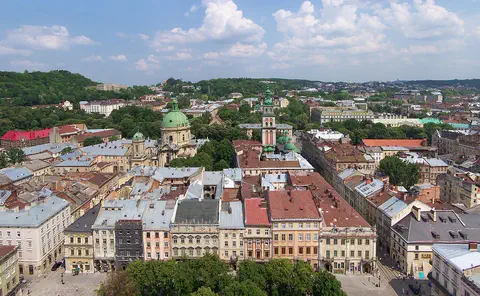
Lviv is a city in western Ukraine, founded in 1256 and named after Lev, a prince's son. Its old center, with a market square, castle hill and churches of many kinds, is on UNESCO's World Heritage List. Ukraine's statistics service estimated 717,273 people there at the start of 2022.
-
 Watch
Landmark
Malbork Castle
Malbork Castle is a huge castle made of brick, beside the Nogat River in northern Poland. It was built in the Middle Ages by the Teutonic Order and became the seat of the order's leader, the Grand Master. Today it is a museum and a World Heritage Site.
-
 Watch
City
Gdańsk
Gdańsk is a port city on Poland's Baltic coast and the capital of the Pomeranian Voivodeship. From the 13th to the 17th century it was one of Europe's great trading places. Statistics Poland estimated 489,328 people in the city at the end of 2025.
-
 Watch
City
Kraków
Kraków is a city in southern Poland on the Vistula River. For almost three centuries it was the capital of Poland, where kings were crowned and buried at Wawel Hill. Its historic center is a UNESCO World Heritage Site, and about 816,600 people lived in the city at the end of 2025.
-
 Watch
City
Riga
Riga is the capital of Latvia, on the Daugava River about 15 kilometers from the Gulf of Riga. Founded in 1201, it grew rich as a trading port, and UNESCO lists its historic center for its Art Nouveau buildings. Latvia's statistics bureau gives 588,911 people at the start of 2026.
Explore next
-
 Watch
Animal
European bison
The European bison, also called the wisent, is a huge plant-eater with a hump on its shoulders, a beard on its chin and horns that curve upward. About 100 years ago it disappeared from the wild completely. Bison kept in zoos and parks were bred and set free again, and today herds roam forests and meadows in ten European countries. It is listed as Near Threatened.
-
 Watch
Natural wonder
Black Forest
The Black Forest is a range of forested mountains in the German state of Baden-Württemberg. Its core is gneiss and granite, covered in places by a sandstone called Buntsandstein, and it rises steeply from the Rhine valley on its west side. Its highest peak, the Feldberg, reaches 1,493 meters, and a national park lets part of its forest grow wild.
-
 Watch
Natural wonder
Carpathians
The Carpathians are a long mountain range in Europe, shared by seven countries that protect it together under the Carpathian Convention. They hold some of Europe's last untouched forests, nearly 4,000 kinds of plants and big populations of brown bears, wolves and lynxes.
-
Watch
 Country
Poland
Poland lies near the center of Europe, between the Baltic Sea and the Carpathian Mountains. Most of it is low, flat land shaped by Ice Age glaciers, and about 37 million people live there. Its capital, Warsaw, stands on the Vistula River.
-
 Watch
 Country
Belarus
Belarus is a landlocked country in eastern Europe. Ice sheets of the last ice age shaped its low hills and wide plains, it has more than 10,000 lakes and one of Europe's largest wetlands, and about 9.1 million people lived there in 2025.
- Watch Geography National parks and protected areas Countries set aside land and sea as national parks and other protected areas, so that wildlife, forests, reefs and wonderful landscapes are looked after. Yellowstone became the first national park in 1872. Today about 18 percent of the world's land is protected, and countries have agreed to aim for 30 percent by 2030.
- Watch Geography Biomes A biome is a huge area of the world with its own climate, soil, plants and animals. National Geographic names five major types: aquatic (water), grassland, forest, desert and tundra. Each biome's plants and animals are suited to its climate, so how warm it is and how much rain falls decide which biome grows where.
-
 Watch
Natural wonder
Virgin Komi Forests
The Virgin Komi Forests in Russia cover 3.28 million hectares of forest, tundra and mountain tundra on the western side of the northern Ural Mountains. UNESCO calls them one of the largest areas of untouched boreal forest, or taiga, left in Europe, and scientists have studied them for more than 50 years.
For parents & teachers
What children will learn
- Locate Białowieża Forest in Poland and Belarus.
- Explain why dead wood matters in a natural forest.
- Describe how the European bison was brought back to the wild.
- Know the park's rules for visiting safely.
Recommended ages: 3 to 17 · About 15 minutes
Talk about it
- Why might a forest with lots of dead wood have more kinds of fungi and insects?
- Why do you think people kept a careful record of every European bison?
- Why might a park allow visitors into its most protected part only with a guide?
Try at home or in class
- Find a fallen log or a piece of old wood outdoors, and with a grown-up look underneath for fungi, beetles or other small creatures, then put it back as you found it.
- On a map of Europe, find Poland and Belarus, then the Baltic Sea and the Black Sea: the forest sits on the watershed, the dividing line between rivers flowing to each sea.
Key vocabulary: old-growth forest, primary forest, European bison, fungi, invertebrate
Where these facts come from
- Wikidata , Wikimedia Foundation (CC0 1.0)
- Białowieża Forest (World Heritage List) , UNESCO World Heritage Centre
- Białowieża National Park , Białowieża National Park (Białowieski Park Narodowy)
- Zasady zwiedzania BPN (visiting rules) , Białowieża National Park (Białowieski Park Narodowy)
- File:Wisent.jpg , Wikimedia Commons
- UNESCO World Heritage List , UNESCO World Heritage Centre (Linked as a reference; site facts come from Wikidata)
- Wikimedia Commons , Wikimedia Foundation (Per file (public domain, CC0, CC BY or CC BY-SA); see each media record)
Checked, not yet human-reviewed. Last updated November 1, 2026. Spotted a mistake? Tell us.