
City Europe
Saint Petersburg
Saint Petersburg is a big city in Russia. It is built on islands where a river meets the sea. It has palaces, canals and lots of bridges. In summer, the nights stay light.
Saint Petersburg, in northwestern Russia, was founded by Tsar Peter the Great in 1703 on the islands of the Neva River delta. It was Russia's capital from 1712 to 1918 and is famous for the Winter Palace and Hermitage museum, its canals and bridges and its 'White Nights'. About 5.65 million people lived there in 2025.
Saint Petersburg, Russia's second-largest city, was founded by Peter I in 1703 as his 'window on Europe' on 42 islands of the Neva delta, at the head of the Gulf of Finland. Capital of the Russian Empire from 1712 to 1918, it was the stage of the 1917 revolutions, endured the 872-day siege of 1941–44 as Leningrad, and took back its original name in 1991. Its historic center has been a World Heritage Site since 1990.
Photo: W. Bulach, CC BY-SA 4.0, via Wikimedia Commons
Discover Saint Petersburg
Saint Petersburg is a big city in Russia.
It is built on many islands where a river meets the sea. Boats sail along its canals. Beautiful palaces line the river.
Saint Petersburg is the second-biggest city in Russia, in the far northwest of the country, about 640 kilometers from Moscow. It spreads across 42 islands in the delta of the Neva River, where the river flows into the Gulf of Finland, an arm of the Baltic Sea. About 5.65 million people lived there in 2025.
For two centuries, from 1712 to 1918, it was the capital of the Russian Empire. Its rivers, canals and bridges have earned it the nickname "Venice of the North," and it is often called Russia's cultural capital.
Saint Petersburg lies in the extreme northwest of Russia, about 640 km northwest of Moscow and only about 7° south of the Arctic Circle, on 42 islands of the Neva delta and the neighboring floodplain at the head of the Gulf of Finland. The city covers about 1,400 km²; Britannica gives 5,601,911 people in 2021 and an estimated 5,652,922 in 2025.
Britannica singles out three traits: a harmonious mix of western European and Russian architecture; the lack of a single center such as a kremlin, which most Russian cities of medieval origin have; and its many waterways, the short, full-flowing arms and canals of the Neva that earned it the name 'Venice of the North'. It ranks it as one of Europe's most splendid cities, Russia's unofficial cultural capital and, in its own eyes, its most European city.
- Country
- Russia
- People (2025 estimate)
- 5,652,922
- Area
- 1,400 km²
- Capital of Russia
- 1712–1918

Famous places
Saint Petersburg has a giant green and white palace.
It is called the Winter Palace. Kings and queens called tsars once lived there. Now it is part of a huge art museum, the Hermitage. Across the river is an old fort with a tall golden spire.
The Winter Palace, built from 1754 to 1762, was the main home of Russia's rulers, the tsars. Its white columns stand out against green walls, and 176 statues line its roof. Today it is part of the Hermitage, a world-famous art museum that began in 1764 as the private collection of Empress Catherine II. In Palace Square in front stands the Alexander Column, 50 meters tall.
Across the river, the Peter-Paul Fortress was the city's very first building, begun in 1703. The slender golden spire of its cathedral rises above the walls. The huge golden dome of St. Isaac's Cathedral, 101 meters high, can be seen all over the city.
The Admiralty, nucleus of Peter's city, was rebuilt in 1806–23 by Andreyan Zakharov; its spire, topped by a ship-shaped weather vane, is a principal landmark. To the east, Palace Square, the oldest, holds the Alexander Column (1830–34), a 600-ton granite monolith 50 m high whose base is not fastened. Rastrelli's Baroque Winter Palace (1754–62), the fifth on the site, was gutted by fire in 1837 and recreated almost exactly by 1839; with the adjoining buildings it forms the State Hermitage Museum, a collection of world significance begun by Catherine II in 1764. Rossi's General Staff building (1811–29) curves opposite.
The Peter-Paul Fortress (1703), the city's first structure, gained stone walls 12 m high; Trezzini's Cathedral of St. Peter and St. Paul (1712–33), with its arrowlike golden spire, holds the tombs of nearly all the tsars from Peter onward. Montferrand's St. Isaac's (1818–58), one of the largest domed buildings in the world, now a museum, has a cupola gilded with about 100 kg of gold rising to 101 m. Nevsky Prospekt, the main avenue, runs past the Kazan Cathedral (1801–11). UNESCO notes more than 400 bridges.
- Winter Palace
- built 1754–62; now part of the Hermitage
- Peter-Paul Fortress
- founded 1703, the city's first structure
- St. Isaac's Cathedral dome
- 101 m high, gilded with about 100 kg of gold
- Alexander Column
- 50 m, a 600-ton granite monolith
Peter's window on Europe
More than 300 years ago, a Russian ruler named Peter wanted a city by the sea.
He built a fort on an island in 1703. Workers dug canals and built palaces. The city became Russia's capital for 200 years.
In 1703, during a war with Sweden, Tsar Peter I, known as Peter the Great, won control of the Neva delta. On May 27, 1703, he laid the foundation of the Peter-Paul Fortress, and around it he built a new city as Russia's "window on Europe." In 1712 he moved the capital here from Moscow. Workers and builders came from all over Russia and from abroad, and canals were dug to drain the marshes.
The city grew into one of Europe's grandest. In 1914 it was renamed Petrograd, and in 1917 two revolutions began here. The capital moved back to Moscow in 1918. As Leningrad, the city survived a long siege in World War II, and in 1991 its people voted to bring back the name Saint Petersburg.
Russians settled the region in the 8th or 9th century; Sweden annexed it in 1617. In the Second Northern War, Peter I took the Swedish fortress of Nienshants and laid the Peter-Paul Fortress's foundation stones on May 16 (May 27, New Style), 1703, the accepted founding date. He moved the capital from Moscow in 1712, compelled nobles and merchants to build there and diverted trade from Arkhangelsk; by 1726 the port handled 90 percent of Russia's foreign trade. Marshy land and a harsh climate made construction costly in human life.
Rastrelli's Baroque and the Neoclassicism of Quarenghi and Rossi shaped the city; the university was founded in 1724. Russia's first railway ran from the city in 1837. Renamed Petrograd in 1914, it saw the February and October revolutions of 1917; the capital returned to Moscow in March 1918, and in 1924 the city became Leningrad. German forces blockaded it for 872 days, from September 8, 1941, to January 27, 1944; an estimated 660,000 people died, many of starvation, with supplies coming over the ice of Lake Ladoga. In a June 1991 referendum, voters restored the name Saint Petersburg.

Getting around Saint Petersburg
Saint Petersburg has hundreds of bridges.
Boats glide along the river and canals. Trains run under the ground. In winter, the river freezes and big icebreaker ships break the ice.
Water is everywhere in Saint Petersburg, and so are bridges: UNESCO counts more than 400. Boats travel along the Neva and the canals, and the city's port is the largest in Russia. In winter the Neva freezes, usually from mid-November until April, and icebreakers keep ships moving.
On land, people ride the Metro, opened in 1955, and buses, streetcars and trolleybuses. Russia's very first railway ran from Saint Petersburg in 1837, and trains leave from several big stations for Moscow and other cities.
Britannica calls Saint Petersburg one of Russia's most important transport hubs. Its port, the country's largest, is reached by a dredged channel from Kronshtadt; from the Neva, smaller seagoing ships reach Lake Ladoga and the inland waterways of European Russia, including routes to the White Sea, the Volga and the Caspian. Pulkovo International Airport lies 18 km south.
Russia's first railway ran from the city to Tsarskoye Selo in 1837, and the line to Moscow opened in 1851; Britannica lists trunk lines radiating to Helsinki, Warsaw and Moscow from the Moscow, Vitebsk, Baltic and Finland stations, and electric suburban trains serve the satellite towns. In the city, a subway (1955) and bus, streetcar and trolleybus networks carry traffic. The Neva normally freezes by early December and breaks up in April; icebreakers prolong navigation.
- Metro (subway)
- opened 1955
- Port
- Russia's largest
- Pulkovo International Airport
- 18 km south of the city
- First railway in Russia
- 1837, to Tsarskoye Selo
Weather and seasons
Winters in Saint Petersburg are long and snowy.
In summer, the sky stays light almost all night! These are called the White Nights. People stay up late to enjoy them.
Saint Petersburg is far north, so winters are cold: in January, the average daily high is about −5 °C and the low about −11 °C, and snow covers the ground for about 132 days a year. Summers are mild, with July highs around 22 °C.
Because the city is so far north, from June 11 to July 2 daylight lasts nearly 19 hours. These are the famous White Nights, celebrated with music and theater festivals. Summer is also the wettest season.
The Atlantic gives Saint Petersburg a milder climate than its latitude suggests, though winters are cold: Britannica gives a mean January temperature of about −6 °C, a few degrees warmer than Moscow's, a July average of 18 °C and about 634 mm of precipitation a year, wettest in summer. The World Meteorological Organization lists mean daily maxima and minima of −5.1 °C and −10.7 °C in January and 21.9 °C and 13.9 °C in July. Snow lies about 132 days.
The low, marshy site floods, especially in autumn, when cyclonic winds drive gulf water upstream; severe floods struck in 1777, 1824 and 1924. A 29 km dike across the Gulf of Finland was built from the 1980s to hold back storm surges. From June 11 to July 2, the White Nights bring nearly 19 hours of daylight, marked by festivals of the Mariinsky and Hermitage theaters.
- January, average daily high and low
- about −5 °C and −11 °C
- July, average daily high and low
- about 22 °C and 14 °C
- White Nights
- June 11 to July 2, nearly 19 hours of daylight
Living in Saint Petersburg
Saint Petersburg is a city of music, ballet and museums.
Dancers leap across the stage at the theater. Families visit palaces with huge fountains. Big ships are built in the city's shipyards.
Saint Petersburg has a long history of music, dance and books. Russia's first ballet school opened here in 1738, and its first music conservatory in 1862, where works by Tchaikovsky and Rimsky-Korsakov were first performed. The Mariinsky Theatre is famous around the world for opera and ballet. Writers such as Pushkin and Dostoyevsky are linked with the city, and Dostoyevsky set his novel Crime and Punishment here.
Outside the city, the palace of Peterhof has a Grand Cascade of 64 fountains running down to the sea. The city builds ships, including icebreakers, and it is home to the tallest building in Europe, the 87-story Lakhta Centre.
Britannica describes Saint Petersburg as one of Russia's leading centers of education and science, with the second-largest concentration of universities in the country, led by St. Petersburg State University (1724), the Academy of Arts (1757) and the Institute of Mines (1773), and as Russia's main center for Arctic research. The Mariinsky (Kirov in Soviet times) has an international reputation, and the Hermitage and the State Russian Museum are of international prominence.
Shipbuilding, the city's original industry, still produces icebreakers (some nuclear-powered), tankers and other vessels, alongside engineering and food processing. About one-fifth of residents still live in communal apartments, where families share a kitchen and bathroom. Peterhof's Great Palace (1714–28, enlarged by Rastrelli) overlooks the Grand Cascade with its grotto and 64 fountains, and Tsarskoye Selo (Pushkin) holds the Catherine Palace. The 87-story Lakhta Centre is the tallest building in Russia and Europe.
- St. Petersburg State University
- founded 1724
- First ballet school in Russia
- 1738
- First music conservatory in Russia
- 1862
Saint Petersburg on the map
Find Saint Petersburg on the globe.
It is in Russia, far in the north of Europe. Look for the long bay of the Baltic Sea. The city is at the very end of it.
Saint Petersburg is in the far northwest of Russia, at the eastern end of the Gulf of Finland, an arm of the Baltic Sea. It is only about 7 degrees of latitude south of the Arctic Circle.
The Neva River splits into several arms here before it reaches the sea, making 42 islands. The main avenue, Nevsky Prospekt, runs from the Admiralty to the Moscow Railway Station, and the palaces of Peterhof stand on the shore to the west.
Saint Petersburg lies at about 59.9° N and 30.3° E, at the head of the Gulf of Finland, where the Neva divides into distributaries around 42 islands. Central Saint Petersburg has four parts: the Admiralty Side on the south bank; Vasilyevsky Island between the Bolshaya and Malaya Neva; the Petrograd Side; and the Vyborg Side to the north and east.
Greater Saint Petersburg curves in a horseshoe around the head of the gulf, from Zelenogorsk on the northern shore, about 80 km away, to Peterhof and Lomonosov on the south, and includes Kotlin Island with Kronshtadt. Upstream, the Neva drains Lake Ladoga, linking the city to Russia's inland waterways.
- Latitude
- about 59.9° north
- Longitude
- about 30.3° east
- Islands in the delta
- 42
- Flood barrier across the gulf
- 29 km long
Amazing facts
-
A giant stone column in Saint Petersburg is not fastened at the bottom.
The Alexander Column is a single piece of granite weighing 600 tons, set so carefully that its base is not fastened.
The 600-ton granite monolith of the Alexander Column (1830–34), 50 m high, is so finely set that its base is not fastened.
-
The Hermitage museum began with one empress's art collection.
The Hermitage art collection began in 1764 as the private collection of Empress Catherine II.
The State Hermitage's collection, mostly of western European painting and sculpture, originated in 1764 as the private holdings of Catherine II.
-
Peterhof has a giant staircase of fountains.
At Peterhof, the Grand Cascade has 64 fountains and two cascading staircases.
Peterhof's Grand Cascade combines a grotto, 64 fountains and two cascading staircases leading to a great semicircular basin.
-
The Admiralty's spire has a little ship on top.
The spire of the Admiralty, where Peter's city began, is topped by a weather vane shaped like a ship.
The Admiralty spire, one of the city's principal landmarks, carries a ship-shaped weather vane; the building now houses a naval college.
-
Russia's first railway started in Saint Petersburg.
Russia's first railway opened in 1837, running from Saint Petersburg to the tsars' summer palace at Tsarskoye Selo.
The first Russian railway ran from Saint Petersburg to Tsarskoye Selo in 1837; the Moscow line followed, opening in 1851.
Words to know
- delta
- flat land at a river's mouth where the river splits into many channels
- tsar
- the title of Russia's emperors before 1917
- fortress
- a large, strongly built place for defending against attack
- canal
- a waterway dug by people for boats or drainage
- siege
- when an army surrounds a city and cuts it off from supplies
- icebreaker
- a strong ship that breaks through ice to keep a waterway open
- White Nights
- early-summer nights in the far north when the sky stays light
Discovery challenge
-
Who started the city of Saint Petersburg?
Which Russian ruler founded Saint Petersburg in 1703?
Which tsar laid the foundation of the Peter-Paul Fortress on May 27 (New Style), 1703?
- Peter the Great
- Catherine the Great
- Ivan the Terrible
Show the answer
Peter the Great
Peter the Great! He built a fort here in 1703.
Peter the Great, who wanted a 'window on Europe'.
Peter I, after taking the Swedish fortress of Nienshants.
-
What are the White Nights?
What happens during Saint Petersburg's White Nights?
What marks the White Nights from June 11 to July 2?
- The sky stays light almost all night
- Snow falls every night
- The river turns white
Show the answer
The sky stays light almost all night
The sky stays light! The sun hardly sets.
Daylight lasts nearly 19 hours, so nights stay light.
Nearly 19 hours of daylight, because the city is only about 7° south of the Arctic Circle.
-
What is the giant art museum in the Winter Palace called?
Which world-famous museum now includes the Winter Palace?
Which museum, begun as Catherine II's private collection in 1764, includes the Winter Palace?
- The Hermitage
- The Louvre
- The Prado
Show the answer
The Hermitage
The Hermitage! It has paintings and statues from all over the world.
The Hermitage, a treasury of mostly western European art.
The State Hermitage Museum.
-
What is Saint Petersburg built on?
Saint Petersburg spreads across how many islands of the Neva delta?
Across how many delta islands, plus the mainland floodplain, does the city spread?
- 42
- 3
- 1,000
Show the answer
42
42 islands! Bridges join them together.
42 islands, joined by hundreds of bridges.
42, at the head of the Gulf of Finland.
-
What did the city change back to in 1991?
In 1991, voters in Leningrad chose to bring back which name?
Which name did a June 1991 referendum restore to Leningrad?
- Saint Petersburg
- Moscow
- Petrograd
Show the answer
Saint Petersburg
Saint Petersburg, its old name!
Saint Petersburg, the city's original name.
Saint Petersburg; it had been Petrograd from 1914 and Leningrad from 1924.
Nearby places
-
 Watch
Landmark
Hermitage Museum
The Hermitage in Saint Petersburg is one of the world's great art museums. Empress Catherine the Great started it in 1764 as her private collection, and it opened to the public in 1852. Today it fills five connected buildings, including the green and white Winter Palace, and holds nearly three million objects, from the Stone Age to today.
-
 Watch
City
Helsinki
Helsinki is the capital of Finland, on a peninsula in the Gulf of Finland. Founded in 1550 and made the capital in 1812, it has white stone buildings, a sea fortress on islands, and the world's most northern metro. About 694,000 people lived there at the end of 2025.
-
 Watch
City
Tallinn
Tallinn, the capital of Estonia, lies on a bay of the Gulf of Finland. Its walled Old Town, with towers, church spires and a town hall finished in 1404, is, says UNESCO, an exceptionally complete and well-preserved medieval trading town, and today the city is also known for its technology companies.
-
 Watch
City
Moscow
Moscow, the capital of Russia, grew up on the Moscow River around a fortress called the Kremlin. About 13.3 million people lived there in 2025. Its rings of roads, snowy winters and palace-like subway stations make it like no other city.
-
Watch
Landmark
Moscow Kremlin
The Moscow Kremlin is the oldest part of Moscow. It began as a wooden fort on a hill by the Moskva River. Its present walls and towers were built from 1485 to 1516. Inside stand golden-domed cathedrals, palaces, a tall bell tower and museums.
-
 Watch
Landmark
St. Basil's Cathedral
St. Basil's Cathedral stands at the end of Red Square in Moscow. Tsar Ivan IV ordered it in 1555, and it was finished by 1561. It is really ten small churches in one building, each with its own colorful dome, and today it is a museum.
-
 Watch
City
Vilnius
Vilnius, the capital of Lithuania, grew where the Vilnia River flows into the Neris, below a castle on a hill. It was first written about in 1323, when it was already the capital of a huge state, and its old town of Gothic, Renaissance and Baroque buildings is a UNESCO World Heritage Site. About 618,000 people lived there in 2026.
-
 Watch
City
Stockholm
Stockholm, the capital of Sweden, is built on islands and the mainland where Lake Mälaren meets an arm of the Baltic Sea. First mentioned as a town in 1252, it has a medieval Old Town, a royal palace, a 17th-century warship you can visit and subway stations full of art. About 985,000 people lived there in 2022.
Explore next
-
Watch
 Country
Russia
Russia is the largest country in the world. It stretches across eastern Europe and all of northern Asia, through 11 time zones, from the Baltic Sea to the Pacific Ocean. It has frozen tundra, huge forests, Lake Baikal and the big cities of Moscow and Saint Petersburg.
-
Watch
Landmark
Hermitage Museum
The Hermitage in Saint Petersburg is one of the world's great art museums. Empress Catherine the Great started it in 1764 as her private collection, and it opened to the public in 1852. Today it fills five connected buildings, including the green and white Winter Palace, and holds nearly three million objects, from the Stone Age to today.
-
Watch
City
Moscow
Moscow, the capital of Russia, grew up on the Moscow River around a fortress called the Kremlin. About 13.3 million people lived there in 2025. Its rings of roads, snowy winters and palace-like subway stations make it like no other city.
-
Watch
City
Stockholm
Stockholm, the capital of Sweden, is built on islands and the mainland where Lake Mälaren meets an arm of the Baltic Sea. First mentioned as a town in 1252, it has a medieval Old Town, a royal palace, a 17th-century warship you can visit and subway stations full of art. About 985,000 people lived there in 2022.
-
Watch
City
Helsinki
Helsinki is the capital of Finland, on a peninsula in the Gulf of Finland. Founded in 1550 and made the capital in 1812, it has white stone buildings, a sea fortress on islands, and the world's most northern metro. About 694,000 people lived there at the end of 2025.
-
 Watch
City
Amsterdam
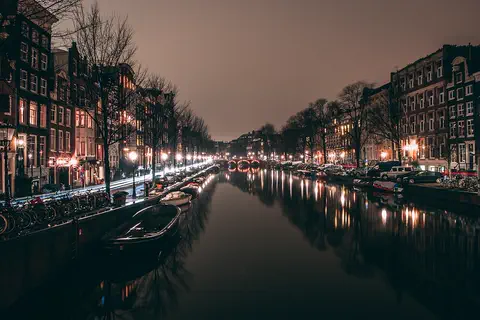
Amsterdam is the capital of the Netherlands. It began as a fishing village beside a dam on the Amstel River, which gave the city its name. Today about 942,000 people live among its rings of canals, hundreds of bridges, houseboats and bicycles.
-
 Watch
City
Athens
Athens is the capital of Greece and one of the oldest cities in the world. Above it rises the Acropolis, a rocky hill crowned by the marble Parthenon, built about 2,500 years ago. Ancient Athens was home to early democracy, great thinkers and theater.
-
 Watch
City
Barcelona
Barcelona, the capital of Catalonia in northeastern Spain, lies on the Mediterranean between mountains and the sea. It is famous for the buildings of the architect Antoni Gaudí, including the Sagrada Família, a giant church begun in 1882. About 1.7 million people live in the city (2025).
For parents & teachers
What children will learn
- Locate Saint Petersburg at the head of the Gulf of Finland in northwestern Russia.
- Explain why Peter the Great built a new capital on the Neva delta.
- Describe how a far-northern location causes the White Nights.
- Name some of the city's famous buildings, such as the Winter Palace and the Peter-Paul Fortress.
Recommended ages: 3 to 17 · About 15 minutes
Talk about it
- Peter the Great built a whole city on marshy islands. What problems would builders face, and how might they solve them?
- Saint Petersburg has had three names. Why do you think cities change their names?
- How would your day change if the sky stayed light until almost midnight?
Try at home or in class
- In a dark room, shine a flashlight on a globe while tilting it. Watch how places near the top stay lit longer as it turns.
- Build a city of islands from clay on a tray of water, then make bridges from craft sticks to join them.
Key vocabulary: delta, tsar, fortress, canal, siege, icebreaker, White Nights
Where these facts come from
- Wikidata , Wikimedia Foundation (CC0 1.0)
- Natural Earth vector data , Natural Earth (NACIS) (Public domain)
- St. Petersburg , Encyclopaedia Britannica
- St. Petersburg: City layout , Encyclopaedia Britannica
- St. Petersburg: Vasilyevsky Island and the Petrograd Side , Encyclopaedia Britannica
- St. Petersburg: Peterhof and other suburbs , Encyclopaedia Britannica
- St. Petersburg: People and economy , Encyclopaedia Britannica
- St. Petersburg: Administration and society , Encyclopaedia Britannica
- St. Petersburg: History , Encyclopaedia Britannica
- St. Petersburg: Evolution of the modern city , Encyclopaedia Britannica
- St. Petersburg: The Soviet period , Encyclopaedia Britannica
- Historic Centre of Saint Petersburg and Related Groups of Monuments , UNESCO World Heritage Centre
- St. Petersburg: climatological information , World Meteorological Organization, World Weather Information Service
- Wikimedia Commons , Wikimedia Foundation (Per file (public domain, CC0, CC BY or CC BY-SA); see each media record)
Checked, not yet human-reviewed. Last updated October 27, 2026. Spotted a mistake? Tell us.