
Landmark Europe
Stari Most
Stari Most means Old Bridge. It is a stone bridge with one high arch over a green river in the town of Mostar!
Stari Most, the Old Bridge, crosses the Neretva River in Mostar, Bosnia and Herzegovina, with a single stone arch. It was built in the 16th century, when the town was an Ottoman frontier town, and the town is even named after it. The bridge was rebuilt in 2004, and since 2005 its old town has been a World Heritage Site.
Designed, UNESCO says, by the architect Mimar Hajruddin after a design by his teacher Mimar Sinan, the Old Bridge of Mostar was rebuilt in stone in the 16th century and spans the Neretva with one arch between two watchtowers. UNESCO calls it an extraordinary technological achievement of bridge construction; rebuilt in 2004, it is the heart of a World Heritage Site inscribed in 2005.
Photo: Ramirez, CC BY-SA 4.0, via Wikimedia Commons
Discover Stari Most
Stari Most is in Mostar, a town in Bosnia and Herzegovina.
It crosses the Neretva River with just one big arch. Stone towers stand at its ends.
Stari Most crosses the Neretva River in the old center of Mostar, a town in a deep river valley in Bosnia and Herzegovina. Its name means Old Bridge.
The bridge is so important to the town that the town is named after it: UNESCO says the name Mostar comes from 'mostari', the bridge keepers. UNESCO calls the bridge an extraordinary achievement of bridge building.
UNESCO's Old Bridge Area of the Old City of Mostar, inscribed in 2005 under criterion (vi), covers 7.6 ha in the valley of the Neretva between Hum Hill and the foot of Velež Mountain, with the bridge at its center.
UNESCO calls the Old Bridge an extraordinary technological achievement of bridge construction and says the town takes its name from it: Mostar, first mentioned in 1474, comes from 'mostari', the bridge keepers.
- Where
- over the Neretva River, Mostar, Bosnia and Herzegovina
- Stone bridge
- 16th century
- Rebuilt
- 2004
- World Heritage
- Old Bridge Area of the Old City of Mostar, inscribed 2005
A bridge that named a town
Long ago, a small town grew up beside a bridge here. People called it Mostar, after the bridge keepers.
In the 1500s, the bridge was built in stone.
A small town grew up here in the 1400s where a road crossed the river. Written records already mention two towers by the bridge in 1459.
The town grew as an Ottoman frontier town. Between 1520 and 1566 it was fortified, and the bridge was rebuilt in stone. UNESCO credits the design to the architect Mimar Hajruddin, following a design by his teacher, the famous architect Mimar Sinan.
UNESCO describes a 15th-century settlement at the crossing of a river and a land road, with two towers around the bridge dated 1459 in written sources. Mostar developed in the 15th and 16th centuries as an Ottoman frontier town and later in a short Austro-Hungarian period in the 19th and 20th centuries.
ICOMOS notes that the town was fortified between 1520 and 1566 and that the bridge was rebuilt in stone; the late 16th and early 17th centuries were Mostar's most important period of growth. UNESCO names the designer as mimar Hajruddin, working to the design of his master-teacher, mimar Sinan.
One stone arch over the river
The bridge has only one arch. It jumps all the way across the river in a single curve!
The bridge you see today was built again in 2004, to look just like the old one.
Stari Most crosses the river in a single stone arch. Watchtowers stand over each end of the bridge.
The old bridge was destroyed in a conflict in the 1990s and rebuilt in 2004. UNESCO says the rebuilding followed the old bridge's size, shape and materials, so it looks as it did before.
ICOMOS names the Halebinovka and Tara towers as the Ottoman watchtowers over the ends of the Old Bridge, together with a stretch of the ramparts.
In UNESCO's words, most of the historic town and the Old Bridge were destroyed in the conflict of the 1990s, and the bridge was rebuilt in 2004 with the help of an international scientific committee set up by UNESCO. The reconstruction kept the original dimensions, forms, scale and materials, UNESCO says, so the bridge again testifies to the history of the Old City.
A town of many traditions
Around the bridge are old stone houses, little shops and streets.
For hundreds of years, people of different backgrounds lived together here.
Around the bridge lies the old town, with old houses, a bazaar, busy streets and buildings from many traditions side by side. UNESCO says people of different communities lived together here for more than four centuries.
Today UNESCO calls the rebuilt Old Bridge and Old City symbols of reconciliation, international cooperation and living together.
UNESCO describes the Old Bridge Area as an outstanding example of a multicultural urban settlement, mixing pre-Ottoman, Eastern Ottoman, Mediterranean and Western European architecture: the bridge and its fortresses, residential quarters (mahalas), houses, a bazaar and public life along the streets and the water.
ICOMOS lists early trading and craft buildings, low shops in wood or stone, stone storehouses and former tanneries around an open courtyard. UNESCO calls the rebuilt bridge and city symbols of reconciliation, international cooperation and the coexistence of diverse communities.
- Towers at the ends
- Halebinovka and Tara
- Town name
- from 'mostari', the bridge keepers; first mentioned 1474
- World Heritage area
- 7.6 ha
The bridge and the old town
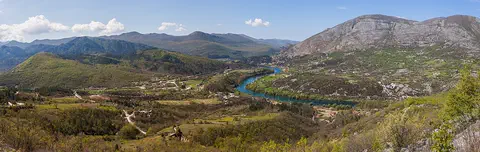
In the photo, the bridge curves over a blue-green river.
Houses climb up both banks, and a tall rocky mountain rises on the right.
The photo was taken on 10 July 2007, looking along the Neretva toward the bridge. The single arch curves over the blue-green river, with a stone tower at its right end.
Old houses with gray roofs, green umbrellas and many trees line both banks, and a rocky mountain slope rises on the right.
The photograph (10 July 2007, by Ramirez; a retouched panorama and a Commons featured picture) looks along the Neretva toward the Old Bridge: the single arch, a stone tower at its right end, the river's blue-green water and rocky banks, old houses with gray roofs and green umbrellas on the slopes, and a steep rocky mountainside at the right.
Amazing facts
-
The town of Mostar is named after the people who kept the bridge!
The name Mostar comes from 'mostari', the bridge keepers.
Mostar, first mentioned by name in 1474, takes its name from 'mostari', the bridge keepers.
-
Towers stood by a bridge here more than 550 years ago.
Written records from 1459 already mention two towers around the bridge.
Written historical sources date the two towers around the bridge to 1459.
-
The rebuilt bridge was made to look just like the old one.
The 2004 rebuilding kept the old bridge's size, shape and materials.
The reconstruction kept the vertical and horizontal dimensions, forms, scale and materials of the bridge as it had been.
Words to know
- arch
- a curved structure that spans an opening and holds weight
- watchtower
- a tall tower from which guards could look out
- bazaar
- a market street with many small shops
- rebuild
- to build something again
- frontier town
- a town near the edge of a country or empire
- reconciliation
- becoming friendly again after a disagreement
Discovery challenge
-
What does Stari Most mean?
What does the name Stari Most mean in English?
How is Stari Most usually translated?
- Old Bridge
- Big River
- High Tower
Show the answer
Old Bridge
Old Bridge!
Old Bridge.
The Old Bridge.
-
How many arches does Stari Most have?
How many arches carry Stari Most across the river?
How many arches span the Neretva at Stari Most?
- One
- Five
- Sixteen
Show the answer
One
Just one big arch!
One single stone arch.
A single arch.
-
Which river does the bridge cross?
Which river flows under Stari Most?
Along which river's deep valley did Mostar develop?
- The Neretva
- The Danube
- The Thames
Show the answer
The Neretva
The Neretva River!
The Neretva.
The Neretva.
-
Where does the name Mostar come from?
Who gave the town of Mostar its name?
From which word does UNESCO derive the name Mostar?
- The bridge keepers, 'mostari'
- A king named Mostar
- A kind of fish
Show the answer
The bridge keepers, 'mostari'
The bridge keepers!
The bridge keepers, called 'mostari'.
'Mostari', the bridge keepers.
-
In which year was the bridge built again?
In which year was Stari Most rebuilt?
When was the Old Bridge rebuilt, with an international scientific committee set up by UNESCO?
- 2004
- 1474
- 1900
Show the answer
2004
In 2004!
In 2004.
In 2004.
Nearby places
-
 Watch
City
Sarajevo
Sarajevo is the capital of Bosnia and Herzegovina, built in a valley ringed by mountains, along the Miljacka River. It grew from an Ottoman town founded in the 1400s around a market, the Baščaršija. An official estimate gives 270,608 people in the City of Sarajevo in mid-2026, and in 1984 the city hosted the Winter Olympics.
-
 Watch
City
Dubrovnik
Dubrovnik is a walled town on the Dalmatian coast of Croatia, beside the Adriatic Sea. UNESCO calls it the 'Pearl of the Adriatic' and says it became an important sea power from the 13th century. Its Old City is a World Heritage site. Croatia's 2021 census counted 26,922 people in the town.
-
 Watch
City
Split
Split is a port on Croatia's Adriatic coast. Larousse says the city was born inside the huge walls of a palace that the Roman emperor Diocletian built around the year 300. Its historic center has been a World Heritage Site since 1979, and Croatia's 2021 census counted 149,830 people in Split.
-
 Watch
Landmark
Mehmed Paša Sokolović Bridge
The Mehmed Paša Sokolović Bridge crosses the Drina River at Višegrad, in eastern Bosnia and Herzegovina. The architect Sinan built it between 1571 and 1577. It is about 180 meters long, with eleven stone arches, and it has been a UNESCO World Heritage Site since 2007.
-
 Watch
City
Podgorica
Podgorica is the capital of Montenegro, on a plain where the valleys of the Morača and Zeta rivers meet. From 1946 to 1992 it was called Titograd. Montenegro's 2023 census counted 179,505 people in the Capital City of Podgorica, the country's most populated municipality.
-
 Watch
Natural wonder
Adriatic Sea
The Adriatic Sea is a long, narrow part of the Mediterranean Sea, about 800 km long and 200 km wide. Its northern part is shallow, but its south drops to about 1,200 meters. In winter, strong bora winds make the densest water in the whole Mediterranean, which flows south and refreshes the deep sea.
-
 Watch
Landmark
Amphitheater of Durrës
The Amphitheater of Durrës is a Roman amphitheater in the center of the coastal city of Durrës, in Albania. It could hold 15,000 to 20,000 spectators. It lay hidden under the city until 1966, when it was found by chance.
-
 Watch
City
Belgrade
Belgrade, the capital of Serbia, stands where the Sava River flows into the Danube. Its name, Beograd, means "white city", probably because of the white limestone walls of its old fortress above the rivers. At the 2022 census, about 1.2 million people lived in the city itself and about 1.7 million in the wider City of Belgrade.
Explore next
-
 Watch
 Country
Bosnia and Herzegovina
Bosnia and Herzegovina is a mountainous country in southeastern Europe. It has forests, limestone hills and many rivers, and famous old stone bridges cross some of them. Its capital is Sarajevo. It touches the Adriatic Sea along only about 20 kilometers of coast.
-
Watch
City
Sarajevo
Sarajevo is the capital of Bosnia and Herzegovina, built in a valley ringed by mountains, along the Miljacka River. It grew from an Ottoman town founded in the 1400s around a market, the Baščaršija. An official estimate gives 270,608 people in the City of Sarajevo in mid-2026, and in 1984 the city hosted the Winter Olympics.
-
Watch
Landmark
Mehmed Paša Sokolović Bridge
The Mehmed Paša Sokolović Bridge crosses the Drina River at Višegrad, in eastern Bosnia and Herzegovina. The architect Sinan built it between 1571 and 1577. It is about 180 meters long, with eleven stone arches, and it has been a UNESCO World Heritage Site since 2007.
-
 Watch
Landmark
Charles Bridge
Charles Bridge crosses the Vltava River in Prague, the capital of Czechia. It was begun in 1357 under Charles IV and finished in 1402, and it is made of sandstone blocks. Towers guard both ends, 30 statues and statue groups stand along its walls, and today it is a bridge for people on foot.
-
 Watch
Landmark
Aachen Cathedral
Aachen Cathedral in western Germany grew around the Palatine Chapel, the chapel of Emperor Charlemagne's palace, built around the year 800 with eight sides and a dome. A tall Gothic choir with very tall windows, called the Glass House, was added from 1355 to 1414. German kings were crowned here until 1531, and in 1978 it became a World Heritage Site.
-
 Watch
Landmark
Acropolis of Athens
The Acropolis is a steep, flat-topped rock in the middle of Athens. Walls have ringed its top for more than 3,300 years. In the 400s BCE, the Athenians built a grand gateway and three temples there, including the Parthenon. Restorers are still repairing them today.
-
 Watch
Landmark
Afsluitdijk
The Afsluitdijk is a dike 32 kilometers long in the Netherlands. It runs between the provinces of North Holland and Friesland and closes off the IJsselmeer lake from the Wadden Sea. Its last gap was closed on 28 May 1932, and for more than 90 years it has helped protect a large part of the country from floods.
-
 Watch
Landmark
Alhambra
The Alhambra is a palace and fortress above the city of Granada, in Spain. The Nasrid rulers built most of it between 1238 and 1358. It is famous for its courtyards, fountains, carved plaster and tiles, and the gardens of the Generalife next door.
For parents & teachers
What children will learn
- Locate Mostar and the Neretva River and describe the bridge's single arch and end towers.
- Explain how a town can be named after a bridge and the people who looked after it.
- Describe how a historic bridge can be rebuilt to match its original size, shape and materials.
Recommended ages: 4 to 17 · About 15 minutes
Talk about it
- The town is named after its bridge keepers. What is your town or street named after?
- Why might people want to rebuild an old bridge exactly as it was, instead of building a new design?
- UNESCO calls the bridge a symbol of people living together. How can a bridge bring people together?
Try at home or in class
- Build a single arch from sugar cubes or blocks over a cardboard 'river' and see how far it can span.
- Draw your own town and give it a name based on an important place or job in it.
Key vocabulary: arch, watchtower, bazaar, rebuild, frontier town, reconciliation
Where these facts come from
- Wikidata , Wikimedia Foundation (CC0 1.0)
- Old Bridge Area of the Old City of Mostar (World Heritage List) , UNESCO World Heritage Centre
- Advisory Body Evaluation: Old Bridge Area of the Old City of Mostar (No. 946 rev) , ICOMOS
- File:Mostar Old Town Panorama 2007.jpg , Wikimedia Commons
- Wikimedia Commons , Wikimedia Foundation (Per file (public domain, CC0, CC BY or CC BY-SA); see each media record)
Checked, not yet human-reviewed. Last updated November 1, 2026. Spotted a mistake? Tell us.