
 Country
Australia and Oceania
French Polynesia
French Polynesia is a big group of islands in the Pacific Ocean. Some islands are tall green mountains. Others are rings of coral around a lagoon.
French Polynesia is a group of about 130 islands in five island chains, spread across the South Pacific. It is an overseas collectivity of France with its own government. Tahiti and its neighbors are tall volcanic islands ringed by coral reefs, while the Tuamotus are low coral atolls. The 2022 census counted 278,786 people.
French Polynesia, an overseas collectivity of France, comprises about 130 islands in five archipelagoes, the Society, Tuamotu, Gambier, Marquesas and Austral (Tubuai) Islands, between 7° and 27° S. Its land area is only 4,167 km², but the islands are scattered across a stretch of ocean five times the size of France. The 2022 census counted 278,786 people, three-quarters of them in the Windward Islands of Tahiti and Moorea.
Photo: Pontauxchats (uploader), public domain, via Wikimedia Commons
Discover French Polynesia
French Polynesia is made of many islands in the Pacific Ocean.
The biggest island is Tahiti. The capital, Papeete, is there. People speak French and Tahitian.
French Polynesia is in the middle of the South Pacific Ocean. It has about 130 islands in five groups. All the land together is small, but the islands are spread over a stretch of ocean five times the size of France.
French Polynesia belongs to France but has its own president and assembly, which run many local matters. French is the official language, and the Tahitian language is a key part of people's identity. The money is the CFP franc, and the capital is Papeete, on Tahiti, the largest island.
Britannica describes French Polynesia as an overseas collectivity of France consisting of five archipelagoes, some 130 islands between 7° and 27° S and 134° and 155° W, with a land area roughly equal to metropolitan Paris and London combined. Its official name is the Overseas Country of French Polynesia.
The President of France is head of state, represented by a high commissioner; a locally elected president heads the government, and the Assembly has 57 members. The territory became autonomous in 1984, was reclassified as an overseas collectivity in 2003, and gained more powers of self-government in 2004. French is official; the Statute of Autonomy names the Tahitian language a fundamental element of cultural identity. The currency is the CFP franc.
Tahiti, Moorea, Bora-Bora and far-off chains
Papeete is a busy port on Tahiti.
Tahiti has two volcanoes joined together. Nearby are Moorea and Bora-Bora. Other islands are very far away.
Tahiti is made of two old volcanoes, Tahiti Nui and Tahiti Iti, joined by a narrow neck of land. Papeete, on the northwest coast, is the capital and a major port, and the international airport is next door at Faaa. The photo looks down from a plane on a coast near Papeete, with houses on green hills, a lagoon and a reef where waves break.
Moorea is about 20 kilometers northwest of Tahiti. Farther west is Bora-Bora, with two volcanic peaks rising above its lagoon. The Marquesas Islands are 1,450 kilometers to the northeast, and the Austral Islands 720 kilometers to the south. In 2024 the Olympic surfing contest was held at Teahupo'o, on Tahiti.
Tahiti (1,043 km²) consists of two eroded volcanic cones, Tahiti Nui and Tahiti Iti (the Taiarapu Peninsula), linked by the Isthmus of Taravao. Papeete, on the northwest coast, is the capital and a major transpacific port, with the international airport at Faaa. In the 2022 census the communes of Faaa (29,826), Punaauia (28,781) and Papeete (26,654) were the most populous.
Moorea lies about 20 km northwest of Tahiti. In the Leeward Islands, Raiatea and Tahaa share one barrier reef, and Bora-Bora rises in two volcanic peaks of 727 m and 661 m. The Tuamotu atolls lie to the east, the Gambier Islands, with Mangareva, at their southern end, the Marquesas 1,450 km northeast of Tahiti and the Austral Islands 720 km south. Teahupo'o, on Tahiti Iti, hosted the surfing competition of the 2024 Paris Olympic Games.
High islands and low atolls
Some islands are tall, with steep green mountains.
Others are low rings of coral. In the middle of each ring is a calm lagoon.
There are two kinds of islands here. The Society Islands, such as Tahiti, were made by underwater volcanoes. Their steep, green mountains are cut by deep valleys, and coral reefs ring them like a wall against the waves. The highest point, Mount Orohena on Tahiti, is 2,241 meters high.
The Tuamotus are about 80 low coral atolls: rings of coral land around a lagoon, some barely above the sea. The Marquesas are different again: they have no ring of reef, and their cliffs rise straight up from the ocean. On Tahiti it is warm all year, from about 24 °C in July to 29 °C in January.
The islands rise from parallel submarine ridges running northwest to southeast. Except for a few atolls, the Society Islands are highly eroded volcanic cones with high crests and deep radiating valleys, almost completely encircled by barrier reefs; Britannica gives Tahiti's summit as 2,241 m on its French Polynesia page and 2,237 m (Mount Orohena) on its Tahiti page. The Tuamotus, some 80 coral atolls with 689 km² of land, have porous soils and no permanent streams; Britannica describes their lagoons as a source of fish, pearls and mother-of-pearl.
UNESCO calls the Marquesas among the world's most "vertical" islands, with ridges and cliffs rising over 1,000 m above the ocean and no coral reefs. Tahiti lies in the easterly trade-wind belt: its wet south gets more than 2,500 mm of rain a year and its north about 1,800 mm, with rain mostly from December to March and average temperatures of 24 °C (July–August) to 29 °C (January–February).
Sharks, rays and seabirds
Sharks swim in the sea around the islands. Sea turtles swim there too.
Whales visit the islands. Many seabirds build nests on the far-off Marquesas.
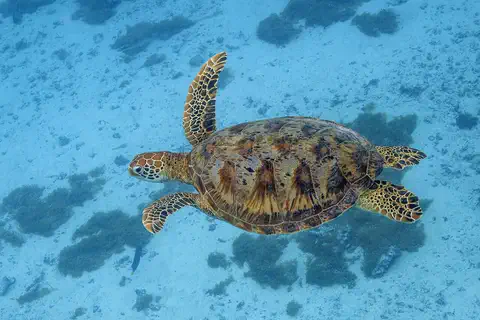
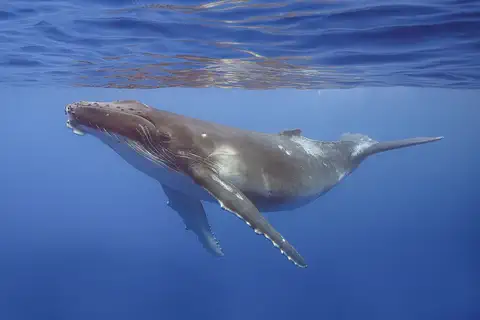
The waters of French Polynesia are a sanctuary for whales, dolphins and all kinds of sharks, and sea turtles and rays are protected too. The photos here were all taken off Moorea: a blacktip reef shark, a green sea turtle and a humpback whale calf.
The Marquesas Islands are especially rich in life found nowhere else. Twenty-one kinds of seabirds nest there, hundreds of dolphins gather in big groups, and two kinds of manta rays share the same diving spots, which is rarely seen anywhere else.
UNESCO notes that all Polynesian waters are a sanctuary for marine mammals and all shark species, and that protection rules cover 164 plant species, 39 bird species, all marine mammals, sharks, rays and sea turtles. The animal photos here (blacktip reef shark, green sea turtle, humpback calf) were taken off Moorea.
The Marquesas, inscribed as a mixed World Heritage site in 2024, rank first or second in the world for endemic species in several groups, including vascular plants, land and seabirds, molluscs and freshwater fish; 13.7% of coastal fish and 10% of mollusc species are found nowhere else. They are one of the world's few nesting sites for 21 seabird species, host dolphin pods in the hundreds, and are unusual for the reef manta and giant manta sharing the same dive sites. Invasive plants such as miconia and the African tulip tree threaten native forest.

Tahitian, French and island life
Most people live on Tahiti and Moorea.
They speak French, and many speak Tahitian. Fishing, farming and visitors from far away are all part of island life.
About three out of every four people in French Polynesia live in the Windward Islands, Tahiti and Moorea. Most people have Polynesian roots, many with French or Chinese ancestors too, and French culture has had a big influence.
French is the official language, and Tahitian is a key part of local identity. Tahiti is an important center for tourism, and visitors arrive through Papeete's port and the airport at Faaa. Its warm climate suits crops such as coconuts, vanilla and coffee on the coastal plain.
The 2022 census counted 209,980 people in the Windward Islands, 36,007 in the Leeward Islands, 16,729 in the Tuamotu-Gambier, 9,478 in the Marquesas and 6,592 in the Austral Islands. Britannica describes a people basically Polynesian, with much admixture chiefly French and Chinese, and deeply influenced by French culture; it notes that people from the outer archipelagoes, where connections to Tahiti are poor, have long moved to Tahiti and Papeete.
Britannica's Tahiti article calls the island an important tourist center and says its climate suits coconuts (for copra), sugarcane, vanilla and coffee on the coastal plain. The painter Paul Gauguin lived on Tahiti in 1891–93 and 1895–1901, and a museum on the south coast is named after him.
Ocean voyagers to an overseas collectivity
Long ago, Polynesian sailors crossed the ocean in canoes to reach these islands.
Much later, ships came from Europe. Today the islands are part of France but run many things themselves.
Polynesian voyagers sailed across the open Pacific to settle these islands. In the Marquesas, a seafaring people arrived around the year 1000 and built stone platforms for homes and gatherings.
European ships came much later. Samuel Wallis reached Tahiti in 1767, and James Cook watched the planet Venus cross the Sun from Tahiti in 1769. Tahiti became a French protectorate in 1842 and a colony in 1880. In 1984 French Polynesia gained autonomy, and in 2003 it became an overseas collectivity of France.
UNESCO dates the settlement of the Marquesas by a seafaring civilization to around 1000 CE; its people built two-story dry-stone platforms (paepae) up to 6 m high and carved stone figures and petroglyphs. Magellan sighted Pukapuka in the Tuamotus in 1521; Wallis reached Tahiti in 1767 and Bougainville in 1768; the Society Islands are named for the Royal Society, which sponsored Cook's 1769 voyage to observe the transit of Venus from Tahiti.
Tahiti became a French protectorate in 1842 and a colony in 1880, and the other groups were annexed by 1900. The colony became an overseas territory in 1946, autonomous in 1984 and an overseas collectivity in 2003. From the 1960s to the mid-1990s France carried out nuclear weapons tests at Mururoa and Fangataufa atolls in the Tuamotus. Independence has continued to be discussed, and in 2013 the UN added French Polynesia to its list of non-self-governing territories.
French Polynesia on the map
Find Australia on the globe.
Now look far to the east, into the middle of the Pacific Ocean. Lots of tiny islands are scattered there. That is French Polynesia.
French Polynesia is spread across the South Pacific between 7 and 27 degrees south of the equator. Tahiti and the other Society Islands are in the west, the Tuamotus stretch to the east, the Marquesas are far to the northeast, and the Austral Islands lie to the south.
There are no land borders. The islands are too small for the globe to draw, so PlayOwl marks them with dots: Papeete, Moorea, Bora-Bora, Rangiroa in the Tuamotus, Nuku Hiva in the Marquesas, Mangareva and Tubuai.
The islands lie between 7° and 27° S and 134° and 155° W on parallel submarine ridges running northwest to southeast. The Society Islands are the most westerly group, the Tuamotus lie to their east with the Gambiers at their southern end, the Marquesas 1,450 km northeast of Tahiti, and the Austral Islands 720 km to the south.
At the globe's scale the islands have no outlines, so the map uses markers: Papeete and Mount Orohena on Tahiti, Moorea, Bora-Bora, Rangiroa, Nuku Hiva, Mangareva and Tubuai.
- Islands
- about 130 in 5 archipelagoes
- Land area
- 4,167 km²
- People (2022 census)
- 278,786
- Tahiti to the Marquesas
- about 1,450 km
Amazing facts
-
The Olympic surfing contest of 2024 was held on Tahiti.
The surfing contest of the 2024 Paris Olympic Games took place at Teahupo'o, a village on Tahiti, far across the world from Paris.
Teahupo'o, on Tahiti, hosted the surfing competition of the 2024 Paris Olympic Games.
-
The Society Islands are named after a group of scientists.
The Society Islands are named after the Royal Society, a group of British scientists who sent James Cook to watch Venus cross the Sun in 1769.
The Society Islands take their name from the Royal Society, which sponsored Cook's expedition to observe the 1769 transit of Venus from Tahiti.
-
All the sharks in French Polynesia's sea are protected.
All the waters of French Polynesia are a sanctuary for whales, dolphins and every kind of shark.
UNESCO notes that all Polynesian waters are a sanctuary for marine mammals and for all shark species.
-
Some cliffs in the Marquesas are more than 1,000 meters tall.
In the Marquesas, cliffs rise more than 1,000 meters straight up from the ocean.
UNESCO describes the Marquesas as among the world's most "vertical" islands, with cliffs rising over 1,000 m above the ocean.
Words to know
- archipelago
- a group or chain of islands
- atoll
- a ring-shaped coral island or chain of islets around a lagoon
- lagoon
- a stretch of calm, shallow water cut off from the open sea by a reef or sandbank
- barrier reef
- a long coral reef separated from the shore by a lagoon
- overseas collectivity
- a part of France far from Europe that has its own local government
- endemic
- found naturally in one place and nowhere else
Discovery challenge
-
What is the biggest island in French Polynesia?
Which is the largest island in French Polynesia, home to the capital?
Which island, made of two volcanic cones joined by the Isthmus of Taravao, is French Polynesia's largest?
- Tahiti
- Hawaii
- Fiji
Show the answer
Tahiti
Tahiti is the biggest.
Tahiti, where the capital Papeete is.
Tahiti: Tahiti Nui and Tahiti Iti, 1,043 km².
-
What is a ring of coral around a lagoon called?
What do we call a ring of low coral islands around a lagoon, like those in the Tuamotus?
The Tuamotus are about 80 low coral islands of what kind?
- A volcano
- An atoll
- A glacier
Show the answer
An atoll
An atoll!
An atoll: coral land in a ring around a lagoon.
Atolls, with porous coral soils and no permanent streams.
-
Which country is French Polynesia part of?
French Polynesia is an overseas collectivity of which country?
Since 2003, French Polynesia has been an overseas collectivity of which country?
- Spain
- New Zealand
- France
Show the answer
France
France.
France, though it has its own president and assembly.
France; the territory has been autonomous since 1984.
-
Which sea animals are all protected in French Polynesia's waters?
French Polynesia's waters are a sanctuary for every kind of which fish?
Besides marine mammals, which group of animals do all Polynesian waters protect as a sanctuary?
- Sharks
- Goldfish
- Penguins
Show the answer
Sharks
Sharks!
Sharks. All shark species are protected there.
All shark species, along with marine mammals.
Places to discover in French Polynesia
-
 Watch
City
Papeete
Papeete is the main town of French Polynesia, on the north coast of Tahiti, an island made of two extinct volcanoes in the South Pacific. Its harbor sits behind a coral reef. The 2022 census counted 26,654 people in the town's commune, while many more live in the towns that have grown around it.
-
 Watch
Natural wonder
Pacific Ocean
The Pacific Ocean is the largest and deepest ocean basin on Earth, covering more than 30 percent of the planet's surface. It holds more than half of Earth's free water. Its deepest point, Challenger Deep in the Mariana Trench, is nearly 11 kilometers down, and earthquakes and volcanoes ring its edges.
-
 Watch
Natural wonder
Tahiti
Tahiti is a volcanic island in the South Pacific, made of two old volcanoes joined by a narrow neck of land. Heavy rain has carved deep valleys into its slopes, coral reefs fringe its shores, and its forests are home to the rare Tahiti monarch, a bird found nowhere else.
Animals of French Polynesia
-
Watch
Animal
Blacktip reef shark
The blacktip reef shark is a medium-sized shark of warm, shallow coral reefs in the Indian and Pacific Oceans. You can spot it by the black tips on all its fins. It hunts fish, squid and crabs, stays close to its home reef, and gives birth to just a few live pups at a time.
-
 Watch
Animal
Green sea turtle
The green sea turtle is the largest sea turtle with a hard shell. It lives in warm seas around the world and, unlike other sea turtles, grown-ups eat mostly seagrass and algae. Females swim hundreds or even thousands of kilometers to lay their eggs on the beaches where they hatched long ago.
-
 Watch
3D
Animal
Humpback whale
The humpback whale is a baleen whale famous for leaping out of the water, slapping its giant flippers and singing long, complex songs. It lives in every ocean and makes one of the longest journeys of any mammal, between cold feeding waters and warm waters where calves are born. Once hunted almost to extinction, it is now recovering.
Explore next
-
Watch
City
Papeete
Papeete is the main town of French Polynesia, on the north coast of Tahiti, an island made of two extinct volcanoes in the South Pacific. Its harbor sits behind a coral reef. The 2022 census counted 26,654 people in the town's commune, while many more live in the towns that have grown around it.
-
 Watch
 Country
France
France is a country in northwestern Europe, between the Atlantic Ocean and the Mediterranean Sea. It has high mountains such as the Alps and the Pyrenees, long rivers such as the Loire and the Seine, and about 69.1 million people (2026). Its capital is Paris.
-
 Watch
 Country
Cook Islands
The Cook Islands are 15 small islands and atolls spread across about 2 million square kilometers of the South Pacific. They govern themselves in free association with New Zealand, and Cook Islanders are New Zealand citizens. The 2021 census counted 14,987 residents, more than 70% of them on Rarotonga.
-
 Watch
 Country
Pitcairn Islands
The Pitcairn Islands are a British overseas territory in the South Pacific: Pitcairn, Henderson, Ducie and Oeno. Only Pitcairn Island has people, around fifty of them, most descended from the sailors of HMS Bounty and their Tahitian companions. Its waters form one of the largest marine reserves on Earth.
-
Watch
Natural wonder
Pacific Ocean
The Pacific Ocean is the largest and deepest ocean basin on Earth, covering more than 30 percent of the planet's surface. It holds more than half of Earth's free water. Its deepest point, Challenger Deep in the Mariana Trench, is nearly 11 kilometers down, and earthquakes and volcanoes ring its edges.
-
Watch
Journey
The first voyagers of the Pacific
Over thousands of years, the ancestors of today's Pacific Islanders sailed double-hulled canoes across the Pacific and settled islands from Samoa and Tonga to Hawaiʻi, Rapa Nui and Aotearoa New Zealand. They had no compasses or maps: navigators read the stars, the ocean swells, the clouds and the birds.
-
Watch
Animal
Blacktip reef shark
The blacktip reef shark is a medium-sized shark of warm, shallow coral reefs in the Indian and Pacific Oceans. You can spot it by the black tips on all its fins. It hunts fish, squid and crabs, stays close to its home reef, and gives birth to just a few live pups at a time.
-
Watch
Animal
Green sea turtle
The green sea turtle is the largest sea turtle with a hard shell. It lives in warm seas around the world and, unlike other sea turtles, grown-ups eat mostly seagrass and algae. Females swim hundreds or even thousands of kilometers to lay their eggs on the beaches where they hatched long ago.
For parents & teachers
What children will learn
- Locate French Polynesia and name its five archipelagoes.
- Explain the difference between a high volcanic island and a coral atoll.
- Describe French Polynesia's status as an overseas collectivity of France.
- Outline its history from Polynesian voyagers to autonomy in 1984.
Recommended ages: 3 to 17 · About 15 minutes
Talk about it
- The islands are spread over an ocean five times the size of France. How might people on far-off islands get food, mail and doctors?
- Why might a place protect every kind of shark?
- Polynesian voyagers crossed huge distances in canoes. What would you need to know to find a tiny island in a big ocean?
Try at home or in class
- Make an atoll: build a sand volcano in a tray of water, ring it with pebbles for a reef, then scoop the volcano away so only the ring and a lagoon remain.
- On a map of the Pacific, measure from Tahiti to the Marquesas and compare it with a journey you know.
Key vocabulary: archipelago, atoll, lagoon, barrier reef, overseas collectivity, endemic
Where these facts come from
- Wikidata , Wikimedia Foundation (CC0 1.0)
- Natural Earth vector data , Natural Earth (NACIS) (Public domain)
- French Polynesia (land: relief, island groups) , Encyclopaedia Britannica
- French Polynesia: history , Encyclopaedia Britannica
- Tahiti , Encyclopaedia Britannica
- French Polynesia: circumscriptions and places, census 1996 to 2022 (from the Institut de la statistique de la Polynésie française) , City Population (Thomas Brinkhoff)
- Te Henua Enata – The Marquesas Islands , UNESCO World Heritage Centre
- PlayOwl region table, version 1 , PlayOwl (PlayOwl original data)
- flag-icons 7.5.0 , Panayiotis Lipiridis and contributors (MIT)
- Wikimedia Commons , Wikimedia Foundation (Per file (public domain, CC0, CC BY or CC BY-SA); see each media record)
Checked, not yet human-reviewed. Last updated November 1, 2026. Spotted a mistake? Tell us.
Picture credits
- Photo: Pontauxchats (uploader), public domain, via Wikimedia Commons · source
- Photo: Charles J. Sharp, CC BY-SA 4.0, via Wikimedia Commons · source · license
- Photo: Charles J. Sharp, CC BY-SA 4.0, via Wikimedia Commons · source · license
- Photo: Charles J. Sharp, CC BY-SA 4.0, via Wikimedia Commons · source · license