
Natural wonder Australia and Oceania
Tahiti
Tahiti is an island in the Pacific Ocean made by two old volcanoes. Rain carved deep valleys, and coral reefs grow around it. A rare little bird lives in its forests.
Tahiti is a volcanic island in the South Pacific, made of two old volcanoes joined by a narrow neck of land. Heavy rain has carved deep valleys into its slopes, coral reefs fringe its shores, and its forests are home to the rare Tahiti monarch, a bird found nowhere else.
Tahiti, described by researchers as the highest and largest of the 14 Society Islands, formed as the Pacific Plate moved northwest over a fixed hotspot: Tahiti-Nui and Tahiti-Iti are two old shield volcanoes linked by an isthmus. Its reefs record sea-level rise since the last ice age, and its forests hold the critically endangered Tahiti monarch.
Photo: Olivier Dugornay (IFREMER, Pôle Images, Centre Bretagne - ZI de la Pointe du Diable - CS 10070 - 29280 Plouzané, France), CC BY 4.0, via Wikimedia Commons
Discover Tahiti
Tahiti is an island in the Pacific Ocean. It was made by two old volcanoes.
In this photo, the sky glows pink at dusk. One person paddles a long, thin canoe on the calm water.
Tahiti is a tropical volcanic island in French Polynesia, in the South Pacific Ocean. Bird scientists who work there describe it as the highest and largest of the 14 Society Islands, rising to 2,241 meters and covering 1,042 square kilometers. Forest covers most of its rugged inside.
The photo is called 'Dusk on the waters of Tahiti'. Pink and gold light shines through the clouds, the water is calm and blue, and a single paddler glides along in a long, narrow canoe.
Blanvillain and colleagues describe Tahiti as a tropical volcanic island, the highest and largest of the 14 islands of the Society group, reaching 2,241 m and covering 1,042 km², with a rugged basaltic interior mostly under forest. Valleys and ridges radiate from the central peaks of both old volcanoes.
The hero photo, 'Crépuscule sur les eaux de Tahiti' (Dusk on the waters of Tahiti), is by Olivier Dugornay of IFREMER: a twilight sky over calm water, with one paddler in a long canoe.
- Made of
- two old volcanoes, Tahiti-Nui and Tahiti-Iti
- Highest point
- 2,241 m
- Area
- 1,042 km²
- Island group
- the highest and largest of the 14 Society Islands
Two volcanoes over a hotspot
Deep under the sea, hot melted rock rose up. It built volcanoes taller than the water.
Two volcanoes grew side by side. A narrow strip of land joins them.
Tahiti is part of a chain of volcanic islands. The chain formed as the Pacific Plate moved northwest over a fixed hotspot. Tahiti has two old volcanoes: Tahiti-Nui in the northwest and Tahiti-Iti in the southeast, joined by an isthmus.
Tahiti-Nui first grew as a round volcano between 1.4 million and 870,000 years ago. Around 860,000 years ago, both its northern and southern sides collapsed. Soon a second volcano began to grow, and its lava began to fill in the southern gap.
NASA's Earth Observatory places Tahiti in a volcanic chain formed by the northwestward movement of the Pacific Plate over a fixed hotspot. From the island's rock layers, geologists reconstructed Tahiti-Nui's history: a roughly round shield built between 1.4 million and 870,000 years ago; collapse of both the northern and southern flanks sometime around 860,000 years ago, gouging great arcs out of the coastline; and, soon after the northern collapse, a second shield whose lava overtopped the old structure and began filling the southern depression.
Today Tahiti-Nui is fairly symmetrical in outline but asymmetrical in three dimensions, with taller mountains on its northern half.
Rain-carved valleys and coral reefs
Lots of rain falls on Tahiti. Over time, the rain carved deep valleys.
Coral reefs grow in the sea around the island.
Heavy tropical rain has carved deep valleys into Tahiti, some with almost straight-up walls as tall as 1,000 meters. The same rain helps thick green plants cover both volcanoes.
Coral reefs fringe the island and are thickest on its southern and western sides. Old reefs now lie deeper underwater, in steps called reef terraces. Cores drilled from them in 2005 show that sea level once rose about 17 meters in just 350 years, when polar ice sheets collapsed.
Heavy tropical rainfall has cut deep valleys, some with nearly vertical walls up to 1,000 m, which complicated geological surveys; it also supports the lush vegetation on Tahiti-Nui and Tahiti-Iti. Reefs fringe the island, thickest on the south and west.
In October and November 2005, IODP Expedition 310 cored 37 boreholes at 22 sites, in water 41.65 to 117.54 m deep, into the old reef terraces seaward of the living barrier reef. ECORD reports that the cores record Meltwater Pulse 1A, between 14,650 and 14,310 years ago: a global sea-level rise of 17 m in 350 years, about 45 mm a year against about 3 mm a year today in ECORD's comparison, which ECORD calls the fastest in Earth's history.
The Tahiti monarch
A rare bird called the Tahiti monarch lives only on Tahiti. In 1998, only 25 were known.
People have worked to keep rats away from these birds.
The Tahiti monarch is a forest bird that lives only on Tahiti. Scientists writing in 2017 called it critically endangered. In 1998 it was known from just four valleys, with only 25 birds in total. Another group of 33 birds was found in 2001, high above waterfalls, but only 12 of them were left by 2009.
The main danger is ship rats, which prey on them. Two birds brought from other places, the common myna and the red-vented bulbul, also cause trouble. A recovery program began in 1998. It first worked to control rats, and later these birds too, the scientists reported.
Blanvillain and colleagues (Bird Conservation International, 2017) studied the Tahiti monarch, or O'mamao (Pomarea nigra), a critically endangered forest bird endemic to Tahiti. In 1998 it survived in four valleys of the Paea and Punaauia districts, five to seven birds each; a remote group of 33 above waterfalls in the Maruapo valley, found in 2001, had fallen to 12 by 2009. By 2015 the remaining territories covered just 50 ha in three valleys.
The main threat is predation by ship rats; the introduced common myna and red-vented bulbul prey on nests or disturb pairs. The monarch breeds slowly: only one young per nest was ever seen, and parents keep feeding it for an average of 74 days after it leaves the nest.
Visiting safely
On a reef, never touch or stand on the coral. It is alive!
Swim only with a grown-up. If water pulls you out, swim along the beach.
NOAA, the United States ocean agency, asks snorkelers and divers to be careful not to touch, kick or stand on corals, and not to touch other sea animals. The slimy coating on fish protects them from infection and rubs off easily.
NOAA also warns about rip currents. If one catches you, don't fight it: swim parallel to the shore, then back to land at an angle. PlayOwl's advice in the forest: walk quietly and watch birds from the trail.
NOAA Fisheries advises that when snorkeling or diving on coral reefs, people should not touch, kick or stand on corals, and should not touch other animals, because the slimy coating on fish and many invertebrates protects them from infection and is easily rubbed off. These are US guidelines, but the reasons apply to any reef.
NOAA's National Ocean Service notes that rip currents can move at up to eight feet (about 2.4 m) per second; swim parallel to the shore and return at an angle rather than fighting one. In the forest, PlayOwl suggests quiet watching from trails, since the monarch's territories lay in just three valleys in 2015.
Amazing facts
-
Some valley walls on Tahiti are almost straight up!
Rain has carved valleys on Tahiti with nearly vertical walls up to 1,000 meters tall.
Heavy tropical rains have cut valleys with nearly vertical walls up to 1,000 m (NASA Earth Observatory).
-
Old coral under the sea tells us the sea once rose very fast.
Coral cores from Tahiti show the sea rose 17 meters in 350 years, between 14,650 and 14,310 years ago.
ECORD: Tahiti's reef cores record Meltwater Pulse 1A, 14,650 to 14,310 years ago, with the sea rising about 45 mm a year.
-
A Tahiti monarch chick is fed by its parents for a long time.
Tahiti monarch parents keep feeding their single chick for about 74 days after it leaves the nest, on average.
Post-fledging care lasts 74 ± 4.7 days on average (range 42 to 174), and only one young per nest was ever observed (Blanvillain et al.).
Words to know
- hotspot
- a place where hot rock from deep inside Earth melts through the crust and makes volcanoes
- shield volcano
- a wide volcano with gentle slopes, built by many lava flows
- isthmus
- a narrow strip of land joining two bigger pieces of land
- flank collapse
- when a whole side of a volcano slides away
- reef terrace
- a step of old coral reef left behind as sea level changed
- endemic
- living naturally in only one place
Discovery challenge
-
What made the island of Tahiti?
What built Tahiti?
Which process formed Tahiti's volcanic chain?
- Volcanoes over a hotspot
- A melting glacier
- Sand blown by the wind
Show the answer
Volcanoes over a hotspot
Volcanoes made it.
Two volcanoes built over a hotspot as the Pacific Plate moved.
The Pacific Plate moving northwest over a fixed hotspot.
-
What carved Tahiti's deep valleys?
What carved Tahiti's deep valleys?
Which process cut Tahiti's valleys with walls up to 1,000 m?
- Heavy rain
- Glaciers
- Earthquakes
Show the answer
Heavy rain
Lots of rain.
Heavy tropical rain.
Erosion by heavy tropical rainfall.
-
What happened to Tahiti-Nui long ago?
What happened to Tahiti-Nui about 860,000 years ago?
What happened to Tahiti-Nui's flanks around 860,000 years ago?
- Its sides collapsed
- It froze over
- It sank under the sea
Show the answer
Its sides collapsed
Its sides fell away.
Its northern and southern sides collapsed.
Both the northern and southern flanks collapsed.
-
What is the biggest danger to the Tahiti monarch?
What is the main threat to the Tahiti monarch?
Which predator is the main threat to the Tahiti monarch?
- Rats
- Sharks
- Snow
Show the answer
Rats
Rats.
Ship rats, which prey on the monarch.
Predation by ship rats (Rattus rattus).
-
What should you never do to coral?
What does NOAA ask snorkelers not to do on a coral reef?
Which behavior on coral reefs does NOAA Fisheries advise against?
- Touch, kick or stand on it
- Look at it
- Take a photo of it
Show the answer
Touch, kick or stand on it
Never touch or stand on coral.
Don't touch, kick or stand on corals.
Touching, kicking or standing on corals.
Nearby places
-
 Watch
City
Papeete
Papeete is the main town of French Polynesia, on the north coast of Tahiti, an island made of two extinct volcanoes in the South Pacific. Its harbor sits behind a coral reef. The 2022 census counted 26,654 people in the town's commune, while many more live in the towns that have grown around it.
-
 Watch
City
Alofi
Alofi is the capital of Niue, a raised coral island in the Pacific Ocean. It is made up of two villages, Alofi North and Alofi South, by Alofi Bay. A census in 2022 counted 606 people in Alofi.
-
 Watch
Natural wonder
Pacific Ocean
The Pacific Ocean is the largest and deepest ocean basin on Earth, covering more than 30 percent of the planet's surface. It holds more than half of Earth's free water. Its deepest point, Challenger Deep in the Mariana Trench, is nearly 11 kilometers down, and earthquakes and volcanoes ring its edges.
-
 Watch
City
Pago Pago
Pago Pago is the main town of American Samoa, on the island of Tutuila in the South Pacific. It lies by Pago Pago Harbor, between steep green mountains. The 2020 census counted 3,000 people in the village of Pago Pago.
-
 Watch
City
Funafuti
Funafuti is the atoll that serves as the capital of Tuvalu, a small island country in the Pacific Ocean. Its main island, Fongafale, is long and very narrow. Tuvalu's 2022 census counted 6,602 people on the atoll.
-
 Watch
Natural wonder
Lake Taupō
Lake Taupō, in the center of New Zealand's North Island, is the country's largest lake. It fills the caldera of Taupō volcano, which last erupted over 1,800 years ago.
-
 Watch
Natural wonder
Tongariro National Park
Tongariro National Park, in the middle of New Zealand's North Island, is the country's oldest national park. At its heart are three active volcanoes: Ruapehu, Tongariro and Ngāuruhoe. The mountains are important to the Māori people of the area, and UNESCO lists the park as a World Heritage Site for both its nature and its culture.
-
 Watch
Natural wonder
Mount Ruapehu
Mount Ruapehu, at 2,797 meters, is the highest mountain in New Zealand's North Island and an active volcano. A crater lake fills its vent, and DOC says lahars, fast volcanic mudflows, are its main volcanic hazard.
Explore next
-
Watch
Natural wonder
Pacific Ocean
The Pacific Ocean is the largest and deepest ocean basin on Earth, covering more than 30 percent of the planet's surface. It holds more than half of Earth's free water. Its deepest point, Challenger Deep in the Mariana Trench, is nearly 11 kilometers down, and earthquakes and volcanoes ring its edges.
-
Watch
Journey
The first voyagers of the Pacific
Over thousands of years, the ancestors of today's Pacific Islanders sailed double-hulled canoes across the Pacific and settled islands from Samoa and Tonga to Hawaiʻi, Rapa Nui and Aotearoa New Zealand. They had no compasses or maps: navigators read the stars, the ocean swells, the clouds and the birds.
- Watch Geography Islands An island is a piece of land surrounded by water that is smaller than a continent. Islands form in different ways: some broke away from continents, some were built by volcanoes on the sea floor, and some were made by corals or by waves piling up sand. Because they are cut off by water, islands often have unusual plants and animals.
- Watch Geography Types of volcanoes Volcanoes come in different shapes. Runny lava builds wide, gentle shield volcanoes like Mauna Loa. Sticky lava and ash build tall, steep stratovolcanoes like Mount Fuji. Small cinder cones grow from bits of lava thrown into the air. Whether lava is runny or sticky, and how much gas it holds, decides the shape and how explosive the eruptions are.
-
Watch
City
Papeete
Papeete is the main town of French Polynesia, on the north coast of Tahiti, an island made of two extinct volcanoes in the South Pacific. Its harbor sits behind a coral reef. The 2022 census counted 26,654 people in the town's commune, while many more live in the towns that have grown around it.
-
 Watch
Natural wonder
Great Barrier Reef
The Great Barrier Reef stretches about 2,300 kilometers along the coast of Queensland, Australia. It is made of about 2,500 separate reefs and more than 900 islands, built by tiny coral animals, and it is home to more than 1,500 kinds of fish.
-
 Watch
Natural wonder
Uluru
Uluru is a huge sandstone rock in the desert of central Australia, rising 348 meters above the plain, with a base 9.4 kilometers around. The Anangu are its Traditional Owners, and the national park around it is run by Anangu and Parks Australia together.
-
 Watch
Natural wonder
Aoraki / Mount Cook
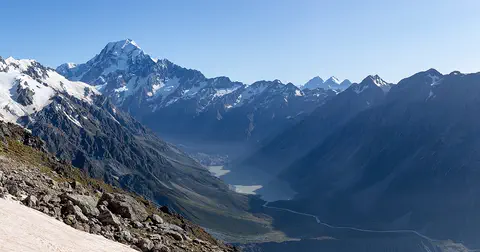
Aoraki / Mount Cook is New Zealand's highest mountain, in the Southern Alps of the South Island. Its name joins its Māori name, Aoraki, with its English name, Mount Cook. The mountain is being pushed up where two of Earth's plates meet, and glaciers carve the valleys around it. In 2013 surveyors measured it at 3,724 meters.
For parents & teachers
What children will learn
- Explain how a hotspot and a moving plate build a chain of volcanic islands.
- Describe how rain erosion shapes a volcanic island.
- Explain how old coral reefs can record past sea levels.
- Know why the Tahiti monarch is rare and how people help it.
Recommended ages: 3 to 17 · About 15 minutes
Talk about it
- Why might islands in a hotspot chain be of different ages?
- How can a reef that grows near the surface end up deep underwater?
- Why are island birds often harmed by rats brought by people?
Try at home or in class
- Hold a pen still and slowly slide a sheet of paper under it, tapping a dot every few seconds: the dots make a line, like islands forming as a plate moves over a hotspot.
- Pour water slowly over a mound of damp sand and watch small valleys form, like Tahiti's rain-carved valleys.
Key vocabulary: hotspot, shield volcano, isthmus, flank collapse, reef terrace, endemic
Where these facts come from
- Wikidata , Wikimedia Foundation (CC0 1.0)
- Tahiti, French Polynesia , NASA Earth Observatory
- Breeding biology of the Critically Endangered Tahiti Monarch Pomarea nigra, a bird with a low productivity (Blanvillain et al.) , Bird Conservation International (Cambridge University Press)
- Expedition 310 summary (Proceedings of the IODP, Volume 310) , Integrated Ocean Drilling Program
- Core replica: Tahiti Sea-Level - IODP Expedition 310 , ECORD
- Marine Life Viewing Guidelines , NOAA Fisheries
- What is a rip current? , NOAA National Ocean Service
- File:Crépuscule sur les eaux de Tahiti (Ifremer 00567-67913 - 47852).jpg , Wikimedia Commons
- Natural Earth vector data , Natural Earth (NACIS) (Public domain)
- Wikimedia Commons , Wikimedia Foundation (Per file (public domain, CC0, CC BY or CC BY-SA); see each media record)
Checked, not yet human-reviewed. Last updated November 1, 2026. Spotted a mistake? Tell us.