
 Country
Australia and Oceania
Niue
Niue is a small island made of old coral in the Pacific Ocean. It has rocky cliffs, sea caves and clear water. Big whales visit every year.
Niue is a raised coral island in the South Pacific, about 2,160 kilometers northeast of Auckland, New Zealand. It governs itself in free association with New Zealand, and its people are New Zealand citizens. Its coast is full of caves and chasms, humpback whales visit from July to October, and in 2020 it became the first country certified as a Dark Sky Place. The 2022 census found 1,689 residents.
Niue, a 260 km² raised coral island in the southwestern Pacific, has been self-governing in free association with New Zealand since the Niue Constitution Act of 1974. Its limestone coast is cut into caves and chasms, and in 2020 it became the first country to be certified as an International Dark Sky Place. The 2022 census found 1,689 usual residents, including 125 who were overseas on census night, far fewer than the 3,281 people counted in 1981, as many Niueans have moved to New Zealand.
Photo: Pseudopanax at English Wikipedia, public domain, via Wikimedia Commons
Discover Niue
Niue is one island in the big Pacific Ocean.
It is far from other land. People call it the Rock. The capital is Alofi.
Niue is a single island in the South Pacific, east of Tonga and about 2,160 kilometers northeast of Auckland, New Zealand. People sometimes call it "the Rock of Polynesia," or just "the Rock."
Niue runs its own affairs, but it is in free association with New Zealand: the two share the same king as head of state, and every Niuean is a New Zealand citizen. New Zealand helps with money and services and, if Niue asks, with defense and foreign affairs. The capital is Alofi, and people use the New Zealand dollar.
Britannica describes Niue as an internally self-governing island state in free association with New Zealand, the westernmost of the Cook Islands group but administered separately, about 2,160 km northeast of Auckland and 385 km east of Tonga's Vava'u Group.
New Zealand's foreign ministry says Niue is part of the Realm of New Zealand and shares its head of state. Under the Niue Constitution Act 1974, New Zealand provides economic and administrative assistance and, if Niue's government requests it, help with foreign affairs, defense and security; all Niueans are New Zealand citizens. The leader of government, called premier until September 2024 and now prime minister, is elected by the 20-member Legislative Assembly. The currency is the New Zealand dollar.
Alofi, villages and sea tracks
Alofi is the capital. Palm trees grow along its main street.
Paths lead down to the sea. At the bottom are rock pools and caves to swim in.
Alofi, on the west coast, is the capital and the main port. The photo shows its main street in the late afternoon, with palm trees, low buildings and a lamp that runs on solar power. Most people live in villages along the coast.
Marked tracks lead from the villages down to the sea. Matapa Chasm, once a bathing place kept for Niue's traditional kings, is now a sheltered spot to swim and snorkel. At the Limu Pools, fresh water from the island mixes with the sea, and the track to Togo Chasm winds through sharp coral spikes to a sandy floor where coconut palms grow.
Alofi is the capital and main port. In the 2022 census Alofi South was the village with the most usual residents (24.6%) and Namukulu the fewest (0.5%); City Population's table, from Niue Statistics, gives 606 residents for Alofi North and South together.
Niue Tourism describes marked sea tracks to the coast: Matapa Chasm, historically a bathing place reserved for Niue's traditional kings; the Talava Arches, once a lookout for raids or approaching ships; the Limu Pools on the north coast, where fresh water flowing out of the island mixes with the sea; Avaiki, the place where the first canoe is said to have landed; and Togo Chasm, reached through a mass of jagged coral pinnacles, with a golden-sand floor and coconut palms.
A raised coral island
Niue is made of old coral rock that rose out of the sea.
The middle of the island is high, wide land. Cliffs drop down to the water. There are no rivers.
Niue is a raised coral island: old coral reef that now stands above the sea. It has two levels. A central plateau, about 60 meters high at most, slopes steeply down to a lower terrace along the coast, which ends in small cliffs above the water. A reef runs around the island.
Erosion has carved the limestone coast into caves, arches and pools. Rain soaks straight into the rock, so the island has no rivers or lakes. About 2,000 millimeters of rain falls in a year, mostly in heavy storms from December to March.
Britannica describes a roughly oval raised coral island about 65 km around, with two levels: a central plateau rising to about 60 m that slopes steeply to a coastal terrace about 0.5 km wide and 25–27 m high, which meets the sea in small cliffs. A fringing reef surrounds it, and erosion of the porous limestone has made caves and pools. Wikidata gives the highest point as 68 m. DarkSky International notes that the coral sits on an ancient volcano, that there is no standing or running fresh water, and that the reef is broken in only one place, near Alofi.
Rain averages about 2,000 mm a year, falling mostly in heavy storms, sometimes tropical cyclones, from December to March; the warm, humid wet season lasts from November to March. Large trees include banyans and Tahiti chestnuts, with coconuts, fan palms and pandanus.
Whales by the shore
Humpback whales come to Niue every year.
Mother whales have their babies near the island. The water is so clear that you can see far down.
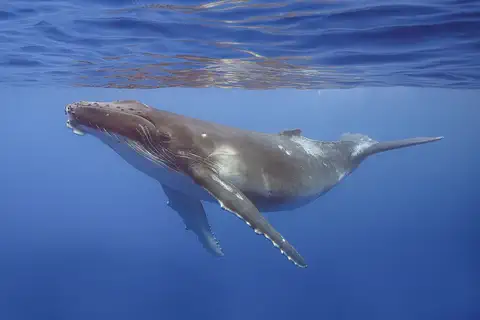
Humpback whales visit Niue every year from July to October. They come to give birth, feed their young and find mates, sometimes just a few meters from the shore. The seabed drops away steeply close to the coast, so deep water is very near.
The water around Niue is very clear, and snorkelers in pools such as Limu can see many kinds of fish. The whale photo here was taken near Moorea, in French Polynesia.
Niue Tourism says humpback whales visit every year from July to October, and DarkSky International's listing describes them arriving to give birth, nurse their young and mate within meters of the shore, where the steep sides of the submerged volcano make the seabed drop quickly. Water visibility is given as up to 70 m by Niue Tourism and up to 100 m by DarkSky International.
The Alofi North Marine Protected Area, reached from the Vaila rock pools, is a no-take area. The humpback photo here shows a calf off Moorea, French Polynesia.
Vagahau Niue and a small population
People on Niue speak Niuean and English.
Many Niuean families also live in New Zealand. The night sky is very dark, so the stars shine brightly.
Most people on Niue are Niuean, and they speak Niuean, called Vagahau Niue, and English. Niuean is a Polynesian language related to Tongan and Samoan. Fewer young people speak it well than older people, and Niue and New Zealand are working together to keep it strong.
The island's population has shrunk as many Niueans moved to New Zealand. By the early 2000s there were many times more people of Niuean family living in New Zealand than on Niue itself. In 2020 Niue became the first country to be certified as a Dark Sky Place, protecting its starry night sky.
In the 2022 census 73.7% of residents identified as Niuean or part-Niuean; the largest other groups were Tongan, Samoan, Tuvaluan, Fijian and Filipino. 61.4% named the Ekalesia Niue Church. Of residents aged 4 and over, 69.7% spoke Vagahau Niue well, against 86.4% in 2006 (the office notes that 2022 used a finer scale), with the highest proficiency among older people; New Zealand supports its revitalization.
Britannica explains the falling population by migration to New Zealand for economic reasons, and notes that in the early 21st century Niueans and their descendants in New Zealand outnumbered those on Niue many times over. The 1981 census counted 3,281 people on the island; the 2022 census found 1,689 usual residents, including 125 who were overseas on census night. In 2020 DarkSky International certified Niue as both a Dark Sky Community and a Dark Sky Sanctuary, the first country to become a Dark Sky Place.
Canoes, Cook and self-government
Long ago, people sailed to Niue in canoes.
They used the stars to find their way. Later, sailors from Britain came. Today Niue runs its own affairs.
Polynesian sailors who could find their way by the stars reached Niue long ago. Archaeologists have found signs that people from Samoa settled the island around the year 900.
The British explorer James Cook landed in 1774. In 1900 Britain made Niue a protectorate, and in 1901 New Zealand took it over. Niuean people elected their first assembly in 1960, and in 1974 they voted for a constitution that made Niue self-governing in free association with New Zealand.
Britannica cites archaeological evidence that Samoans settled Niue about 900 CE; DarkSky International credits Polynesian navigation and knowledge of the night sky with making settlement possible. James Cook landed in 1774 and, after a hostile reception, named it Savage Island. London Missionary Society members arrived from the 1830s.
Britain declared a protectorate in 1900; in 1901 Niue was annexed to New Zealand as part of the Cook Islands, but it was separated in 1903 with its own resident commissioner and island council. The first Legislative Assembly was elected in 1960, and in 1974 Niueans voted for self-government in free association with New Zealand. A tropical cyclone in 2004 caused severe damage along the coast, including in Alofi, and the island rebuilt with help from foreign aid, particularly from New Zealand.
Niue on the map
Find New Zealand on the globe.
Now look up and to the right, into the Pacific Ocean. Past Tonga there is one small island alone in the sea. That is Niue.
Niue sits alone in the South Pacific, about 19 degrees south of the equator. Tonga lies to the west, the Cook Islands to the east, and New Zealand is about 2,160 kilometers to the southwest.
Niue has no land borders. It is too small for the globe to draw, so PlayOwl marks it with dots: Alofi, Matapa Chasm, the Limu Pools and Togo Chasm.
Niue lies at about 19.05° S, 169.9° W, some 2,160 km northeast of Auckland and 385 km east of Tonga's Vava'u Group, with no land borders. The island is about 65 km around.
At the globe's scale it has no outline of its own, so the map uses markers: Alofi on the west coast, Matapa Chasm and the Limu Pools in the northwest, and Togo Chasm on the east coast.
- Distance to Auckland
- about 2,160 km
- Around the island
- about 65 km
- Residents (2022 census)
- 1,689
- Rain in a year
- about 2,000 mm
Amazing facts
-
Niue was the first country to protect its dark night sky.
In 2020 Niue became the first country in the world to be certified as a Dark Sky Place, so its stars stay bright.
DarkSky International certified Niue in 2020 as both an International Dark Sky Community and a Dark Sky Sanctuary, the first country ever to become a Dark Sky Place.
-
Niue has no rivers at all.
Rain soaks straight into Niue's coral rock, so the island has no rivers or lakes.
Niue's raised coral does not hold water, so the island has no standing or running fresh water.
-
A rock pool on Niue was once a bath for kings.
Matapa Chasm was once a bathing place kept for Niue's traditional kings. Today anyone can swim there.
Niue Tourism describes Matapa Chasm, with its expansive cliff face, as historically a bathing place reserved for Niue's traditional kings.
-
Every person from Niue is also a citizen of New Zealand.
Under New Zealand law, all Niueans are New Zealand citizens, and many people in New Zealand have Niuean families.
Under New Zealand law all Niueans are New Zealand citizens; Niue is part of the Realm of New Zealand and shares its head of state.
Words to know
- raised coral island
- an island made of old coral reef that now stands above the sea
- free association
- an arrangement in which a small country governs itself but chooses to share some things with a bigger partner
- chasm
- a deep, narrow opening in rock
- plateau
- a large area of high, mostly flat land
- light pollution
- too much artificial light at night, which hides the stars
- census
- an official count of all the people in a place
Discovery challenge
-
What is Niue made of?
What kind of island is Niue?
What kind of rock forms the island of Niue?
- Old coral rock
- Ice
- Sand dunes
Show the answer
Old coral rock
Old coral rock that rose out of the sea.
Niue is a raised coral island, made of old coral reef.
Porous coral limestone, raised above the sea and sitting on an ancient volcano.
-
Which big animals visit Niue every year?
Which animals visit Niue from July to October?
Which animals come close to Niue's shore from July to October to calve, nurse and mate?
- Polar bears
- Humpback whales
- Elephants
Show the answer
Humpback whales
Humpback whales!
Humpback whales, which give birth and raise their young near Niue.
Humpback whales; the steep seabed brings deep water close to the shore.
-
Which country is Niue's close partner?
Niue is in free association with which country?
Under the Niue Constitution Act 1974, Niue is in free association with which country?
- Japan
- Chile
- New Zealand
Show the answer
New Zealand
New Zealand.
New Zealand. All Niueans are New Zealand citizens.
New Zealand, which provides assistance and, on request, help with foreign affairs and defense.
-
What did Niue become first in the world to protect?
In 2020 Niue was the first country certified to protect what?
In 2020 Niue became the first country certified as what kind of place?
- Its dark night sky
- Its snowy mountains
- Its big rivers
Show the answer
Its dark night sky
Its dark sky, so the stars shine brightly.
Its dark night sky. Niue became the first Dark Sky country.
An International Dark Sky Place, as both a Dark Sky Community and a Dark Sky Sanctuary.
Places to discover in Niue
-
 Watch
City
Alofi
Alofi is the capital of Niue, a raised coral island in the Pacific Ocean. It is made up of two villages, Alofi North and Alofi South, by Alofi Bay. A census in 2022 counted 606 people in Alofi.
-
 Watch
Natural wonder
Pacific Ocean
The Pacific Ocean is the largest and deepest ocean basin on Earth, covering more than 30 percent of the planet's surface. It holds more than half of Earth's free water. Its deepest point, Challenger Deep in the Mariana Trench, is nearly 11 kilometers down, and earthquakes and volcanoes ring its edges.
Animals of Niue
Explore next
-
Watch
City
Alofi
Alofi is the capital of Niue, a raised coral island in the Pacific Ocean. It is made up of two villages, Alofi North and Alofi South, by Alofi Bay. A census in 2022 counted 606 people in Alofi.
-
 Watch
 Country
New Zealand
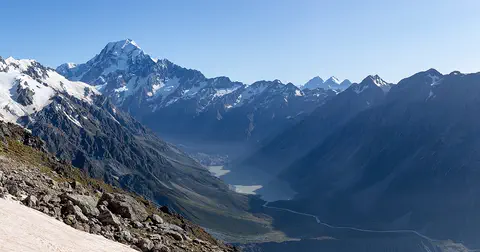
New Zealand, also called Aotearoa, is an island country in the South Pacific. Its two main islands have snowy mountains, glaciers, volcanoes and deep fiords, and about 5.36 million people lived there in 2026.
-
 Watch
 Country
Tonga
Tonga is a Polynesian kingdom of about 170 islands in the southwestern Pacific, in three main groups: Tongatapu, Ha'apai and Vava'u. Some islands are volcanoes and others are low coral islands. Captain Cook called them the Friendly Islands. Tonga's 2021 census counted 100,179 people, and the capital is Nuku'alofa.
-
 Watch
 Country
Samoa
Samoa is a Polynesian country in the South Pacific, made of nine volcanic islands ringed by coral reefs and lagoons. Most people live in coastal villages and follow the fa'a Samoa, the Samoan way of life. Samoa became independent from New Zealand in 1962, and in 2011 it jumped across the International Date Line. Its 2021 census counted 205,557 people.
-
 Watch
 Country
Cook Islands
The Cook Islands are 15 small islands and atolls spread across about 2 million square kilometers of the South Pacific. They govern themselves in free association with New Zealand, and Cook Islanders are New Zealand citizens. The 2021 census counted 14,987 residents, more than 70% of them on Rarotonga.
-
Watch
Natural wonder
Pacific Ocean
The Pacific Ocean is the largest and deepest ocean basin on Earth, covering more than 30 percent of the planet's surface. It holds more than half of Earth's free water. Its deepest point, Challenger Deep in the Mariana Trench, is nearly 11 kilometers down, and earthquakes and volcanoes ring its edges.
-
Watch
3D
Animal
Humpback whale
The humpback whale is a baleen whale famous for leaping out of the water, slapping its giant flippers and singing long, complex songs. It lives in every ocean and makes one of the longest journeys of any mammal, between cold feeding waters and warm waters where calves are born. Once hunted almost to extinction, it is now recovering.
- Watch Geography Caves and karst landscapes Most caves are made by slightly acidic water slowly dissolving rock such as limestone. Over hundreds of thousands of years, cracks grow into tunnels and rooms. The land above, with its sinkholes, disappearing streams and springs, is called karst. Inside, dripping water builds stalactites and stalagmites.
For parents & teachers
What children will learn
- Locate Niue in the South Pacific and describe how a raised coral island is shaped.
- Explain what free association with New Zealand means for Niue and its people.
- Describe Niue's language, its shrinking population and the link with New Zealand.
- Explain why Niue protects its dark night sky.
Recommended ages: 3 to 17 · About 15 minutes
Talk about it
- Niue has no rivers or lakes. Where else could people on an island get fresh water?
- Why might young people leave a small island, and what might help a language stay strong when families live far apart?
- What do we lose when the night sky is too bright to see the stars?
Try at home or in class
- On a clear night, count the stars you can see inside a cardboard tube from a bright place and then from a darker place. Which shows more?
- Pour water onto a sponge and onto a plate. Like Niue's coral rock, the sponge soaks the water up instead of letting it run off.
Key vocabulary: raised coral island, free association, chasm, plateau, light pollution, census
Where these facts come from
- Wikidata , Wikimedia Foundation (CC0 1.0)
- Natural Earth vector data , Natural Earth (NACIS) (Public domain)
- Niue (land, people, economy, government, history) , Encyclopaedia Britannica
- 2022 Niue Census of Population and Housing report , Niue Statistics Office
- Niue: island and villages, census 1981 to 2022 (from Niue Statistics) , City Population (Thomas Brinkhoff)
- Niue , New Zealand Ministry of Foreign Affairs and Trade
- Niue (International Dark Sky Places) , DarkSky International
- Niue Island , Niue Tourism
- Tracks, walks and caves , Niue Tourism
- PlayOwl region table, version 1 , PlayOwl (PlayOwl original data)
- flag-icons 7.5.0 , Panayiotis Lipiridis and contributors (MIT)
- Wikimedia Commons , Wikimedia Foundation (Per file (public domain, CC0, CC BY or CC BY-SA); see each media record)
Checked, not yet human-reviewed. Last updated November 1, 2026. Spotted a mistake? Tell us.