
 Country
Australia and Oceania
Tonga
Tonga is a country of about 170 islands in the Pacific Ocean. It has a king. Most people live on the island of Tongatapu.
Tonga is a Polynesian kingdom of about 170 islands in the southwestern Pacific, in three main groups: Tongatapu, Ha'apai and Vava'u. Some islands are volcanoes and others are low coral islands. Captain Cook called them the Friendly Islands. Tonga's 2021 census counted 100,179 people, and the capital is Nuku'alofa.
Tonga is a hereditary constitutional monarchy whose roughly 170 islands sit on two parallel chains of undersea mountains: a western chain of volcanic high islands and an eastern chain of coral and limestone low islands. Unified under King George Tupou I, who granted the 1875 constitution, it was a British protectorate from 1900 and regained full control of its affairs in 1970. The 2021 census counted 100,179 people.
Photo: Uhooep, CC BY-SA 4.0, via Wikimedia Commons
Discover Tonga
Tonga has about 170 islands in the Pacific Ocean.
Tonga has a king. The capital city is Nuku'alofa.
Tonga is made up of about 170 islands in the southwestern Pacific Ocean. They form three main groups: Tongatapu in the south, Ha'apai in the center and Vava'u in the north, plus a few far-off islands.
Tonga is a kingdom: a king or queen is head of the country, working with a prime minister and an elected assembly. Tongan and English are the official languages. The 2021 census counted 100,179 people. The photo shows the Royal Palace in Nuku'alofa, the capital.
Tonga's islands are spread between latitudes 15° and 23° S and longitudes 173° and 177° W, in the Tongatapu, Ha'apai and Vava'u groups, with the Niuas (Niuafo'ou, Niuatoputapu, Tafahi) in the far north and 'Ata in the far south.
The Tonga Statistics Department's census of November 30, 2021 counted 100,179 people; a new census is planned for 2026. The monarch governs in consultation with the prime minister, and the 26-seat Legislative Assembly (Fale Alea) has 9 nobles elected by their peers and 17 representatives elected by all citizens aged 21 and over. Tongan and English are official; the currency is the pa'anga. The photo shows the Royal Palace in Nuku'alofa.
Nuku'alofa and the island groups
Nuku'alofa is the capital city.
It is on the island of Tongatapu. Most people in Tonga live on that island.
Nuku'alofa, on Tongatapu, is the capital and a major port with several wharves. Much of its work involves coconuts and coconut products. Tongatapu is Tonga's largest island, and nearly three out of four Tongans live there.
Other ports and trading centers are Neiafu in the Vava'u group and Pangai in the Ha'apai group. Vava'u Island has a large harbor almost surrounded by land.
Tongatapu, a raised atoll of 260.5 km², is the largest and most densely populated island and holds nearly three-fourths of the population; most Tongans live in villages. Nuku'alofa is the capital and a major port of entry, its economy built largely on coconut products.
Neiafu (Vava'u) and Pangai (Ha'apai) are the other ports and commercial centers, and copra and bananas are shipped from Pangai. Fua'amotu International Airport on Tongatapu links Tonga with New Zealand, Fiji, Australia, Samoa, Niue and Hawaii. The University of the South Pacific has an extension center in Nuku'alofa, and the private 'Atenisi Institute dates from 1975.
Volcanic islands and coral islands
Some of Tonga's islands are volcanoes.
Other islands are low and flat. Tiny sea animals called corals help build them.
Tonga's islands sit on top of two lines of undersea mountains. The western islands are high islands pushed up by volcanoes, and four of them are still active. The highest point in Tonga, 1,033 meters, is on Kao Island in the Ha'apai group.
The eastern islands are low, topped with coral rock and limestone made by tiny sea animals such as corals. Tonga has no rivers. It is warm, about 27 °C in December and January, and cooler in June and July. Typhoons usually come between December and April, especially in the northern islands.
The islands are the summits of two roughly parallel undersea chains. Western high islands were raised by repeated volcanism, four still active: shield volcanoes such as Kao and Late have hard cones, while explosive ones such as Fonuafo'ou (Falcon Island) are ash and pumice that erode easily, so Fonuafo'ou has repeatedly appeared and vanished. Eastern low islands are capped by coral and foraminifera; a reef protects Tongatapu, but many unprotected Vava'u islands are shrinking.
Kao reaches 1,033 m (Britannica; Wikidata gives 1,030 m). There are no rivers. Rainfall runs from 1,620 mm in Ha'apai to 2,450 mm on Niuafo'ou. On January 15, 2022, the undersea volcano Hunga Tonga–Hunga Ha'apai, about 65 km north of Nuku'alofa, erupted, sending ash, gas and steam more than 20 km high and causing a tsunami and widespread damage.
Flying foxes, parrots and whales
Bats called flying foxes live in Tonga. They hang in trees in the day.
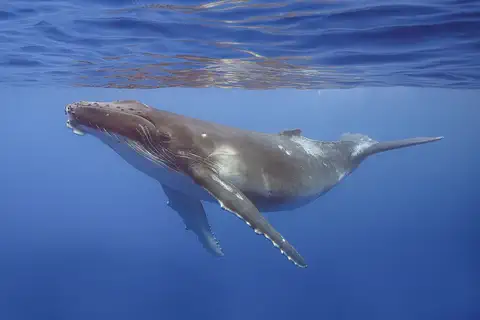
Humpback whales visit Tonga's warm sea.
In the village of Kolovai on Tongatapu, a colony of flying foxes, a kind of fruit bat, hangs in big trees by day and flies out at night to find food. The red-breasted musk parrot and the blue-crowned lory live on 'Eua, and tropicbirds nest on island cliffs.
Humpback whales visit Tonga's waters in their season. Southern humpbacks spend about mid-July to mid-October in warm waters, where calves are born. The photo shows a humpback calf off Moorea, in French Polynesia.
Britannica lists doves, rails, starlings and kingfishers among the land birds, the red-breasted musk parrot and blue-crowned lory on 'Eua, red-tailed and white-tailed tropicbirds on the cliffs, and the incubator bird on Niuafo'ou. Kolovai village on Tongatapu has a colony of Pacific flying foxes (Pteropus tonganus). Golden plovers, wandering tattlers and bar-tailed godwits pass through.
The Khaled bin Sultan Living Oceans Foundation describes Tonga's humpback whale season: Southern Hemisphere humpbacks are in low latitudes from about mid-July to mid-October to calve and mate, and calves are born without an insulating blubber layer. The photo shows a humpback calf off Moorea, French Polynesia.
Tapa cloth, fale and the lakalaka
People in Tonga make cloth from tree bark. It is called tapa.
Groups dance the lakalaka together at big celebrations.
Nearly all Tongans have Polynesian ancestors, and they are closely related to Samoans. Most families belong to a Christian church. Many people live in villages, some in traditional houses called fale, with sides of woven coconut leaves, reeds or wood.
Women make tapa cloth from bark and weave mats and baskets from pandanus leaves. In the lakalaka, often called Tonga's national dance, rows of up to several hundred people sing, clap and move together. Farmers grow squash, coconuts, bananas and vanilla to sell.
Almost the entire population is of Polynesian ancestry, with some Melanesian influence through contact with Fiji. About one-third belong to the Free Wesleyan (Methodist) Church and nearly one-fifth are Latter-day Saints. Education is free and compulsory from 5 to 14, and many Tongans have emigrated, especially to the United States and New Zealand.
All land is essentially owned by the monarchy, with estates divided among nobles; traditionally every man of 16 or over could receive a 3-hectare allotment. UNESCO inscribed the lakalaka in 2008 (proclaimed 2003): a dance of about 30 minutes for groups of up to several hundred, men on the right and women on the left, led by a punake who is poet, composer and choreographer. Other dances include the me'etu'upaki paddle dance and the tau'olunga.
From Lapita voyagers to a modern kingdom
People sailed to Tonga about 3,000 years ago.
Long ago Captain Cook visited. He called Tonga the Friendly Islands.
People of the Lapita culture, known for their decorated pottery, settled Tonga about 3,000 years ago. From at least the 900s, Tonga was ruled by a line of kings and queens called the Tu'i Tonga. Captain James Cook visited between 1773 and 1777 and called them the Friendly Islands, because people gave him supplies and a warm welcome.
King George Tupou I united Tonga and gave it a constitution in 1875. Tonga was a British protectorate from 1900 and became fully independent in 1970.
Austronesian-speaking Lapita people settled Tonga about 3,000 years ago. From at least the 10th century CE the Tu'i Tonga line ruled; powers later passed to the Tu'i Ha'a Takalaua (about 1470) and the Tu'i Kanokupolu (about 1600). Le Maire (1616) and Tasman (1643) visited, but effective contact began with Cook (1773–77). A Methodist mission succeeded in 1826.
Taufa'ahau ended decades of disorder, took the title King George Tupou I in 1845 and granted the 1875 constitution; Germany, Britain and the United States recognized Tonga's independence by treaty. It was a British protectorate from 1900, with foreign affairs run through a British consul, until 1970. Queen Salote Tupou III reigned 1918–65. Reforms from 2008 shifted most of the monarch's decisions to consultation with the prime minister, and Tupou VI has reigned since 2012.
Tonga on the map
Find New Zealand on the globe.
Move up across the sea. A long line of small islands is Tonga.
Find New Zealand, then travel about 2,000 kilometers northeast. Tonga's islands run from south to north: Tongatapu, then Ha'apai, then Vava'u, with the Niuas far to the north.
Tonga has no land borders. Its islands are spread between latitudes 15° and 23° south. Look for Tongatapu, the biggest island, in the south; nearly three out of four Tongans live there.
Tonga spans latitudes 15° to 23° S and longitudes 173° to 177° W, about 2,000 km northeast of New Zealand (UNESCO). From 'Ata in the south to the Niuas in the north, the islands follow two parallel chains: the volcanic western line, including Kao and Late, and the eastern line of low coral islands.
The active undersea volcano Hunga Tonga–Hunga Ha'apai lies about 65 km north of Nuku'alofa.
- Island groups
- Tongatapu, Ha'apai, Vava'u
- Number of islands
- about 170
- Kao (highest point)
- 1,033 m
- People (2021 census)
- 100,179
Amazing facts
-
Captain Cook called Tonga the Friendly Islands.
Captain Cook named Tonga the Friendly Islands because people gave him supplies and a warm welcome.
Cook, visiting in 1773–77, called the group the Friendly Islands after the welcome and supplies he received.
-
One Tongan island has appeared and disappeared again and again.
Fonuafo'ou, or Falcon Island, is made of soft ash, so it has appeared and washed away many times.
Fonuafo'ou (Falcon Island), built of easily eroded ash and pumice, has repeatedly emerged and disappeared in cycles of eruption and erosion.
-
Hundreds of people can dance the lakalaka together.
A lakalaka can last about 30 minutes, with up to several hundred dancers singing and clapping.
The punake who creates a lakalaka is poet, composer, choreographer and director at once.
-
Tonga has no rivers.
There are no rivers in Tonga, though 'Eua and Niuatoputapu have small creeks.
Tonga has no rivers; only 'Eua and Niuatoputapu have creeks.
Words to know
- kingdom
- a country whose head is a king or queen
- constitution
- the set of basic laws that says how a country is governed
- protectorate
- a country that keeps its own ruler but lets a stronger country handle some of its affairs
- tapa
- cloth made by beating the inner bark of trees
- high island
- an island raised well above the sea by volcanoes
- low island
- a flat island built mostly of coral and limestone
Discovery challenge
-
Who is the head of Tonga?
Tonga is a kingdom. Who is its head of state?
Under Tonga's 1875 constitution, who is the head of state?
- A king or queen
- A president
- A mayor
Show the answer
A king or queen
Tonga has a king.
A king or queen, working with a prime minister.
A hereditary monarch, who governs in consultation with the prime minister.
-
What did Captain Cook call Tonga?
What name did Captain Cook give the islands of Tonga?
Which name did Cook give Tonga after his visits in 1773–77?
- The Sandwich Islands
- The Friendly Islands
- The Spice Islands
Show the answer
The Friendly Islands
The Friendly Islands!
The Friendly Islands, because people welcomed him.
The Friendly Islands, for the supplies and welcome he received.
-
What is tapa cloth made from?
Tongan women make tapa cloth. What is it made from?
Which material is traditional Tongan tapa cloth made from?
- Sheep's wool
- Tree bark
- Seaweed
Show the answer
Tree bark
Tapa is made from bark.
Bark. Women also weave mats and baskets from pandanus leaves.
Bark; mats and baskets are woven from pandanus leaves.
-
What built some of Tonga's islands?
Kao and Late in Tonga's western chain were built by what?
What raised the high islands of Tonga's western chain?
- Glaciers
- Volcanoes
- Rivers
Show the answer
Volcanoes
Volcanoes pushed them up.
Volcanoes; four islands are still active.
Repeated volcanic activity; the eastern low islands were built by coral.
Animals of Tonga
Explore next
-
 Watch
 Country
Samoa
Samoa is a Polynesian country in the South Pacific, made of nine volcanic islands ringed by coral reefs and lagoons. Most people live in coastal villages and follow the fa'a Samoa, the Samoan way of life. Samoa became independent from New Zealand in 1962, and in 2011 it jumped across the International Date Line. Its 2021 census counted 205,557 people.
-
 Watch
 Country
Fiji
Fiji is a country of about 300 islands and 540 islets in the South Pacific, around a sea called the Koro Sea. About 100 of the islands have people living on them. The capital, Suva, is on the largest island, Viti Levu. The 2017 census counted about 885,000 people.
-
 Watch
 Country
New Zealand
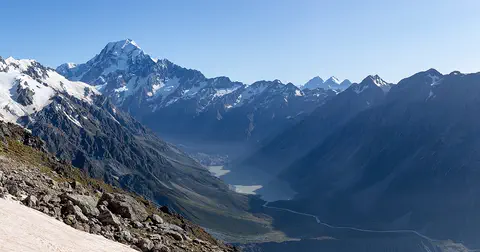
New Zealand, also called Aotearoa, is an island country in the South Pacific. Its two main islands have snowy mountains, glaciers, volcanoes and deep fiords, and about 5.36 million people lived there in 2026.
-
 Watch
Journey
The first voyagers of the Pacific
Over thousands of years, the ancestors of today's Pacific Islanders sailed double-hulled canoes across the Pacific and settled islands from Samoa and Tonga to Hawaiʻi, Rapa Nui and Aotearoa New Zealand. They had no compasses or maps: navigators read the stars, the ocean swells, the clouds and the birds.
-
Watch
3D
Animal
Humpback whale
The humpback whale is a baleen whale famous for leaping out of the water, slapping its giant flippers and singing long, complex songs. It lives in every ocean and makes one of the longest journeys of any mammal, between cold feeding waters and warm waters where calves are born. Once hunted almost to extinction, it is now recovering.
-
 Watch
 Country
American Samoa
American Samoa is a group of islands in the South Pacific, the eastern part of the Samoan islands. It is a territory of the United States, but most people are Samoan and follow the fa'asamoa, the Samoan way of life. Rainforest covers its steep volcanic mountains, coral reefs ring its shores, and the 2020 census counted 49,710 people.
-
 Watch
 Country
Cook Islands
The Cook Islands are 15 small islands and atolls spread across about 2 million square kilometers of the South Pacific. They govern themselves in free association with New Zealand, and Cook Islanders are New Zealand citizens. The 2021 census counted 14,987 residents, more than 70% of them on Rarotonga.
-
 Watch
 Country
Niue
Niue is a raised coral island in the South Pacific, about 2,160 kilometers northeast of Auckland, New Zealand. It governs itself in free association with New Zealand, and its people are New Zealand citizens. Its coast is full of caves and chasms, humpback whales visit from July to October, and in 2020 it became the first country certified as a Dark Sky Place. The 2022 census found 1,689 residents.
For parents & teachers
What children will learn
- Locate Tonga and name its three main island groups.
- Compare high volcanic islands with low coral islands.
- Describe Tongan crafts and the lakalaka dance.
- Outline Tonga's history from Lapita settlement to the 1875 constitution and full independence in 1970.
Recommended ages: 3 to 17 · About 15 minutes
Talk about it
- Why might Captain Cook have called Tonga the Friendly Islands?
- How is an island made by a volcano different from one made by coral?
- What celebrations bring your whole community together?
Try at home or in class
- Make a pattern on brown paper with crayons to look like tapa cloth, then fold and crumple it to soften it.
- Practice a group dance in two rows, one stepping briskly and one moving their hands, and clap together.
Key vocabulary: kingdom, constitution, protectorate, tapa, high island, low island
Where these facts come from
- Wikidata , Wikimedia Foundation (CC0 1.0)
- Natural Earth vector data , Natural Earth (NACIS) (Public domain)
- Tonga (introduction, land, people) , Encyclopaedia Britannica
- Tonga: Economy, government and cultural life , Encyclopaedia Britannica
- Tonga: History , Encyclopaedia Britannica
- Tonga Statistics Department (population at 30 November 2021) , Tonga Statistics Department
- Lakalaka, dances and sung speeches of Tonga , UNESCO Intangible Cultural Heritage
- Whales, Whales, Whales (Tonga) , Khaled bin Sultan Living Oceans Foundation
- PlayOwl region table, version 1 , PlayOwl (PlayOwl original data)
- flag-icons 7.5.0 , Panayiotis Lipiridis and contributors (MIT)
- Wikimedia Commons , Wikimedia Foundation (Per file (public domain, CC0, CC BY or CC BY-SA); see each media record)
Checked, not yet human-reviewed. Last updated November 1, 2026. Spotted a mistake? Tell us.