
City Europe
Hamburg
Hamburg is a big port city in Germany. Huge ships sail up the Elbe River to its harbor. It has canals, a lake and a concert hall with a shining glass top.
Hamburg, in northern Germany, is the country's second-biggest city and one of Europe's largest ports. It grew from a castle built about 825 into a rich trading city on the Elbe River, with canals, a big lake and brick warehouses. About 1.9 million people lived there in 2025.
Hamburg, the Free and Hanseatic City, is both a city and one of Germany's 16 states. It grew from the Hammaburg of about 825 into a leading Hanseatic port, survived the fire of 1842 and wartime destruction, and remains one of Europe's largest ports; its Speicherstadt warehouse district became a UNESCO World Heritage Site in 2015.
Photo: kallerna, CC BY-SA 4.0, via Wikimedia Commons
Discover Hamburg
Hamburg is a big city in Germany.
It sits on a wide river called the Elbe. Giant ships come up the river from the sea. In the middle of the city is a big lake for little sailboats.
Hamburg is in northern Germany, on the Elbe River, about 105 kilometers from the North Sea. It is Germany's second-biggest city, after Berlin, with about 1.9 million people in 2025, and its harbor is one of the largest and busiest in Europe.
Hamburg is also one of Germany's 16 states, so the city runs itself, much as it has for hundreds of years. It has many canals, called Fleete, and in its center is a lake made by damming a smaller river, the Alster.
The Free and Hanseatic City of Hamburg is the second smallest of Germany's 16 Länder, with about 755 km², and the most populous German city after Berlin: about 1.9 million people in 2025 (Wikidata). Its official name covers both the state and the city, reflecting a long tradition of self-government; Britannica notes that Hamburg and Bremen are the only German city-states that keep something of their medieval independence.
The city stands at the northern edge of the lower Elbe valley, here 8 to 13 km wide. The Elbe splits into two branches southeast of the old city and rejoins opposite Altona to form the Unterelbe, which reaches the North Sea some 65 miles (about 105 km) downstream. The Alster flows in from the north and the Bille from the east. Britannica adds that Hamburg has more consulates than any city except New York City.
- Country
- Germany (a city-state)
- People (2025)
- about 1.9 million
- Area
- about 755 km²
- Rivers
- the Elbe, the Alster and the Bille
Famous places
Hamburg has a concert hall on top of an old brick warehouse.
Its top is made of shining glass! Nearby are long rows of red-brick warehouses beside narrow canals. Five old churches have tall towers.
The Elbphilharmonie is a concert hall built on top of an old red-brick warehouse by the harbor. Its glittering glass top, made of more than 1,100 window panels, rises to 110 meters, and its Grand Hall seats 2,100 people. It opened in January 2017.
Nearby is the Speicherstadt, a district of huge brick warehouses built between 1885 and 1927 on narrow islands, with canals running between them. Next to it stands the Chilehaus, a brick office building of 1922 to 1924. Above the old town rise the towers of five great churches.
The Elbphilharmonie, designed by Herzog & de Meuron, rises from the redbrick Kaispeicher A warehouse: a glass structure of more than 1,100 window panels reaching 110 m. Its Grand Hall seats 2,100 and opened in January 2017; an 82 m curved escalator carries visitors up toward the public Plaza, 37 m above the ground.
UNESCO inscribed the Speicherstadt and Kontorhaus District in 2015. The Speicherstadt, developed on narrow Elbe islands between 1885 and 1927 and partly rebuilt in 1949–67, has 15 very large warehouse blocks and a network of short canals; the Kontorhaus district beside it has six large office complexes of the 1920s to 1940s, including Fritz Höger's Chilehaus (1922–24). The old town keeps the towers of five principal churches, none in its original state; Sankt Michaelis, an 18th-century Baroque church, burned in 1906 and was rebuilt twice. The Rathaus (City Hall) dates from the late 19th century.
- Elbphilharmonie
- 110 m high; Grand Hall with 2,100 seats; opened January 2017
- Speicherstadt
- warehouses built 1885–1927; UNESCO site 2015
- Chilehaus
- brick office building, 1922–1924
- Television tower
- 271.5 m
From castle to Hanseatic port
Long ago, Hamburg began as a small castle by two rivers.
Traders came with their ships, and the town grew rich. A big fire burned part of the city, and people built it again. Today Hamburg is huge.
Hamburg's story begins with the Hammaburg, a small castle with a moat, built about the year 825 between the Alster and Elbe rivers. In 1189 the emperor gave the town special trading rights, and Hamburg became a great trading city and a member of the Hanseatic League, a group of trading towns.
In May 1842 a great fire destroyed a quarter of the city, but it was rebuilt. Hamburg grew from 130,000 people to 700,000 during the 1800s. It was badly damaged in World War II and rebuilt again.
Hamburg began as the Hammaburg, a modest moated castle built about 825 on a sandy promontory between the Alster and the Elbe. In 1188 the count of Holstein chartered a new town with a harbor on the Alster, and on May 7, 1189, Emperor Frederick I Barbarossa granted it trading rights, toll exemptions and navigation privileges. In the Hanseatic League, Hamburg's role was second only to Lübeck's, and by 1550 it had overtaken Lübeck; a stock exchange followed in 1558 and the Bank of Hamburg in 1619.
The great fire of May 1842 devastated a quarter of the city, yet the economy kept booming, and the population rose from 130,000 to 700,000 over the 19th century; the free port and its warehouses were built in the 1880s. The Greater Hamburg Act of 1937 added Altona, Wandsbek and Harburg. Air raids in World War II destroyed more than half of the homes and harbor installations, and a flood in 1962 struck the city; reconstruction was rapid.
Getting around Hamburg
People in Hamburg ride buses and underground trains.
Little boats float along the canals and across the lake. Big trains go all over Germany. Airplanes fly from an airport more than 100 years old!
Hamburg has a good network of buses and underground trains, and it is well connected to the rest of Germany by rail. Its airport, at Fuhlsbüttel, dates from 1911, which makes it one of the oldest in Europe.
Water is everywhere. Pleasure boats travel the waterways that run into the Outer Alster lake, and the old canals, called Fleete, link the Alster with the docks on the Elbe. From the Lombard Bridge, which divides the lake in two, you get one of the best views of the city's church towers.
Britannica describes the harbor and city as well served by the German railway network, with a good system of buses and underground trains. Hamburg-Fuhlsbüttel airport, dating from 1911, is one of the oldest in Europe.
Waterways shape movement in the center. The Alster, dammed to form a lake of 184 hectares, is divided by the Lombardsbrücke into the Binnenalster (Inner Alster) and the Aussenalster (Outer Alster); navigable waterways for pleasure boats run into the outer lake, and the Fleete, old canals following the medieval layout, connect the Alster with the docks on the Elbe. In the 19th century the harbor was made accessible at any time, so ships no longer had to wait for the tide in the Elbe estuary.
- Airport
- Hamburg-Fuhlsbüttel, dating from 1911
- Public transport
- buses and underground trains
- Lake in the center
- about 184 hectares, split by the Lombard Bridge
Weather and seasons
Hamburg is often cool and rainy.
Summer days are pleasant, not too hot. Winter days are cold, but not freezing most of the time. Bring an umbrella!
Hamburg's weather is mild and often damp. At the World Meteorological Organization's Hamburg station, January days averaged about 4 °C and nights about −1 °C between 1971 and 2000. July days averaged about 22 °C and nights about 13 °C.
Rain falls in every month, adding up to about 770 millimeters a year. Summer and December are the wettest times.
WMO normals for the Hamburg station (1971–2000) give average daily highs and lows of about 4 °C and −1 °C in January and about 22 °C and 13 °C in July and August. Only January and February average lows below freezing.
Precipitation is frequent: the monthly averages add up to about 770 mm, from about 42 mm in February to about 78 mm in December, with about 12 days of precipitation in January and about 11 in July.
- January, average daily high and low (WMO Hamburg station, 1971–2000)
- about 4 °C and −1 °C
- July, average daily high and low (same station and period)
- about 22 °C and 13 °C
- Rain and snow in a year (sum of the monthly averages)
- about 770 mm
Living in Hamburg
Many people in Hamburg work with ships and trade.
On Sunday mornings there is a busy market by the harbor. Families visit museums, the opera and parks around the lake.
For centuries, shipping and trade have been the heart of Hamburg, and its harbor is still the city's most important feature. Since 1937 it has also become Germany's major industrial city, with chemical, steel and shipbuilding industries.
Hamburg loves culture. Its opera house dates from 1678, its art museum, the Kunsthalle, from 1868, and its university from 1919. Every Sunday morning, a colorful market at the Fischmarkt by the harbor sells everything from fish to secondhand household goods. Around the Outer Alster lake are parks and leafy neighborhoods.
Britannica calls shipping and trade Hamburg's lifeblood and its harbor the city's most important feature. Since absorbing Altona, Harburg and Wandsbek in 1937, Hamburg has become Germany's major industrial city: it treats most of the country's copper supplies, and its chemical, steel and shipbuilding industries are important. The prosperous years 1890–1910 left elegant patrician houses around the Aussenalster, many now consulates, and the 1920s and 1930s revived the north German dark red brick.
Cultural institutions include the Hamburg Staatsoper (1678), the Kunsthalle (1868), one of Europe's most remarkable galleries according to Britannica, the Museum of Hamburg History and the Universität Hamburg (1919), one of Germany's largest. Deichstrasse, backing onto the Nikolai canal, keeps the last intact ensemble of traditional tall, narrow Hamburg houses; the fire of 1842 began at number 42. The Sunday-morning market at the Fischmarkt by the harbor is another famous institution.
- Opera
- Hamburg Staatsoper, dating from 1678
- University
- Universität Hamburg, founded 1919
- Art museum
- the Kunsthalle, founded 1868
Hamburg on the map
Find Hamburg on the globe.
It is in Germany, in Europe. Look for the Elbe River in the north. Follow it toward the sea, and you will find Hamburg.
Hamburg is in northern Germany, on the Elbe River, about 105 kilometers from where the river reaches the North Sea. Berlin, the capital, is to the southeast.
Even though Hamburg is not on the coast, the deep river lets big ships reach its harbor from the sea.
Hamburg lies at about 53.6° N and 10.0° E, at the northern edge of the lower Elbe valley. The Unterelbe carries shipping some 65 miles (about 105 km) from the city to the North Sea, giving an inland city one of Europe's largest seaports.
Between the city and the Elbe's left bank lie the islands from Veddel to Finkenwerder, which Hamburg gained by the Treaty of Gottorp in 1768 and which later became the site of new docks.
- Latitude
- about 53.6° north
- Longitude
- about 10.0° east
- Distance down the Elbe to the North Sea
- about 65 miles (105 km)
Amazing facts
-
Hamburg's concert hall sits on top of an old warehouse.
The Elbphilharmonie's glass top sits on an old brick warehouse called Kaispeicher A, and it is made of more than 1,100 window panels.
The Elbphilharmonie's glass superstructure, of more than 1,100 window panels (about 21,000 m² of glass facade), rises from the redbrick Kaispeicher A to 110 m.
-
Hamburg's coat of arms shows a castle with three towers.
Hamburg's coat of arms shows a silver castle with three towers on red. It stands for the Hammaburg, the castle where the city began.
Hamburg's arms, a silver three-towered castle on a red field, represent the Hammaburg; the design comes from the city's great seal of 1241.
-
Hamburg's opera house is more than 300 years old.
The Hamburg Staatsoper, the city's opera house, dates from 1678.
The Hamburg Staatsoper dates from 1678 and, according to Britannica, has won world renown.
-
Hamburg's old warehouses stand on islands in the river.
The Speicherstadt's 15 giant warehouse blocks were built on narrow islands in the Elbe, with canals running between them.
UNESCO calls the Speicherstadt one of the largest coherent historic ensembles of port warehouses in the world, about 300,000 m² on narrow Elbe islands.
Words to know
- port
- a town or city with a harbor where ships load and unload
- city-state
- a city that governs itself like a state
- Hanseatic League
- a group of trading towns in northern Europe in the Middle Ages that worked together
- warehouse
- a large building for storing goods
- canal
- a waterway made by people for boats
- estuary
- the wide part of a river where it meets the sea
Discovery challenge
-
Which river flows through Hamburg?
Big ships reach Hamburg along which river?
Up which river do seagoing ships travel about 105 km to reach Hamburg?
- The Elbe
- The Danube
- The Seine
Show the answer
The Elbe
The Elbe! Big ships sail up it from the sea.
Ships sail up the Elbe from the North Sea, about 105 kilometers away.
The Elbe; its Unterelbe section carries shipping some 65 miles (about 105 km) from the North Sea.
-
What is on top of Hamburg's old harbor warehouse?
What was built on top of the old Kaispeicher A warehouse by Hamburg's harbor?
Which building, opened in January 2017, rises from the Kaispeicher A warehouse?
- A concert hall
- A football stadium
- An airport
Show the answer
A concert hall
A concert hall! It has a shiny glass top.
The Elbphilharmonie, a concert hall with a Grand Hall of 2,100 seats.
The Elbphilharmonie by Herzog & de Meuron, 110 m high, with a 2,100-seat Grand Hall.
-
How did Hamburg begin?
What was the Hammaburg, where Hamburg began about 825?
What kind of structure was the Hammaburg of about 825?
- A castle
- A lighthouse
- A bridge
Show the answer
A castle
As a castle! It had a moat around it.
A small castle with a moat, between the Alster and Elbe rivers.
A modest moated castle on a sandy promontory between the Alster and the Elbe.
-
What happened in Hamburg in 1842?
What destroyed a quarter of Hamburg in May 1842?
What struck Hamburg in May 1842, devastating a quarter of the city?
- A great fire
- An earthquake
- A volcano
Show the answer
A great fire
A big fire. Then people built the city again.
A great fire. It started in a house on Deichstrasse, and the city was rebuilt.
The great fire, which began at Deichstrasse 42; the economy kept booming regardless.
-
Which month is warmer in Hamburg?
In which month is Hamburg warmer, on average?
In which month do days at the WMO Hamburg station average about 22 °C?
- January
- July
Show the answer
July
July! Summer is pleasant.
July days average about 22 °C, and January days about 4 °C.
WMO normals (1971–2000) give about 22 °C for July days and about 4 °C for January days.
Nearby places
-
 Watch
Landmark
Brandenburg Gate
The Brandenburg Gate is a grand sandstone gateway in the center of Berlin, built from 1788 to 1791 with 12 columns and five passages. On top, a statue called the Quadriga shows a chariot pulled by four horses. From 1961 to 1989 the Berlin Wall shut it off, so the gate became a symbol first of a divided Germany and then of its reunification.
-
Watch
City
Berlin
Berlin, the capital of Germany, grew from two small trading towns on the Spree River. From 1961 to 1989 the Berlin Wall divided it. Today about 3.7 million people live there (2025), among lakes, forests, museums and the Brandenburg Gate.
-
 Watch
City
Copenhagen
Copenhagen, the capital of Denmark, grew from a small harbor town into a royal city of palaces, canals and towers. Its name means "Merchants' Harbor." It has the Tivoli Gardens, opened in 1843, and the Little Mermaid statue, and about 673,000 people lived there in 2026.
-
 Watch
City
Amsterdam
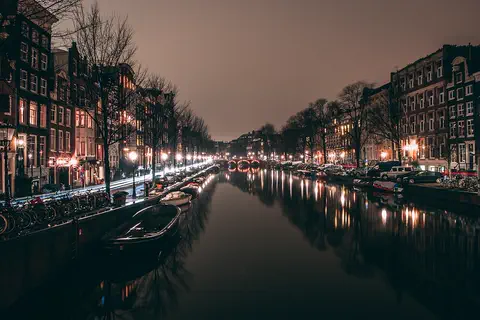
Amsterdam is the capital of the Netherlands. It began as a fishing village beside a dam on the Amstel River, which gave the city its name. Today about 942,000 people live among its rings of canals, hundreds of bridges, houseboats and bicycles.
-
 Watch
City
Brussels
Brussels is the capital of Belgium. It began as a market where a road crossed the small Senne River, and its old name means "settlement in the marshes." Its Grand-Place, ringed by 17th-century guildhalls, is a UNESCO World Heritage Site, and the city is home to many offices of the European Union.
-
 Watch
City
Prague
Prague, the capital of the Czech Republic, lies on the Vltava River in the heart of Europe. With Prague Castle on its hill, the 14th-century Charles Bridge and so many church towers that it is called the 'City of a Hundred Spires', its historic center is a UNESCO World Heritage Site. About 1.4 million people lived there in 2025.
-
 Watch
City
Munich
Munich is the capital of Bavaria, a state in southern Germany, and the country's third-biggest city. It began in 1158 as a market by a bridge over the Isar River, and its name means "Home of the Monks." Today it is famous for its palaces, art museums, the huge Deutsches Museum and its autumn Oktoberfest.
-
 Watch
Natural wonder
Danube
The Danube is Europe's second-longest river, after the Volga. It begins as two small streams in Germany's Black Forest and flows about 2,850 kilometers east to the Black Sea, passing through 10 countries and four capital cities. For more than 2,000 years it has been a border, a highway for boats and a home for wildlife, and it ends in a giant delta of reeds, lakes and birds.
Explore next
-
 Watch
 Country
Germany
Germany is a country in north-central Europe. The land rises from flat plains by the North Sea and the Baltic Sea to forested hills and, in the far south, the Alps. About 83.5 million people (2025) live there, and its capital is Berlin.
-
Watch
City
Berlin
Berlin, the capital of Germany, grew from two small trading towns on the Spree River. From 1961 to 1989 the Berlin Wall divided it. Today about 3.7 million people live there (2025), among lakes, forests, museums and the Brandenburg Gate.
-
Watch
City
Amsterdam
Amsterdam is the capital of the Netherlands. It began as a fishing village beside a dam on the Amstel River, which gave the city its name. Today about 942,000 people live among its rings of canals, hundreds of bridges, houseboats and bicycles.
- Watch Geography What is a World Heritage Site? World Heritage Sites are places so important that they belong, in a way, to everyone. Under a 1972 agreement, countries nominate their most outstanding places, experts check them, and a UNESCO committee decides. By 2026 the list held 1,273 sites: cultural places like the Taj Mahal, natural places like the Galápagos, and mixed ones like Machu Picchu.
-
 Watch
City
Athens
Athens is the capital of Greece and one of the oldest cities in the world. Above it rises the Acropolis, a rocky hill crowned by the marble Parthenon, built about 2,500 years ago. Ancient Athens was home to early democracy, great thinkers and theater.
-
 Watch
City
Barcelona
Barcelona, the capital of Catalonia in northeastern Spain, lies on the Mediterranean between mountains and the sea. It is famous for the buildings of the architect Antoni Gaudí, including the Sagrada Família, a giant church begun in 1882. About 1.7 million people live in the city (2025).
-
 Watch
City
Belgrade
Belgrade, the capital of Serbia, stands where the Sava River flows into the Danube. Its name, Beograd, means "white city", probably because of the white limestone walls of its old fortress above the rivers. At the 2022 census, about 1.2 million people lived in the city itself and about 1.7 million in the wider City of Belgrade.
-
Watch
City
Brussels
Brussels is the capital of Belgium. It began as a market where a road crossed the small Senne River, and its old name means "settlement in the marshes." Its Grand-Place, ringed by 17th-century guildhalls, is a UNESCO World Heritage Site, and the city is home to many offices of the European Union.
For parents & teachers
What children will learn
- Locate Hamburg on the Elbe in northern Germany and explain how a river port can be far from the sea.
- Describe how trade shaped Hamburg's history, from a castle to a Hanseatic city.
- Name landmarks such as the Elbphilharmonie and the Speicherstadt and say what they were built for.
- Read temperature and rainfall averages to describe a mild, damp climate.
Recommended ages: 3 to 17 · About 15 minutes
Talk about it
- Hamburg is about 105 kilometers from the sea, yet it is a major port. How can that work?
- An old warehouse became the base of a concert hall. What old building near you could be reused?
- Hamburg governs itself as a city-state. What decisions would you want your town to make for itself?
Try at home or in class
- Build a model of the Elbphilharmonie: stack a brick-colored box for the warehouse and add a wavy top cut from clear plastic or tracing paper.
- On a map, trace the Elbe from Hamburg to the North Sea and measure the distance with a piece of string and the map's scale.
Key vocabulary: port, city-state, Hanseatic League, warehouse, canal, estuary
Where these facts come from
- Wikidata , Wikimedia Foundation (CC0 1.0)
- Natural Earth vector data , Natural Earth (NACIS) (Public domain)
- UNESCO World Heritage List , UNESCO World Heritage Centre (Linked as a reference; site facts come from Wikidata)
- Hamburg , Encyclopaedia Britannica
- Hamburg: History and evolution of the modern city , Encyclopaedia Britannica
- Hamburg: Climate and economy , Encyclopaedia Britannica
- Hamburg: Economy, transport and cultural life , Encyclopaedia Britannica
- Speicherstadt and Kontorhaus District with Chilehaus , UNESCO World Heritage Centre
- Details and facts about the Elbphilharmonie (opening January 2017) , Elbphilharmonie Hamburg
- Hamburg: climatological information , World Meteorological Organization, World Weather Information Service
- Wikimedia Commons , Wikimedia Foundation (Per file (public domain, CC0, CC BY or CC BY-SA); see each media record)
Checked, not yet human-reviewed. Last updated October 27, 2026. Spotted a mistake? Tell us.