
Landmark North America
Willis Tower
Willis Tower is a very, very tall black skyscraper in Chicago, in the United States. It has 110 stories. At the top, you can stand in a glass box and look straight down!
Willis Tower, first called the Sears Tower, is a skyscraper in Chicago finished in 1973. It is 442 meters tall and was the tallest building in the world for about 25 years. Its clever 'bundled tube' design was made by engineer Fazlur Khan and the firm SOM.
Designed by Skidmore, Owings & Merrill with structural engineer Fazlur Khan, the Sears Tower (renamed Willis Tower in 2009) pioneered the bundled-tube structure: nine steel tubes that end at different heights. At 442.1 m, it was the world's tallest building for about 25 years after 1973.
Photo: Daniel Schwen, CC BY-SA 4.0, via Wikimedia Commons
Discover Willis Tower
Willis Tower is in Chicago, a big city in the United States.
It is a skyscraper, a building so tall it seems to scrape the sky. It is black and has 110 stories. Two white antennas stick up from the top.
Willis Tower stands in downtown Chicago, near the Chicago River. It is a skyscraper of 110 stories, built as the headquarters of Sears, Roebuck and Company, so for many years it was called the Sears Tower. In 2009 it was renamed after the Willis Group, an insurance company based in London.
The tower is 442 meters tall, or about 1,450 feet. With its two antennas, it reaches 1,730 feet. When it was finished in 1973, it was the tallest building in the world, and it kept that title for about 25 years. Each day, thousands of people work in it or visit it.
Willis Tower, at 233 South Wacker Drive in Chicago's Loop, was commissioned in 1969 by Sears, Roebuck and Co., then the world's largest retailer with about 350,000 employees, which wanted one large building for its staff. The Skyscraper Center gives its architectural height as 442.1 m (1,451 ft), with the highest occupied floor at 412.7 m, and counts 108 floors above ground; the tower's own Skydeck counts 110 stories and gives 1,730 ft including the antennas.
It opened in 1973, though the Skydeck notes that construction was not fully complete until 1974, the year the Skyscraper Center lists; it was the world's tallest building for about 25 years. The Skyscraper Center classes it as an all-steel office building with 104 elevators. In 2009 it was renamed for the Willis Group, a London-based insurance broker.
- Where
- 233 South Wacker Drive, Chicago, Illinois, USA
- Height
- 442.1 m (1,451 ft); 1,730 ft with antennas
- Built
- August 1970 to May 1973
- Designers
- Skidmore, Owings & Merrill; engineer Fazlur Khan
From Sears Tower to Willis Tower
Long ago, a big store company had lots and lots of workers. It wanted one giant office for them all.
So builders made this tower. It took about 2,000 workers three years. Later, the tower got a new name.
In 1969, Sears, Roebuck and Company was the largest store company in the world, with about 350,000 workers. It wanted one huge building for its many office staff, so it asked the architects Skidmore, Owings and Merrill to design one.
Work began in August 1970, and the tower was finished in May 1973, after about three years and the work of around 2,000 people. Some last work went on into 1974. In 1982 its broadcast antennas were added, and in 1985 an arched glass atrium was built at its base. Sears later moved out, and in 2009 the building was renamed Willis Tower. A big renovation from 2017 to 2022 added shops, restaurants and a rooftop garden.
Sears commissioned the tower in 1969 and broke ground in August 1970; the Skydeck's history gives completion in May 1973, after about three years of work by some 2,000 workers. The last beam to be placed was signed by about 12,000 construction workers, Sears employees and Chicagoans.
The tower's own timeline adds the broadcast antennas in 1982, the arched-glass Wacker Drive Atrium in 1985, the Skydeck's first renovation in 2000 and the renaming in 2009; the building was bought by Blackstone in 2015, and a five-year renovation from 2017 to 2022 added the Catalog retail and dining center and a rooftop green space. Sources give different years for the move of Sears's headquarters out of the tower (1988, 1989 and 1995 appear on the Skydeck's and SOM's pages), so no single date is given here.
Nine tubes bundled together
Inside the walls, the tower is made of nine tall steel tubes, like nine straws held in a bunch.
Some tubes stop lower. Some go higher. That gives the tower its stair-step shape.
The structural engineer Fazlur Khan came up with the 'bundled tube' design. Imagine nine tall, square steel tubes standing side by side, each about 75 feet (23 meters) wide, held together like a bundle of straws. Each tube is strong on its own, and together they resist both the wind and the building's own weight.
All nine tubes rise together for the first 50 stories. Then, one by one, some tubes stop, so the tower gets narrower in steps. The steel frame was put together in sections and bolted into place, and the outside is covered in black aluminum and bronze-tinted glass.
SOM describes the structure as nine column-free square tubes, each 75 by 75 ft, forming a cellular-tube frame. Each tube is rigid in itself without internal supports, and the bundle rests on reinforced-concrete caissons that reach bedrock. The tubes rise together as a closed square for the first 50 stories and then terminate at varying heights, producing the multi-tiered setbacks. The setbacks answered the client's brief: Sears wanted both very large floors for its own operations and smaller floors to rent to other tenants.
The Skydeck credits Fazlur Khan with the bundled-tube system that handled both wind and gravity loads. The steel frame was pre-assembled in sections and bolted together on site. The skin of black aluminum and bronze-tinted, glare-reducing glass insulates the frame, keeping its temperature fairly steady and so limiting expansion and contraction. The tower sways about 6 inches (152 mm) on average and is designed to sway up to 3 ft.
The Skydeck and the Ledge
Near the top is the Skydeck. People ride a fast elevator up to look out.
There are glass boxes that stick out from the building. You can stand inside and see the street far, far below your feet!
On the 103rd floor, 1,353 feet above the ground, is the Skydeck, the highest observation deck in the United States. On a clear day you can see four states: Illinois, Indiana, Wisconsin and Michigan, as far as 40 to 50 miles away.
The Ledge is a set of glass boxes that stick out 4.3 feet from the Skydeck. Their floors are made of three layers of half-inch glass joined into one, and they can hold 10,000 pounds. For cleaning, the boxes slide back into the building. Below, about 16,100 bronze-tinted windows are washed by six robot machines on the roof.
The Skydeck, 1,353 ft (412 m) up on the 103rd floor, is the highest observation deck in the United States; its operators give visibility of about 40 to 50 miles (65 to 80 km), reaching Illinois, Indiana, Wisconsin and Michigan. The Ledge, opened in 2009 and renovated by SOM in 2021, is a set of five-sided glass balconies extending 4.3 ft from the facade; each box weighs 7,500 lb, its floor is three half-inch layers of glass laminated into one, it is rated for 10,000 lb, and heat tracing melts snow from the glass. The boxes retract into the building on rails for cleaning.
The tower's elevators travel at up to 1,600 ft (488 m) per minute. About 16,100 bronze-tinted windows are cleaned by six roof-mounted robotic machines. The Skydeck says about 1.3 million tourists visit it each year.
- Skydeck
- 103rd floor, 1,353 ft (412 m) up
- The Ledge
- glass boxes reaching 4.3 ft out
- Windows
- about 16,100
- View on a clear day
- 4 states, 40 to 50 miles
A city inside a tower
Lots of people work in the tower every day.
At night, the antennas on top light up in different colors for holidays and special days.
Willis Tower is like a small city. It is home to large companies and hundreds of smaller businesses, and about 25,000 people enter it each day, the Skydeck says. Its 4.5 million square feet of floor space is about the size of 101 football fields.
The antennas on the roof send out television and radio signals for the Chicago area. Each night they glow in different colors to celebrate holidays, sports teams and special causes. Many skyscrapers around the world are now taller: in October 2026 the Skyscraper Center ranked it 25th in the world.
The building's managers describe a broadcast facility on the roof serving large Chicago television and radio stations, with antennas lit in rotating colors each night for holidays, awareness campaigns and teams. The Skydeck describes large companies and hundreds of smaller businesses in the tower and about 25,000 people entering it each day; its 4.5 million gross square feet (418,064 m²) of floor space equal roughly 101 football fields, and the whole building weighs about 222,500 tons.
Rankings change as new towers rise: in October 2026 the Skyscraper Center ranked it the tallest building in Chicago, the third tallest in the United States and the 25th tallest in the world (the tower's own pages still say 12th). SOM credits the tower with defining its belief that a building's structure should shape its exterior profile.
Amazing facts
-
The tower sways a tiny bit in the wind.
On average, Willis Tower sways about 6 inches from its center, and it is designed to sway up to 3 feet.
Average sway is about 152 mm from true center; the design allows up to about 3 ft (0.9 m).
-
Thousands of people signed the last beam.
The last steel beam put in place was signed by about 12,000 construction workers, Sears employees and people from Chicago.
Some 12,000 builders, Sears staff and Chicagoans signed the final beam before it was set.
-
Robots on the roof wash the windows.
Six robot window-washing machines on the roof clean all of the tower's roughly 16,100 windows.
Six roof-mounted robotic machines clean the approximately 16,100 bronze-tinted windows.
-
The glass boxes melt snow off by themselves.
The Ledge's glass boxes have heating called heat tracing to melt snow off the glass.
Heat tracing keeps snow off the Ledge's laminated glass, which is rated to hold 10,000 lb.
Words to know
- skyscraper
- a very tall building with many floors
- story
- one floor or level of a building
- setback
- a step where a tall building gets narrower as it rises
- structural engineer
- a person who designs the frame that holds a building up
- observation deck
- a high place where people go to look at the view
- caisson
- a deep underground column that holds a building up from solid rock
Discovery challenge
-
What is Willis Tower made of inside, like a bunch of straws?
What structure did Fazlur Khan design for Willis Tower?
What structural system does Willis Tower pioneer?
- Nine steel tubes bundled together
- One big stone column
- Wooden beams
Show the answer
Nine steel tubes bundled together
Nine steel tubes, held together like straws!
The bundled tube: nine square steel tubes that together resist wind and weight.
The bundled tube: nine 75 ft square tubes, each rigid alone, ending at different heights.
-
What was the tower called first?
What was Willis Tower called until 2009?
Under what name was the tower built for its first owner-occupier?
- The Sears Tower
- The Chicago Spire
- The Lake Tower
Show the answer
The Sears Tower
The Sears Tower! It got a new name in 2009.
It was the Sears Tower, built for Sears, Roebuck and Company, until it was renamed in 2009.
The Sears Tower, commissioned by Sears, Roebuck and Co. in 1969; renamed for the Willis Group in 2009.
-
How many states can you see from the top on a clear day?
On a clear day, how many states can you see from the Skydeck?
How many US states are visible from the Skydeck in clear weather?
- 1
- 4
- 50
Show the answer
4
Four states! It is a very long way to see.
Four: Illinois, Indiana, Wisconsin and Michigan.
Four (Illinois, Indiana, Wisconsin, Michigan), at about 40 to 50 miles' visibility.
-
Why does the tower look like big steps?
Why does Willis Tower get narrower in steps as it rises?
What produces Willis Tower's multi-tiered setbacks?
- Some of its tubes stop at lower heights
- Parts of it fell off
- It was built upside down
Show the answer
Some of its tubes stop at lower heights
Some tubes stop lower, so the tower gets thinner.
All nine tubes rise for 50 stories; then some stop, so the tower narrows in steps.
Tubes terminate at varying heights, giving Sears large lower floors and smaller upper ones.
Nearby places
-
 Watch
City
Chicago
Chicago, in the state of Illinois, is the third-biggest city in the United States, with about 2.7 million people (2025). It grew fast beside Lake Michigan, rebuilt itself after the Great Fire of 1871 and became famous for its skyscrapers, railways, museums and music.
-
 Watch
Natural wonder
Lake Superior
Lake Superior is the largest of North America's five Great Lakes, shared by the United States and Canada. It covers about 82,100 square kilometers, reaches 406 meters deep, and holds more water than the other four Great Lakes put together. It sits in an ancient crack in the continent that glaciers scooped out.
-
 Watch
Landmark
CN Tower
The CN Tower in Toronto is 553 meters tall. It was built between 1973 and 1975 so that radio and TV signals could reach over the city's new tall buildings. For more than 30 years it was the tallest freestanding structure in the world, and today more than two million people visit it every year.
-
 Watch
Natural wonder
Niagara Falls
Niagara Falls is a set of three waterfalls on the Niagara River, which flows from Lake Erie to Lake Ontario across the border between Canada and the United States. About 500 waterfalls in the world are taller, but Niagara is famous for its height together with the enormous amount of water that pours over it.
-
 Watch
Landmark
White House
The White House in Washington, D.C. is the home and office of the President of the United States. Building began in 1792, and President John Adams moved in on November 1, 1800. Its sandstone walls are painted white, and today it has 132 rooms.
-
 Watch
City
Washington, D.C.
Washington, D.C., is the capital of the United States, on the Potomac River. It was planned from scratch in the 1790s, with wide avenues, the U.S. Capitol, the White House and a long green park called the National Mall. About 690,000 people lived there in 2020.
-
 Watch
City
Ottawa
Ottawa is the capital of Canada. It stands where three rivers meet, beside the Ottawa River, which divides the provinces of Ontario and Quebec. It began as a lumber town called Bytown, became the capital in 1857, and had 1,017,449 people at the 2021 census.
-
 Watch
Landmark
Statue of Liberty
The Statue of Liberty stands on Liberty Island in New York Harbor. France gave her to the United States as a sign of friendship. The sculptor Auguste Bartholdi shaped her copper skin, Gustave Eiffel designed the iron frame inside, and she was dedicated in 1886.
Explore next
-
 Watch
 Country
United States
The United States is a large country in North America made of 50 states, from icy Alaska to the warm islands of Hawaii. It has the Grand Canyon, the Mississippi River and Yellowstone, and about 342 million people live there.
-
Watch
City
Chicago
Chicago, in the state of Illinois, is the third-biggest city in the United States, with about 2.7 million people (2025). It grew fast beside Lake Michigan, rebuilt itself after the Great Fire of 1871 and became famous for its skyscrapers, railways, museums and music.
-
 Watch
Landmark
Empire State Building
The Empire State Building rises 1,454 feet (443 meters) over Fifth Avenue in New York City. Its steel frame went up at about four and a half floors a week, and the whole building was finished in one year and 45 days, opening on May 1, 1931.
-
 Watch
Landmark
Burj Khalifa
Burj Khalifa in Dubai, United Arab Emirates, is 828 meters tall, the tallest building in the world (2026). It took about six years to build, from 2004 to 2010. Its Y-shaped plan, inspired by a desert flower, helps it stand up to strong winds.
-
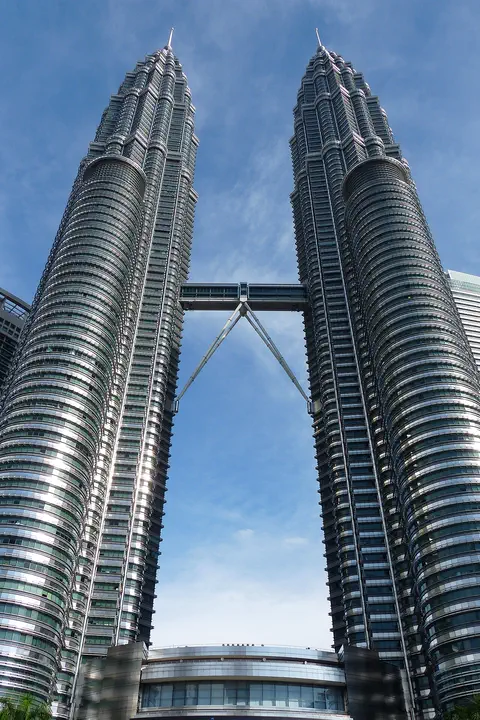 Watch
Landmark
Petronas Towers
The Petronas Twin Towers in Kuala Lumpur, Malaysia, are two matching skyscrapers 452 meters tall, finished in 1998. Seen from above, each floor is shaped like an eight-pointed star, a pattern from Islamic art. A two-story skybridge joins them 170 meters above the ground, and from 1996 to 2003 they were counted as the tallest buildings in the world.
-
 Watch
Landmark
Brooklyn Bridge
The Brooklyn Bridge crosses the East River between Brooklyn and Manhattan in New York City. Built from 1869 to 1883, it was the first bridge to use steel wire for its cables, and its main span was the longest in the world until 1890. Every day, cars, walkers and cyclists still cross it.
-
 Watch
Landmark
Chichén Itzá
Chichén Itzá is the ruin of a great Maya city on the Yucatán Peninsula in Mexico. Its people built pyramids, a huge ball court and a round building for watching the sky. Its most famous pyramid, El Castillo, has 365 steps, as many as the days in a year.
-
Watch
Landmark
CN Tower
The CN Tower in Toronto is 553 meters tall. It was built between 1973 and 1975 so that radio and TV signals could reach over the city's new tall buildings. For more than 30 years it was the tallest freestanding structure in the world, and today more than two million people visit it every year.
For parents & teachers
What children will learn
- Locate Chicago and describe Willis Tower as a 110-story skyscraper finished in 1973.
- Explain the bundled-tube structure and how it creates the tower's setbacks.
- Describe the Skydeck and the Ledge, and what makes them safe.
- Recognize that building records change as new towers are built.
Recommended ages: 3 to 17 · About 15 minutes
Talk about it
- Why might a tall building need to sway a little in the wind instead of staying perfectly stiff?
- Sears wanted big floors for itself and smaller floors to rent. How did that wish shape the tower?
- Would you stand in a glass box 1,353 feet up? What would help you feel safe?
Try at home or in class
- Bundle nine paper straws with a rubber band and compare how easily one straw and the bundle bend; then cut some straws shorter to make 'setbacks'.
- Build a tall tower from paper cups and test it with a fan on low: what shape stands up best to wind?
Key vocabulary: skyscraper, story, setback, structural engineer, observation deck, caisson
Where these facts come from
- Wikidata , Wikimedia Foundation (CC0 1.0)
- Willis Tower , The Skyscraper Center
- Willis Tower (formerly Sears Tower) , Skidmore, Owings & Merrill (SOM)
- Fun Facts , Skydeck Chicago
- Willis Tower History and Facts , Skydeck Chicago
- The Incredible Willis Tower , Skydeck Chicago
- About Willis Tower , Willis Tower (Perform Properties)
- Wikimedia Commons , Wikimedia Foundation (Per file (public domain, CC0, CC BY or CC BY-SA); see each media record)
Checked, not yet human-reviewed. Last updated October 27, 2026. Spotted a mistake? Tell us.