
Natural wonder Australia and Oceania
Ball's Pyramid
Ball's Pyramid is a tall, pointed rock that sticks up out of the sea near Australia. It is all that is left of an old volcano.
Ball's Pyramid is a steep, narrow rock rising straight out of the Tasman Sea, south of Lord Howe Island in Australia. It is the worn-down remnant of an old volcano, and it is where the Lord Howe Island stick insect, feared extinct, was found again.
Ball's Pyramid, 23 km south of Lord Howe Island (Lord Howe Island Museum), is the eroded remnant of a separate shield volcano. Part of the Lord Howe Island Group World Heritage Site, it is where the world's largest stick insect, feared extinct, was rediscovered (UNESCO).
Photo: PotMart186, CC BY-SA 4.0, via Wikimedia Commons
Discover Ball's Pyramid
Ball's Pyramid is a huge rock in the sea. It is very steep and pointed at the top.
In this photo, waves crash at the bottom of the tall, dark rock.
Ball's Pyramid rises abruptly out of the Tasman Sea, UNESCO says. The Lord Howe Island Museum places it 23 kilometers south of Lord Howe Island and describes it as just 1,100 meters long and about 200 meters wide at its base, with knife-like ridges at both ends.
This photo by PotMart186, taken on 8 March 2014 in the Lord Howe Island Marine Park, shows the dark, pointed rock with patches of reddish rock, white waves breaking along its base and a cloudy sky.
UNESCO lists Ball's Pyramid, 'rising abruptly from the ocean', in the Lord Howe Island Group (World Heritage 1982; 146,300 ha including the marine area), about 570 km east of Port Macquarie in the Tasman Sea. The museum gives it as 1,100 m long and about 200 m wide at its base, with knife-like ridges at each end.
The photo (PotMart186, CC BY-SA 4.0, 8 March 2014 10:03, Lord Howe Island Marine Park) shows the dark, steep stack with reddish patches, a low rocky shelf at its left, waves breaking on its base and broken cloud.
- Distance from Lord Howe Island (museum)
- 23 km south
- Length at its base (museum)
- 1,100 m
- World Heritage Site
- part of the Lord Howe Island Group, since 1982
The last piece of a volcano
Long ago, a volcano grew up from the sea floor here.
Over a very long time, most of it wore away. This tall rock is what is left.
The Lord Howe Island Museum explains that Lord Howe Island and Ball's Pyramid are the tops of two old volcanoes that rose from an undersea plateau called the Lord Howe Rise. They are the youngest of a chain of nine volcanic peaks, made as the Australian plate slowly moved north over a hot spot.
Ball's Pyramid was its own volcano, about 12 kilometers wide. Since then, erosion has worn almost all of it away. About 100 old lava flows can be seen as layers in its cliffs.
Lord Howe Island Museum: the islands are the emergent parts of two volcanic seamounts on the western edge of the Lord Howe Rise, the youngest and most southerly of a chain of nine peaks formed as the Australian plate moved north over a stationary hot spot; Lord Howe's shield volcano erupted around 7 million years ago.
Separated from Lord Howe Island by an 800-m-deep trench, Ball's Pyramid is believed to have always been a separate island, built by a second shield volcano roughly 12 km across. Around 100 lava flows in its cliffs dip about 8 degrees northeast, showing that its volcanic center lay to the southwest. UNESCO calls the group an outstanding example of an island system built by submarine volcanic activity.
The stick insect that came back
A very big stick insect lives on Ball's Pyramid. People thought it was gone forever.
Many seabirds nest on these islands too.
UNESCO says the Lord Howe Island stick insect is the largest stick insect in the world. It was feared extinct until it was found again on Ball's Pyramid.
The Lord Howe Island Group, which includes Ball's Pyramid, has large colonies of nesting seabirds. It is the only major breeding place of the Providence petrel and holds one of the world's largest breeding groups of red-tailed tropicbirds.
UNESCO: the Lord Howe Island Phasmid (Dryococelus australis), the world's largest stick insect, was feared extinct until its rediscovery on Balls Pyramid, where it still exists; a number of endemic species disappeared after people and their accompanying species arrived.
The group supports extensive colonies of nesting seabirds, significant over a wide oceanic region: the only major breeding locality of the Providence petrel (Pterodroma solandri) and one of the world's largest breeding concentrations of the red-tailed tropicbird (Phaethon rubricauda).
A protected island group
Ball's Pyramid is part of a special protected area.
The sea around it is a marine park.
UNESCO says about 75 percent of the land in the Lord Howe Island Group is managed as a Permanent Park Preserve, and Ball's Pyramid is part of it. The waters around the islands are marine parks.
The group also has the world's most southerly coral reef. UNESCO says the islands show an almost complete stage in the wearing away of a large shield volcano.
About 75% of the property's land is a Permanent Park Preserve (Lord Howe's northern and southern mountains, the Admiralty Islands, Mutton Bird Islands, Balls Pyramid and surrounding islets); the surrounding waters are Marine Parks, and the boundary includes a substantial proportion of the Lord Howe Island and Balls Pyramid seamounts (UNESCO).
Criterion (vii): the group demonstrates the nearly complete stage in the destruction of a large shield volcano and has the most southerly coral reef in the world.
Exploring safely
Ball's Pyramid is far out in the open sea. Wear a life jacket on a boat.
Wear a hat and sunscreen too.
Ball's Pyramid stands in the open ocean, 23 kilometers from Lord Howe Island. The CDC says life jackets lower the risk of drowning while boating for people of all ages, and children should wear them in and around natural water.
On the water, sunlight also bounces back at you. The CDC says UV rays reflect off water, so wear sunscreen, sunglasses and a hat.
CDC drowning prevention: life jackets reduce the risk of drowning while boating for people of all ages and swimming abilities, and children should use them for all activities in and around natural water.
CDC sun safety: UV rays reflect off water and sand; use broad-spectrum sunscreen, UV-blocking sunglasses and a wide-brimmed hat.
Amazing facts
-
The world's biggest stick insect was found again on this rock.
The Lord Howe Island stick insect, the world's largest stick insect, was feared extinct until it was rediscovered on Ball's Pyramid.
UNESCO: the Lord Howe Island Phasmid (Dryococelus australis), the world's largest stick insect, was feared extinct until its rediscovery on Balls Pyramid.
-
This rock was always its own island.
An 800-meter-deep trench separates Ball's Pyramid from Lord Howe Island, so scientists believe it was always a separate island.
Lord Howe Island Museum: separated by an 800-m-deep trench, Ball's Pyramid is believed to have always been a separate island, built by its own shield volcano.
-
You can count old lava layers in its cliffs.
About 100 old lava flows show as layers in the cliffs of Ball's Pyramid.
Around 100 lava flows in the cliffs dip about 8 degrees to the northeast, showing that the volcano's center lay to the southwest (museum).
Words to know
- shield volcano
- a wide volcano with gentle slopes built by runny lava
- erosion
- the slow wearing away of rock by waves, wind or water
- hot spot
- a place where hot rock rises from deep inside the Earth and can make volcanoes
- seamount
- a mountain on the sea floor
- phasmid
- a stick insect or leaf insect
Discovery challenge
-
What is Ball's Pyramid left over from?
Ball's Pyramid is the worn-down remnant of what?
What kind of volcano built Ball's Pyramid, according to the Lord Howe Island Museum?
- An old volcano
- A sunken ship
- A giant coral reef
Show the answer
An old volcano
An old volcano.
An old volcano worn down by erosion.
A separate shield volcano about 12 km across.
-
Which big insect was found again on Ball's Pyramid?
Which insect, the largest of its kind, was rediscovered on Ball's Pyramid?
Which species, feared extinct, was rediscovered on Ball's Pyramid?
- Lord Howe Island stick insect
- Monarch butterfly
- Honeybee
Show the answer
Lord Howe Island stick insect
The Lord Howe Island stick insect.
The Lord Howe Island stick insect.
The Lord Howe Island Phasmid, Dryococelus australis (UNESCO).
-
In which sea does Ball's Pyramid stand?
Ball's Pyramid rises out of which sea?
In which sea does UNESCO place the Lord Howe Island Group?
- Tasman Sea
- Red Sea
- Baltic Sea
Show the answer
Tasman Sea
The Tasman Sea.
The Tasman Sea.
The Tasman Sea (UNESCO).
-
Which island is near Ball's Pyramid?
Ball's Pyramid lies 23 kilometers south of which island?
From which island is Ball's Pyramid separated by an 800-m-deep trench?
- Lord Howe Island
- Tasmania
- New Guinea
Show the answer
Lord Howe Island
Lord Howe Island.
Lord Howe Island.
Lord Howe Island (museum).
-
What wore the old volcano away?
What has worn away almost all of the old volcano?
Which process left only a narrow stack of a 12-km-wide shield volcano?
- Erosion
- Snowfall
- Earth's spin
Show the answer
Erosion
Erosion slowly wore it away.
Erosion.
Erosion; the museum says Ball's Pyramid illustrates the last stages of erosion of a volcanic island.
Nearby places
-
 Watch
City
Brisbane
Brisbane is the capital of Queensland, in eastern Australia. An estimated 1,375,301 people lived in the City of Brisbane in mid-2025, and the wider Brisbane area about 2.7 million, the third-largest in Australia. It began in 1825 as a penal colony on a bend of the Brisbane River.
-
 Watch
Landmark
Sydney Opera House
The Sydney Opera House stands on a point of land in Sydney Harbour, Australia. Danish architect Jørn Utzon won a competition to design it in 1957, building began in 1959, and it opened on October 20, 1973. Its shell-shaped roofs are covered in more than a million tiles.
-
 Watch
Landmark
Sydney Harbour Bridge
The Sydney Harbour Bridge is a steel arch bridge across Sydney Harbour in Australia. Its arch spans 503 meters, and the top of the arch is 134 meters above the sea. Work began in 1923, and the bridge opened on 19 March 1932. It carries cars, trains, bicycles and people walking.
-
 Watch
Landmark
Australian Museum
The Australian Museum in Sydney is the nation's first museum, set up in 1827. It stands opposite Hyde Park and holds more than 22 million specimens and objects, from animals and minerals to cultural collections. Its first permanent building opened in 1857, and more wings have been added ever since.
-
 Watch
City
Sydney
Sydney is Australia's largest city and the capital of the state of New South Wales. It surrounds Port Jackson, a harbor of countless bays, on the lands of the Gadigal people of the Eora Nation. The British set up a convict colony here in 1788. Today the Harbour Bridge, the Opera House and its beaches are world famous, and about 5.45 million people lived in Greater Sydney in 2023.
-
 Watch
Natural wonder
K'gari
K'gari, off the coast of Queensland in Australia, is the largest sand island in the world. Sand dunes rise up to about 250 meters, rainforest grows right on the sand, and about half of the world's perched dune lakes sparkle among the dunes. Once called Fraser Island, it was officially renamed K'gari, the Butchulla people's name for it, in 2023.
-
 Watch
Landmark
Siding Spring Observatory
Siding Spring Observatory sits on Mount Woorut in New South Wales, Australia, next to Warrumbungle National Park. The Australian National University chose the site in 1962 for its dark, cloudless skies. Today it is home to many telescopes, including the Anglo-Australian Telescope, the largest optical telescope in Australia.
-
 Watch
City
Canberra
Canberra is the capital of Australia. Instead of growing slowly, it was planned: in 1912 Walter Burley Griffin, a city planner from Chicago, won a competition to design it, and the city was named in 1913. Its center is a lake made by damming a river, and Parliament House is built into a hill with grass on its roof.
Explore next
-
 Watch
Natural wonder
Great Barrier Reef
The Great Barrier Reef stretches about 2,300 kilometers along the coast of Queensland, Australia. It is made of about 2,500 separate reefs and more than 900 islands, built by tiny coral animals, and it is home to more than 1,500 kinds of fish.
-
 Watch
Natural wonder
Giant's Causeway
The Giant's Causeway, on the north coast of Northern Ireland, is made of some 40,000 columns of dark basalt rock, many of them six-sided, packed together like a honeycomb. They formed about 60 million years ago, when a deep pool of lava cooled slowly, shrank and cracked into columns.
-
 Watch
 Country
Australia
Australia is a country and the smallest continent, surrounded by ocean in the Southern Hemisphere. Much of its middle is dry and flat, most people live near the coast, and its animals include kangaroos, koalas and the platypus, a mammal that lays eggs.
- Watch Geography Islands An island is a piece of land surrounded by water that is smaller than a continent. Islands form in different ways: some broke away from continents, some were built by volcanoes on the sea floor, and some were made by corals or by waves piling up sand. Because they are cut off by water, islands often have unusual plants and animals.
- Watch Geography Weathering and erosion Weathering is rocks breaking apart where they are: ice in cracks, rain, wind-blown sand and growing roots all do it. Erosion is the next step, when gravity, rain, rivers, waves, wind and glaciers carry the broken pieces away. Over thousands to millions of years, they carve valleys, cliffs and canyons.
-
 Watch
Natural wonder
Uluru
Uluru is a huge sandstone rock in the desert of central Australia, rising 348 meters above the plain, with a base 9.4 kilometers around. The Anangu are its Traditional Owners, and the national park around it is run by Anangu and Parks Australia together.
-
 Watch
Natural wonder
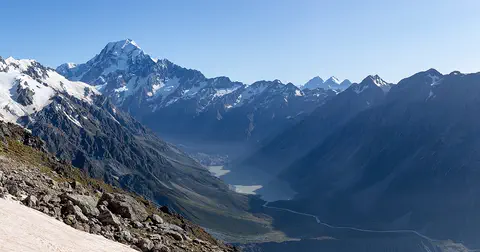
Aoraki / Mount Cook
Aoraki / Mount Cook is New Zealand's highest mountain, in the Southern Alps of the South Island. Its name joins its Māori name, Aoraki, with its English name, Mount Cook. The mountain is being pushed up where two of Earth's plates meet, and glaciers carve the valleys around it. In 2013 surveyors measured it at 3,724 meters.
-
 Watch
Natural wonder
Kakadu National Park
Kakadu, in Australia's Northern Territory, is the country's largest national park. It stretches from a high sandstone cliff called the escarpment down to floodplains, mangroves and the sea. Aboriginal people have lived here for tens of thousands of years, and their rock paintings, some up to 20,000 years old, record their way of life.
For parents & teachers
What children will learn
- Locate Ball's Pyramid and Lord Howe Island in the Tasman Sea.
- Explain how erosion can wear a volcano down to a narrow stack.
- Describe how a chain of volcanoes can form over a hot spot.
- Explain why a remote island can be a refuge for a rare animal.
Recommended ages: 3 to 17 · About 15 minutes
Talk about it
- Why might a rare insect survive on a small, steep island when it disappeared from a bigger one?
- How can layers of old lava in a cliff tell scientists where a volcano's center was?
- Why might islands far out at sea be important nesting places for seabirds?
Try at home or in class
- Build a sand volcano on a tray and pour water over it again and again to see how erosion leaves only the hardest parts.
- On a map, find Port Macquarie in Australia and measure about 570 kilometers east to the Lord Howe Island Group.
Key vocabulary: shield volcano, erosion, hot spot, seamount, phasmid
Where these facts come from
- Wikidata , Wikimedia Foundation (CC0 1.0)
- Lord Howe Island Group (World Heritage List) , UNESCO World Heritage Centre
- Geology , Lord Howe Island Museum
- Preventing Drowning , US Centers for Disease Control and Prevention
- Sun Safety Facts , US Centers for Disease Control and Prevention
- File:Balls Pyramid, Lord Howe Marine Park 1008.jpg , Wikimedia Commons
- Natural Earth vector data , Natural Earth (NACIS) (Public domain)
- Wikimedia Commons , Wikimedia Foundation (Per file (public domain, CC0, CC BY or CC BY-SA); see each media record)
Checked, not yet human-reviewed. Last updated November 1, 2026. Spotted a mistake? Tell us.