
Animal
Spotted hyena
The spotted hyena is a clever animal of Africa with a spotty coat. It lives in a big family called a clan. It makes a sound that sounds like giggling.
The spotted hyena is the largest of the hyenas and a skilled hunter of the African savanna. Many people think hyenas only eat leftovers, but in East and Southern Africa they catch most of their own food. They live in big clans led by females, and they whoop, groan and 'giggle' to talk.
Crocuta crocuta, the largest hyena, is a highly social carnivore of sub-Saharan Africa. Despite its reputation as a scavenger, it kills most of its own food in East and Southern Africa. Clans of 5 to 80 or more are ranked in a dominance hierarchy in which females outrank males. The IUCN lists it as Least Concern but decreasing.
Photo: Diego Delso, CC BY-SA 4.0, via Wikimedia Commons
Meet the spotted hyena
The spotted hyena has a spotty, sandy coat and round ears.
Its front legs are longer than its back legs, so its back slopes down. It looks a bit like a dog, but it is not a dog.
The spotted hyena is the largest of the four members of the hyena family. It weighs about 40 to 86 kilograms, and females are a little bigger than males. Its sandy or grayish coat is covered in dark spots, and every hyena's pattern is different.
It has a big head, a thick, muscular neck, powerful jaws and rounded ears. Its front legs are longer than its back legs, so its back slopes downward. Although it looks like a dog, a hyena is actually more closely related to cats, civets and genets.
Crocuta crocuta is the largest member of the family Hyaenidae, which also includes the striped hyena, brown hyena and aardwolf. Britannica notes that the family split from the cat lineage about 30 million years ago, so hyenas, though doglike, are closer to cats. Animal Diversity Web (ADW) gives a body length of 95 to 150 centimeters and a shoulder height of 75 to 85; San Diego Zoo Wildlife Alliance gives weights of 40 to 86 kilograms, females being about 10 percent heavier.
The coarse coat is sandy, yellowish or gray with dark spots that differ between individuals and fade in very old animals. Front limbs are longer than hind limbs, the paws have four toes with non-retractable claws, and a short mane stands along the back.
Quick facts
- Group
- Mammal
- Length
- 95 to 150 cm
- Height
- 75 to 85 cm
- Weight
- 40 to 86 kg
- Top speed
- up to 60 km/h
Where it lives
Spotted hyenas live in Africa.
They live on grassy plains, in swamps, in dry places and even in mountain forests. In the hot day, they rest in the shade.
Spotted hyenas live in Africa south of the Sahara Desert, but not in rainforests. They live on savannas and in swamps, dry semi-desert lands and even mountain forests.
Adults do not usually rest in dens. In the heat of the day they lie in holes, shallow pools or under bushes, anywhere with shade. Fossils show that hyenas once lived in North America, Europe and Asia too, but for the last 8,000 years spotted hyenas have lived only in Africa.
The IUCN Red List (assessed 2014, published 2015) lists the species as extant in 39 sub-Saharan countries, from Senegal and Mauritania to Ethiopia, Somalia and South Africa, possibly extinct in Algeria and Togo, and a vagrant in Gabon. Britannica notes that it is absent from rainforests.
It uses savanna, swamps, semi-arid land and montane forest. Adults rest by day in holes, shallow pools or shade, and use waterholes to cool off and to stash food. Hyaenid fossils come from four continents, but San Diego Zoo dates the spotted hyena's restriction to Africa to the last 8,000 years. Shading is by country; hyenas live only in some regions of many countries.
Continent
Its habitat

Where can you find this animal?
- Lives here naturally · Countries and seas named by a scientific source
- Sightings recorded · Records of wild sightings (GBIF)
Lives here naturally · Countries and seas named by a scientific source
Savannas, swamps, semi-arid lands and mountain forests of sub-Saharan Africa, but not rainforests. In many countries shown, hyenas live only in some regions.
Places: Angola, Benin, Botswana, Burkina Faso, Burundi, Cameroon, Central African Rep., Chad and 31 more places.
Source: iucn-red-list · checked October 2026
Sightings recorded · Records of wild sightings (GBIF)
Counts of GBIF records of wild observations (human and machine) and preserved specimens. Records include introduced populations, vagrants, escaped or released animals and misidentifications, so a country with records is not necessarily part of the native range.
Wild sightings have been recorded in South Africa, Kenya, Tanzania, Zambia, Namibia, Botswana, Benin, Uganda and 47 more places.
Source: gbif · checked October 2026
Range maps show where scientists say an animal lives, often country by country. An animal may live in only part of a country shown, and sightings records can include animals that wandered far from home.
Hunter, not just a scavenger
Some people think hyenas only eat leftovers. That is not true!
Spotted hyenas are good hunters. They work as a team to catch zebras, wildebeest and gazelles.
A common mistaken idea is that hyenas only eat what other animals leave behind. In fact, in East and Southern Africa spotted hyenas catch most of their own food. A study in the Kalahari found that about 70 percent of their diet came from animals they caught themselves. They do scavenge too, when they find leftovers.
They often chase prey such as wildebeest, zebras and gazelles over long distances, at up to 60 kilometers an hour. Bigger clans can catch bigger animals. A hyena can eat a third of its body weight at one meal, and its strong jaws and stomach can handle skin and bone.
The spotted hyena's reputation as mainly a scavenger is inaccurate. Britannica reports that in East and Southern Africa it kills most of its own food, taking healthy as well as weakened animals, and ADW cites a Kalahari study in which about 70 percent of the diet came from direct kills. Scavenging still contributes, in competition with jackals and vultures.
Prey choice scales with group size: larger clans tackle wildebeest, zebra and Cape buffalo, smaller groups gazelles, impala and warthogs, and lone hyenas hares, birds and fish. In the Serengeti and Ngorongoro Crater, about 80 percent of fecal samples contained wildebeest, zebra or gazelle. Massive jaws and molars crush bone, which is digested by highly concentrated stomach acid.
Did you know?
Hyena moms make very rich milk.
Spotted hyena milk has more protein than the milk of any other meat-eating land animal.
San Diego Zoo reports that spotted hyena milk has the highest protein content of any land carnivore.
Built for long chases
Spotted hyenas have very strong jaws.
They can trot for a long, long time without getting tired. They can even swim.
A spotted hyena can trot at 10 kilometers an hour for long distances without getting tired, and sprint at up to 60 kilometers an hour. It is also a good swimmer. It finds food using sharp eyesight, good hearing and a keen sense of smell.
Its big head and thick neck hold some of the strongest jaws of any mammal, able to crush bones. The front legs are longer than the back legs. Its paws have four toes with claws that cannot be pulled in.
Hyenas are tireless trotters; San Diego Zoo cites sustained trotting at about 10 kilometers per hour and chases at up to 60, while Britannica reports chases at up to 65 kilometers per hour over 3 kilometers. Keen sight, hearing and smell locate live prey and carrion from far away.
A large head on a long, thick, muscular neck carries jaws that San Diego Zoo describes as having the strongest bite of any mammal, with broad molars for crushing bone. The forelimbs are longer than the hindlimbs, and Britannica notes that the stomach can hold 14.5 kilograms of meat, so hyenas can go several days between meals.
Growing up
Baby hyenas are called cubs.
They are born with dark fur and their eyes open. Later, many families share one big den. The cubs drink their mother's milk for a long time.
After a pregnancy of about 110 days, a mother spotted hyena usually has two cubs in a hidden den. The cubs are born with their eyes open, some teeth already in, and dark brown fur.
At two to six weeks old, the mother moves them to a shared den, used by other mothers in the clan, a bit like a kindergarten. Each mother feeds only her own cubs. At about two months the cubs start to get spots. They drink milk for more than a year, and young males leave the clan at about three years old.
Gestation is about 110 days, and litters are usually two cubs, born in any month. Cubs are born with eyes open, some teeth erupted and dark fur, in an isolated den; at two to six weeks they move to a communal den, often an old aardvark burrow, where each mother nurses only her own young. San Diego Zoo notes that spotted hyena milk has the highest protein content of any land carnivore.
For about six months milk is the cubs' only food; they then begin eating meat but nurse until about 14 months (Britannica) or one to two years (San Diego Zoo). Females inherit their mother's rank and stay in their birth clan, while males usually leave at around three years. ADW gives a wild life span of about 20 years.

Clans, whoops and giggles
Hyenas live in big families called clans.
The females are in charge. Hyenas whoop to call each other, and sometimes they giggle when they are nervous.
Spotted hyenas live in clans that can have from 5 to 80 or more members. The females are in charge: they are bigger and bolder than the males, and even a young cub of a low-ranking female ranks above adult males that joined from other clans.
San Diego Zoo calls spotted hyenas the most vocal mammals in Africa, with more than 11 different sounds. Their famous 'laugh' is made when they are nervously excited or giving way to a stronger hyena. A loud 'whoop' can be heard several kilometers away and calls the clan together.
Clans range from 5 to 80 individuals (Britannica) and up to about 100 (San Diego Zoo). Society is matriarchal, with a linear hierarchy in which the lowest-ranking female outranks the highest-ranking male, and the dominant female monopolizes carcasses when she can, improving her cubs' nutrition. Territories are marked with latrines and anal-gland scent.
The vocal repertoire exceeds 11 calls. The 'giggle' accompanies nervous excitement or submission, and its pitch can signal age or status; whoops carry for kilometers, gather the clan and identify the caller; groans and squeals serve as greetings. Spotted hyenas are generally nocturnal but can be active by day.
Did you know?
Hyenas look like dogs, but they are closer cousins of cats.
Even though they look and act a bit like dogs, hyenas are more closely related to cats, civets and genets.
The hyena family split from the cat lineage about 30 million years ago, according to Britannica.
A misunderstood animal
Hyenas are often shown as silly or mean in stories. Real hyenas are clever and live in big family groups.
There are still many spotted hyenas, but people need to learn to share the land with them.
In cartoons and films, hyenas are often shown as giggling villains. San Diego Zoo says this reputation is not fair: spotted hyenas are intelligent, resourceful and efficient animals.
The IUCN lists the spotted hyena as Least Concern, but its numbers are going down. When people and hyenas compete for land and food, and when hyenas take livestock, people sometimes shoot, poison or trap them, even in protected areas. Drought can also reduce their food. Teaching people about hyenas can help.
The IUCN lists Crocuta crocuta as Least Concern with a decreasing population trend. San Diego Zoo describes conflict with people as common wherever the two compete for resources: deforestation brings them closer together, and hyenas that take livestock are shot, poisoned and trapped, sometimes even inside protected areas, and drought can disrupt the food chain they depend on.
Negative cultural portrayals add to the problem, and San Diego Zoo argues that education is needed to correct them. It notes that hyenas do not hunt humans, although rare killings have been reported.
IUCN Red List
How is the spotted hyena doing in the wild?
- Least Concern (this animal)
- Near Threatened
- Vulnerable
- Endangered
- Critically Endangered
- Extinct in the Wild
- Extinct
Least Concern
Not at risk of disappearing from the wild right now.
See the IUCN Red List assessment · The IUCN Red List of Threatened Species 2022.2
Amazing facts
-
Hyenas look like dogs, but they are closer cousins of cats.
Even though they look and act a bit like dogs, hyenas are more closely related to cats, civets and genets.
The hyena family split from the cat lineage about 30 million years ago, according to Britannica.
-
Hyena cubs are born with their eyes open.
Spotted hyena cubs are born with their eyes open, some teeth already in and dark brown fur.
Cubs are precocial, born with open eyes, erupted teeth and dark fur.
-
Hyena moms make very rich milk.
Spotted hyena milk has more protein than the milk of any other meat-eating land animal.
San Diego Zoo reports that spotted hyena milk has the highest protein content of any land carnivore.
-
Hyenas can tell who is calling.
A hyena's whoop can be heard kilometers away, and other hyenas can tell which hyena is calling.
Whoops are individually distinctive, letting clan members identify callers at long range.
Words to know
- clan
- a large family group of hyenas
- scavenger
- an animal that eats leftovers or animals that are already dead
- matriarchal
- led by females
- communal den
- a den shared by several mothers and their young
- precocial
- born fairly well developed, for example with eyes open
- endurance
- being able to keep going for a long time
Discovery challenge
-
Where do spotted hyenas get most of their food?
Where do spotted hyenas in East and Southern Africa get most of their food?
What is true about spotted hyena feeding in East and Southern Africa?
- Only from leftovers
- Mostly from animals they hunt
- Only from plants
Show the answer
Mostly from animals they hunt
No! Spotted hyenas are good hunters and catch most of their food.
They catch most of their own food. In one study, about 70 percent of their diet came from their own kills.
They kill most of their food, taking healthy as well as weakened prey, and scavenge as well.
-
Who is in charge in a hyena clan?
Who leads a spotted hyena clan?
How is rank arranged in a spotted hyena clan?
- The females
- The youngest cub
- A lion
Show the answer
The females
The female hyenas are in charge.
Females are bigger and bolder and rank above males.
A linear hierarchy in which the lowest-ranking female outranks the highest-ranking male.
-
What does a hyena's giggle mean?
What does a spotted hyena's 'laugh' usually show?
In what context do spotted hyenas produce the 'giggle'?
- It heard a joke
- It is nervous or giving in
- It is going to sleep
Show the answer
It is nervous or giving in
It means the hyena feels nervous, not that something is funny.
It is a sound of nervous excitement, or of giving way to a stronger hyena.
Nervous excitement or submission to a dominant individual.
-
Which animals are hyenas closer cousins of?
Which animals are hyenas more closely related to?
To which group is the family Hyaenidae more closely related?
- Dogs
- Cats
- Horses
Show the answer
Cats
Hyenas are closer cousins of cats.
Cats, civets and genets, even though hyenas look doglike.
The cat lineage, from which hyenas split about 30 million years ago.
Places where you might see it
-
 Watch
 Country
Tanzania
Tanzania is a country in East Africa, just south of the Equator, on the Indian Ocean. It has Mount Kilimanjaro, Africa's highest mountain, deep lakes in the East African Rift, and the Serengeti, where huge herds of wildebeest travel each year.
-
 Watch
 Country
Kenya
Kenya is a country in East Africa, crossed by the equator. It has the snow-capped Mount Kenya, the deep Great Rift Valley, Lake Victoria and a long Indian Ocean coast, and about 54 million people live there, many of them speaking Swahili.
-
Watch
Natural wonder
Serengeti National Park
Serengeti National Park in northern Tanzania protects 14,763 square kilometers of grassy plains and woodlands. Each year more than a million wildebeest, with zebras and gazelles, travel a great loop across the Serengeti and into Kenya in search of grass and water, followed by lions and other predators.
-
 Watch
 Country
Djibouti
Djibouti is a small country in the Horn of Africa, where the Red Sea meets the Gulf of Aden. It is hot and dry, with volcanic rock everywhere, and Lake Assal, 155 meters below sea level, is the lowest point in Africa. About 1.2 million people lived there in 2025, most of them in the capital, also called Djibouti.
Explore next
-
 Watch
3D
Animal
African wild dog
The African wild dog, or painted dog, has a patchy coat unlike any other dog's, big round ears and only four toes on its front feet. It lives in close packs that hunt together, share food and care for the pups. It is endangered: the IUCN estimated in 2025 that only about 1,676 adults are left in the wild.
-
 Watch
3D
Animal
Lion
The lion is the only big cat that lives in a family group, called a pride. Lionesses hunt together, males guard the pride's land, and their roar can be heard about 8 kilometers away. Wild lions live in Africa, plus one small group in western India.
-
 Watch
Animal
Blue wildebeest
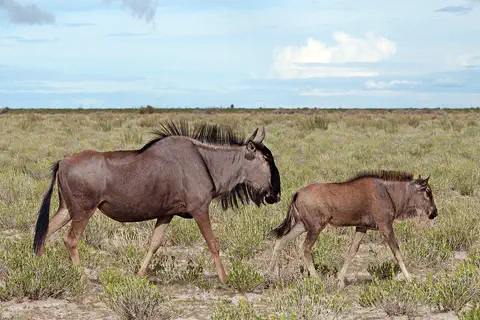
The blue wildebeest, or gnu, is a big antelope with a box-like head, curved horns, a mane and a beard. It grazes the savannas of eastern and southern Africa, and in the Serengeti huge herds travel in a giant circle every year following the rains.
-
 Watch
Animal
Plains zebra
Plains zebras are striped members of the horse family that graze on the grasslands of eastern and southern Africa. They live in close family groups, travel long distances to find fresh grass and water, and every zebra's stripes are different.
-
Watch
Country
Tanzania
Tanzania is a country in East Africa, just south of the Equator, on the Indian Ocean. It has Mount Kilimanjaro, Africa's highest mountain, deep lakes in the East African Rift, and the Serengeti, where huge herds of wildebeest travel each year.
-
Watch
Country
Kenya
Kenya is a country in East Africa, crossed by the equator. It has the snow-capped Mount Kenya, the deep Great Rift Valley, Lake Victoria and a long Indian Ocean coast, and about 54 million people live there, many of them speaking Swahili.
-
Watch
Natural wonder
Serengeti National Park
Serengeti National Park in northern Tanzania protects 14,763 square kilometers of grassy plains and woodlands. Each year more than a million wildebeest, with zebras and gazelles, travel a great loop across the Serengeti and into Kenya in search of grass and water, followed by lions and other predators.
-
Watch
Country
Djibouti
Djibouti is a small country in the Horn of Africa, where the Red Sea meets the Gulf of Aden. It is hot and dry, with volcanic rock everywhere, and Lake Assal, 155 meters below sea level, is the lowest point in Africa. About 1.2 million people lived there in 2025, most of them in the capital, also called Djibouti.
For parents & teachers
What children will learn
- Describe the spotted hyena's body and how it suits long chases and eating bone.
- Correct the mistaken idea that hyenas only scavenge, using evidence.
- Describe clan life, female leadership and hyena calls.
- Discuss how stories and films can shape the way people treat animals.
Recommended ages: 3 to 17 · About 15 minutes
Talk about it
- Why do you think hyenas got a reputation for only eating leftovers? What evidence changes that picture?
- How might cartoons and films affect how people treat real animals?
- What would it be like to live in a family where everyone has a rank?
Try at home or in class
- Make a 'true or false' card game about hyenas using the facts on this page, and test a family member.
- Try a 'whoop' game: one person whoops from another room and the others guess who it is by voice, like hyenas recognizing each other.
Key vocabulary: clan, scavenger, matriarchal, communal den, precocial, endurance
Where these facts come from
- The IUCN Red List of Threatened Species , International Union for Conservation of Nature (IUCN terms of use (no redistribution of Red List data or range maps))
- GBIF Backbone Taxonomy and GBIF Occurrence Search , Global Biodiversity Information Facility (CC0 1.0 (backbone); occurrence counts are facts derived from records under CC0, CC BY and CC BY-NC)
- Crocuta crocuta (Spotted Hyaena), 2014 assessment , IUCN Red List of Threatened Species
- Spotted Hyena , San Diego Zoo Wildlife Alliance
- Hyena , Encyclopaedia Britannica
- Crocuta crocuta , Animal Diversity Web, University of Michigan Museum of Zoology
- Wikidata , Wikimedia Foundation (CC0 1.0)
- Wikimedia Commons , Wikimedia Foundation (Per file: Public domain, CC0, CC BY or CC BY-SA only (credited on each page))
Checked, not yet human-reviewed. Last updated October 24, 2026. Spotted a mistake? Tell us.