
Natural wonder Africa
Okavango Delta
The Okavango Delta is a giant wetland in Botswana, in Africa. A river spreads out into the desert and never reaches the sea. Elephants, hippos, lions and many birds come to drink and splash.
The Okavango Delta, in northwestern Botswana, is a huge wetland in the middle of a dry land. The Okavango River flows in from Angola, spreads out into channels, lagoons and grassy plains, and then soaks away into the sands of the Kalahari instead of reaching the sea. Its flood arrives in the dry season, drawing elephants, buffalo, zebras and many other animals.
The Okavango Delta is a large, low-gradient alluvial fan in northwestern Botswana: an endorheic (inland) delta whose waters drain into the Kalahari Basin rather than the sea. UNESCO calls it Africa's largest endorheic delta and its third-largest alluvial fan. Its annual flood pulse peaks in the dry winter months, sustaining a remarkable variety of habitats and wildlife. In 2014 it became the 1,000th site inscribed on the World Heritage List.
Photo: Teo Gómez, public domain, via Wikimedia Commons
Discover the Okavango Delta
The Okavango Delta is in Botswana, in southern Africa.
A big river flows into a dry, sandy land. There it splits into many small streams and spreads out. It makes a giant wet land of pools, grass and islands. The water never reaches the sea.
The Okavango Delta lies in northwestern Botswana, at the edge of the Kalahari, a vast dry land. A delta is the place where a river splits into many branches. Most deltas lie where rivers meet the sea, but the Okavango Delta is an inland delta: its water spreads out and disappears into the desert sand.
The delta is a maze of channels, lagoons, swamps, grassy floodplains and islands. UNESCO says permanent swamps cover about 600,000 hectares, with up to 1.2 million hectares of grassland that floods each year. In 2014, the Okavango Delta became the 1,000th place added to UNESCO's World Heritage List.
UNESCO describes the Okavango Delta as a large, low-gradient alluvial fan, or inland delta, in northwestern Botswana: about 600,000 ha of permanent swamp and up to 1.2 million ha of seasonally flooded grassland. It is one of very few large inland delta systems with no outlet to the sea, an endorheic delta whose waters drain into the sands of the Kalahari Basin; UNESCO calls it Africa's third-largest alluvial fan and the continent's largest endorheic delta, and describes it as a near-pristine, largely untransformed wetland.
The property covers 2,023,590 ha with a buffer zone of 2,286,630 ha. It was inscribed on 22 June 2014 under criteria (vii), (ix) and (x), becoming the 1,000th site on the World Heritage List. Britannica, measuring the delta region as a whole, gives about 16,800 km², less than half of it swamp all year.
- Country
- Botswana
- World Heritage property
- 2,023,590 ha
- Permanent swamps
- about 600,000 ha
- River source
- Central Angola (as the Kubango)
- World Heritage Site
- since 2014 (the 1,000th site)
A river that ends in the desert
The Okavango River starts far away, in a country called Angola.
It flows a very long way. Then the land gets flat. The river spreads out like the fingers of a hand. The water sinks into the sand and dries up in the sun.
The Okavango River begins in the highlands of central Angola, where it is called the Kubango. Britannica says it flows about 1,600 kilometers southeast, along part of the border with Namibia and across Namibia's narrow Caprivi Strip, into Botswana.
Inside Botswana the river enters flat, swampy land, widens and spreads out into a triangle-shaped delta. UNESCO explains that the shape of the land here, part of the great African Rift Valley system, "captured" the river and made the delta. Thick papyrus reeds keep blocking channels, Britannica says, so the water keeps changing its path.
Britannica traces the Okavango from the Bié Plateau of central Angola, where it rises as the Kubango at about 1,780 m, southeast for about 1,600 km; it forms part of the Angola-Namibia border, is joined by the Kwito, crosses the Caprivi Strip and, about 110 km (70 miles) inside Botswana, fans out into a triangular delta whose base extends for about 240 km. UNESCO gives the river as 1,500 km long; the two sources give different lengths.
UNESCO attributes the delta to the region's geology, part of the African Rift Valley system, which "captured" the river. Changes in the land's shape alter flow directions, flooding some areas and drying others (UNESCO), and dense papyrus continually blocks channels (Britannica). Subsurface precipitation of calcite and amorphous silica helps build islands and habitat gradients (UNESCO).
A flood in the dry season
You might expect a flood to come with the rain. The Okavango is different!
Its flood comes when the land is dry. Dusty hollows fill with clear water. Thirsty animals hurry to drink and splash.
Every year, a pulse of water flows down the Okavango River and spreads through the delta. The surprise is its timing: UNESCO says the flood reaches its peak in June and July, in the middle of Botswana's dry season.
When the flood arrives, huge sandy, dry hollows turn into clear pools and lagoons. Herds of elephants, buffalo, red lechwe and zebras come to drink and splash, some after weeks-long journeys across the Kalahari. The plants and animals of the flooded grasslands time their growth and breeding to match the coming of the water.
UNESCO highlights the paradox at the heart of the property: an annual flood pulse that peaks during the height of Botswana's dry season (June and July), transforming dry depressions into clear, nutrient-carrying water and revitalizing the ecosystem when rain is absent. Plants and animals of the flooded grasslands have synchronized their growth and reproduction with its arrival.
The flood drives constant change in islands, channels, banks, floodplains, oxbow lakes and lagoons, which UNESCO cites under criterion (ix) as an outstanding example of interacting climatic, geomorphological, hydrological and biological processes: flood inundation, channel formation, nutrient cycling, breeding, migration, colonization and plant succession. Britannica adds that flow varies sharply with the seasons, tributaries, evaporation and absorption into the riverbed.
Elephants, lechwe and wild dogs
Many animals live in the delta.
Elephants, hippos, zebras and buffalo come to the water. Lions, cheetahs and wild dogs live here too. Hundreds of kinds of birds fly over the swamps.
The delta is one of Africa's great wildlife places. UNESCO says it supports strong populations of some of the world's most endangered large mammals, including cheetahs, white and black rhinoceroses, African wild dogs and lions.
It counts 1,061 kinds of plants, 89 fish, 64 reptiles, 482 birds and 130 mammals. Botswana has the largest elephant population in the world, about 130,000 when UNESCO listed the delta, and the Okavango is the core area for their survival. Birds include vultures, the southern ground hornbill and the wattled crane.
UNESCO records 1,061 plant species (134 families, 530 genera), 89 fish, 64 reptiles, 482 birds and 130 mammals, with robust populations of cheetah, white and black rhinoceros, African wild dog and lion. It is an Important Bird Area with 24 globally threatened bird species, among them six vultures, the southern ground hornbill, wattled crane and slaty egret, and 33 waterbird species occur in numbers above 0.5% of their global or regional populations. At inscription Botswana held the world's largest elephant population, around 130,000, with the delta as its core area.
UNESCO also records concerns: elephant numbers rising while other species decline, unclear survey data, poaching (for example of giraffe for meat) and veterinary cordon fences that disrupt wildlife movement, notably for roan and sable antelope. The Moremi reserve protects about 40 percent of the property; Britannica lists lions, cheetahs, buffalo, wildebeests, hippos, zebras, wild dogs and crocodiles there.
People and a shared river
People have lived around the delta for hundreds of years.
Some fished, and some hunted. Today villages sit around the edges. Three countries share the river and work together to keep its water flowing.
UNESCO says small groups of Indigenous people have lived in the delta for centuries, each adapting to the resources around them, such as fishing or hunting. Today, mixed villages of Indigenous people and later arrivals sit mostly around the edges of the delta. Britannica names the Tswana as the main inhabitants of the delta.
The river's water comes from Angola and Namibia, upstream. When UNESCO listed the delta, there were no dams or big water takings upstream, and the three countries, Angola, Namibia and Botswana, manage the river together through a joint commission called OKACOM. Keeping that water flowing is the key to keeping the delta alive.
UNESCO notes that the delta has been inhabited for centuries by small numbers of Indigenous people living as hunter-gatherers, with groups adapting their identity and way of life to particular resources such as fishing or hunting; this low-level use did not harm the wetland. Mixed settlements of Indigenous peoples and later immigrants now lie mostly around the fringes, outside the property. The land is communally owned Tribal Land under the Tawana Land Board, and UNESCO asks that residents be included in management and share in tourism benefits.
Because the water originates in Angola and Namibia, UNESCO stresses that upstream flows must remain unimpeded: the source catchment is free of dams and major abstraction, and the three riparian states coordinate through the Permanent Okavango River Basin Water Commission (OKACOM). Mining and prospecting are not permitted within the property, and UNESCO asks for monitoring of activities outside it that could affect water flow or quality.
Visiting safely
Many visitors fly in on small planes. They sleep in tents in small camps.
Wild animals are big and strong. Stay with your guide and watch quietly from far away.
Because the delta is so big and hard to reach, it has never been heavily developed. UNESCO explains that tourism in the inner delta is limited to small, temporary tented camps reached by air, and that they are checked to make sure they follow environmental rules.
The delta is home to hippos, elephants, buffalo, lions and crocodiles, so it is a place to watch, not to wander. Travel with trained guides, keep a respectful distance from animals on land and in the water, and leave no trash behind.
UNESCO attributes the delta's near-pristine condition to its size and difficult access: tourism in the inner delta is restricted to small, temporary tented camps with access by air, monitored for compliance with environmental standards, which UNESCO says have minimal ecological impact.
Britannica lists lions, buffalo, hippopotamuses and crocodiles among the wildlife of the Moremi reserve, and UNESCO describes large herds of elephants, so visitors should follow their guides, stay in vehicles or boats when told to, and keep well away from wildlife. Protecting the delta also means protecting its water: no dams, irrigation schemes or mining that would alter the flood that everything here depends on.
Amazing facts
-
The Okavango was the 1,000th World Heritage Site.
On 22 June 2014, the Okavango Delta became the 1,000th site on UNESCO's World Heritage List.
Inscribed on 22 June 2014 by the World Heritage Committee, meeting in Doha, it was the 1,000th site on the List.
-
The delta's flood comes when it is dry, not when it rains.
The Okavango's yearly flood reaches its peak in June and July, during Botswana's dry season.
UNESCO notes that the flood pulse peaks during the height of the dry season, and that flooded-grassland life has synchronized with it.
-
Reeds can block the river and send the water a new way.
Thick papyrus reeds keep blocking the delta's channels, so the water keeps changing the paths it takes.
Britannica notes that dense papyrus continually blocks channels, changing the pattern of flow.
-
Some islands in the delta are built by minerals in the water.
Minerals that come out of the water underground help build some of the delta's islands.
Subsurface precipitation of calcite and amorphous silica helps create islands and habitat gradients (UNESCO).
Words to know
- delta
- land where a river splits into many branches as it spreads out
- inland delta
- a delta that spreads out on land instead of reaching the sea
- floodplain
- flat land beside a river that floods when the river is high
- lagoon
- a pool or lake of still water connected to a river or the sea
- papyrus
- a tall reed that grows thickly in shallow water
- alluvial fan
- a fan-shaped spread of sand and mud left by a river where it slows down
Discovery challenge
-
Where does the Okavango River's water end up?
Where does the Okavango River end?
What makes the Okavango an endorheic delta?
- In the sands of the Kalahari, not the sea
- In the Atlantic Ocean
- In a big glacier
Show the answer
In the sands of the Kalahari, not the sea
It soaks into the desert sand.
It spreads out and disappears into the Kalahari's sand; it never reaches the sea.
Its waters drain into the Kalahari Basin with no outlet to the sea.
-
When does the Okavango's flood come?
In which season does the Okavango flood reach its peak?
When does the annual flood pulse peak, according to UNESCO?
- In the dry season
- Only on snowy days
- Never
Show the answer
In the dry season
In the dry season, when animals are thirsty.
In the dry season, in June and July.
At the height of Botswana's dry season, in June and July.
-
Which country is the Okavango Delta in?
Which country is the Okavango Delta in?
In which country does the Okavango River form its delta?
- Botswana
- Egypt
- Brazil
Show the answer
Botswana
Botswana, in southern Africa.
Botswana; the river starts in Angola.
Botswana, after flowing from Angola across Namibia's Caprivi Strip.
-
Which big animal has its most important home here?
Botswana has the world's biggest population of which animal?
For which species does UNESCO call the delta the core area for survival?
- Elephant
- Polar bear
- Kangaroo
Show the answer
Elephant
Elephants!
Elephants: about 130,000 in Botswana when the delta was listed.
The African elephant, about 130,000 in Botswana at inscription.
-
How do many visitors get into the middle of the delta?
How do visitors usually reach the camps in the inner delta?
Which access model limits tourism impact in the inner delta?
- By small plane
- By train
- By subway
Show the answer
By small plane
By plane, to small tent camps.
By air, to small, temporary tented camps.
Air access to small, temporary tented camps monitored for environmental compliance.
Nearby places
-
 Watch
Natural wonder
Victoria Falls
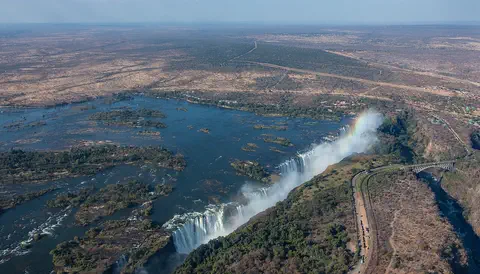
Victoria Falls, on the Zambezi River between Zambia and Zimbabwe, is about 1,708 meters wide and up to 108 meters deep. UNESCO calls it the largest curtain of falling water in the world, and its spray can be seen from tens of kilometers away.
-
 Watch
Natural wonder
Kalahari Desert
The Kalahari is a giant sandy plain in southern Africa, covering almost all of Botswana and parts of Namibia and South Africa. It stretches about 1,600 kilometers from north to south. Its southwest is a true desert, with long red dunes, while its north is green with woodlands and even has a huge swamp, the Okavango Delta.
-
 Watch
Natural wonder
Namib
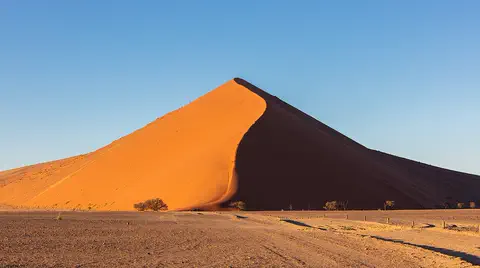
The Namib is a cool desert that runs for about 1,900 kilometers along Africa's Atlantic coast, from Angola through Namibia into South Africa. It gets almost no rain, but cold ocean water makes thick fog that drifts inland. UNESCO says its Namib Sand Sea is the only coastal desert in the world with huge dune fields influenced by fog.
-
 Watch
Natural wonder
Lake Tanganyika
Lake Tanganyika lies in a deep crack in Africa called a rift valley. Britannica calls it the longest freshwater lake in the world, and only Lake Baikal, in Russia, is deeper. Four countries share it: Tanzania, the Democratic Republic of the Congo, Burundi and Zambia. Its water is home to about 250 kinds of cichlid fish found nowhere else.
-
 Watch
Natural wonder
River Congo
The Congo is Africa's second-longest river, about 4,700 kilometers long. It curves in a giant arc through the rainforests of central Africa and empties into the Atlantic Ocean. Rain falls in its basin all year, so it carries a huge amount of water, and its wild lower rapids are home to about 320 kinds of fish, about 90 of them found nowhere else.
-
 Watch
Natural wonder
Mount Nyiragongo
Mount Nyiragongo is a steep volcano in the Virunga Mountains of the Democratic Republic of the Congo, near the border with Rwanda and just north of Lake Kivu. It is 3,470 meters high, and its deep summit crater often holds a lake of bubbling lava. Its lava is very runny, and eruptions in 1977, 2002 and 2021 sent lava flowing down its sides toward the city of Goma.
-
 Watch
Natural wonder
Virunga National Park
Virunga National Park, in the east of the Democratic Republic of the Congo, was founded in 1925; the park describes itself as Africa's first national park. It stretches from active volcanoes in the south to the snowy Rwenzori Mountains in the north. About one third of the world's mountain gorillas live in its forests, along with elephants, hippos, chimpanzees and hundreds of kinds of birds.
-
 Watch
Natural wonder
Ngorongoro Conservation Area
The Ngorongoro Conservation Area in northern Tanzania holds the Ngorongoro Crater, a giant bowl about 16 to 20 kilometers across, left when an ancient volcano collapsed about 2.5 million years ago. Around 25,000 large animals live in and around the crater. The area also protects Olduvai Gorge and Laetoli, where scientists have found important evidence of how humans evolved.
Experiments to try
Explore next
-
Watch
 Country
Botswana
Botswana is a landlocked country in the middle of southern Africa. Deep Kalahari sand covers most of it, but in the north the Okavango River spreads into a huge green delta full of wildlife. Botswana became independent in 1966 and has grown more prosperous, helped by diamonds.
-
Watch
Natural wonder
Kalahari Desert
The Kalahari is a giant sandy plain in southern Africa, covering almost all of Botswana and parts of Namibia and South Africa. It stretches about 1,600 kilometers from north to south. Its southwest is a true desert, with long red dunes, while its north is green with woodlands and even has a huge swamp, the Okavango Delta.
- Watch Geography River deltas A delta is land a river builds where it slows down and empties into a sea, a lake or another river. The slowing water drops its sand and mud, which pile up into low, flat, watery land. Many deltas are fan-shaped, like the Greek letter delta (Δ), but some look like a bird's foot.
-
 Watch
Animal
Common hippopotamus
The common hippopotamus is one of the biggest animals on land, yet it spends most of the day resting in rivers and lakes to keep cool. At night it walks out to graze, and its special skin makes its own sunscreen.
-
 Watch
3D
Animal
African wild dog
The African wild dog, or painted dog, has a patchy coat unlike any other dog's, big round ears and only four toes on its front feet. It lives in close packs that hunt together, share food and care for the pups. It is endangered: the IUCN estimated in 2025 that only about 1,676 adults are left in the wild.
- Watch What If? Lab What if a river flooded every year? For thousands of years, the Nile in Egypt flooded every year, spreading fresh mud across its banks. That mud made the land rich for farming, in the middle of a desert. Imagine a river that flooded every year: you could plan for it, farm on it, and build banks called levees to control it. Many of the earliest towns grew up beside rivers like this.
-
Watch
Natural wonder
Victoria Falls
Victoria Falls, on the Zambezi River between Zambia and Zimbabwe, is about 1,708 meters wide and up to 108 meters deep. UNESCO calls it the largest curtain of falling water in the world, and its spray can be seen from tens of kilometers away.
-
 Watch
Natural wonder
Sahara
The Sahara fills almost all of northern Africa. Britannica calls it the largest hot desert in the world: about 4,800 kilometers from east to west and about 8.6 million square kilometers in all. Only about a quarter of it is sand dunes; the rest is gravel plains, rocky plateaus and mountains.
For parents & teachers
What children will learn
- Locate the Okavango Delta in Botswana and trace its river from Angola.
- Explain what an inland (endorheic) delta is.
- Describe why a flood in the dry season matters for wildlife.
- Explain why countries upstream matter for the delta's future.
Recommended ages: 3 to 17 · About 15 minutes
Talk about it
- Why might a flood that arrives in the dry season be so important for animals?
- The water comes from other countries. Why do the three countries need to work together?
- How could tourism help protect the delta, and how could it harm it?
Try at home or in class
- In a tray of sand, pour water slowly from one end. Watch it split into channels and soak in before reaching the far end, like an inland delta.
- Make a bar chart of the delta's species counts: 1,061 plants, 482 birds, 130 mammals and 89 fish.
Key vocabulary: delta, inland delta, floodplain, lagoon, papyrus, alluvial fan
Where these facts come from
- Wikidata , Wikimedia Foundation (CC0 1.0)
- UNESCO World Heritage List , UNESCO World Heritage Centre (Linked as a reference; site facts come from Wikidata)
- Okavango Delta , UNESCO World Heritage Centre
- World Heritage List reaches 1000 sites with inscription of Okavango Delta in Botswana , UNESCO World Heritage Centre
- Okavango River , Encyclopaedia Britannica
- Wikimedia Commons , Wikimedia Foundation (Per file (public domain, CC0, CC BY or CC BY-SA); see each media record)
Checked, not yet human-reviewed. Last updated October 27, 2026. Spotted a mistake? Tell us.
Picture credits
- Photo: Teo Gómez, public domain, via Wikimedia Commons · source