
Animal
Tardigrade
A tardigrade is a tiny animal with eight short legs. It is so small you need a microscope to see it well. People call it a water bear.
Tardigrades, or water bears, are tiny eight-legged animals about a millimeter long or less. They live in damp moss, soil, fresh water and the sea all over the world, and they can survive drying out completely by curling into a little barrel called a tun.
Tardigrades (phylum Tardigrada) are microscopic invertebrates related to arthropods and nematodes. Large, predatory Milnesium water bears, up to about 1 millimeter long, are among the best studied: dried 'tuns' from a German laboratory culture, then called Milnesium tardigradum and since 2019 named Milnesium inceptum, survived ten days of open space on the FOTON-M3 mission in 2007.
Photo: Hoddyfool, CC BY-SA 4.0, via Wikimedia Commons
Meet the water bear
A tardigrade is a very, very tiny animal.
It has a chubby body and eight short legs with little claws. People call it a water bear.
Tardigrades are tiny animals with plump bodies and eight short, stubby legs. People nickname them water bears. Most are about a millimeter long or smaller, so you need a microscope to see them clearly.
There are more than 1,100 known kinds of tardigrade. The one in our photo, Milnesium tardigradum, is one of the big ones: it can grow to about 1 millimeter long. It is also a hunter that eats other tiny animals.
Tardigrades form their own phylum, Tardigrada, with more than 1,100 described species. Britannica describes them as close relatives of arthropods such as insects and crustaceans, and also related to nematodes (roundworms). Most are about 1 millimeter or less in length.
Milnesium tardigradum, described by Doyère in 1840, is a comparatively large species, reaching about 1 millimeter, and a predator rather than a plant-feeder. Its name was long given to many similar-looking Milnesium. In 2019 Morek and colleagues (Zootaxa) showed that the two most-used laboratory strains called M. tardigradum, one from Germany and one from Japan, are in fact a separate species, which they named Milnesium inceptum. The space and life-history studies on this page used those strains, so their results belong, strictly, to M. inceptum.
Quick facts
- Group
- Invertebrate
- Length
- 0.1 to 1.5 mm
- Lifespan in the wild
- up to 58 days
Where it lives
Water bears live all over the world.
They live in wet moss and in ponds. Some live in the sea. They might even live in moss near your home!
Tardigrades live all over the world. Many live in wet moss and lichens. Others live in sand, in fresh water such as ponds, and in the sea.
Moss often dries out in the sun. When that happens, tardigrades dry out too and wait, sometimes for years, until water brings them back to life. While they are dried up, the wind and water can carry them to new places.
Britannica lists damp moss, flowering plants, sand, fresh water and the sea among tardigrade habitats; the group occurs worldwide, which Britannica links to their ability to withstand extreme conditions. Many live on wet mosses and lichens, homes that often dry out; tardigrades can revive after years of dryness (Cell Press, 2008).
In the dried tun state they are easily carried by wind and water. The map on this page shows where tardigrades as a group are found, not a mapped range for Milnesium tardigradum alone.
Continents
Did you know?
Water bears can wake up after being frozen very, very cold.
In one experiment, more than half of the tardigrades kept for 21 months at −190 °C came back to life.
Britannica reports 60 percent of specimens reviving after 21 months in liquid air at −190 °C, and revival after hours at −272 °C.
Where can you find this animal?
- Lives here naturally · Countries and seas named by a scientific source
- Sightings recorded · Records of wild sightings (GBIF)
Lives here naturally · Countries and seas named by a scientific source
Tardigrades as a group live all over the world, in damp moss, lichens, soil, sand, fresh water and the sea. The shading shows tardigrades in general, not a mapped range for Milnesium tardigradum alone.
Places: Africa, Asia, Europe, North America, South America, Australia and Oceania and Antarctica.
Source: https://www.britannica.com/animal/tardigrade · checked October 2026
Sightings recorded · Records of wild sightings (GBIF)
Counts of GBIF records of wild observations (human and machine) and preserved specimens. Records include introduced populations, vagrants, escaped or released animals and misidentifications, so a country with records is not necessarily part of the native range.
Wild sightings have been recorded in United States, Norway, New Zealand, Mexico, Ecuador, Dominican Rep., Sweden, Canada and 20 more places.
Source: gbif · checked October 2026
Range maps show where scientists say an animal lives, often country by country. An animal may live in only part of a country shown, and sightings records can include animals that wandered far from home.
What it eats
Most water bears eat tiny bits of plants.
The water bear in our photo is a hunter. It catches even tinier animals and slurps them up.
Most tardigrades are plant-eaters. They poke a hole in a single plant cell with sharp, spear-like parts near the mouth, called stylets, then suck out the juice inside, like drinking through a straw.
Milnesium water bears are among the few hunters. In a lab study in Japan, a scientist raised Milnesium on rotifers, another kind of tiny animal that lives in water, and watched them feed and grow every day.
According to Britannica, most herbivorous tardigrades feed by piercing individual plant cells with their stylets, spear-like structures near the mouth, and sucking out the contents; a few species are predatory carnivores.
Milnesium tardigradum is one of those predators. In a 2003 rearing study, Atsushi Suzuki kept a Japanese laboratory strain then identified as M. tardigradum (reidentified in 2019 as M. inceptum) in water on agar plates at 25 °C and offered the rotifer Lecane inermis as food, a setup that allowed its feeding and growth to be watched day by day under the microscope.
Did you know?
Dried-up water bears have been to space and back!
In 2007, dried tardigrades spent ten days outside a spacecraft in orbit, and many of them came back to life when they got wet.
On FOTON-M3 in 2007, tardigrades survived open-space vacuum without significant losses; some survived solar UV doses far above those at Earth's surface.
A tiny body with claws
A water bear has a head and a round body.
It has eight short legs. Each leg ends in tiny claws for holding on. It breathes through its skin.
A tardigrade has a head and a short body made of four parts joined together. Each part has a pair of short, stubby legs with no joints, so there are eight legs in all. Each leg ends in several sharp little claws.
Tardigrades have no heart and no lungs. Instead, liquid inside the body carries food and oxygen around, and oxygen soaks in through the skin. A tube for food runs from the mouth at the front to the back end.
The body plan is simple: a well-developed head region and four fused trunk segments, each bearing a pair of short, stout, unjointed limbs that usually end in several claws. The mouth carries stylets used to pierce food.
Britannica notes that tardigrades have no known specialized organs for circulation or respiration. The body cavity, a hemocoel, is filled with fluid that moves nutrients and oxygen; oxygen diffuses in through the body wall (integument). The gut runs straight through the body from end to end.
Growing up fast
A water bear hatches from a tiny egg.
It grows by wriggling out of its old skin. Soon it can lay eggs of its own.
Tardigrades hatch from eggs. As a young tardigrade grows, it sheds its outer skin several times, which is called molting.
In a lab study, Milnesium water bears grew up fast. Their eggs hatched after 5 to 16 days, and the quickest youngster laid its own eggs only 12 days after hatching. Every animal in that lab group was female and laid eggs without a male. The oldest lived 58 days.
Britannica notes that tardigrades reproduce sexually or asexually, by parthenogenesis or self-fertilization. Suzuki's 2003 culture of the Japanese Milnesium strain (then called M. tardigradum, now M. inceptum) gives a detailed life history at 25 °C: up to seven molts; the first two molts 4 to 5 days apart; maturity at the third instar, with the first eggs laid at the third molt; the fastest individual laid eggs 12 days after hatching.
Adults molted or laid eggs every 6 to 10 days, with a mean clutch of 6.9 eggs, and embryos took 5 to 16 days to develop. All animals in this population were female and reproduced by parthenogenesis. The longest-lived female survived 58 days after hatching and laid 41 eggs in five clutches.
The tun superpower
When its home dries up, a water bear curls up into a tiny ball.
It stays very still for a long time. When water comes back, it wakes up again!
When their home dries out, tardigrades dry up and shrink into a little barrel called a tun. Their metabolism, the body's chemistry that uses energy, slows to as little as 0.01 percent of normal. They can stay like this for years, even decades.
Add water, and within about half an hour the water bear can become active again. In this dried-up state tardigrades have survived amazing tests, including freezing cold in a lab and even a trip into space. But they are not unbreakable: a long soak in very hot water can kill them.
Tardigrades survive desiccation by entering cryptobiosis: the body dries out into a 'tun' and metabolism may fall to about 0.01 percent of normal (Britannica). Tuns can persist for years or decades and, per the University of Stuttgart, can return to activity within half an hour of rewetting.
Britannica reports specimens reviving after eight days in a vacuum, three days in helium and several hours at −272 °C, and 60 percent reviving after 21 months at −190 °C. The tun is not indestructible, though: one study found that an hour in water at 82.7 °C can kill tuns. How tardigrades protect and repair their cells under such stress is still being worked out.
Did you know?
There are more than 1,100 kinds of water bear.
Scientists have named more than 1,100 kinds of tardigrade, and they live in places from damp moss to the sea.
Over 1,100 tardigrade species have been described, in habitats from moss and sand to fresh water and the sea.
Water bears in space
Scientists sent dried-up water bears into space!
They went around the Earth for ten days. Back home, many woke up and even laid eggs.
In September 2007, scientists sent dried-up tardigrades into space on a European spacecraft called FOTON-M3. For ten days the water bears circled the Earth about 270 kilometers up, outside the spacecraft, with no air around them.
Back on Earth, the scientists added water. Most of the tardigrades had survived the airless vacuum of space. Some even survived the Sun's strong ultraviolet light, which is more than 1,000 times stronger up there. The survivors ate, laid eggs, and their babies were normal.
Jönsson, Rabbow, Schill, Harms-Ringdahl and Rettberg (Current Biology, 2008) flew dried Richtersius coronifer and Milnesium from the Stuttgart laboratory culture (then called M. tardigradum, since 2019 M. inceptum) on ESA's FOTON-M3 mission in September 2007, in the BIOPAN-6 module outside the capsule, at about 270 kilometers for ten days.
Both species survived space vacuum without significant losses compared with controls. Adding solar radiation cut survival sharply: with the full UV spectrum plus cosmic radiation, just over 2 percent of the Milnesium survived (University of Stuttgart), while animals exposed to vacuum with only UV-A and UV-B did much better. Survivors fed and laid eggs that developed normally. The authors called their recovery from such UV doses a mystery.
Did you know?
A water bear has no heart and no lungs.
Tardigrades have no heart and no lungs: oxygen simply soaks in through their skin.
Lacking specialized circulatory and respiratory organs, tardigrades rely on diffusion through the integument and fluid in the hemocoel.
Water bears and us
Water bears are easy to find in wet moss.
Scientists study them to learn how they stay alive. You can look for them too, with a grown-up and a microscope.
Tardigrades are found all over the world, in places as ordinary as damp moss. They are too small to see well without a microscope, but scientists study them closely.
Researchers want to understand how tardigrades protect their bodies when they dry out, freeze or are hit by radiation. Ralph Schill, one of the scientists who sent them into space, hopes that learning their tricks could lead to better ways to preserve cells and other delicate living things.
Tardigrades as a group are found worldwide, in moss, sand, fresh water and the sea (Britannica), and Cell Press describes them as easy to find on wet lichens and mosses. Because they are microscopic, almost everything known about them comes from careful laboratory work: rearing studies such as Suzuki's, freezing and drying experiments, and missions such as FOTON-M3.
Their tolerance of drying, cold and radiation makes them a model for research. Ralph Schill of the University of Stuttgart, one of the space study's authors, said in 2008 that understanding how tardigrades protect and repair their cells could lead to new methods for preserving large molecules, cells and even whole organisms.
Amazing facts
-
Dried-up water bears have been to space and back!
In 2007, dried tardigrades spent ten days outside a spacecraft in orbit, and many of them came back to life when they got wet.
On FOTON-M3 in 2007, tardigrades survived open-space vacuum without significant losses; some survived solar UV doses far above those at Earth's surface.
-
Water bears can wake up after being frozen very, very cold.
In one experiment, more than half of the tardigrades kept for 21 months at −190 °C came back to life.
Britannica reports 60 percent of specimens reviving after 21 months in liquid air at −190 °C, and revival after hours at −272 °C.
-
A water bear has no heart and no lungs.
Tardigrades have no heart and no lungs: oxygen simply soaks in through their skin.
Lacking specialized circulatory and respiratory organs, tardigrades rely on diffusion through the integument and fluid in the hemocoel.
-
There are more than 1,100 kinds of water bear.
Scientists have named more than 1,100 kinds of tardigrade, and they live in places from damp moss to the sea.
Over 1,100 tardigrade species have been described, in habitats from moss and sand to fresh water and the sea.
Words to know
- tardigrade
- a tiny eight-legged animal, also called a water bear
- microscope
- a tool that makes tiny things look much bigger
- tun
- the dried-up, barrel-shaped state a tardigrade enters to survive drying out
- stylet
- a sharp, needle-like part near a tardigrade's mouth for piercing food
- molt
- to shed an old outer skin so the body can grow
- vacuum
- a space with no air in it, like outer space
Discovery challenge
-
How many legs does a water bear have?
How many legs does a tardigrade have?
How many pairs of legs does a tardigrade have, one on each trunk segment?
- Eight legs (four pairs)
- Six legs (three pairs)
- No legs at all
Show the answer
Eight legs (four pairs)
A water bear has eight short legs with claws.
Each of its four body parts has a pair of stubby legs: eight legs in all.
Four fused trunk segments each carry one pair of unjointed, clawed limbs.
-
What does a water bear do when its home dries up?
What does a tardigrade do when its home dries out?
How do tardigrades survive desiccation?
- It flies away to find water
- It digs a deep hole
- It dries up into a tun and waits
Show the answer
It dries up into a tun and waits
It curls into a tiny barrel and wakes up when water comes back.
It shrivels into a tun, its body almost stops, and it revives when water returns.
Cryptobiosis: the body dries into a tun and metabolism falls to as little as 0.01 percent of normal.
-
How big is a water bear?
About how long is a big tardigrade like Milnesium?
What is the approximate maximum length of Milnesium tardigradum?
- About as long as a pencil
- About 1 millimeter long
- About as long as a cat
Show the answer
About 1 millimeter long
It is tiny! You need a microscope to see it well.
Even a big tardigrade is only about 1 millimeter long. Photos and models show it hugely enlarged.
About 1 millimeter; tardigrades in general range from about 0.1 to 1.5 millimeters.
-
Where did scientists send dried water bears in 2007?
Where did scientists send dried tardigrades in 2007?
Where were the dried Milnesium water bears exposed during the FOTON-M3 experiment?
- To the bottom of a volcano
- Into space
- To the Moon's surface
Show the answer
Into space
They went around the Earth in space for ten days!
They rode outside a spacecraft in orbit for ten days, and many survived.
In low Earth orbit, about 270 kilometers up, outside the FOTON-M3 capsule for ten days.
Explore next
-
 Watch
Animal
Common earthworm
The common earthworm digs deep tunnels in the soil and comes up at night to drag fallen leaves down to eat. It breathes through its damp skin, has red blood and five pairs of heart-like pumps. Its tunnels and droppings help keep soil healthy.
-
 Watch
3D
Animal
Antarctic krill
Antarctic krill are small, shrimp-like crustaceans about 6 centimeters long that live in the icy Southern Ocean around Antarctica. They gather in enormous swarms, and almost all the bigger animals of the Antarctic, from penguins to blue whales, depend on them for food.
-
 Watch
Animal
American lobster
The American lobster is a big crustacean that lives on the rocky sea floor of the northwest Atlantic Ocean. It has two very different claws, one for crushing and one for tearing, and it must climb out of its hard shell again and again to grow.
-
 Watch
Animal
Army ant
Army ants hunt together in giant swarms and never build a permanent nest. This page is about the best-studied kind, Eciton burchellii, of Central and South American forests. Each night of its traveling phase the colony moves, and the workers link their legs to build a living camp around their queen and young.
-
 Watch
3D
Animal
Atlantic blue crab
The Atlantic blue crab is a swimming crab with bright blue claws and back legs shaped like paddles. It lives along the Atlantic coast of the Americas, especially in bays where rivers meet the sea, like the Chesapeake Bay. A mother crab carries up to two million eggs in a spongy orange mass under her body.
-
 Watch
3D
Animal
Atlantic ghost crab
The Atlantic ghost crab is a sand-colored crab of beaches along the Atlantic coast of the Americas. It is so pale that it almost disappears on the sand, like a ghost. It digs deep burrows, comes out mostly at night, and runs very fast on its long legs.
-
 Watch
3D
Animal
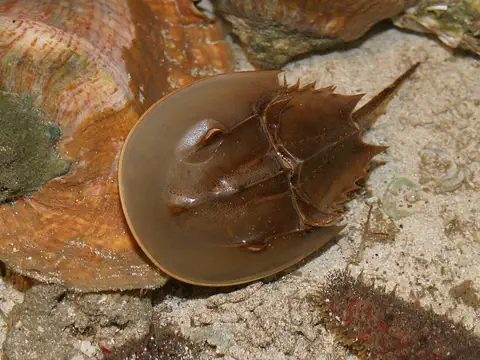
Atlantic horseshoe crab
The Atlantic horseshoe crab is a living fossil: its relatives have looked much the same for hundreds of millions of years. Despite its name, it is more closely related to spiders and scorpions than to crabs. Each spring, thousands crawl onto beaches to lay eggs, feeding hungry shorebirds, and its blue blood helps keep medicines safe.
-
 Watch
Animal
Atlas moth
The atlas moth is one of the largest moths in the world, with wings up to about 24 centimeters across. It lives in tropical and subtropical forests of southern and Southeast Asia. Its caterpillars eat a lot and spin silk cocoons, and the adults cannot eat at all: they live for only about a week.
For parents & teachers
What children will learn
- Describe a tardigrade's body: head, four segments, eight clawed legs, no heart or lungs.
- Understand how small tardigrades really are and that photos and models are enlargements.
- Explain the tun state and why it lets tardigrades survive drying, cold and even space vacuum.
- Read results from a real experiment (FOTON-M3) and a real lab study.
Recommended ages: 3 to 17 · About 15 minutes
Talk about it
- Why might an animal that lives in moss need to survive drying out?
- Why do scientists test animals in space? What could we learn from them?
- How can something be real but too small to see? How do we know it is there?
Try at home or in class
- Mark 1 millimeter on a ruler and compare it with a coin: that is the length of a big tardigrade.
- With a grown-up, soak a pinch of dry moss in a dish of water overnight and look at the water under a magnifying glass or toy microscope.
Key vocabulary: tardigrade, microscope, tun, stylet, molt, vacuum
Where these facts come from
- GBIF Backbone Taxonomy and GBIF Occurrence Search , Global Biodiversity Information Facility (CC0 1.0 (backbone); occurrence counts are facts derived from records under CC0, CC BY and CC BY-NC)
- Tardigrade , Encyclopaedia Britannica
- 'Water Bears' Able To Survive Exposure To Vacuum Of Space (Cell Press release on Jönsson et al., Current Biology 2008) , ScienceDaily
- Bärtierchen überleben im Weltraum (University of Stuttgart press release, in German) , idw – Informationsdienst Wissenschaft
- Life history of Milnesium tardigradum Doyère (Tardigrada) under a rearing environment (Suzuki, Zoological Science 2003), abstract , Europe PMC
- Redescription of Milnesium alpigenum Ehrenberg, 1853 and a description of Milnesium inceptum sp. nov., a tardigrade laboratory model (Morek et al., Zootaxa 2019) , Jagiellonian University Repository
- University of Stuttgart names new tardigrade species , University of Stuttgart
- Wikidata , Wikimedia Foundation (CC0 1.0)
- Wikimedia Commons , Wikimedia Foundation (Per file: Public domain, CC0, CC BY or CC BY-SA only (credited on each page))
Checked, not yet human-reviewed. Last updated October 27, 2026. Spotted a mistake? Tell us.