
Animal
Green anole
The green anole is a small lizard that can turn from green to brown! Males puff out a pink throat flap.
The green anole is a slim, climbing lizard from the southeastern United States. It can change color from bright green to brown or gray, and it has sticky toe pads for climbing walls and trees. Males show off a pink or red throat fan called a dewlap and bob their heads up and down to defend their space and attract females.
Anolis carolinensis (family Dactyloidae) is a diurnal, mostly arboreal anole native to the southeastern United States and introduced to Hawaii, several Pacific and Caribbean islands, Japan and Spain, largely through the pet trade. Frost and Hammerson assessed it as Least Concern for the IUCN Red List (assessed 21 July 2015, published 2020; marked as needing updating) because of its large, apparently stable range and population, though it has declined in parts of Florida.
Photo: Paul Hirst (Phirst), CC BY-SA 2.5, via Wikimedia Commons
Meet the green anole
The green anole is a small, thin lizard.
It can be green or brown.
It climbs trees, fences and walls.
The green anole is a slender lizard that lives in the southeastern United States. It is active in the daytime and is a great climber, found on trees, shrubs, fences and even the walls of houses.
People sometimes call it the American chameleon because it can change color. But it is not related to chameleons, and its color changes are not used for camouflage the way a chameleon's are.
Anolis carolinensis is the green anole of the southeastern United States, where the Alabama Department of Conservation and Natural Resources calls it the only anole native to the country. It is diurnal and mostly arboreal (IUCN; NC Wildlife), and its nickname 'American chameleon' comes from its ability to change color, although anoles are not related to chameleons (Alabama DCNR) and their color shifts do not serve camouflage as in true chameleons (NC Wildlife). It is widely sold in the pet trade, which has spread it to islands across the Pacific and Caribbean and to Japan and Spain (IUCN).
Quick facts
- Group
- Reptile
- Length
- 0.13 to 0.2 m
- Lifespan in the wild
- 2 to 8 years
Woods, swamps and gardens
Green anoles live in woods and swamps.
They also live in gardens and on houses.
At night they sleep on plants.
Green anoles live in the southeastern United States, from Texas and Oklahoma east to North Carolina and south to Florida. They live in many places: forests, scrubby areas, rocky places, swamps, parks, fields and yards in coastal towns. They are often found at the edges of woods.
They climb tree trunks, shrubs, vines, fence posts and walls. At night they sleep in plants, and in cold weather they hide under cover. People have also brought green anoles to Hawaii, Japan, Spain and several islands, where they now live too.
The IUCN gives a native range across the southeastern United States: southern and eastern Texas, southeastern Oklahoma, central Arkansas, Tennessee and North Carolina south to the Rio Grande, the Gulf Coast and the Florida Keys. It occupies upland forests, pine-palmetto scrub, rocky escarpments, swamps, wooded parks, cleared fields, maritime scrub and residential lots, commonly in edge situations, sleeping in vegetation at night and seeking cover in cold weather without going deep underground (Mount 1975). Introduced populations are established in the Hawaiian Islands and Midway, Guam, the Northern Mariana Islands, Palau, Grand Bahama, Anguilla and Canouan, and it has also been introduced to Okinawa and the Ogasawara Islands and to several sites in Spain.
Continent
Its habitats


Where can you find this animal?
- Brought here by people · Countries and seas named by a scientific source
- Lives here naturally · Countries and seas named by a scientific source
- Sightings recorded · Records of wild sightings (GBIF)
Brought here by people · Countries and seas named by a scientific source
Introduced to Grand Bahama (established there), Japan (Okinawa and the Ogasawara Islands) and a few sites in Spain. Also introduced to the Hawaiian Islands and Midway (United States), Guam, the Northern Mariana Islands, Palau, Anguilla and Canouan (Saint Vincent and the Grenadines), which are too small to show; a few have been reported on Grand Cayman, and one record from Tamaulipas, Mexico, is pr
Places: Bahamas, Japan and Spain.
Source: iucn-red-list · checked November 2026
Lives here naturally · Countries and seas named by a scientific source
Native to the southeastern United States only: Texas, Oklahoma, Arkansas, Tennessee and North Carolina south to the Rio Grande, the Gulf Coast and the Florida Keys (IUCN). It lives in only part of the country shaded.
Places: United States.
Source: iucn-red-list · checked November 2026
Sightings recorded · Records of wild sightings (GBIF)
Counts of GBIF records of wild observations (human and machine) and preserved specimens. Records include introduced populations, vagrants, escaped or released animals and misidentifications, so a country with records is not necessarily part of the native range.
Wild sightings have been recorded in United States, Bahamas, Japan, Mexico, Cuba, Canada, Trinidad & Tobago, Colombia and 8 more places.
Source: gbif · checked October 2026
Range maps show where scientists say an animal lives, often country by country. An animal may live in only part of a country shown, and sightings records can include animals that wandered far from home.
Hunting small bugs
Green anoles eat insects and spiders.
They watch for bugs that move.
Green anoles eat small animals, mostly insects and spiders. Their food includes flies, crickets, moths, butterflies, termites, ants and beetles, and sometimes small worms and slugs.
They stalk their prey on shrubs, vines, walls and even window screens. An insect has to move for an anole to find it, so a bug that stays still may not be found.
NC Wildlife lists small arthropods, especially insects such as flies, crickets, moths, butterflies, termites, ants and beetles, and sometimes small worms and slugs. The Alabama Department of Conservation and Natural Resources adds grubs and spiders and notes that anoles stalk prey in shrubs and vines and on walls and window screens, and that prey must move for an anole to find it.
Did you know?
Male anoles do push-ups!
To show they are in charge, male green anoles bob their heads and do push-ups before flaring their dewlaps.
Head bobbing, push-ups and dewlap extension assert dominance and court females (NC Wildlife).
Color changes and a throat fan
An anole can turn green, brown or gray.
Males have a pink throat flap.
Sticky toes help it climb.
A green anole can be vivid green, brown or gray, sometimes with darker streaks or spots. Its color depends on its mood, health, temperature and humidity. Females and young anoles often have a light stripe down the middle of the back.
Grown-up males have a bright pink or red throat fan, called a dewlap; females have a smaller, paler one. Anoles have a pointed snout, eyelids that move, eyes that can look in different directions, and toe pads that help them climb smooth surfaces.
Total length is typically 12.5 to 20 cm including the tail (NC Wildlife), and females are usually smaller than males (Alabama DCNR). Coloration ranges from vivid green to brown or gray and depends on mood, health, temperature and humidity (Alabama DCNR). Adult males have a bright pink or red dewlap and may raise a faint crest along the neck and back during displays; females have a smaller, paler dewlap and, like juveniles, often a light vertebral stripe. Adhesive lamellae on the foot pads allow climbing on smooth surfaces (Alabama DCNR), and the eyelids are movable, with independent eye movement (NC Wildlife).
One egg at a time
The mother lays one egg at a time.
She hides it in damp soil.
The baby hatches and looks after itself.
Green anoles breed in spring and summer, from about March to September. Instead of laying many eggs at once, a female lays a single egg about every two weeks. She often buries it in moist soil, leaf litter or rotting wood. Over a season she may lay up to 10 to 18 eggs.
The leathery eggs hatch after five to seven weeks, and the babies take care of themselves right away. In the wild, green anoles live about 2 to 8 years.
Breeding runs mainly from March to September in North Carolina (NC Wildlife) and from late March to early October in Alabama (Alabama DCNR). Females lay a single egg about every two weeks, buried in moist soil, sphagnum, leaf litter, rotting wood or under rocks and debris (IUCN), with season totals given as about 10 (Alabama DCNR) or up to 10 to 18 (NC Wildlife). The leathery eggs are 1/4 to 3/8 inch long and hatch after 5 to 7 weeks; hatchlings are fully independent. Wild lifespan is about 2 to 8 years (NC Wildlife).
Push-ups and a pink flag
Male anoles bob their heads up and down.
They flash their pink throat fan.
This says: this is my space!
Green anoles are active in the daytime, and males guard a territory. To show who is in charge, a male bobs his head and does 'push-ups', then flares his pink dewlap. If another male challenges him, he may turn sideways to look bigger and raise a crest along his back. The loser bobs his head and moves away.
Males also use the dewlap and head-bobbing to court females.
Males are strongly territorial and use head bobbing, push-up displays and dewlap extension both to assert dominance and in courtship (NC Wildlife). In male contests, the Alabama DCNR describes throat extension, lateral display to enlarge the body profile, an erected dorsal crest and an eyespot, after which the loser performs submissive head-bobbing and retreats to another territory. In courtship, a receptive female stays or allows herself to be caught and bows her head before mating.
Did you know?
An anole only notices a bug that moves.
A green anole finds its food by movement: an insect has to move for the anole to find it.
Prey must move to be detected (Alabama DCNR).
Common, with some local losses
There are lots of green anoles.
But in parts of Florida they have become rarer where other kinds of anoles moved in.
The green anole is listed as least concern: it lives across a large area, it is common in many places, and it occurs in many protected areas. But in central and southern Florida it has declined. It seems to disappear where the brown anole, a lizard brought in from elsewhere, has moved in, and other non-native anoles and habitat damage add to the problem.
Green anoles are also caught in large numbers for the pet trade and for schools and laboratories.
Frost and Hammerson assessed Anolis carolinensis as Least Concern (Global; assessed 21 July 2015, published 2020; trend stable; 'needs updating'), with no major threats across most of its native range. In Florida it appears to disappear where the introduced brown anole is established, and competition with and predation by other non-native anoles plus human habitat degradation have caused declines in central and southern Florida. Losos (2011) reports that at least 250,000 were captured for domestic use in Florida in four years in the 1990s, possibly an underestimate, and a comparable number were legally exported from the US, mainly to Europe, between 1998 and 2002 (IUCN).
IUCN Red List
How is the green anole doing in the wild?
- Least Concern (this animal)
- Near Threatened
- Vulnerable
- Endangered
- Critically Endangered
- Extinct in the Wild
- Extinct
Least Concern
Not at risk of disappearing from the wild right now.
Amazing facts
-
People call the green anole the American chameleon.
The green anole is often called the American chameleon because it changes color, but it is not related to chameleons.
Nicknamed 'American chameleon', though anoles are not related to chameleons and their color shifts are not camouflage (Alabama DCNR; NC Wildlife).
-
A mother anole lays just one egg at a time.
Instead of a big clutch, a female green anole lays a single egg about every two weeks through the breeding season.
Single-egg clutches about every two weeks, up to 10 to 18 per season (NC Wildlife).
-
An anole only notices a bug that moves.
A green anole finds its food by movement: an insect has to move for the anole to find it.
Prey must move to be detected (Alabama DCNR).
-
Male anoles do push-ups!
To show they are in charge, male green anoles bob their heads and do push-ups before flaring their dewlaps.
Head bobbing, push-ups and dewlap extension assert dominance and court females (NC Wildlife).
Words to know
- anole
- a member of a large group of small, mostly tree-climbing lizards of the Americas
- dewlap
- a flap of skin under the throat that a lizard can spread out to show off
- territory
- an area an animal guards against others of its kind
- diurnal
- active in the daytime
- introduced
- brought by people to a place where it did not live before
- least concern
- not currently at serious risk of dying out in the wild
Discovery challenge
-
What is the flap under a male anole's throat called?
What is the name of the pink throat fan that male green anoles flare?
What is the extensible throat fan of a male Anolis carolinensis called?
- A dewlap
- A gill
- A crest
Show the answer
A dewlap
A dewlap!
The dewlap: bright pink or red in males, smaller and paler in females.
The dewlap, used in dominance and courtship displays (NC Wildlife).
-
How many eggs does a mother anole lay at one time?
How many eggs does a female green anole lay at a time?
What is the clutch size of Anolis carolinensis?
- One
- Twenty
- One hundred
Show the answer
One
Just one!
One egg about every two weeks during the breeding season.
Single eggs about every two weeks (NC Wildlife).
-
Which colors can a green anole be?
Which colors can a green anole change between?
Across which colors does Anolis carolinensis range?
- Green, brown or gray
- Blue or purple
- Black and white stripes
Show the answer
Green, brown or gray
Green, brown or gray!
From vivid green to brown or gray, depending on mood, health, temperature and humidity.
Vivid green to brown or gray (NC Wildlife; Alabama DCNR).
-
Where do green anoles come from?
Where is the green anole's native home?
Where is Anolis carolinensis native?
- The southeastern United States
- Australia
- Northern Europe
Show the answer
The southeastern United States
The southeastern United States!
From Texas and Oklahoma to North Carolina and Florida.
The southeastern United States; introduced elsewhere (IUCN).
Places where you might see it
Explore next
-
 Watch
3D
Animal
Veiled chameleon
The veiled chameleon lives in the dry mountains of Yemen and Saudi Arabia. It has a tall helmet-like casque on its head, eyes that can look two ways at once, feet that grip like hands and a super-fast sticky tongue. It changes color to show its mood, not to hide.
-
 Watch
Animal
Leopard gecko
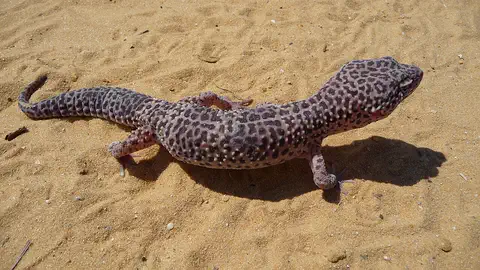
The leopard gecko is a spotted lizard from the rocky deserts and dry grasslands of Pakistan, Afghanistan, northwestern India and Nepal. It hunts insects and scorpions at night, stores fat in its thick tail, and has real eyelids. It is also one of the most popular pet lizards in the world.
-
 Watch
Animal
Eastern blue-tongued skink
The eastern blue-tongued skink is one of the larger skinks in Australia. It has a wide head, a thick body with smooth, shiny scales, and short legs. When something scares it, it opens its mouth wide and shows its broad blue tongue. It eats snails, insects, flowers and fruit, lives in forests, grasslands and even town gardens, and the mother gives birth to about ten live babies at a time.
-
 Watch
 Country
United States
The United States is a large country in North America made of 50 states, from icy Alaska to the warm islands of Hawaii. It has the Grand Canyon, the Mississippi River and Yellowstone, and about 342 million people live there.
-
 Watch
Animal
Texas horned lizard
The Texas horned lizard is a wide, flat lizard covered in pointed scales, with big horns at the back of its head. It lives in dry, open country in the south-central United States and northern Mexico, where it eats mostly ants, especially harvester ants. It hides by blending in with the soil, and it can even catch rainwater on its back to drink.
-
 Watch
Animal
Common chuckwalla
The common chuckwalla is a large lizard of the rocky deserts of the southwestern United States and northwestern Mexico. It eats plants, such as the leaves and fruit of the creosote bush. When a predator comes near, it hides in a rock crack, fills its lungs and puffs up its skin, so it is wedged in tight.
-
 Watch
Animal
Common basilisk
The common basilisk is a lizard of riversides and streams from Nicaragua to Venezuela. It climbs trees, swims well and, when it is startled, can sprint upright across the surface of the water on its big back feet before it sinks and swims.
-
 Watch
3D
Animal
Green iguana
The green iguana is a large lizard from the forests of Central and South America. It climbs high into trees to bask in the sun, eats leaves, flowers and fruit, and dives into rivers to get away from danger. It can grow to about 2 meters long, tail included.
For parents & teachers
What children will learn
- Describe how a green anole changes color and what affects it.
- Explain how male anoles use head-bobbing and the dewlap.
- Describe how green anoles lay their eggs.
- Explain how introduced animals can affect native ones.
Recommended ages: 3 to 17 · About 15 minutes
Talk about it
- Why might a lizard that finds food by movement miss a bug that stays very still?
- Why might a male anole want other males to know where his territory is?
- How could a pet lizard end up living wild far from its home?
Try at home or in class
- Dewlap model: fold a pink paper fan and tape it under a paper lizard's chin. Practice a 'push-up' display with it.
- Moving or still: roll a small paper ball slowly across a table, then leave it still. Which is easier to notice?
Key vocabulary: anole, dewlap, territory, diurnal, introduced, least concern
Where these facts come from
- GBIF Backbone Taxonomy and GBIF Occurrence Search , Global Biodiversity Information Facility (CC0 1.0 (backbone); occurrence counts are facts derived from records under CC0, CC BY and CC BY-NC)
- Wikidata , Wikimedia Foundation (CC0 1.0)
- The IUCN Red List of Threatened Species , International Union for Conservation of Nature (IUCN terms of use (no redistribution of Red List data or range maps))
- Anolis carolinensis (Frost and Hammerson, assessed 21 July 2015, published 2020) , IUCN Red List of Threatened Species
- Anolis carolinensis: justification, range, population, habitat, threats, use and trade, and conservation text , IUCN Red List of Threatened Species
- Anolis carolinensis: IUCN Red List global assessment record (Frost and Hammerson 2020), IUCN checklist on GBIF , GBIF
- Green Anole , North Carolina Wildlife Resources Commission
- Northern Green Anole , Alabama Department of Conservation and Natural Resources
- File:Anole Lizard Hilo Hawaii edit.jpg (Paul Hirst, 26 August 2006) , Wikimedia Commons
- Wikimedia Commons , Wikimedia Foundation (Per file: Public domain, CC0, CC BY or CC BY-SA only (credited on each page))
Checked, not yet human-reviewed. Last updated November 1, 2026. Spotted a mistake? Tell us.