
Animal
Mossy leaf-tailed gecko
The mossy leaf-tailed gecko lives on trees in Madagascar. It looks just like moss and bark, so it is very hard to see!
The mossy leaf-tailed gecko is a flat lizard from the rainforests of Madagascar. Its skin looks like tree bark covered in moss and lichens, and flaps of skin along its sides, chin and legs are part of its disguise. It has a flat tail and a long, flat snout, and it lays eggs.
Uroplatus sikorae (family Gekkonidae) is a large leaf-tailed gecko endemic to the humid mid-elevation forests of eastern and northern Madagascar. Ratsoavina, Glaw, Rabibisoa and Rakotondrazafy assessed it as Least Concern for the IUCN Red List (assessed 29 January 2011, published 2011; marked as needing updating), but genetic work since then (Gehring et al. 2023) has found 12 deep mitochondrial lineages within it, and its taxonomy and status may change.
Photo: Charles J. Sharp, CC BY-SA 4.0, via Wikimedia Commons
Meet the mossy leaf-tailed gecko
This gecko lives in Madagascar.
It rests flat on tree branches.
It looks so much like moss that it is hard to find!
The mossy leaf-tailed gecko is a lizard that lives only on the island of Madagascar. It is one of the leaf-tailed geckos, which have flat tails.
Its skin looks like a tree trunk covered in moss and lichens. When it rests, it lies flat against the bark, and flaps of skin along its edges are part of its disguise. It can hide in plain sight on a rainforest tree.
Uroplatus sikorae was named by Boettger in 1913 from the high plateau near Andrangoloaka, southeast of Antananarivo (Reptile Database), in honor of the collector Franz Sikora. It belongs to the U. fimbriatus group of large leaf-tailed geckos, which have dermal fringes along the flanks, under the chin and on the limbs (Gehring et al. 2023). Its close lowland relative, U. sameiti, was first described as a subspecies of it in 1990 and is now treated as a full species. Gehring et al. (2023) found 12 deep mitochondrial lineages within U. sikorae but no clear morphological differences between them, so its taxonomy is still unresolved.
Quick facts
- Group
- Reptile
- Length
- 0.09 to 0.12 m
Mossy rainforest trees
It lives in wet forests on hills and mountains.
It stays on tree trunks and branches.
Mossy leaf-tailed geckos live in the humid forests of eastern and northeastern Madagascar, along much of the length of the island. Most live in hill and mountain forests at middle heights, usually more than 600 meters above the sea, and there is an apparently separate group on Montagne d'Ambre in the north.
They stay in the lower part of the forest, between one and five meters above the ground. They can live in forest that has been partly damaged, but not where the forest has been cut down.
The IUCN describes an endemic of humid forest in the east and throughout the northeast of Madagascar, with an apparently isolated population at Montagne d'Ambre, an extent of occurrence of 77,103 km² and records from 700 m to at least 1,200 m (plus one lower forest fragment at 379 to 435 m). Molecularly confirmed localities span 279 to 1,550 m, with sites below 600 m only in the southern clade and most others above 900 m (Gehring et al. 2023). It is active in the understorey at heights of one to five meters, tolerates some habitat degradation, but cannot survive in deforested areas and may be absent from heavily degraded forest (IUCN).
Continent
Did you know?
Inside its mouth can be black!
In northern and central Madagascar, these geckos have a black lining inside the mouth; in the south it is pink.
Oral mucosa is black in the central-highland and northern lineages and unpigmented in the southern lineages (Gehring et al. 2023).
Where can you find this animal?
- Lives here naturally · Countries and seas named by a scientific source
- Sightings recorded · Records of wild sightings (GBIF)
Lives here naturally · Countries and seas named by a scientific source
The IUCN lists the mossy leaf-tailed gecko only in Madagascar: humid forest in the east and northeast, mostly at mid-elevations, with an apparently isolated population at Montagne d'Ambre in the north. It lives in only part of the island.
Places: Madagascar.
Source: iucn-red-list · checked November 2026
Sightings recorded · Records of wild sightings (GBIF)
Counts of GBIF records of wild observations (human and machine) and preserved specimens. Records include introduced populations, vagrants, escaped or released animals and misidentifications, so a country with records is not necessarily part of the native range.
Wild sightings have been recorded in Madagascar, United States, Japan and Switzerland.
Source: gbif · checked October 2026
Range maps show where scientists say an animal lives, often country by country. An animal may live in only part of a country shown, and sightings records can include animals that wandered far from home.
Waiting for insects
It eats insects.
It catches insects that climb up tree trunks.
Mossy leaf-tailed geckos catch insects. A National Geographic photo caption explains that when they rest, they face downward on tree trunks, which lets them catch insects that climb up from the ground.
Scientists still know little about how these geckos live in the wild. Most of what is known about the lives of leaf-tailed geckos comes from animals kept in human care.
Field data on its natural history, diet included, are scarce: Gehring et al. (2023) note that most natural-history information on Uroplatus comes from captive observations and that no long-term field study of any species has been carried out. A National Geographic photo caption (Chien C. Lee) describes resting geckos facing downward on tree trunks, partly to catch insects climbing up from the ground. Large-sized Uroplatus also have more teeth than any other squamate, and possibly any amniote (Bauer and Russell 1989, cited by Gehring et al. 2023).
Did you know?
This gecko is named after a man called Franz Sikora.
Its scientific name, sikorae, honors Franz Sikora, a collector who worked in Madagascar in the 1890s.
Named for Franz Sikora (1863-1902), an Austrian explorer and collector who collected in Madagascar for seven years in the 1890s (Reptile Database).
Built to look like a branch
Its skin looks like moss.
It has flaps of skin on its sides.
Its tail is flat, like a leaf.
This gecko's body and head are flat, and its snout is long. Along its sides, under its chin and on its legs are fringes of skin, which are part of its camouflage disguise.
Its colors are very different from one gecko to the next: mossy green, lichen gray, bark brown, reddish or almost white, with blotches, spots or stripes. Its tail is long and flat, with a fringe on each side and a rounded tip. Under its toes are rows of ridges, called lamellae, used for climbing.
Gehring et al. (2023) describe a dorsally flattened body with serrated dermal fringes along the flanks, under the chin and on the limbs; a strongly flattened head ending in an elongated snout; granular dorsal scales scattered with pointed, cone-like tubercles; 3 to 5 lobes on the upper eyelid; 8 to 10 climbing lamellae under the third finger; and an elongated, flattened tail with two lateral fringes and a rounded tip. Dorsal coloration mimics moss- and lichen-covered rainforest trunks and varies hugely; longitudinal stripes were seen only in males. The mouth lining is black in central and northern populations but unpigmented in the south.
Eggs and a mystery
The mother gecko lays eggs.
Baby geckos hatch out of the eggs.
Mossy leaf-tailed geckos lay eggs, and the babies hatch from them. Grown-up geckos have a head and body about 9 to 12 centimeters long, plus a flat tail.
Scientists know surprisingly little about how these geckos grow up in the wild. Most of what is known about the lives of leaf-tailed geckos comes from geckos in human care, and nobody has yet done a long study of any leaf-tailed gecko in the forest.
U. sikorae is oviparous (Reptile Database). In a study sample, adult snout-vent length was 97 to 120 mm in males and 93 to 116 mm in females, and the species is known to reach 123 mm (Gehring et al. 2023). The same authors stress how poorly known the natural history and reproduction of the large leaf-tailed geckos are: most data come from captive animals, no dedicated long-term field study exists for any Uroplatus, and even population densities from mark-recapture work are lacking for most species.
Hide, then surprise
It hides by looking just like the tree.
If something scares it, it opens its mouth wide and makes a loud call!
This gecko needs its camouflage, because its forest is full of sharp-eyed hunting birds. A National Geographic caption explains that a resting gecko faces downward, so that light shining off its eyes does not catch the attention of birds above.
When it is threatened, the gecko opens its jaws wide and gives a loud call. It can also push its eyes out a little, showing a bright yellow ring of skin around each eye.
Its camouflage is needed in a forest full of keen-eyed predatory birds: according to a National Geographic caption (Chien C. Lee), resting geckos face downward to avoid eye reflections that could alert predatory birds above. When threatened they open the jaws wide and give a loud call. Gehring et al. (2023) describe a bright yellow dermal ring around the eyeball that becomes visible when the geckos protrude their eyes during defensive behaviour, and an iris that is yellow to light gray or reddish by day but appears brown at night, when a network of fine veins shows.
Did you know?
Big leaf-tailed geckos have lots and lots of teeth!
Big leaf-tailed geckos have more teeth than any other lizard or snake.
Large-sized Uroplatus are the squamates, and possibly the amniotes, with the largest number of teeth (Bauer and Russell 1989, cited by Gehring et al. 2023).
A forest gecko in a shrinking forest
People are cutting down its forest.
Some geckos are also caught and sold as pets.
The mossy leaf-tailed gecko is listed as least concern because it lives across a wide area and can cope with some damage to its forest. But it needs forest to survive, and Madagascar's eastern forests are being cleared for farming, burned, mined and logged.
Some are also caught and sold abroad as pets. Madagascar sets a limit on how many may be exported each year. The geckos live in several protected areas, such as Montagne d'Ambre.
Least Concern (Global; assessed 29 January 2011, published 2011; 'needs updating'; trend decreasing) on the basis of its 77,103 km² extent of occurrence and tolerance of moderate degradation, though it is confined to a highly threatened area and should be monitored. Threats are slash-and-burn agriculture, bush fire, mining and selective logging for charcoal, construction and export hardwoods. The IUCN records an export quota of 2,000 a year (including U. sameiti); Gehring et al. (2023) report 1,500 to 2,000 a year released for export in 2005 to 2019 and 1,391 exported from 2019 to October 2022, and warn that if the complex is split, the smaller units may qualify as threatened. Protected areas include Analamazaotra, Anjanaharibe-Sud, Manongarivo and Montagne d'Ambre.
IUCN Red List
How is the mossy leaf-tailed gecko doing in the wild?
- Least Concern (this animal)
- Near Threatened
- Vulnerable
- Endangered
- Critically Endangered
- Extinct in the Wild
- Extinct
Least Concern
Not at risk of disappearing from the wild right now.
Amazing facts
-
When it rests, this gecko faces down the tree trunk.
A resting mossy leaf-tailed gecko faces downward, which keeps its eyes from shining toward birds above and lets it catch insects climbing up.
Resting geckos face downward, avoiding eye reflections visible to birds above and catching insects climbing from the ground (National Geographic caption, Chien C. Lee).
-
Big leaf-tailed geckos have lots and lots of teeth!
Big leaf-tailed geckos have more teeth than any other lizard or snake.
Large-sized Uroplatus are the squamates, and possibly the amniotes, with the largest number of teeth (Bauer and Russell 1989, cited by Gehring et al. 2023).
-
Inside its mouth can be black!
In northern and central Madagascar, these geckos have a black lining inside the mouth; in the south it is pink.
Oral mucosa is black in the central-highland and northern lineages and unpigmented in the southern lineages (Gehring et al. 2023).
-
This gecko is named after a man called Franz Sikora.
Its scientific name, sikorae, honors Franz Sikora, a collector who worked in Madagascar in the 1890s.
Named for Franz Sikora (1863-1902), an Austrian explorer and collector who collected in Madagascar for seven years in the 1890s (Reptile Database).
Words to know
- gecko
- a member of a family of lizards, the Gekkonidae, many of which climb well
- camouflage
- colors, patterns or shapes that help an animal blend in with its surroundings
- lichen
- a crusty growth made by a fungus and an alga living together, often found on tree bark
- understorey
- the lower layer of a forest, below the treetops
- lineage
- a line of related animals that share a family history
- least concern
- not currently at serious risk of dying out in the wild
Discovery challenge
-
What does this gecko look like?
What does the mossy leaf-tailed gecko's skin look like?
What does the dorsal coloration of Uroplatus sikorae mimic?
- Moss and lichens on bark
- Green leaves
- Yellow sand
Show the answer
Moss and lichens on bark
Moss on bark!
Its skin looks like a tree trunk covered in moss and lichens.
Moss- and lichen-covered rainforest trunks (Gehring et al. 2023).
-
Where does this gecko live?
On which island does the mossy leaf-tailed gecko live?
To which island is Uroplatus sikorae endemic?
- Madagascar
- Iceland
- Hawaii
Show the answer
Madagascar
Madagascar!
It lives only in the humid forests of Madagascar.
Madagascar, in humid forest of the east and northeast (IUCN).
-
What does it do when it is scared?
What does a mossy leaf-tailed gecko do if hiding does not work?
Which defensive behavior does a National Geographic caption describe in this gecko?
- Opens its mouth wide and gives a loud call
- Changes into a leaf
- Jumps into the water
Show the answer
Opens its mouth wide and gives a loud call
It opens its mouth and calls loudly!
It opens its jaws wide and gives a loud call.
Jaws opened wide with a loud call (National Geographic caption); the eyes may also be protruded to show a yellow ring (Gehring et al. 2023).
-
How do baby geckos start life?
How do mossy leaf-tailed gecko babies come into the world?
What is the mode of reproduction of Uroplatus sikorae?
- They hatch from eggs
- They are born live
- They grow from seeds
Show the answer
They hatch from eggs
From eggs!
The mother lays eggs, and the babies hatch from them.
Oviparous (Reptile Database).
Places where you might see it
Explore next
-
 Watch
Animal
Panther chameleon
The panther chameleon is a lizard famous for its brilliant colors. It lives on the island of Madagascar, grips branches with tong-shaped feet and a curling tail, looks two ways at once, and catches insects with a lightning-fast tongue. Males change their colors to send messages.
-
 Watch
Animal
Leopard gecko
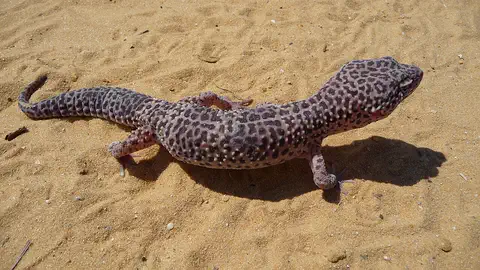
The leopard gecko is a spotted lizard from the rocky deserts and dry grasslands of Pakistan, Afghanistan, northwestern India and Nepal. It hunts insects and scorpions at night, stores fat in its thick tail, and has real eyelids. It is also one of the most popular pet lizards in the world.
-
 Watch
Animal
Tokay gecko
The tokay gecko is one of the biggest geckos in the world, a blue-gray lizard covered in orange spots. It lives in forests and on houses across South and Southeast Asia, hunts insects at night, climbs walls and ceilings with special toe pads, and gets its name from the male's loud to-kay call.
-
 Watch
 Country
Madagascar
Madagascar is the fourth-largest island in the world, in the Indian Ocean off southeastern Africa. It split from other land more than 60 million years ago, so many of its plants and animals, such as its lemurs, live nowhere else. About 32.7 million people lived there in 2025.
-
 Watch
Animal
Crested gecko
The crested gecko is a tree-climbing lizard from the forests of the islands of New Caledonia. It has a row of spiky scales above each eye and along its back, sticky toe pads for climbing, and it is active at night. Scientists once thought it might be extinct, but it was found again in the 1990s.
-
 Watch
Animal
Aldabra giant tortoise
The Aldabra giant tortoise is one of the largest land tortoises on Earth. Wild ones live on Aldabra Atoll, a ring of coral islands in the Indian Ocean, where about 180,000 of them graze, browse and shape the land like elephants do in Africa. They can live for more than 100 years.
-
 Watch
Animal
Alligator snapping turtle
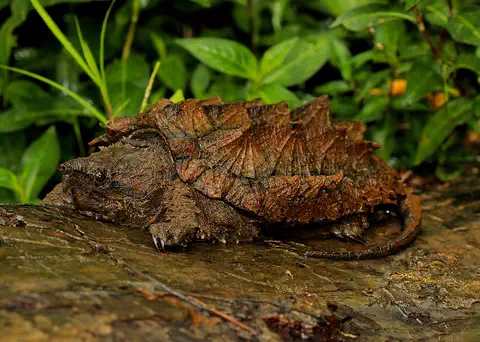
The alligator snapping turtle is the largest freshwater turtle in the United States. It lies still on the bottom of rivers and lakes with its mouth open, wiggling a worm-like lure on its tongue to trick fish into swimming close. Its numbers have fallen, and it is now endangered.
-
 Watch
3D
Animal
American alligator
The American alligator is a large, armored reptile of the swamps, marshes and lakes of the southeastern United States. Alligator mothers guard their nests and carry their babies to the water, and the holes alligators dig help many other animals survive dry seasons.
For parents & teachers
What children will learn
- Describe how body shape, skin fringes and color help a gecko hide.
- Explain why a forest-dependent animal is at risk when forests are cleared.
- Understand that scientists are still discovering how many kinds of these geckos exist.
Recommended ages: 3 to 17 · About 15 minutes
Talk about it
- Why might facing downward on a tree help a gecko?
- Why is it hard for scientists to study an animal that is so well hidden?
- If scientists find that one species is really several, why might that change how worried we are about them?
Try at home or in class
- Camouflage hunt: cut a gecko shape from paper, color it like bark and moss, and tape it to a tree or a brown box. How long does it take someone to find it?
- Outline test: lay a paper cut-out on a textured surface, then add a frilly paper edge around it. Which is harder to spot?
Key vocabulary: gecko, camouflage, lichen, understorey, lineage, least concern
Where these facts come from
- GBIF Backbone Taxonomy and GBIF Occurrence Search , Global Biodiversity Information Facility (CC0 1.0 (backbone); occurrence counts are facts derived from records under CC0, CC BY and CC BY-NC)
- Wikidata , Wikimedia Foundation (CC0 1.0)
- The IUCN Red List of Threatened Species , International Union for Conservation of Nature (IUCN terms of use (no redistribution of Red List data or range maps))
- Uroplatus sikorae (Ratsoavina, Glaw, Rabibisoa and Rakotondrazafy, assessed 29 January 2011, published 2011) , IUCN Red List of Threatened Species
- Uroplatus sikorae: justification, range, population, habitat, threats, use and trade, and conservation text , IUCN Red List of Threatened Species
- Uroplatus sikorae: IUCN Red List global assessment record (Ratsoavina et al. 2011), IUCN checklist on GBIF , GBIF
- High diversity of deep mitochondrial lineages meets low morphological distinctiveness: insights into the complex phylogeography of the Malagasy leaf-tailed geckos Uroplatus sikorae and U. sameiti (Gehring et al. 2023, Salamandra 59: 158-178) , Salamandra (German Herpetological Society, DGHT)
- Uroplatus sikorae , The Reptile Database
- Mossy leaf-tailed gecko, Madagascar (photo caption, Chien C. Lee) , National Geographic
- File:Mossy leaf-tailed gecko (Uroplatus sikorae) Montagne d'Ambre 2.jpg (Charles J. Sharp, 1 December 2018) , Wikimedia Commons
- Wikimedia Commons , Wikimedia Foundation (Per file: Public domain, CC0, CC BY or CC BY-SA only (credited on each page))
Checked, not yet human-reviewed. Last updated November 1, 2026. Spotted a mistake? Tell us.