
Animal
Tokay gecko
The tokay gecko is a big, spotty lizard from Asia. It climbs walls with sticky toes and shouts its name at night: to-kay!
The tokay gecko is one of the biggest geckos in the world, a blue-gray lizard covered in orange spots. It lives in forests and on houses across South and Southeast Asia, hunts insects at night, climbs walls and ceilings with special toe pads, and gets its name from the male's loud to-kay call.
Gekko gecko is a large, nocturnal gecko native from northeastern India and Bangladesh to southern China and throughout Southeast Asia, common in forests and in buildings. Famous for setae-based adhesion and its loud call, it is assessed as Least Concern by the IUCN, though heavy harvest for traditional medicine has reduced some populations.
Photo: Bernard DUPONT from FRANCE, CC BY-SA 2.0, via Wikimedia Commons
Meet the tokay gecko
The tokay gecko is a big lizard with orange spots.
It has huge eyes and sticky toes. At night the boy tokay calls out loudly: to-kay, to-kay! That is how it got its name.
The tokay gecko is one of the largest geckos alive. A grown-up male can be 35 to 40 centimeters long, about as long as a school ruler and a bit more. Its skin is blue-gray or gray and covered in spots that range from light yellow to bright red.
Its name comes from the male's call: a loud "to-kay" repeated again and again, getting louder each time. You can listen to a male's call recorded at nightfall beside the Mekong River in Laos. Tokays are also famous climbers that can run up walls and across ceilings.
Gekko gecko is one of the largest living geckos: the Smithsonian's National Zoo gives 35 to 40 centimeters for males and 20 to 30 for females, which are also duller in color. The body is cylindrical and the head is large and distinct from the neck. Two forms are described, red-spotted and black-spotted; the black-spotted form is more likely in northern Vietnam and southern China, the red-spotted one more widespread in Southeast Asia.
The common name echoes the male's advertisement call, a loud "to-kay" repeated in a crescendo. The recording here is of a male calling at nightfall on the bank of the Mekong River near Huay Xai in northern Laos.
Quick facts
- Group
- Reptile
- Length
- 35 to 40 cm
- Lifespan in the wild
- 10 years
Where it lives
Tokay geckos live in warm places in Asia.
They live in forests, on rocks and on houses. In the daytime they hide in cracks. At night they come out to hunt.
Tokay geckos live in South and Southeast Asia, from northeastern India and Bangladesh to southern China, and across Thailand, Vietnam, Malaysia, Indonesia, the Philippines and nearby countries.
In the wild they live on trees in lowland and hill forests and hide in rock cracks during the day. They also do very well around people, living on walls and in roofs of houses, where they eat insects. People have also carried them, in cargo or as pets, to other places such as Florida, Hawaii and Madagascar.
The IUCN's assessment (made in 2017, published in 2019) lists the species as native in Bangladesh, Bhutan, Cambodia, China, India, Indonesia, Laos, Malaysia, Myanmar, Nepal, the Philippines, Thailand, Timor-Leste and Vietnam. Its natural range in China is uncertain and probably limited to border areas with Vietnam and Laos, and Taiwan's records are of uncertain origin.
It is introduced in Hong Kong, Singapore, Florida and Hawaii in the United States, Madagascar, and the West Indies, including Martinique and Guadeloupe. In natural habitats it lives on trees in lowland and hill dipterocarp forest and shelters in rock cracks by day, and it thrives in buildings; in Indonesia it is rarely found above 700 meters.
Continent
Its habitat

Where can you find this animal?
- Brought here by people · Countries and seas named by a scientific source
- Lives here naturally · Countries and seas named by a scientific source
- Sightings recorded · Records of wild sightings (GBIF)
Brought here by people · Countries and seas named by a scientific source
Brought by people, through the pet trade or in cargo: established in Florida and Hawaii in the United States and in Madagascar. Introduced populations in Hong Kong, Singapore, Guadeloupe and Martinique are not shown on this map.
Places: United States and Madagascar.
Source: iucn-red-list · checked October 2026
Lives here naturally · Countries and seas named by a scientific source
Forests, rocky places and buildings from northeastern India and Bangladesh to southern China and throughout Southeast Asia. In India it lives only in the northeast and the Andaman Islands, and in China probably only near the borders with Vietnam and Laos.
Places: Bangladesh, Bhutan, Cambodia, China, India, Indonesia, Laos, Malaysia and 6 more places.
Source: iucn-red-list · checked October 2026
Sightings recorded · Records of wild sightings (GBIF)
Counts of GBIF records of wild observations (human and machine) and preserved specimens. Records include introduced populations, vagrants, escaped or released animals and misidentifications, so a country with records is not necessarily part of the native range.
Wild sightings have been recorded in Indonesia, Thailand, Philippines, United States, Vietnam, Cambodia, Myanmar, China and 19 more places.
Source: gbif · checked October 2026
Range maps show where scientists say an animal lives, often country by country. An animal may live in only part of a country shown, and sightings records can include animals that wandered far from home.
What it eats
Tokay geckos eat bugs.
They eat moths, crickets, beetles and cockroaches. Big tokays can even catch a mouse.
Tokay geckos hunt at night. They usually sit still and wait for prey to come close, then grab it. Most of their food is insects and other small invertebrates: moths, grasshoppers, beetles, cockroaches, termites, crickets, mosquitoes and spiders.
Because they are so big, tokays can also catch small mice, rats, snakes and other geckos. In some places tokays and people share homes: the gecko shelters in the walls and ceiling and eats insects that people do not want.
Tokays are solitary, nocturnal sit-and-wait predators that keep a foraging area. The Smithsonian's National Zoo lists moths, locusts, grasshoppers, beetles, cockroaches, termites, crickets, mosquitoes and spiders, plus small rats, mice and snakes; the IUCN adds other geckos and small birds.
Because they eat a lot and thrive in buildings, they are sometimes used to control pest insects, and the zoo describes a mutualistic relationship in which a gecko shelters in the walls and ceilings of a home while eating unwanted insects.
Did you know?
A tokay's eyelids are clear and joined together.
Tokays have no moving eyelids. Their eyelids are joined into a clear covering over each eye.
The eyelids are fused and transparent, forming a fixed spectacle over each eye.
Sticky toes and big eyes
Tokay geckos have sticky toes.
Tiny hairs on their toes help them hold on to walls. Their big eyes see well in the dark. They can drop their tail to get away.
Look at the photo: the gecko is holding on to a wall with wide toe pads. Under the toes are tiny hairs called setae. They grip so well that a tokay can hang on to a wall with just one toe.
Tokays have big eyes with slit pupils, and clear, joined eyelids instead of ones that blink. They can make their skin lighter or darker to blend in. If something grabs a tokay's tail, the tail can break off and wiggle, which gives the gecko time to escape. A new tail grows back in about three weeks.
Adhesion comes from setae, fine filaments on the toe pads that greatly increase contact area and bind to surfaces at the molecular level; the National Zoo notes a tokay can hold a vertical surface with as little as one toe. The large eyes have vertical pupils and fused, transparent eyelids, and a rudimentary parietal (third) eye on top of the head is thought to help regulate activity with light levels.
Tokays can lighten or darken their skin for camouflage, and skin folds can flatten against bark so the resting gecko casts no shadow. The tail breaks at several fracture planes and keeps moving for several minutes after it is shed; it regrows in about three weeks, usually shorter than before (Smithsonian's National Zoo; Animal Diversity Web).
Growing up
A mother tokay glues her hard eggs to a wall or a tree.
Both parents guard the eggs. The babies are small, and they grow up in about a year.
The tokay breeding season lasts about four to six months. Males call loudly to attract females. During the season, a female can lay eggs about once a month.
She sticks her hard-shelled eggs onto a solid surface, such as a rock crack or a wall, and both parents guard them until they hatch. Baby tokays are 5 to 7.5 centimeters long. They are ready to have young of their own after about a year.
The breeding season lasts about four to six months (Smithsonian's National Zoo; Animal Diversity Web gives four to five). Males call to attract females and release a secretion from femoral pores on the hind legs that is thought to help with mating. Mating can happen monthly, so a female lays repeatedly through the season.
The hard-shelled eggs are fixed to a solid surface and guarded by both parents until they hatch; the IUCN cites clutches found in a rock crack on a karst tower in Perlis, Malaysia, from March through October. Hatchlings are 5 to 7.5 centimeters long, eat their shed outer skin, and reach maturity after about a year.
Loud and alone
Tokay geckos like to live alone.
At night the boys call "to-kay" to find a girl. If a tokay is scared, it hisses. Tokays can bite hard, so they are not for touching.
Tokay geckos live alone and only meet others in the breeding season. Each one guards its own patch, usually the male, and chases away other tokays and other animals that come too close.
They use their voices a lot. Males call "to-kay" to find females, and a frightened tokay hisses or croaks. Usually a tokay will run away, but if it is cornered it can give a hard bite, so tokays are animals to watch, not to handle.
Tokays are solitary, nocturnal and territorial; territories are usually defended by males and occasionally by females, against both other tokays and other species (Animal Diversity Web). Tokays communicate with their voices: males call to find mates, and threatened animals hiss or croak.
A tokay not defending its territory usually flees, but a cornered one bites quickly and hard. The Smithsonian's National Zoo also describes its keen chemical senses: sensory cells in the nostrils detect scents, and the tongue carries scent particles to the Jacobson's organ in the roof of the mouth.
Did you know?
The tokay gecko is named after its call.
The tokay gets its name from the male's loud "to-kay" call, repeated over and over.
The common name comes from the male's call, a loud "to-kay" repeated multiple times in a crescendo (Smithsonian's National Zoo).
Too many caught
Lots of tokay geckos live in Asia.
But people catch many of them to sell. Some countries now protect them, so they can stay wild.
Tokay geckos are listed as least concern because they are common across a huge area and do well around houses. But they have a big problem: people catch very large numbers of them.
Dried tokays are sold for traditional medicines, even though evidence does not support all the claims made about them, and live ones are sold as pets. In China tokays have become rare, and Vietnam lists them as threatened. Malaysia now protects them, and people need a permit to collect them.
The IUCN lists the tokay as Least Concern (assessed 2017, published 2019) because of its wide range, presumed large population, presence in protected areas and tolerance of modified habitat, but notes increasing exploitation and an unknown global trend. Studies it cites estimate about 2.5 million tokays exported from Thailand each year and 1.2 million dried specimens from Java; declines are reported in China, where it appears rare, and in Vietnam.
The Smithsonian's National Zoo notes that China's Red Data Book lists it as endangered and Vietnam's as threatened, that Malaysia protected it in 2010 with permits for harvesters, and that rumors in 2009 that tokays could cure HIV/AIDS, for which there is no evidence, caused a spike in trafficking. Introduced populations elsewhere come from the pet trade and cargo shipments.
IUCN Red List
How is the tokay gecko doing in the wild?
- Least Concern (this animal)
- Near Threatened
- Vulnerable
- Endangered
- Critically Endangered
- Extinct in the Wild
- Extinct
Least Concern
Not at risk of disappearing from the wild right now.
See the IUCN Red List assessment · The IUCN Red List of Threatened Species 2022.2
Amazing facts
-
The tokay gecko is named after its call.
The tokay gets its name from the male's loud "to-kay" call, repeated over and over.
The common name comes from the male's call, a loud "to-kay" repeated multiple times in a crescendo (Smithsonian's National Zoo).
-
A tokay can hang on to a wall with just one toe.
Thanks to tiny hairs on its toe pads, a tokay can hold on to a wall with only one toe.
Setae on the toe pads let a tokay cling to a vertical surface with as little as one toe (Smithsonian's National Zoo).
-
A tokay's eyelids are clear and joined together.
Tokays have no moving eyelids. Their eyelids are joined into a clear covering over each eye.
The eyelids are fused and transparent, forming a fixed spectacle over each eye.
-
Both tokay parents guard their eggs.
Tokay mothers and fathers both guard their eggs until they hatch.
The hard-shelled eggs are attached to a solid surface and guarded by both parents until hatching (Smithsonian's National Zoo; Animal Diversity Web).
Words to know
- nocturnal
- active at night
- setae
- tiny hairs on a gecko's toe pads that help it cling
- pupil
- the dark opening in the middle of the eye that lets in light
- territory
- an area an animal guards as its own
- introduced
- brought by people to a place where it did not live before
- invertebrate
- an animal without a backbone, such as an insect or spider
Discovery challenge
-
How did the tokay gecko get its name?
Where does the name "tokay" come from?
What is the origin of the tokay gecko's common name?
- From the sound of the male's call
- From the color of its spots
- From the city where it was found
Show the answer
From the sound of the male's call
The boy tokay calls "to-kay!"
It comes from the male's loud "to-kay" call.
It echoes the male's repeated advertisement call.
-
What helps a tokay stick to walls?
What helps a tokay gecko cling to walls and ceilings?
What structures give geckos their adhesion?
- Glue it makes in its mouth
- Tiny hairs on its toe pads
- Suction cups on its tail
Show the answer
Tiny hairs on its toe pads
Tiny hairs on its toes help it hold on.
Toe pads covered in tiny hairs called setae let it cling, even with one toe.
Setae, fine filaments on the toe pads, create a large contact area and molecular-level attraction.
-
What can a tokay do if something grabs its tail?
What happens if a predator grabs a tokay's tail?
How does tail autotomy help a tokay escape?
- The tail breaks off and wiggles while the gecko runs
- The tail turns into a wing
- The tail squirts water
Show the answer
The tail breaks off and wiggles while the gecko runs
The tail comes off and wiggles, and the gecko gets away. A new tail grows.
The tail breaks off and keeps moving, while the gecko escapes. It grows back in about three weeks.
The shed tail keeps moving for several minutes, giving the gecko time to escape; regeneration takes about three weeks.
-
When are tokay geckos awake?
When are tokay geckos most active?
What is the tokay gecko's activity pattern?
- Only at noon
- At night
- Only in winter
Show the answer
At night
They are awake at night.
They are nocturnal: they hunt and call at night and hide by day.
Nocturnal; by day they shelter in crevices or buildings.
Places where you might see it
-
 Watch
 Country
Thailand
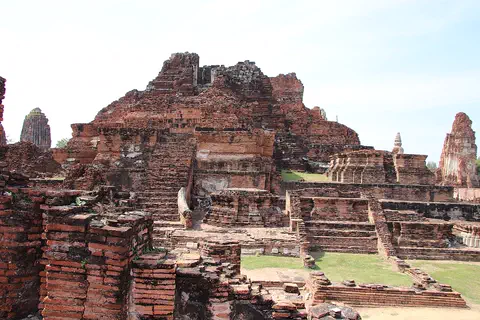
Thailand is a tropical country in the middle of mainland Southeast Asia, with forested mountains in the north, rice fields on its central plains and a long, narrow peninsula in the south. Its capital is Bangkok, and about 65.8 million people were on its civil register at the end of 2025.
-
 Watch
 Country
Indonesia
Indonesia is a country of about 17,500 islands in Southeast Asia, spread across the Equator between the Indian and Pacific oceans. It has more than 100 active volcanoes, rainforests full of wildlife, and about 286 million people (2025).
Experiments to try
Explore next
-
 Watch
Animal
Leopard gecko
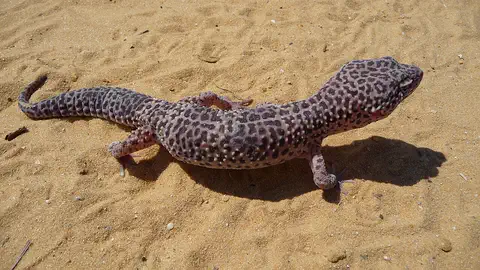
The leopard gecko is a spotted lizard from the rocky deserts and dry grasslands of Pakistan, Afghanistan, northwestern India and Nepal. It hunts insects and scorpions at night, stores fat in its thick tail, and has real eyelids. It is also one of the most popular pet lizards in the world.
-
Watch
Country
Thailand
Thailand is a tropical country in the middle of mainland Southeast Asia, with forested mountains in the north, rice fields on its central plains and a long, narrow peninsula in the south. Its capital is Bangkok, and about 65.8 million people were on its civil register at the end of 2025.
-
Watch
Country
Indonesia
Indonesia is a country of about 17,500 islands in Southeast Asia, spread across the Equator between the Indian and Pacific oceans. It has more than 100 active volcanoes, rainforests full of wildlife, and about 286 million people (2025).
-
 Watch
Animal
King cobra
The king cobra is the largest venomous snake in the world, growing to more than 5 meters long. It lives in forests and near streams in South and Southeast Asia, eats mainly other snakes, and the mother builds a nest of leaves and guards her eggs.
- Watch What If? Lab What if glue stuck to everything? Glue and tape stick by spreading into tiny bumps on a surface and holding on with weak pulls between molecules. They stick well to some things and badly to others. Imagine a glue that stuck to everything, and follow the clues: how glue holds on, sticky notes and gecko feet.
-
 Watch
Animal
Aldabra giant tortoise
The Aldabra giant tortoise is one of the largest land tortoises on Earth. Wild ones live on Aldabra Atoll, a ring of coral islands in the Indian Ocean, where more than 100,000 of them graze, browse and shape the land like elephants do in Africa. They can live for more than 100 years.
-
 Watch
Animal
Alligator snapping turtle
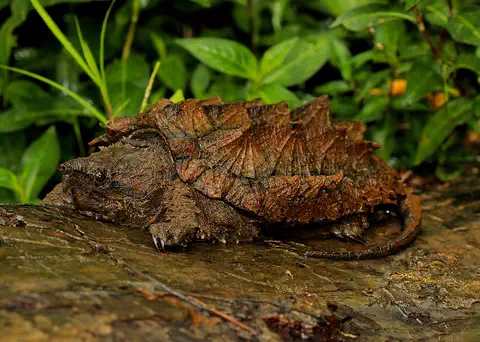
The alligator snapping turtle is the largest freshwater turtle in the United States. It lies still on the bottom of rivers and lakes with its mouth open, wiggling a worm-like lure on its tongue to trick fish into swimming close. Its numbers have fallen, and it is now endangered.
-
 Watch
3D
Animal
American alligator
The American alligator is a large, armored reptile of the swamps, marshes and lakes of the southeastern United States. Alligator mothers guard their nests and carry their babies to the water, and the holes alligators dig help many other animals survive dry seasons.
For parents & teachers
What children will learn
- Explain how gecko toe pads with setae let tokays climb walls and ceilings.
- Describe the tokay's body features: big eyes, ear openings, color change and a tail that regrows.
- Describe the tokay's diet, call and life cycle, including parents guarding eggs.
- Understand how wildlife trade can affect a common species.
Recommended ages: 3 to 17 · About 15 minutes
Talk about it
- Why might an animal that lives on houses be welcome to some people?
- How does dropping its tail help a gecko, and what might it cost the gecko?
- Why is it important to have evidence before believing that something is a cure?
Try at home or in class
- Press a strip of sticky tape onto a smooth window and peel it off slowly, then compare how it grips a dusty surface: geckos keep their grip using tiny hairs instead of glue.
- Listen to the tokay's recorded call and count how many times it says "to-kay" in a row.
Key vocabulary: nocturnal, setae, pupil, territory, introduced, invertebrate
Where these facts come from
- The IUCN Red List of Threatened Species , International Union for Conservation of Nature (IUCN terms of use (no redistribution of Red List data or range maps))
- GBIF Backbone Taxonomy and GBIF Occurrence Search , Global Biodiversity Information Facility (CC0 1.0 (backbone); occurrence counts are facts derived from records under CC0, CC BY and CC BY-NC)
- Gekko gecko (Tokay Gecko), global Red List assessment 2019 , IUCN Red List of Threatened Species
- Tokay gecko , Smithsonian's National Zoo and Conservation Biology Institute
- Gekko gecko (Tokay Gecko) , Animal Diversity Web, University of Michigan Museum of Zoology
- Wikidata , Wikimedia Foundation (CC0 1.0)
- Wikimedia Commons , Wikimedia Foundation (Per file: Public domain, CC0, CC BY or CC BY-SA only (credited on each page))
Checked, not yet human-reviewed. Last updated October 27, 2026. Spotted a mistake? Tell us.