
Animal
European peacock butterfly
The peacock butterfly has four big spots on its wings that look like eyes. It can even make a hissing sound with its wings.
The European peacock butterfly has rusty-red wings with four big, colorful eyespots, like the spots on a peacock's tail. When a bird comes close, it flashes its eyespots and makes a hissing sound. Its black, spiny caterpillars live together on stinging nettles, and the adults sleep through the winter in hollow trees and sheds.
Aglais io, a nymphalid butterfly of Europe and temperate Asia, overwinters as an adult. At rest its near-black underside mimics a dead leaf; when disturbed it flicks open its wings to show four large eyespots and hisses. A 2005 experiment showed the eyespots alone protect it well against blue tits. It is common and not threatened in Europe.
Photo: Korall, CC BY-SA 3.0, via Wikimedia Commons
Meet the peacock butterfly
The peacock butterfly has red wings.
On its wings are four big round spots. They look like eyes! The spots are blue, black, yellow and white.
The European peacock butterfly is easy to recognize. Its wings are a deep rusty red, and each of its four wings has a big, colorful eyespot of blue, black, yellow and white. These eyespots look like the eye markings on a peacock's tail feathers, which is how the butterfly got its name.
Turn it over, though, and it looks completely different. The underside of its wings is very dark, almost black, and looks like a dead leaf. In Britain, people recently voted it their favorite butterfly.
Aglais io (formerly Inachis io) belongs to the brush-footed butterflies, family Nymphalidae (order Lepidoptera, class Insecta). Butterfly Conservation describes its spectacular pattern of eyespots as having evolved to startle or confuse predators, and notes that the butterfly is named for these markings; it was recently voted Britain's favourite butterfly.
The two sides of the wings serve opposite purposes. The upperside is conspicuous, while the underside is very dark and resembles a dead leaf, providing camouflage on tree trunks and in hibernation sites. Females are somewhat larger than males (Animal Diversity Web), with a wingspan of 63 to 69 millimeters from male to female (Butterfly Conservation).
Quick facts
- Group
- Invertebrate
- Wingspan
- 6.3 to 6.9 cm
Where it lives
Peacock butterflies live in Europe and Asia.
You can see them in gardens, parks, meadows and at the edges of woods.
Peacock butterflies live throughout Europe and across the cooler, temperate parts of Asia, all the way to Japan. They live in woods, fields, meadows, parks and gardens, from lowlands up into the mountains.
They are strong fliers that wander widely over the countryside. In late summer you may find them in gardens, feeding on flowers. They often stay in sheltered places such as clearings and the edges of woods.
Animal Diversity Web gives a range throughout Europe and the temperate regions of Asia and Japan, in woods, fields, meadows, pastures, parks and gardens, from lowlands to mountains as high as about 8,200 feet (2,500 meters).
Butterfly Conservation describes a strong flight and nomadic habits that take the butterfly widely through the countryside, often to the shelter of woodland clearings, rides and edges, and it is a familiar garden visitor in late summer. In Britain it is found throughout Britain and Ireland, and UK Butterflies notes that its range seems to be increasing.
Continents
Its habitats


Where can you find this animal?
- Lives here naturally · Countries and seas named by a scientific source
- Sightings recorded · Records of wild sightings (GBIF)
Lives here naturally · Countries and seas named by a scientific source
Throughout Europe and the temperate regions of Asia, as far as Japan. The map shades whole continents; peacock butterflies do not live in tropical or desert parts of Asia.
Places: Europe and Asia.
Source: https://animaldiversity.org/accounts/Aglais_io/ · checked October 2026
Sightings recorded · Records of wild sightings (GBIF)
Counts of GBIF records of wild observations (human and machine) and preserved specimens. Records include introduced populations, vagrants, escaped or released animals and misidentifications, so a country with records is not necessarily part of the native range.
Wild sightings have been recorded in UK, Netherlands, France, Germany, Belgium, Sweden, Finland, Switzerland and 61 more places.
Source: gbif · checked October 2026
Range maps show where scientists say an animal lives, often country by country. An animal may live in only part of a country shown, and sightings records can include animals that wandered far from home.
What it eats
Peacock caterpillars eat stinging nettle leaves.
The grown-up butterflies sip sweet nectar from flowers.
Peacock caterpillars eat the leaves of stinging nettles, the plants that can make your skin itch. Sometimes they also eat small nettle or hop plants. They munch both during the day and at night.
Grown-up peacock butterflies feed on the sweet nectar of flowers. In gardens they often visit buddleia bushes in late summer, and wild flowers such as teasel, marjoram and yarrow.
The main larval foodplant is Common Nettle (Urtica dioica); UK Butterflies also records Small Nettle (Urtica urens) and Hop (Humulus lupulus). Larvae feed both by day and at night, living gregariously while young.
Adults take nectar from many flowers. Butterfly Conservation notes them as familiar visitors to garden buddleias in late summer, and UK Butterflies lists nectar sources including Wild Teasel, Wild Marjoram, Water Mint, Wild Privet and Yarrow.
Did you know?
Peacock butterflies sleep all winter.
Peacock butterflies spend the winter asleep in hollow trees, wood piles, sheds and barns, and wake up in spring.
Adults hibernate in hollow trees, wood piles and outbuildings, often with other individuals, and most emerge at the end of March or in early April (UK Butterflies).
A peacock up close
A peacock butterfly has two long feelers.
It has four wings, and each wing has a big eyespot. Its body is fuzzy and brown.
Like all insects, the peacock butterfly has a head, a thorax and an abdomen. On its head are two antennae with knobbed tips. Its wings and legs join the thorax, and its fuzzy brown abdomen is behind.
The front wings each have an eyespot near the tip, and the back wings each have a large dark eyespot ringed with pale yellow. When the butterfly flicks its wings open, all four eyes appear at once.
Each forewing carries an eyespot near the apex, blue and white within red, yellow and black, and each hindwing a large dark eyespot with pale blue scaling and a cream ring. UK Butterflies suggests that, seen head-on, the eyespots and body together resemble a face with a beak, which may look threatening to a predator such as a mouse.
As in other nymphalids, the wings are covered in scales, and the near-black underside contrasts sharply with the colorful upperside. The species can produce a hissing sound, audible to people, by rubbing its wings together.
From egg to butterfly
A peacock butterfly lays lots of tiny eggs on a nettle leaf.
Black, spiky caterpillars hatch. They eat and grow. Then each makes a chrysalis and turns into a butterfly.
Peacock butterflies go through metamorphosis. After waking from their winter sleep, females lay eggs in clusters of up to 400 under a nettle leaf. The eggs hatch in one to three weeks.
The tiny caterpillars spin a silk web together near the top of the plant and live in a group. As they grow they turn jet black and spiky. After about four weeks each one hangs head down and becomes a chrysalis, yellow or dark gray. Two to four weeks later, a new butterfly comes out.
UK Butterflies reports that females lay one or more clusters of up to 400 eggs on the underside of a nettle leaf, usually in sheltered spots; the eggs hatch in 1 to 3 weeks. Frohawk's 1908 rearing found eggs piled six or more deep and a larval period of 27 days, the fully grown larva averaging about 41 millimeters.
Larvae build a communal web near the top of the plant, move to new plants as they grow and become mostly jet black. The pupa hangs head down from the cremaster, is yellow or dark gray depending on the site, and lasts 2 to 4 weeks depending on temperature. The new adults feed on nectar and later hibernate; most wake at the end of March or in early April.
Flash, hiss and hide
When a bird comes close, the peacock butterfly opens its wings fast.
It shows its big eyespots and makes a hissing sound. The bird gets a surprise!
A peacock butterfly at rest folds its wings and looks like a dark, dead leaf. But if a bird comes too close, it suddenly flicks its wings open and shut, flashing its four big eyespots. At the same time it rubs its wings together to make a hissing sound.
Scientists in Sweden tested this trick with blue tits. Of 34 butterflies that could flash their eyespots, the birds caught only 1. Of 20 whose eyespots had been painted over, the birds caught 13. The caterpillars have tricks too: a group jerks their bodies together when disturbed.
Vallin and colleagues (2005) describe the peacock as a cryptic leaf mimic at rest that switches to active defense when disturbed, repeatedly exposing its eyespots while hissing. In experiments with wild-caught blue tits, only 1 of 34 butterflies with intact eyespots was killed, compared with 13 of 20 with the eyespots painted over. Eyespots alone, or with sound, were an effective defense, and the butterflies were not distasteful, so the authors conclude that the defense works by bluffing.
Larvae have their own defenses: UK Butterflies reports that disturbed groups jerk their bodies from side to side in unison, regurgitate green fluid, or curl up and drop to the ground.
Did you know?
A peacock butterfly can make a hissing sound.
A peacock butterfly can hiss by rubbing its wings together, and the sound is loud enough for people to hear.
The peacock produces a hissing sound audible to humans by rubbing its wings together, part of its startle display.
A common butterfly
Peacock butterflies are common.
You can help them by leaving a patch of nettles and growing flowers in a garden.
The peacock butterfly is common and not threatened in Europe. In Britain and Ireland it is found almost everywhere, and over the last few decades it has spread into more places.
Peacocks need two things: patches of stinging nettles for their caterpillars, and nectar-rich flowers for the adults. A wild corner with nettles and a garden full of flowers can help them.
The species has no global IUCN Red List assessment. Butterfly Conservation lists it as Least Concern on the GB Red List (2022), not threatened in Europe and a low conservation priority. Its British distribution trend is +36 percent (1975 to 2019) and its abundance trend −3 percent (1976 to 2019): it now occupies more places, with little change in abundance.
Because the larvae depend on nettles in sheltered, sunny spots and the adults on flower nectar, leaving nettle patches and planting nectar flowers are simple ways to support it.
Did you know?
People in Britain voted the peacock their favorite butterfly.
The peacock was recently voted Britain's favorite butterfly.
Butterfly Conservation reports that the peacock was recently crowned Britain's favourite butterfly.
Amazing facts
-
A peacock butterfly can make a hissing sound.
A peacock butterfly can hiss by rubbing its wings together, and the sound is loud enough for people to hear.
The peacock produces a hissing sound audible to humans by rubbing its wings together, part of its startle display.
-
Peacock butterflies sleep all winter.
Peacock butterflies spend the winter asleep in hollow trees, wood piles, sheds and barns, and wake up in spring.
Adults hibernate in hollow trees, wood piles and outbuildings, often with other individuals, and most emerge at the end of March or in early April (UK Butterflies).
-
Peacock caterpillars live together in a silk tent.
Peacock caterpillars hatch together and spin a shared silk web near the top of a nettle plant.
Larvae build communal webs near the tops of nettles and move to new plants as they grow, leaving webs decorated with shed skins.
-
People in Britain voted the peacock their favorite butterfly.
The peacock was recently voted Britain's favorite butterfly.
Butterfly Conservation reports that the peacock was recently crowned Britain's favourite butterfly.
Words to know
- eyespot
- a round mark on a wing that looks like an eye
- hibernate
- to spend the winter in a deep rest
- metamorphosis
- a big change in body shape as an animal grows, such as caterpillar to butterfly
- chrysalis
- the hard case a caterpillar makes while it turns into a butterfly
- camouflage
- colors or shapes that help an animal blend in
- nectar
- a sweet liquid made by flowers
Discovery challenge
-
What do the big round spots on its wings do?
What do the peacock butterfly's eyespots help it do?
What did the 2005 blue tit experiment show the eyespots do?
- Scare away birds and other predators
- Help it see behind itself
- Keep it warm at night
Show the answer
Scare away birds and other predators
The eyespots give birds a fright, so they leave the butterfly alone.
When the butterfly flashes its eyespots, birds usually back off.
Eyespots alone protected the butterflies: 1 of 34 with eyespots was killed versus 13 of 20 without.
-
What do peacock caterpillars eat?
Which plant do peacock caterpillars mainly eat?
What is the main larval foodplant of Aglais io?
- Pine needles
- Stinging nettles
- Grass
Show the answer
Stinging nettles
They eat stinging nettle leaves.
They mainly eat stinging nettles, and sometimes small nettle or hop.
Common Nettle (Urtica dioica), with Small Nettle and Hop also recorded.
-
What does a peacock butterfly do in winter?
How does a peacock butterfly spend the winter?
In which life stage does the peacock butterfly overwinter?
- It sleeps as a butterfly in a sheltered spot
- It flies to Africa
- It stays an egg under the snow
Show the answer
It sleeps as a butterfly in a sheltered spot
It sleeps all winter in a safe, dark place.
Adult butterflies hibernate in hollow trees, wood piles, sheds and barns until spring.
It overwinters as a hibernating adult, emerging mostly in late March or April.
-
What noise can a peacock butterfly make?
What sound can a peacock butterfly make?
Which sound does a disturbed peacock butterfly produce?
- A bark
- A hiss
- A song like a bird
Show the answer
A hiss
It makes a hissing sound.
It rubs its wings together to make a hissing sound.
A hiss produced by rubbing the wings together, audible to humans.
Places where you might see it
Explore next
-
 Watch
3D
Animal
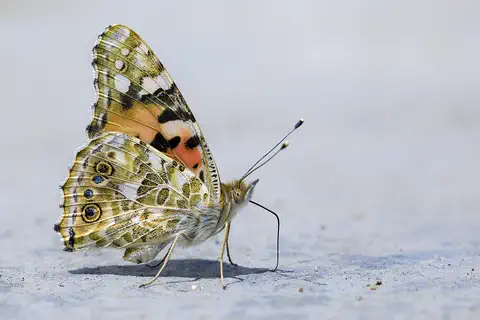
Painted lady
The painted lady is one of the most widespread butterflies in the world. Its orange and black wings carry it on huge journeys: each year, families of painted ladies fly between Africa and northern Europe, one generation after another.
-
 Watch
3D
Animal
Old World swallowtail
The Old World swallowtail is a large butterfly with yellow wings, black veins, blue spots and a red eyespot near the long tails on its hindwings. It lives across Europe and Asia and in northern North America. Its green and black caterpillar has a hidden orange fork that pops out when it is bothered.
-
 Watch
3D
Animal
Eurasian blue tit
The Eurasian blue tit is a small, colorful songbird of woods, parks and gardens across Europe and western Asia. It hangs upside down to find caterpillars, nests in holes and nest boxes, and can lay a very large clutch of eggs once a year, timed for when caterpillars are plentiful.
-
 Watch
3D
Animal
Monarch butterfly
The monarch butterfly is famous for its bright orange wings and its amazing journey. Each fall, monarchs from eastern North America fly up to 3,000 miles to mountain forests in Mexico, where they spend the winter clustered together on fir trees. Their caterpillars eat only milkweed, which makes them taste bad to predators.
-
 Watch
 Country
Sweden
Sweden is a country in northern Europe on the Scandinavian Peninsula. It stretches about 1,600 kilometers from north to south, with forests, many lakes and a rocky coast full of islands. About 10.6 million people live there, and its capital is Stockholm.
-
 Watch
Animal
American lobster
The American lobster is a big crustacean that lives on the rocky sea floor of the northwest Atlantic Ocean. It has two very different claws, one for crushing and one for tearing, and it must climb out of its hard shell again and again to grow.
-
 Watch
3D
Animal
Antarctic krill
Antarctic krill are small, shrimp-like crustaceans about 6 centimeters long that live in the icy Southern Ocean around Antarctica. They gather in enormous swarms, and almost all the bigger animals of the Antarctic, from penguins to blue whales, depend on them for food.
-
 Watch
Animal
Army ant
Army ants hunt together in giant swarms and never build a permanent nest. This page is about the best-studied kind, Eciton burchellii, of Central and South American forests. Each night of its traveling phase the colony moves, and the workers link their legs to build a living camp around their queen and young.
For parents & teachers
What children will learn
- Describe how the peacock butterfly uses eyespots, sound and camouflage to stay safe.
- Name the stages of the peacock's complete metamorphosis.
- Explain how scientists tested whether eyespots work, using a fair comparison.
- Identify the plants the peacock needs at different stages of life.
Recommended ages: 3 to 17 · About 15 minutes
Talk about it
- Why might a butterfly have a bright upperside and a dull underside?
- In the blue tit experiment, why did the scientists paint some spots on another part of the wing instead?
- How could a garden be made friendly for peacock butterflies?
Try at home or in class
- Draw a butterfly, fold the paper in half, and add an eyespot to each wing; open it quickly in front of a friend to see the surprise.
- Count the eyespots on a picture of a peacock butterfly, then look for other animals with eye-like markings.
Key vocabulary: eyespot, hibernate, metamorphosis, chrysalis, camouflage, nectar
Where these facts come from
- GBIF Backbone Taxonomy and GBIF Occurrence Search , Global Biodiversity Information Facility (CC0 1.0 (backbone); occurrence counts are facts derived from records under CC0, CC BY and CC BY-NC)
- Peacock (Aglais io) , Butterfly Conservation
- Peacock - Aglais io , UK Butterflies
- Aglais io (peacock butterfly) , Animal Diversity Web, University of Michigan Museum of Zoology
- Prey survival by predator intimidation: an experimental study of peacock butterfly defence against blue tits (Vallin, Jakobsson, Lind and Wiklund 2005, Proceedings of the Royal Society B) , PubMed, U.S. National Library of Medicine
- Wikidata , Wikimedia Foundation (CC0 1.0)
- Wikimedia Commons , Wikimedia Foundation (Per file: Public domain, CC0, CC BY or CC BY-SA only (credited on each page))
Checked, not yet human-reviewed. Last updated October 27, 2026. Spotted a mistake? Tell us.