
Animal
Central bearded dragon
The central bearded dragon is a spiky lizard from the dry middle of Australia. When it is scared, it puffs out the spiky beard under its chin.
The central bearded dragon is a lizard of the dry woodlands, scrub and deserts of eastern inland Australia. It eats plants and small animals, basks on fence posts and logs, waves its arm and bobs its head to talk to other dragons, and puffs out a spiky beard to look big. It is also a very popular pet lizard.
Pogona vitticeps is an omnivorous agamid of the semi-arid interior of eastern Australia, known for its expandable spiny throat pouch, rapid color change and rich signaling with head bobs and arm waves. Locally common, it is listed by the IUCN as Least Concern, and captive-bred animals are among the most common agamid lizards in the global pet trade.
Photo: Toni Segers, CC BY-SA 4.0, via Wikimedia Commons
Meet the central bearded dragon
The central bearded dragon is a lizard from Australia.
It has spiky scales and a wide, flat body. Under its chin is a beard of spikes. It puffs the beard out when it wants to look big.
The central bearded dragon is a lizard from the dry inland of Australia. Its body is low and wide, so it can hug the ground when it lies down, and its tail is about as long as its head and body together. Grown-ups are about 39 to 58 centimeters long.
Under its chin is a spiky pouch called a beard. When the dragon is alarmed it opens its mouth, puffs out the beard and gulps air to make its body look bigger. The spikes look sharp, but they are actually rubbery. Wild dragons can be red, brown or yellow, often matching the color of the soil where they live.
Pogona vitticeps is one of several bearded dragon species in Australia. The Australian Museum describes a low, wide body that hugs surfaces at rest, a high-legged gait that can be fast, a triangular head and a tail about as long as the head and body; the elongated spiny scales on the jaw and flanks are rubbery and serve to make the lizard look unappealing to predators.
Color is variable, including shades of red, brown and yellow, and usually matches the local soil; males generally have larger heads and brighter colors than females. Adults are about 39 to 58 centimeters long and 280 to 510 grams (Cosley Zoo). The species can change color quickly: the Australian Museum records one individual changing from mostly yellow to almost black within a few minutes.
Quick facts
- Group
- Reptile
- Length
- 39 to 58 cm
- Weight
- 280 to 510 g
Where it lives
Wild bearded dragons live in the dry middle of eastern Australia.
They live in dry woods, scrub and sandy deserts. They like to sit up high on logs and fence posts.
In the wild, central bearded dragons live only in Australia, in a wide band across the dry inland of the east. They live in Queensland, New South Wales, Victoria, South Australia and the southeast of the Northern Territory, but not near the coasts.
Their homes include dry woodlands, scrub, spinifex grasslands with scattered trees, and sandy deserts. They are good climbers, and you often see them sitting on tree stumps, branches, boulders and fence posts, where they soak up the sun and watch what is going on.
The IUCN's assessment (made in 2017, published in 2018) places the species in the interior of all the eastern mainland states, extending into the eastern half of South Australia and the southeast of the Northern Territory. Habitats range from dry sclerophyll forest, eucalypt and Callitris woodland and mallee and acacia scrub to sandplain and sand-ridge desert.
It is semi-arboreal. From elevated perches on stumps, branches, boulders and fence posts it basks and watches for predators, prey, rivals and mates, and in very hot periods it may stay perched for long spells: the Australian Museum describes one male that stayed in the same tree, 3 meters up, for three weeks.
Continent
Its habitats


Where can you find this animal?
- Lives here naturally · Countries and seas named by a scientific source
- Sightings recorded · Records of wild sightings (GBIF)
Lives here naturally · Countries and seas named by a scientific source
Dry woodland, scrub and desert in the inland of eastern Australia: Queensland, New South Wales, Victoria, the eastern half of South Australia and the southeast of the Northern Territory. Pet bearded dragons are kept in many countries, but wild ones live only in this part of Australia.
Places: Australia.
Source: iucn-red-list · checked October 2026
Sightings recorded · Records of wild sightings (GBIF)
Counts of GBIF records of wild observations (human and machine) and preserved specimens. Records include introduced populations, vagrants, escaped or released animals and misidentifications, so a country with records is not necessarily part of the native range.
Wild sightings have been recorded in Australia, United States, Japan, Poland, Germany, Netherlands and Brazil.
Source: gbif · checked October 2026
Range maps show where scientists say an animal lives, often country by country. An animal may live in only part of a country shown, and sightings records can include animals that wandered far from home.
What it eats
Bearded dragons eat plants and small animals.
They eat leaves, flowers and fruit. They also catch bugs like ants and beetles with their sticky tongues.
Central bearded dragons are omnivores, which means they eat both plants and animals. In the wild they eat leaves, flowers and fruit, and catch insects such as ants and beetles, and sometimes small lizards or mice.
Food can be hard to find in the dry outback, so bearded dragons are not fussy eaters. When a dragon spots food, its mouth opens fast and its sticky tongue shoots out to pull the food in.
The species is an opportunistic omnivore. The Australian Museum lists fruit and leaves, invertebrates such as ants and beetles, and small vertebrates such as lizards; Cosley Zoo adds flowers and rodents. Animal Diversity Web notes a large stomach that can hold large quantities of plant matter.
Prey and plant food are taken with a rapid strike of the sticky tongue, then held and broken up by the teeth and strong jaw muscles. The Australian Museum also describes an unusual way of drinking, seen in an outdoor enclosure and possibly used in the wild: in light rain, a dragon stood with its head and tail sloping down and licked the water running forward over its body to its snout, holding the pose for 20 to 30 minutes.
Did you know?
A bearded dragon can change color fast.
One bearded dragon changed from mostly yellow to almost black in just a few minutes.
The Australian Museum records an individual changing from predominantly yellow to almost completely black within a few minutes.
A beard for showing off
The beard is a spiky pouch under the chin.
The dragon puffs it out and opens its mouth wide. A boy dragon can turn his beard black!
Look at the photo: this bearded dragon has puffed out its beard and opened its mouth wide. This makes its head look much bigger to an attacker.
Both males and females have beards, but grown-up males often turn theirs black, especially when showing off. Bearded dragons do not make many sounds, just a low hiss when threatened. Spiky scales cover the body, and strong legs end in long, curved claws for climbing.
The beard is an expandable throat pouch covered in spiny scales, present in both sexes (Cosley Zoo). In defense the lizard faces the threat with its mouth wide open and the beard inflated, and gulps air to expand its body so that the spiny flanks stand out (Australian Museum). Mature males often darken the beard to black, which makes the display more striking.
Bearded dragons are largely silent apart from a low hiss. Like other reptiles they regulate body temperature by basking, and when they get very hot they open their mouths, which the Australian Museum suggests may cool the blood flowing through the head by evaporation.
Growing up
A mother bearded dragon digs a burrow and lays lots of eggs.
She covers the hole to hide it. After a few months, the babies hatch and look after themselves.
After the cool winter, male bearded dragons compete for mates by puffing their beards, circling and even nipping each other's tails. They mate in spring, and in mid-spring the female digs a burrow and lays 11 to 30 eggs, then fills the hole in to hide it.
The eggs hatch after about two and a half months. The temperature of the nest matters: in a very warm nest, some babies that would have become males grow up as females instead. Young dragons are ready to breed when they are one to two years old.
Males compete after the winter cooling period with beard flaring, signaling, circling and tail biting, and mating takes place in spring (Australian Museum); Animal Diversity Web and Cosley Zoo give a breeding season of September to March. In southeastern New South Wales females carry eggs around November, and clutches of 11 to 30 eggs are laid in a burrow that the female backfills. Females can store sperm and lay more than one fertile clutch from a single mating.
Incubation took 78 to 85 days at about 26 degrees Celsius (Australian Museum); Cosley Zoo gives 67 to 80 days. Sex is set by chromosomes, but Cosley Zoo notes that high incubation temperatures can make embryos with male chromosomes develop as females. Maturity comes at one to two years (Animal Diversity Web).
Waving and bobbing
Bearded dragons talk with their bodies.
They bob their heads up and down. They also wave one arm slowly, as if they are saying hello!
Bearded dragons talk with their bodies instead of their voices. A strong male bobs his head quickly, often with a black, puffed-up beard, to show he is in charge. A smaller or shyer dragon answers by standing on three legs and slowly waving one front leg in a circle, which means "I give up."
They usually live alone, but they gather where there are great basking spots or lots of food. In cooler seasons they slow right down, stop eating and rest, which is called brumation.
Communication relies on posture, color, head bobbing and arm waving (Australian Museum). Fast head bobs with an inflated, blackened beard signal male dominance; slow bows can signal a female's submission; vigorous whole-body bobbing precedes mating. Arm waving, a slow circular wave of one forelimb while standing on three legs, signals submission and, Animal Diversity Web suggests, species recognition.
Usually solitary, bearded dragons form clear hierarchies when they gather at prime basking sites or abundant food. They are diurnal, though the Australian Museum notes they are sometimes seen on roads after dark following hot days, and in cool seasons they enter brumation, a hibernation-like state in which they stop eating (Cosley Zoo).
Did you know?
Warm nests can change baby dragons.
If bearded dragon eggs get very warm, some babies that would have been boys grow up as girls.
High incubation temperatures can cause embryos with male sex chromosomes to develop as females (Cosley Zoo).
Wild dragons and pet dragons
There are lots of wild bearded dragons in Australia.
Foxes and cats brought by people catch some of them. Many people around the world keep bearded dragons as pets.
Wild central bearded dragons are common, so they are listed as least concern. Their natural enemies include goannas, black-headed pythons, dingoes and birds of prey, and foxes and cats brought to Australia by people catch them too.
In Australia they are protected, and nobody may take them from the wild. Australia has not allowed its wild animals to be sold to other countries since the 1960s, and most pet bearded dragons around the world are bred in captivity.
The IUCN lists the species as Least Concern (assessed 2017, published 2018) because it is very widespread and locally common, with an unknown population trend; it is preyed on by introduced foxes and feral cats, but no major threats are known, and its range overlaps many protected areas.
The IUCN notes that it and Pogona henrylawsoni are the most common agamids in the global pet trade, and that it is widely captive-bred. Australia has banned the export of native wildlife since the 1960s, and Animal Diversity Web reports the belief that the founder stock of captive dragons outside Australia was smuggled out between 1974 and 1990. In Australia it is protected: it cannot be collected from the wild, and most states require a permit to keep one (Australian Museum).
IUCN Red List
How is the central bearded dragon doing in the wild?
- Least Concern (this animal)
- Near Threatened
- Vulnerable
- Endangered
- Critically Endangered
- Extinct in the Wild
- Extinct
Least Concern
Not at risk of disappearing from the wild right now.
See the IUCN Red List assessment · The IUCN Red List of Threatened Species 2022.2
Amazing facts
-
Bearded dragons wave hello, or that is what it looks like!
A bearded dragon can stand on three legs and slowly wave one front leg in a circle. It usually means "I give up."
Arm waving, a slow circular wave of one forelimb, is used by both sexes, for example by a subordinate male toward a dominant one or by a female toward a courting male (Australian Museum).
-
A bearded dragon can change color fast.
One bearded dragon changed from mostly yellow to almost black in just a few minutes.
The Australian Museum records an individual changing from predominantly yellow to almost completely black within a few minutes.
-
Warm nests can change baby dragons.
If bearded dragon eggs get very warm, some babies that would have been boys grow up as girls.
High incubation temperatures can cause embryos with male sex chromosomes to develop as females (Cosley Zoo).
-
A bearded dragon's spikes are soft.
A bearded dragon's spikes look sharp, but they are actually rubbery.
The elongated spinous scales on the jaw and flanks are rubbery; their role is to make the lizard look unappealing to predators (Australian Museum).
Words to know
- omnivore
- an animal that eats both plants and animals
- beard
- a bearded dragon's spiky throat pouch that it can puff out
- bask
- to lie in the sun to warm up
- brumation
- a resting, hibernation-like state some reptiles enter in cool weather
- clutch
- a group of eggs laid at one time
- captive-bred
- born to parents kept by people, not caught in the wild
Discovery challenge
-
What does a bearded dragon puff out to look big?
What does a bearded dragon puff out when it is alarmed?
Which structure does a bearded dragon inflate in its defensive display?
- Its tail
- Its spiky beard
- Its ears
Show the answer
Its spiky beard
It puffs out the spiky beard under its chin.
It puffs out its beard, opens its mouth and gulps air to look bigger.
The spiny throat pouch is inflated, the mouth gapes and the body is expanded with air.
-
What do bearded dragons eat?
What kind of eater is a bearded dragon?
How would you describe the central bearded dragon's diet?
- Only meat
- Plants and small animals
- Only seaweed
Show the answer
Plants and small animals
They eat leaves, flowers, fruit and bugs.
They are omnivores: they eat plants and also catch insects and small animals.
An opportunistic omnivore taking plant matter, invertebrates and small vertebrates.
-
Where do wild central bearded dragons live?
Where do central bearded dragons live in the wild?
What is the native range of the central bearded dragon?
- In the dry inland of eastern Australia
- In the rainforests of Brazil
- On islands near Antarctica
Show the answer
In the dry inland of eastern Australia
Wild ones live in the dry middle of eastern Australia.
They live wild only in Australia's dry eastern inland. Pet dragons elsewhere are bred by people.
The interior of the eastern mainland states, the eastern half of South Australia and the southeast of the Northern Territory.
-
What does a slow arm wave mean?
What does a bearded dragon usually mean when it slowly waves one arm?
What does arm waving usually signal in bearded dragons?
- I give up
- I am hungry
- I am cold
Show the answer
I give up
A slow wave means it does not want to fight.
A slow arm wave usually means "I give up," and it often stops a fight.
Arm waving signals submission and generally defuses confrontations; it may also aid species recognition.
Places where you might see it
Explore next
-
 Watch
Animal
Frilled lizard
The frilled lizard is a dragon lizard of the warm woodlands of northern Australia and southern New Guinea. It spends most of its life in trees, and when it is cornered it pops open a huge frill around its neck, opens its bright mouth and hisses, a bluff that makes it look much bigger than it is.
-
 Watch
Animal
Thorny devil
The thorny devil is a small Australian desert lizard covered in spikes from head to tail. Despite its fierce name it is slow and harmless, it eats nothing but ants, and tiny channels in its skin carry water to its mouth.
-
 Watch
Animal
Leopard gecko
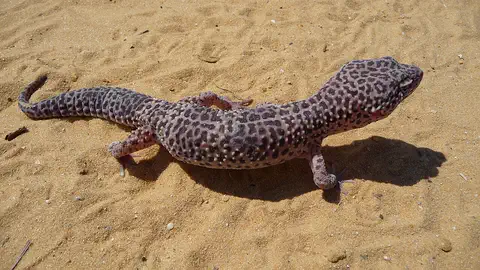
The leopard gecko is a spotted lizard from the rocky deserts and dry grasslands of Pakistan, Afghanistan, northwestern India and Nepal. It hunts insects and scorpions at night, stores fat in its thick tail, and has real eyelids. It is also one of the most popular pet lizards in the world.
-
 Watch
 Country
Australia
Australia is a country and the smallest continent, surrounded by ocean in the Southern Hemisphere. Much of its middle is dry and flat, most people live near the coast, and its animals include kangaroos, koalas and the platypus, a mammal that lays eggs.
-
 Watch
Animal
Emu
The emu is Australia's tallest native bird and the second-largest bird in the world, after the ostrich. It cannot fly, but it can sprint at about 48 kilometers an hour. Emus are famous fathers: the male sits on the eggs for about eight weeks without eating, then looks after the striped chicks.
-
 Watch
Animal
Aldabra giant tortoise
The Aldabra giant tortoise is one of the largest land tortoises on Earth. Wild ones live on Aldabra Atoll, a ring of coral islands in the Indian Ocean, where more than 100,000 of them graze, browse and shape the land like elephants do in Africa. They can live for more than 100 years.
-
 Watch
Animal
Alligator snapping turtle
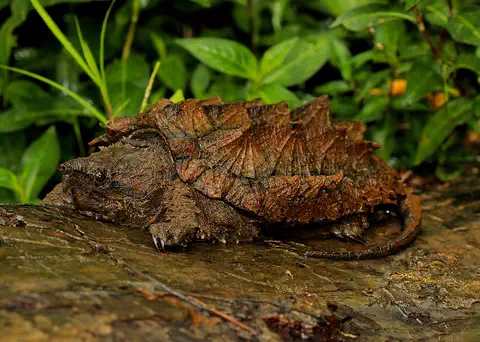
The alligator snapping turtle is the largest freshwater turtle in the United States. It lies still on the bottom of rivers and lakes with its mouth open, wiggling a worm-like lure on its tongue to trick fish into swimming close. Its numbers have fallen, and it is now endangered.
-
 Watch
3D
Animal
American alligator
The American alligator is a large, armored reptile of the swamps, marshes and lakes of the southeastern United States. Alligator mothers guard their nests and carry their babies to the water, and the holes alligators dig help many other animals survive dry seasons.
For parents & teachers
What children will learn
- Describe how the central bearded dragon uses its beard, mouth and spines in display.
- Explain how bearded dragons communicate with head bobs, arm waves and color.
- Describe its omnivorous diet and its life cycle.
- Understand the difference between wild animals and captive-bred pets, and why wild collection is banned.
Recommended ages: 3 to 17 · About 15 minutes
Talk about it
- How do people use body language, like waving or nodding, the way bearded dragons do?
- Why might it be important that pet reptiles are bred by people instead of taken from the wild?
- How could the temperature of a nest matter for a whole population of lizards?
Try at home or in class
- Play a silent signals game: agree on head-bob and arm-wave signals with a friend, then have a whole conversation without words.
- Measure 55 centimeters with a tape measure, then mark the halfway point to see how much of a bearded dragon is tail.
Key vocabulary: omnivore, beard, bask, brumation, clutch, captive-bred
Where these facts come from
- The IUCN Red List of Threatened Species , International Union for Conservation of Nature (IUCN terms of use (no redistribution of Red List data or range maps))
- GBIF Backbone Taxonomy and GBIF Occurrence Search , Global Biodiversity Information Facility (CC0 1.0 (backbone); occurrence counts are facts derived from records under CC0, CC BY and CC BY-NC)
- Pogona vitticeps (Central Bearded Dragon), global Red List assessment 2018 , IUCN Red List of Threatened Species
- Central Bearded Dragon , Australian Museum
- Central Bearded Dragon , Cosley Zoo (Wheaton Park District, AZA-accredited)
- Pogona vitticeps (Central Bearded Dragon) , Animal Diversity Web, University of Michigan Museum of Zoology
- Wikidata , Wikimedia Foundation (CC0 1.0)
- Wikimedia Commons , Wikimedia Foundation (Per file: Public domain, CC0, CC BY or CC BY-SA only (credited on each page))
Checked, not yet human-reviewed. Last updated October 27, 2026. Spotted a mistake? Tell us.