Animal
Giant tube worm
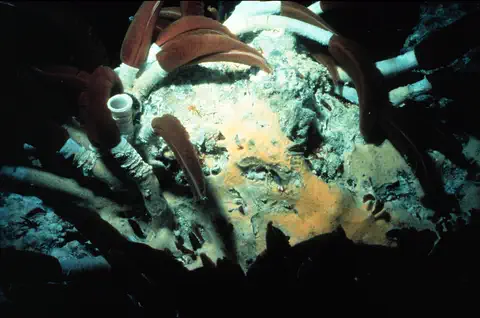
The giant tube worm lives at the bottom of the deep, dark sea. It has a white tube and a bright red top like a paintbrush.
The giant tube worm lives more than a mile deep in the Pacific Ocean, beside hot springs in the seafloor called hydrothermal vents. It has no mouth and no stomach. Instead, billions of bacteria living inside its body make its food from chemicals in the vent water.
Riftia pachyptila is a siboglinid tubeworm of eastern Pacific hydrothermal vents. Adults lack a mouth and gut and depend entirely on sulfur-oxidizing bacteria in an internal organ, the trophosome, which fix carbon by chemosynthesis. Its discovery in 1977 helped show scientists that life can thrive without sunlight.
Photo: C. Van Dover (OAR/National Undersea Research Program (NURP); College of William & Mary), public domain, via Wikimedia Commons
Meet the giant tube worm
The giant tube worm lives deep, deep down in the sea.
It is very dark there. The worm lives in a long white tube. Its top is bright red and feathery.
The giant tube worm is no ordinary worm. It lives in a tall white tube on the deep seafloor, and it has a bright red, feathery plume on top, like a giant paintbrush.
It has no mouth, no eyes and no stomach. So how does it eat? Tiny living things called bacteria live inside its body and make food for it. Scientists first found these worms in 1977, and they were amazed that so much life could grow where sunlight never reaches.
Riftia pachyptila is an annelid worm in the family Siboglinidae. When scientists found lush thickets of 6-foot-tall, red-tipped tubeworms on the seafloor in 1977, the Woods Hole Oceanographic Institution recalls, they realized that life could thrive without sunlight in extreme environments.
The adult has no mouth, digestive tract or anus. Its nutrition comes from symbiotic bacteria housed in an organ called the trophosome, which turn carbon dioxide into organic carbon using chemical energy, much as chloroplasts make food for plants using the Sun's energy.
Quick facts
- Group
- Invertebrate
- Length
- up to 1.5 m
Where it lives
Giant tube worms live in the Pacific Ocean.
They live next to hot springs on the bottom of the sea. Hot water full of minerals comes up through cracks there.
Giant tube worms live near hydrothermal vents on the floor of the Pacific Ocean, more than a mile below the surface. A hydrothermal vent is a hot spring on the seafloor. NOAA explains that seawater sinks into cracks near underwater volcanoes, gets heated by hot magma, and comes back up, sometimes hotter than 700 degrees Fahrenheit.
The water does not boil, because the weight of the deep ocean above presses down so hard. The worms need both kinds of water: oxygen from the cold seawater and chemicals from the vent water.
Riftia lives in sulfide-rich water at hydrothermal vents in the eastern Pacific, including the East Pacific Rise, more than a mile deep (Animal Diversity Web); studies of its young at the East Pacific Rise worked at about 2,500 meters. Vents were discovered in 1977 on a spreading ridge near the Galápagos Islands.
NOAA describes vents as forming where seawater percolates down through fissures near spreading centers or subduction zones, is heated by magma and reemerges, at times above 700 °F, kept from boiling by the extreme pressure. Around the vents, the hot fluid meets near-freezing seawater.
Its habitat

Where can you find this animal?
- Lives here naturally · Countries and seas named by a scientific source
- Sightings recorded · Records of wild sightings (GBIF)
Lives here naturally · Countries and seas named by a scientific source
Hydrothermal vents on the deep floor of the eastern Pacific Ocean: the East Pacific Rise, more than a mile deep (Animal Diversity Web), and the Galápagos Rift, where NOAA saw Riftia in 2011. The whole Pacific is shaded, but the worm lives only at scattered vents in its eastern part.
Places: Pacific Ocean.
Source: https://animaldiversity.org/accounts/Riftia_pachyptila/ · checked October 2026
Sightings recorded · Records of wild sightings (GBIF)
Counts of GBIF records of wild observations (human and machine) and preserved specimens. Records include introduced populations, vagrants, escaped or released animals and misidentifications, so a country with records is not necessarily part of the native range.
Wild sightings have been recorded in Mexico, Ecuador, United States, Portugal, Pacific Ocean, Atlantic Ocean, Southern Ocean, Arctic Ocean and 1 more places.
Source: gbif · checked October 2026
Range maps show where scientists say an animal lives, often country by country. An animal may live in only part of a country shown, and sightings records can include animals that wandered far from home.
How it eats without a mouth
The giant tube worm has no mouth!
Tiny living things called bacteria live inside it. They make food for the worm, and the worm gives them a safe home.
Plants make food using sunlight. That is called photosynthesis. But there is no sunlight at the bottom of the deep sea. Instead, bacteria use chemosynthesis: they make food using energy from chemicals in the vent water.
Billions of these bacteria live in a sack inside the giant tube worm called the trophosome. The worm's red plume collects the chemicals the bacteria need, and the bacteria make food for the worm. Both partners win. This kind of partnership is called symbiosis.
Riftia is an obligate symbiont host. Its red plume works as a gill, absorbing oxygen from seawater and hydrogen sulfide from vent fluid. A special hemoglobin in the worm's blood can carry oxygen and sulfide at the same time, delivering both to the trophosome (WHOI).
There, bacteria oxidize the hydrogen sulfide for energy and fix carbon dioxide into organic carbon. A study reported by WHOI found that these symbionts can switch between two carbon-fixing pathways, the Calvin cycle and the reductive tricarboxylic acid cycle, or use both at once, which suits the rapidly changing chemistry at vents. NOAA notes that chemosynthetic bacteria and archaea form the base of the whole vent food web.
Did you know?
Baby tube worms do have a mouth, but it goes away.
Young giant tube worms are born with a mouth and gut. Once their bacteria move in, the mouth disappears.
Larvae hatch bacteria-free with a complete digestive system; after symbionts infect them through the skin, the mouth disappears and the gut shrinks away (Nussbaumer, Fisher and Bright, 2006).
An amazing body
The worm's red top is called a plume.
It is red because it is full of blood. The white tube keeps the worm's soft body safe.
The bright red plume at the top is the worm's gill. It is red because it is full of a special kind of hemoglobin, the same kind of chemical that makes your blood red. It soaks up oxygen from the seawater and the chemicals the bacteria need from the vent water.
Below the plume, the worm's soft body hides inside a tough white tube. The body itself has no color. Inside it is the trophosome, a large sack full of the bacteria that feed the worm.
The plume owes its red color to hemoglobin. Unlike human hemoglobin, which carries only oxygen, Riftia's can bind oxygen and sulfide at the same time (WHOI), so the plume can gather both of the bacteria's raw materials.
The rest of the body stays inside a tough tube, which the Animal Diversity Web describes as made of chitin and growing to over 3 meters, although NOAA describes a full-size worm as almost five feet long. Inside the tube the body is colorless and holds, along with the worm's other organs, a large sack called the trophosome that contains billions of symbiotic bacteria.
Growing up
A baby tube worm is very, very tiny.
It is born with a mouth! It swims to a vent and settles down. Then the bacteria move in, and its mouth goes away.
Giant tube worms start life as tiny larvae, only about 200 micrometers (0.2 millimeters) long. A larva has a mouth and a gut, and no bacteria at all.
It drifts until it finds a vent, then settles on the rock. In 2006 scientists showed that the right bacteria then enter the young worm through its skin. As the trophosome grows, its mouth and gut disappear. After that, giant tube worms grow fast: NOAA says they can reach full size, almost five feet, in less than two years.
Females release eggs and males release sperm bundles into the water, where fertilization takes place (Animal Diversity Web). Larvae, about 200 micrometers long, are born free of bacteria with a complete digestive system. They drift, then settle on rock near a vent when they detect the right chemicals.
For decades scientists assumed larvae swallowed their symbionts. In 2006 Nussbaumer, Fisher and Bright showed instead that the bacteria infect settled larvae through the skin and migrate to tissue that becomes the trophosome; the mouth disappears and the gut shrinks away. Larvae that fail to acquire the symbiont die. Growth is then rapid: WHOI reports about 80 centimeters of new tube a year, and NOAA says full size comes in under two years.
Life at a vent
Giant tube worms live in big groups.
They stand close together like a forest of red flowers. Crabs, mussels and other animals live near them.
Giant tube worms never leave their tubes. They grow in thick clumps around a vent, like a forest of red-tipped stalks. When scientists first saw them in 1977, they found lush thickets of worms about 6 feet tall.
Many other animals share the vents with them. On a NOAA expedition to the Galápagos Rift in 2011, scientists saw deep-sea mussels, feather duster worms, other kinds of tube worms and vent crabs living together. NOAA says chemosynthetic bacteria are the base of the whole vent food web.
Adults stand rooted to one spot (Penn State) in dense thickets (WHOI). The flow of vent fluid around them changes quickly, and WHOI microbiologist Stefan Sievert described the symbionts' ability to switch carbon-fixation pathways as an asset in habitats that depend on such fluctuating flows.
A 2011 NOAA Okeanos Explorer expedition to the Galápagos Rift recorded Riftia alongside Bathymodiolus mussels, which are often the first animals to colonize a vent, serpulid feather duster worms, Tevnia tubeworms and vent crabs, which NOAA calls the top predator of the vent community. Fresh lava flows were also seen, a reminder that vent habitats change over time.
Did you know?
A giant tube worm has no mouth and no tummy!
An adult giant tube worm has no mouth, no eyes and no stomach. Bacteria inside it make all its food.
Adults lack a mouth, digestive tract and anus, relying entirely on symbiotic bacteria in the trophosome for nutrition.
A world we are still exploring
Giant tube worms live so deep that few people have ever seen them.
Scientists visit them in special submarines. There is still a lot to learn.
The giant tube worm has not been assessed by the IUCN Red List, so it has no official status. It lives so deep that people can only visit it in special research submarines, such as the deep-sea vehicle Alvin.
Scientists are still learning about it. When the Woods Hole Oceanographic Institution reported on the worm's bacteria, no one had been able to grow them in a laboratory, because life at a vent is so hard to copy. NOAA says the seafloor at the vents keeps changing, so there is always more to learn.
No IUCN Red List assessment exists for Riftia pachyptila. Vent habitats are naturally unstable: lava flows reshape the seafloor, and NOAA's 2011 expedition saw fresh flows at the Galápagos Rift.
Much of its biology is still being worked out. According to WHOI's report, the vent environment is so hard to imitate in laboratories that the symbiotic bacteria had never been cultured, so scientists studied them through their genomes and proteins instead. To collect young worms for the 2006 skin-infection study, researchers left settlement traps on the seafloor at 2,500 meters and returned with the submersible Alvin the next season.
Did you know?
A giant tube worm can grow almost as tall as a grown-up in less than two years.
NOAA says giant tube worms can reach their full size of almost five feet in less than two years.
WHOI reports roughly 80 centimeters of new tube a year, and NOAA gives full size, almost five feet, in under two years.
Amazing facts
-
A giant tube worm has no mouth and no tummy!
An adult giant tube worm has no mouth, no eyes and no stomach. Bacteria inside it make all its food.
Adults lack a mouth, digestive tract and anus, relying entirely on symbiotic bacteria in the trophosome for nutrition.
-
Baby tube worms do have a mouth, but it goes away.
Young giant tube worms are born with a mouth and gut. Once their bacteria move in, the mouth disappears.
Larvae hatch bacteria-free with a complete digestive system; after symbionts infect them through the skin, the mouth disappears and the gut shrinks away (Nussbaumer, Fisher and Bright, 2006).
-
A giant tube worm can grow almost as tall as a grown-up in less than two years.
NOAA says giant tube worms can reach their full size of almost five feet in less than two years.
WHOI reports roughly 80 centimeters of new tube a year, and NOAA gives full size, almost five feet, in under two years.
-
The worm's red top gets its color from blood.
The plume is red because of hemoglobin, the same kind of chemical that makes your blood red.
Riftia hemoglobin can bind oxygen and sulfide at the same time, whereas human hemoglobin carries only oxygen.
Words to know
- hydrothermal vent
- a hot spring on the seafloor where heated, mineral-rich water comes out
- chemosynthesis
- making food using energy from chemicals instead of sunlight
- bacteria
- tiny living things made of just one cell
- symbiosis
- two different living things living closely together, often helping each other
- trophosome
- the organ inside a giant tube worm that holds its food-making bacteria
- hemoglobin
- a red substance in blood that carries oxygen
Discovery challenge
-
How does a giant tube worm get its food?
How does a giant tube worm get its food?
What supplies an adult Riftia with its nutrition?
- It catches fish with its mouth
- Bacteria inside it make food
- It eats plants on the seafloor
Show the answer
Bacteria inside it make food
It has no mouth. Bacteria inside it make its food.
Bacteria living in its trophosome make food from chemicals in the vent water.
Symbiotic bacteria in the trophosome oxidize hydrogen sulfide and fix carbon dioxide into organic carbon.
-
Where do giant tube worms live?
Where do giant tube worms live?
Which habitat does Riftia pachyptila occupy?
- In ponds and lakes
- At hot springs on the deep seafloor
- In soil in a garden
Show the answer
At hot springs on the deep seafloor
They live next to hot springs deep in the sea.
They live at hydrothermal vents more than a mile deep in the Pacific Ocean.
Sulfide-rich hydrothermal vents of the eastern Pacific, such as the East Pacific Rise.
-
What makes the worm's top red?
What makes the giant tube worm's plume red?
Which molecule gives the plume its red color and carries oxygen and sulfide?
- Hemoglobin, like in blood
- Red paint
- Red sand
Show the answer
Hemoglobin, like in blood
It is red because it is full of blood.
Hemoglobin, the same kind of chemical that makes your blood red, colors the plume.
Riftia hemoglobin binds oxygen and sulfide simultaneously and delivers both to the symbionts.
-
What does a baby tube worm have that a grown-up one does not?
What does a young giant tube worm have that an adult does not?
Which structure do Riftia larvae have that adults lack?
- A red plume
- A mouth and gut
- A white tube
Show the answer
A mouth and gut
Babies have a mouth. It goes away when they grow up.
Larvae have a mouth and gut, which disappear once the bacteria move in.
Larvae have a complete digestive system; after symbionts enter through the skin, the mouth disappears and the gut shrinks away.
Places where you might see it
Explore next
-
 Watch
3D
Animal
Giant isopod
The giant isopod is a deep-sea relative of the pill bugs and sowbugs you find under garden stones, but it can grow to about 50 centimeters long. It crawls over the dark sea floor of the western Atlantic, cleaning up dead fish, squid and other food that sinks from above.
-
 Watch
Animal
Christmas tree worm
The Christmas tree worm is a small sea worm that lives in a tube inside living coral on Caribbean reefs. Only its two colorful, spiral crowns show. They catch tiny floating food and help it breathe, and the worm pulls them in with a flash if anything comes too close.
-
 Watch
 Country
Ecuador
Ecuador is a country in northwestern South America, named after the equator, which crosses it. In a small space it holds Pacific beaches, high snowy volcanoes of the Andes, part of the Amazon rainforest and the Galápagos Islands, whose wildlife helped Charles Darwin develop his ideas.
-
 Watch
Animal
American lobster
The American lobster is a big crustacean that lives on the rocky sea floor of the northwest Atlantic Ocean. It has two very different claws, one for crushing and one for tearing, and it must climb out of its hard shell again and again to grow.
-
 Watch
3D
Animal
Antarctic krill
Antarctic krill are small, shrimp-like crustaceans about 6 centimeters long that live in the icy Southern Ocean around Antarctica. They gather in enormous swarms, and almost all the bigger animals of the Antarctic, from penguins to blue whales, depend on them for food.
-
 Watch
Animal
Army ant
Army ants hunt together in giant swarms and never build a permanent nest. This page is about the best-studied kind, Eciton burchellii, of Central and South American forests. Each night of its traveling phase the colony moves, and the workers link their legs to build a living camp around their queen and young.
-
 Watch
3D
Animal
Atlantic blue crab
The Atlantic blue crab is a swimming crab with bright blue claws and back legs shaped like paddles. It lives along the Atlantic coast of the Americas, especially in bays where rivers meet the sea, like the Chesapeake Bay. A mother crab carries up to two million eggs in a spongy orange mass under her body.
-
 Watch
3D
Animal
Atlantic ghost crab
The Atlantic ghost crab is a sand-colored crab of beaches along the Atlantic coast of the Americas. It is so pale that it almost disappears on the sand, like a ghost. It digs deep burrows, comes out mostly at night, and runs very fast on its long legs.
For parents & teachers
What children will learn
- Explain what a hydrothermal vent is and why the water there does not boil.
- Compare photosynthesis and chemosynthesis as two ways living things make food.
- Describe the partnership (symbiosis) between the giant tube worm and its bacteria.
- Describe the worm's life cycle, from a larva with a mouth to a mouthless adult.
Recommended ages: 3 to 17 · About 15 minutes
Talk about it
- Why was finding life at hydrothermal vents such a big surprise for scientists?
- How do the worm and its bacteria each benefit from living together?
- What other partnerships between living things can you think of?
Try at home or in class
- Measure 1.5 meters (almost five feet) up a wall with tape and stand beside it: that is a full-size giant tube worm.
- Make a tube worm from a white paper-towel tube and red tissue paper, then label its plume, tube and trophosome.
Key vocabulary: hydrothermal vent, chemosynthesis, bacteria, symbiosis, trophosome, hemoglobin
Where these facts come from
- GBIF Backbone Taxonomy and GBIF Occurrence Search , Global Biodiversity Information Facility (CC0 1.0 (backbone); occurrence counts are facts derived from records under CC0, CC BY and CC BY-NC)
- Wikimedia Commons , Wikimedia Foundation (Per file: Public domain, CC0, CC BY or CC BY-SA only (credited on each page))
- The Depths Below: Life on a Vent (video transcript) , NOAA Ocean Today
- What is a hydrothermal vent? , NOAA National Ocean Service
- Deep-sea Tubeworms Get Versatile 'Inside' Help , Woods Hole Oceanographic Institution (Oceanus)
- Giant Deep-Sea Tubeworm's Meal Ticket Comes in as a Skin Infection (2006) , Penn State Eberly College of Science
- Riftia pachyptila , Animal Diversity Web, University of Michigan Museum of Zoology
- Hydrothermal Vent Creatures (read via the Wayback Machine, snapshot of 14 Oct 2026) , Smithsonian Ocean
- Wikidata , Wikimedia Foundation (CC0 1.0)
Checked, not yet human-reviewed. Last updated October 27, 2026. Spotted a mistake? Tell us.
Picture credits
- Photo: C. Van Dover (OAR/National Undersea Research Program (NURP); College of William & Mary), public domain, via Wikimedia Commons · source