
Animal
Great cormorant
The great cormorant is a big black water bird. It dives under the water to catch fish. Then it often stands with its wings spread out to dry.
The great cormorant lives on coasts, lakes and rivers on every continent except South America and Antarctica. It dives underwater to catch fish, usually not far below the surface. Afterward it often stands with its wings held out to dry, and in the breeding season adults grow white patches near the bill and on the thighs.
Phalacrocorax carbo is a widespread, mostly fish-eating diving bird of coasts and inland wetlands across Europe, Africa, Asia, Australia and north-eastern North America. BirdLife International assessed it as Least Concern for the IUCN Red List (assessed 2018, published 2019 as an amended version), with about 1.4 to 2.1 million individuals (Wetlands International 2015) and an increasing trend. In the UK, its spread to inland waters has brought it into conflict with commercial fisheries and anglers (BTO).
Photo: JJ Harrison (https://www.jjharrison.com.au/), CC BY-SA 3.0, via Wikimedia Commons
Meet the great cormorant
The great cormorant is a big black bird.
It has a yellow patch on its face and a thick beak.
The great cormorant is a large, bulky water bird, 84 centimeters to 1 meter long, with a big head and a thick bill. Its wings spread 1.3 to 1.6 meters. The RSPB says its reptile-like neck gives it an almost prehistoric look.
An adult is black, with bare yellow skin on its face and a broad white band across its throat. In the breeding season it also grows white patches near the bill and on its thighs. Males and females look alike, though males are slightly larger.
Kenn Kaufman's account on Audubon's guide (1996) gives a length of 84 centimeters to 1 meter, a wingspan of 1.3 to 1.6 meters and a weight of 2.2 to 4 kilograms, with the male slightly larger; the BTO gives a typical weight of 2.3 kilograms. The bird is large and bulky, with a relatively short tail, a big head and a thick bill.
Adults have a broad white band across the throat behind bare yellow facial skin and, in the breeding season, white patches on the flanks or thighs (Audubon guide; RSPB). Immatures are brownish at first, usually with a brown neck and chest and a white belly. The throat pouch is dull yellow. The RSPB describes a 'reptilian' neck that gives the bird an almost prehistoric appearance.
Quick facts
- Group
- Bird
- Length
- 0.84 to 1 m
- Wingspan
- 1.3 to 1.6 m
- Weight
- 2.2 to 4 kg
- Lifespan in the wild
- 11 to 21.5 years
Coasts, lakes and rivers
Great cormorants live by the sea and by lakes and rivers.
They live in many parts of the world.
Great cormorants live on every continent except South America and Antarctica. They are found on sheltered coasts, estuaries and lagoons, and also far inland on lakes, reservoirs, wide rivers and swamps. They usually stay out of deep water and rarely go far out to sea.
In North America they nest only in the north-east, and also in western Greenland, while in Europe, Africa, Asia and Australia they are widespread. Birds in the north migrate, while many others stay in the same area all year.
The IUCN describes an extremely large range on every continent except South America and Antarctica: north-eastern North America (wintering south to the tip of Florida) and western Greenland; most of Europe's Atlantic coast, the Mediterranean and much of eastern Europe; Africa's north-west coast, pockets of central-east Africa and South Africa; patches across central Asia to eastern China, with India and southern China year-round and wintering in south-east Asia; and most of Australia except the center, wintering in New Zealand.
It uses sheltered coasts, estuaries, saltpans, lagoons, mangroves and deltas, and inland lakes, reservoirs, wide rivers, floodwaters and swamps, generally avoiding deep water. Most populations are sedentary or wander locally, while northern populations migrate (del Hoyo et al. 1992).
Continents
Its habitat

Where can you find this animal?
- Lives here naturally · Countries and seas named by a scientific source
- Sightings recorded · Records of wild sightings (GBIF)
- Visits for part of the year · Countries and seas named by a scientific source
Lives here naturally · Countries and seas named by a scientific source
Sheltered coasts, estuaries, lakes, reservoirs, rivers and swamps across Europe, Africa, Asia and Australia, and on the north-east coast of North America and in western Greenland. Some small islands and territories, including Bermuda and Saint Pierre and Miquelon, are also in the range but have no separate map shape.
Places: Canada, United States, Greenland, Iceland, UK, Ireland, Norway, Sweden and 99 more places.
Source: iucn-red-list · checked October 2026
Sightings recorded · Records of wild sightings (GBIF)
Counts of GBIF records of wild observations (human and machine) and preserved specimens. Records include introduced populations, vagrants, escaped or released animals and misidentifications, so a country with records is not necessarily part of the native range.
Wild sightings have been recorded in Sweden, UK, Netherlands, Denmark, France, Norway, Spain, Australia and 127 more places.
Source: gbif · checked October 2026
Visits for part of the year · Countries and seas named by a scientific source
Places where the IUCN lists great cormorants only outside the breeding season, from Portugal and North Africa to the Arabian Peninsula, South Asia and South-East Asia. The Faroe Islands, Gibraltar, Malta, Bahrain and Hong Kong are also listed but have no separate map shape.
Places: Portugal, Slovenia, Algeria, Tunisia, Saudi Arabia, Yemen, Oman, UAE and 10 more places.
Source: iucn-red-list · checked October 2026
Range maps show where scientists say an animal lives, often country by country. An animal may live in only part of a country shown, and sightings records can include animals that wandered far from home.
An underwater fisher
Great cormorants eat fish.
They dive under the water to catch them.
Great cormorants eat almost entirely fish, with some crustaceans (the group that includes crabs and shrimp), worms and other small animals. One study found them eating at least 22 kinds of fish. At sea they mostly catch fish that live near the bottom.
A cormorant dives underwater to catch fish. Most of its fishing happens within about 3 meters of the surface, but it can go much deeper. It fishes only in daylight, usually alone, though in some places large fishing flocks gather.
The IUCN lists a mainly fish diet, including sculpins, capelin, cod-family fish and flatfish, with crustaceans, amphibians, molluscs and nestling birds; at sea it takes mostly bottom-dwelling fish, and one study recorded at least 22 fish species (Gremillet 1997). Feeding is exclusively by day, usually alone, though large fishing flocks form in some areas.
Diving depths differ by source: Audubon's account (Kaufman 1996) puts most foraging within 3 meters (10 feet) of the surface, with dives to 9 meters (30 feet), while the IUCN says birds rarely dive below 10 meters but have been recorded at 35 meters. Most foraging trips stay within 10 kilometers of the colony, with some up to 35 kilometers (IUCN).
Did you know?
One cormorant lived to be 21 years old.
The BTO's record for a ringed great cormorant is 21 years and 6 months.
BTO longevity record: 21 years, 6 months and 21 days (set in 1984).
Wings out to dry
After fishing, a cormorant often stands with its wings spread out.
This helps its wings dry.
A great cormorant is often seen in one pose: standing with its wings held out to dry. The RSPB explains that its feathers are not waterproof. Wet feathers make the bird less floaty, which helps it move quickly underwater.
Great cormorants and the slender shag can look alike, but the RSPB notes that the cormorant is stockier and, in the breeding season, has white patches near its bill and on its thighs.
The RSPB describes great cormorants as often standing with their wings held out to dry, and notes that, although they are agile underwater hunters, their feathers are not waterproof: wet feathers reduce buoyancy and help them move quicker underwater. It separates them from the similar European shag by their stockier build and, in the breeding season, white patches at the bill base and on the thighs; the shag is slender, sea-faring and wears a crest in the breeding season.
Audubon's guide describes broad, rounded wings. Its account notes that immatures resemble North America's double-crested cormorant but usually have a brown neck and chest contrasting with a white belly, and a dull yellow, not orange, throat pouch.
Nests of sticks and seaweed
Great cormorants build nests of sticks and seaweed.
The mother lays three or four pale eggs.
Great cormorants nest in colonies, often with other kinds of birds. On coasts they nest on cliffs, rocky islands and stacks; inland they nest in trees, bushes or reedbeds. The nest is a pile of sticks, reeds or seaweed, and the same sites are often used year after year.
The female usually lays 3 to 5 pale blue-green eggs, and both parents keep them warm for 28 to 31 days. The chicks first fly at about 50 days old, but may come back to be fed for another 40 to 50 days.
Breeding happens all year in some places, with the rains in the tropics, and peaks from April to June in the temperate Northern Hemisphere (IUCN). Colonies hold 10 to 500 pairs, occasionally up to 1,000, often with other species. Nests range from a depression to a platform of sticks, reeds and seaweed, on cliffs, islands, stacks, boulders and sometimes artificial structures, or inland in trees, bushes, reedbeds or on bare ground; the female does most of the building with material the male brings (Audubon guide).
The BTO gives a typical clutch of 3 to 4 eggs (3 to 6 observed), each about 58 grams; Audubon's account gives 3 to 5, rarely 1 to 6, pale blue-green. Both sexes incubate for 28 to 31 days; chicks fledge at 48 to 52 days (BTO) or first fly at about 50 days (Audubon guide). First breeding is typically at 3 years (BTO) or 4 to 5 years (Audubon guide). The BTO gives a typical life expectancy of 11 years; the oldest ringed bird lived 21 years and 6 months.
Wing-waving and neck-twisting
A male cormorant waves his wings to show off to a female.
Partners twist their necks together at the nest.
In the breeding season a male picks a nest site and tries to attract a female by waving his wings up and down, showing off white patches on his body. Once paired, the two birds greet each other at the nest by twisting and winding their necks together.
Cormorants also gather to rest together at regular roosting sites, near their nests or near good fishing places. They make deep, throaty grunts.
The male chooses the nest site and displays to attract a female by waving his wings up and down and flashing white rump patches; paired birds display at the nest by writhing and intertwining their necks (Audubon guide, Kaufman 1996). The call is a deep guttural grunt.
The species roosts communally at nesting sites or major feeding areas and flies in flocks of varying size; flocks of up to 890 birds were counted off eastern Jutland and Læsø, Denmark (Petersen et al. 2003, cited by the IUCN). The BTO notes that some individuals are remarkably faithful to their roosts over time.
Did you know?
Cormorant partners twist their necks together.
When a pair meets at the nest, the two birds twist and wind their necks around each other.
Paired birds display at the nest by writhing and intertwining their necks (Audubon guide, Kaufman 1996).
A bird that has done well
There are lots of great cormorants.
In some places there are more now than before.
The great cormorant is listed as least concern, and its numbers have been increasing. In the UK, cormorants nested almost only on the coast until 1981, but they have since set up colonies in many inland areas of England. The number spending the winter in the UK grew by 46% from 1998 to 2023.
Because cormorants are expert fishers, they can come into conflict with people who fish, and in the past they were persecuted. Cormorants can also get caught by accident in fishing nets.
BirdLife International assessed Phalacrocorax carbo as Least Concern for the IUCN Red List (assessed 9 August 2018, published 2019 as an amended version): an extremely large range, about 1.4 to 2.1 million individuals worldwide (Wetlands International 2015), 401,000 to 512,000 pairs in Europe (2015), and an increasing trend. Because it dives in shallow water and hunts inside purse-seine and gill nets, it is particularly prone to bycatch, though this is not currently found to be driving colony declines (IUCN).
In the UK, the BTO reports that inland colonies spread after 1981, thought to have been sparked by the continental race sinensis from the Netherlands and Denmark, with 2,362 inland pairs in 2012; the wintering population rose 46% from 1998 to 2023, while monitored breeding numbers are similar to 1986 with falling productivity. The expansion has caused conflict with commercial fisheries and anglers, and the RSPB notes past persecution. In North America, Audubon's account (1996) describes a great increase and a breeding range spreading south into New England.
IUCN Red List
How is the great cormorant doing in the wild?
- Least Concern (this animal)
- Near Threatened
- Vulnerable
- Endangered
- Critically Endangered
- Extinct in the Wild
- Extinct
Least Concern
Not at risk of disappearing from the wild right now.
Amazing facts
-
Cormorants stand with their wings spread out to dry.
Great cormorants are often seen standing with their wings held out to dry.
Often seen standing with its wings held out to dry (RSPB).
-
Cormorant partners twist their necks together.
When a pair meets at the nest, the two birds twist and wind their necks around each other.
Paired birds display at the nest by writhing and intertwining their necks (Audubon guide, Kaufman 1996).
-
One cormorant lived to be 21 years old.
The BTO's record for a ringed great cormorant is 21 years and 6 months.
BTO longevity record: 21 years, 6 months and 21 days (set in 1984).
-
Young cormorants are brown, not black.
Young great cormorants are brownish, with a brown neck and chest and a white belly.
Immatures are brownish, with brown neck and chest contrasting with a white belly (Audubon guide).
Words to know
- colony
- a large group of birds nesting close together
- roost
- a place where birds rest or sleep
- estuary
- the wide part of a river where it meets the sea, and fresh and salt water mix
- bycatch
- animals caught by accident in fishing nets or on fishing lines
- regurgitate
- to bring swallowed food back up, as cormorant parents do to feed their chicks
- immature
- a young bird that is not yet an adult
Discovery challenge
-
What does a cormorant often do after fishing?
Which pose is a great cormorant often seen in?
Which posture does the RSPB give as a typical sight of the great cormorant?
- It stands with its wings held out to dry
- It hangs upside down from a branch
- It buries itself in the sand
Show the answer
It stands with its wings held out to dry
It spreads its wings out to dry.
It stands with its wings held out to dry.
Standing with wings held out to dry (RSPB).
-
What do great cormorants mostly eat?
What makes up most of a great cormorant's diet?
Which food group dominates the diet of Phalacrocorax carbo?
- Fish
- Seeds
- Fruit
Show the answer
Fish
Fish! They swim after them underwater.
Fish, almost entirely, with a few crustaceans and worms.
Predominantly fish, with crustaceans, amphibians, molluscs and nestling birds (IUCN); one study recorded at least 22 fish species.
-
Which continent has no great cormorants?
On which of these continents do great cormorants NOT live?
Which continent lies outside the range of Phalacrocorax carbo?
- South America
- Europe
- Australia
Show the answer
South America
South America. (Antarctica has none either.)
South America: they live on every continent except South America and Antarctica.
South America (and Antarctica) (IUCN).
-
What color is the skin on a great cormorant's face?
What color is the bare skin on an adult great cormorant's face?
What color is the bare facial skin of an adult Phalacrocorax carbo?
- Yellow
- Blue
- Red
Show the answer
Yellow
Yellow.
Yellow, with a white band across the throat behind it.
Yellow, behind which runs a broad white throat band (Audubon guide).
Places where you might see it
-
 Watch
 Country
United Kingdom
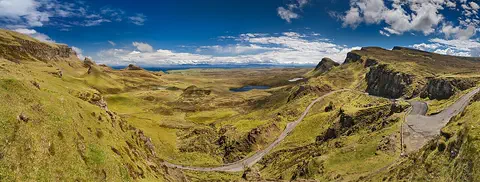
The United Kingdom, or UK, lies on islands off the northwest coast of Europe. It is made up of four parts, England, Scotland, Wales and Northern Ireland, and about 69.5 million people live there. Its capital is London.
-
 Watch
 Country
Australia
Australia is a country and the smallest continent, surrounded by ocean in the Southern Hemisphere. Much of its middle is dry and flat, most people live near the coast, and its animals include kangaroos, koalas and the platypus, a mammal that lays eggs.
Explore next
-
 Watch
Animal
Northern gannet
The northern gannet is a large seabird of the North Atlantic Ocean, with wings that spread 1.7 to 2 meters. It catches fish by plunging headfirst into the sea, sometimes from more than 30 meters up. Gannets nest packed together in big colonies on sea cliffs and islands, and each pair raises just one chick a year.
-
 Watch
Animal
Great white pelican
The great white pelican is a huge water bird. It lives on large, warm, shallow lakes, rivers and deltas in Africa, south-east Europe and Asia. It has white feathers, black flight feathers on its wings and a long bill with a big yellow pouch underneath. Pelicans often fish together in a group, pushing fish into shallow water and scooping them up.
-
 Watch
Animal
Brown pelican
The brown pelican is a large coastal bird of the Americas with an enormous bill and a stretchy throat pouch. It catches fish by diving head-first into the sea from high in the air. Brown pelicans almost disappeared from North America because of pesticides such as DDT, but after DDT was banned they made a full comeback.
-
Watch
Country
United Kingdom
The United Kingdom, or UK, lies on islands off the northwest coast of Europe. It is made up of four parts, England, Scotland, Wales and Northern Ireland, and about 69.5 million people live there. Its capital is London.
-
Watch
Country
Australia
Australia is a country and the smallest continent, surrounded by ocean in the Southern Hemisphere. Much of its middle is dry and flat, most people live near the coast, and its animals include kangaroos, koalas and the platypus, a mammal that lays eggs.
-
 Watch
Animal
Adélie penguin
The Adélie penguin is a medium-sized penguin, about 70 centimeters tall, with a black back, a white front and a bright white ring around each eye. It breeds in summer on rocky, ice-free ground all around Antarctica, building nests of pebbles, and spends the winter far out at sea among the pack ice.
-
 Watch
Animal
African fish eagle
The African fish eagle is a big eagle of Africa's lakes, rivers and coasts, with a white head, chest and tail and a chestnut-brown body. It snatches fish from the surface of the water, and its loud, ringing call is one of the best-known sounds of Africa.
-
 Watch
Animal
African jacana
The African jacana is a chestnut-brown water bird with a white throat, a golden chest and a sky-blue patch on its forehead. Its very long toes spread its weight, so it can walk across water lilies and other floating plants. Unusually, the female leaves the eggs to a male, who keeps them warm and raises the chicks.
For parents & teachers
What children will learn
- Locate the continents where great cormorants live, and the two where they don't.
- Describe how a cormorant catches fish underwater.
- Describe the wing-drying pose and the breeding-season white patches.
- Discuss why a bird that catches fish can come into conflict with people who fish.
Recommended ages: 3 to 17 · About 15 minutes
Talk about it
- Why might a bird that dives underwater stand with its wings spread afterward?
- How could a coastal bird start nesting far inland?
- How could people who fish and cormorants share the same lakes?
Try at home or in class
- Measure out 1.6 meters with a tape measure to see how wide a great cormorant's wings can spread.
- Look for cormorants on a local river, lake or harbor and draw the pose you see most often.
Key vocabulary: colony, roost, estuary, bycatch, regurgitate, immature
Where these facts come from
- GBIF Backbone Taxonomy and GBIF Occurrence Search , Global Biodiversity Information Facility (CC0 1.0 (backbone); occurrence counts are facts derived from records under CC0, CC BY and CC BY-NC)
- Wikidata , Wikimedia Foundation (CC0 1.0)
- The IUCN Red List of Threatened Species , International Union for Conservation of Nature (IUCN terms of use (no redistribution of Red List data or range maps))
- Phalacrocorax carbo (BirdLife International, assessed 9 August 2018, published 2019 as an amended version) , IUCN Red List of Threatened Species
- Phalacrocorax carbo: range, population, ecology and threats text , IUCN Red List of Threatened Species
- Phalacrocorax carbo: IUCN Red List global assessment record (BirdLife International 2019), IUCN checklist on GBIF , GBIF
- Great Cormorant (guide text from Lives of North American Birds, Kenn Kaufman, 1996) , National Audubon Society
- Cormorant (BirdFacts) , British Trust for Ornithology (BTO)
- Cormorant: bird facts , RSPB
- File:Phalacrocorax carbo Vic.jpg (Australia, 5 February 2010, JJ Harrison) , Wikimedia Commons
- Wikimedia Commons , Wikimedia Foundation (Per file: Public domain, CC0, CC BY or CC BY-SA only (credited on each page))
Checked, not yet human-reviewed. Last updated November 1, 2026. Spotted a mistake? Tell us.