
Animal
Great horned owl
The great horned owl is a big brown owl with two feathery tufts on its head. It hoots in the night: hoo, hoo-hoo, hoo, hoo.
The great horned owl is a large, powerful owl with two long, earlike tufts of feathers on its head. It is one of the most common owls in North America and lives in almost any kind of semi-open place, from deserts and forests to city parks. It hunts mostly at night.
Bubo virginianus is one of the most common owls in North America and ranges from the northern tree line to South America. A predator with the most diverse diet of any North American raptor, it hunts with the help of soft, quiet plumage, large eyes with many rod cells and a facial disc that directs sound to its ears.
Photo: © Giles Laurent, gileslaurent.com, License CC BY-SA, CC BY-SA 4.0, via Wikimedia Commons
Meet the great horned owl
The great horned owl is a big, strong owl.
It has two pointy tufts of feathers on its head. They look like horns, but they are only feathers. It has big round eyes and soft, brown feathers.
The great horned owl is the owl many people picture from storybooks. It is big and thick-bodied, with mottled gray-brown feathers, a reddish-brown face, a white patch on its throat and big eyes.
The two 'horns' on its head are not horns or ears at all. They are long, earlike tufts of feathers. The owl hears with its ears, helped by feathers on its face that steer sounds toward them.
Bubo virginianus (family Strigidae) is a large, thick-bodied owl with two prominent feather tufts, broad, rounded wings and, in flight, a blunt-headed silhouette from its rounded head and short bill. Cornell describes it as mottled gray-brown with a reddish-brown face and a neat white throat patch.
Color varies across the range. Cornell notes that birds of the Pacific Northwest are dark and sooty, those of the Southwest paler and grayer, and some from subarctic Canada almost white. The owl in our photo was photographed in Encontro das Águas State Park, Brazil.
Quick facts
- Group
- Bird
- Length
- 0.46 to 0.63 m
- Wingspan
- 1.01 to 1.45 m
- Weight
- 0.91 to 2.5 kg
Where it lives
Great horned owls live in North America and South America.
They live in forests, deserts, fields and even city parks. They like places with trees and open spaces close together.
Great horned owls live from Alaska and northern Canada, all through the United States and Mexico, down into South America. They live in forests, swamps, deserts, grasslands, farms, backyards and cities.
What they like best is a mix: trees or cliffs for resting and nesting, next to open land such as fields or wetlands where they can hunt.
The IUCN's global assessment lists the species as resident in 21 countries from Canada to Argentina and Uruguay, with rare visitors farther afield. It occupies almost every semi-open habitat between the Arctic tree line and the tropics, from up to about 4,000 meters in the mountains down to sea level.
Typical home ranges combine woodland, used for roosting and nesting, with open habitat such as fields, pastures or wetlands for hunting. In deserts the owls use cliffs or junipers. They are fairly common in wooded parks, suburbs and cities, and they adapt well to habitat change as long as nest sites remain.
Continents
Its habitats


Where can you find this animal?
- Lives here naturally · Countries and seas named by a scientific source
- Sightings recorded · Records of wild sightings (GBIF)
Lives here naturally · Countries and seas named by a scientific source
Forests, deserts, grasslands, farmland and towns from Alaska and northern Canada through Central America to South America. French Guiana (part of France on this map) is also in the range.
Places: Argentina, Bolivia, Brazil, Belize, Canada, Colombia, Costa Rica, Ecuador and 12 more places.
Source: iucn-red-list · checked October 2026
Sightings recorded · Records of wild sightings (GBIF)
Counts of GBIF records of wild observations (human and machine) and preserved specimens. Records include introduced populations, vagrants, escaped or released animals and misidentifications, so a country with records is not necessarily part of the native range.
Wild sightings have been recorded in United States, Canada, Mexico, Brazil, Argentina, Guatemala, Colombia, Ecuador and 21 more places.
Source: gbif · checked October 2026
Range maps show where scientists say an animal lives, often country by country. An animal may live in only part of a country shown, and sightings records can include animals that wandered far from home.
What it eats
Great horned owls eat many kinds of animals.
They catch rabbits, mice, frogs and birds. They even eat skunks! They swallow small animals whole.
Great horned owls have the most varied diet of any bird of prey in North America. Most of their food is mammals and birds, especially rabbits, hares and mice, but they also catch frogs, reptiles, insects, fish and even scorpions.
They are strong enough to catch birds and mammals bigger than themselves, and they even hunt skunks, geese and other owls. A great horned owl usually spots its prey from a perch and then swoops after it.
Cornell describes the great horned owl's diet as the most diverse of any North American raptor, ranging from scorpions and small rodents to hares, skunks, porcupines, geese and other raptors, including peregrine falcons and other owls. Mammals, especially rabbits, hares and mice, and birds such as American coots make up most of it, supplemented by reptiles, amphibians, insects, fish and occasionally carrion.
It usually hunts from a perch, pursuing prey on the wing over woodland edges, meadows and open water, and sometimes walks on the ground to stalk small prey around bushes.
Did you know?
The girl owl is bigger, but the boy owl has the deeper voice.
Female great horned owls are bigger than males, but the male has the deeper hoot.
Despite being smaller, males have a larger voice box and a deeper voice, so pairs calling together differ audibly in pitch.
Eyes, ears and a strong grip
A great horned owl has huge eyes that see in the dark.
It cannot move its eyes, so it turns its whole head. Its feet have strong, sharp claws.
A great horned owl's eyes are so big that they cannot move in their sockets. Instead, the owl swivels its head more than halfway around to look in any direction. Its eyes have wide pupils and many light-sensing cells, so it sees well at night.
Its face works like a dish, steering sounds to its ears. Soft feathers keep it warm and let it fly quietly. Its feet are amazingly strong: once they close, it takes a pull of about 28 pounds to open them.
The large eyes are fixed in their sockets, so the owl rotates its head more than 180 degrees. Wide pupils and retinas rich in rod cells give strong low-light vision, and facial-disc feathers direct sound to the ears.
Very soft plumage both insulates and muffles flight noise, while short, broad wings allow agile maneuvering among trees. Cornell reports that a clenched foot needs a force of about 28 pounds (roughly 12.7 kilograms) to open, a grip that lets it subdue prey larger than itself. Females are larger than males, but males have a larger voice box and a deeper voice.
Growing up
Great horned owls often use an old nest made by another bird.
The mother lays one to four white eggs. The chicks hatch with their eyes shut and fluffy white feathers.
Great horned owls usually do not build their own nests. They move into an old stick nest made by a hawk, crow, heron or squirrel, or use a tree hole, cliff ledge or old building.
The female lays one to four nearly round, dull white eggs, which take about a month to hatch. The chicks hatch with closed eyes and white fluff, and they stay in the nest for about six weeks.
Pairs are monogamous and may roost together near the future nest for months before laying. Nests are usually taken over from other species, often red-tailed hawks, crows, ravens, herons or squirrels, though cavities, snags, cliff ledges, buildings and human-made platforms are also used; nests are rarely reused in later years.
Cornell gives a clutch of 1 to 4 nearly spherical, dull white eggs, an incubation period of 30 to 37 days and a nestling period of about 42 days. Hatchlings are helpless, with closed eyes, pink skin and white down. The oldest wild great horned owl on record was at least 28 years old.

Night calls and noisy crows
Great horned owls are awake at night and sleep in the day.
They call to each other with deep hoots. Crows do not like owls. They gather and caw at them very loudly.
Great horned owls are nocturnal: they are busiest at dusk, at night and before dawn. Their call is a deep, stuttering series of four or five hoots, and pairs often hoot together, the male lower than the female.
The owls rest in trees during the day, but they are not always left in peace. If you hear a crowd of crows cawing loudly, they may be mobbing a great horned owl, chasing and pestering it for hours. Crows have good reason: this owl is their most dangerous predator.
Activity peaks around dusk and before dawn, although the owls hunt by day when food is scarce or in winter. Pairs are territorial and advertise with loud duets, especially in the winter before egg-laying and in autumn when young disperse; the male's call is lower despite his smaller size.
Threatened owls clack their bills, hiss and spread their wings. Crows, ravens, songbirds and raptors often harass great horned owls with loud calls, dive-bombing and chasing. Cornell notes that northern populations rise and fall in cycles along with their prey.
Did you know?
Owls turn their heads because their eyes cannot move.
A great horned owl can turn its head more than halfway around because its eyes are fixed in place.
Because the eyes do not move in their sockets, the owl swivels its head more than 180 degrees to look in any direction.
A common owl
There are lots of great horned owls.
They can live in many places, even near people. They need safe places to make their nests.
Great horned owls are common and are listed as Least Concern, which means they are not at risk. They adapt well when places change, as long as they can still find nest sites.
Long ago many were shot, but that is no longer allowed. Today some owls are poisoned by pesticides and other harmful chemicals that have built up in the animals they eat.
The IUCN lists Bubo virginianus as Least Concern. Partners in Flight, quoted by Cornell, estimates a global breeding population of about 5.7 million, and the North American Breeding Bird Survey showed fairly steady numbers between 1966 and 2019.
The owls were heavily hunted until this was abolished in the mid-twentieth century, though some illegal killing continues. Secondary poisoning from pesticides and other toxins accumulated in prey is a continuing concern. As capable predators, great horned owls can themselves pressure species of concern such as peregrine falcons and spotted owls.
IUCN Red List
How is the great horned owl doing in the wild?
- Least Concern (this animal)
- Near Threatened
- Vulnerable
- Endangered
- Critically Endangered
- Extinct in the Wild
- Extinct
Least Concern
Not at risk of disappearing from the wild right now.
See the IUCN Red List assessment · The IUCN Red List of Threatened Species 2021.3
Amazing facts
-
A great horned owl's 'horns' are really feathers.
The great horned owl's 'horns' are long, earlike tufts of feathers.
The 'horns' are feather tufts; hearing relies on the ears and on facial-disc feathers that direct sound waves to them.
-
Owls turn their heads because their eyes cannot move.
A great horned owl can turn its head more than halfway around because its eyes are fixed in place.
Because the eyes do not move in their sockets, the owl swivels its head more than 180 degrees to look in any direction.
-
Crows shout at owls to chase them away.
Crows gather to mob great horned owls, sometimes for hours, because these owls are their most dangerous predator.
Cornell calls the great horned owl the American crow's most dangerous predator, which is why crows mob it.
-
The girl owl is bigger, but the boy owl has the deeper voice.
Female great horned owls are bigger than males, but the male has the deeper hoot.
Despite being smaller, males have a larger voice box and a deeper voice, so pairs calling together differ audibly in pitch.
Words to know
- nocturnal
- active at night
- feather tufts
- bunches of feathers on an owl's head that look like horns or ears
- talons
- the sharp, curved claws of a bird of prey
- mobbing
- when a group of birds gangs up to chase away a predator
- predator
- an animal that hunts other animals for food
- facial disc
- the round, flat face of an owl, whose feathers steer sounds to its ears
Discovery challenge
-
What are the 'horns' on the owl's head?
What are a great horned owl's 'horns' made of?
What are the 'horns' that give the great horned owl its name?
- Feathers
- Bones
- Ears
Show the answer
Feathers
They are tufts of feathers.
They are long, earlike tufts of feathers, not ears or horns.
Feather tufts; the owl hears with its ears, helped by facial-disc feathers that direct sound.
-
Why does the owl turn its head to look around?
Why does a great horned owl turn its head so far?
Why must a great horned owl rotate its head to look around?
- Its eyes cannot move
- Its neck is very short
- It is trying to sleep
Show the answer
Its eyes cannot move
Its eyes stay still, so it turns its head.
Its huge eyes are fixed in their sockets, so it turns its head more than halfway around.
The large eyes do not move in their sockets, so the owl swivels its head more than 180 degrees.
-
Where do great horned owls often lay their eggs?
Where do great horned owls usually nest?
Which best describes great horned owl nests?
- In another animal's old nest
- In the sea
- In an underground burrow they dig
Show the answer
In another animal's old nest
They often use an old nest made by another bird.
They usually move into an old stick nest built by a hawk, crow, heron or squirrel.
They usually adopt a nest built by another species, and nests are seldom reused in later years.
-
When do great horned owls hunt?
When are great horned owls most active?
When does great horned owl activity peak?
- Mostly at night
- Only at noon
- Never
Show the answer
Mostly at night
They hunt mostly at night.
They are nocturnal, busiest at dusk, at night and before dawn.
Activity peaks around dusk and before dawn, with some daytime hunting in winter or when food is scarce.
Places where you might see it
Explore next
-
 Watch
Animal
Snowy owl
The snowy owl is a large white owl that nests on the Arctic tundra. Unlike most owls it hunts in daylight, and in the endless light of an Arctic summer it may hunt at any hour. Lemmings are its favorite food.
-
 Watch
Animal
Barn owl
The barn owl is a pale, ghostly owl with a heart-shaped face that works like a dish to collect sound. It hunts mice and voles at night over fields and grassland, finding them by hearing alone if it has to. Barn owls live on every continent except Antarctica.
-
 Watch
Animal
Eurasian eagle-owl
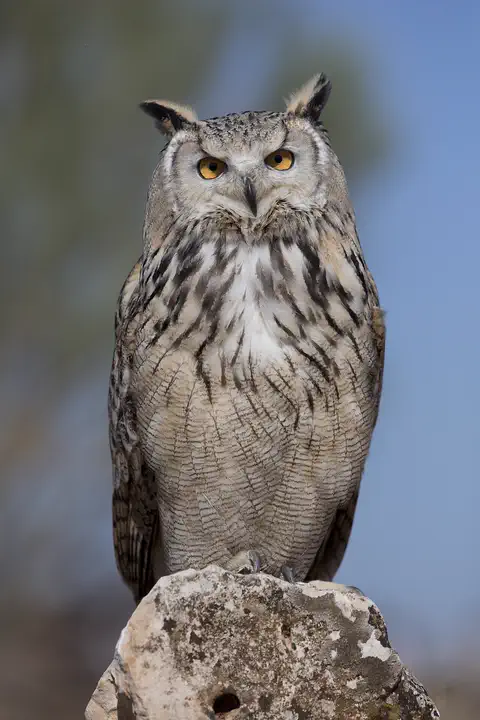
The Eurasian eagle-owl is one of the biggest owls in the world, with wings up to about 2 meters across, big orange eyes and two tall ear tufts. It lives across Europe and Asia, nests on rocky ledges and flies silently at night to catch rats, voles, hares and birds.
-
 Watch
Animal
American crow
The American crow is an all-black bird found across much of North America, from fields and beaches to city centers. It eats almost anything, lives in close family groups, gathers in huge winter roosts, and a University of Washington study found that wild crows can recognize and remember a human face.
-
 Watch
3D
Animal
Red-tailed hawk
The red-tailed hawk is probably the most common hawk in North America. It soars in wide circles over fields or waits on a pole or fence post, watching for voles, mice and rabbits, then drops down to catch them with its sharp talons.
-
 Watch
 Country
United States
The United States is a large country in North America made of 50 states, from icy Alaska to the warm islands of Hawaii. It has the Grand Canyon, the Mississippi River and Yellowstone, and about 342 million people live there.
-
 Watch
Animal
Wild turkey
The wild turkey is a big, bronze-feathered bird of North American forests and clearings. It walks most of the time but can run, fly and even roost high in trees at night. By the early 1900s wild turkeys had become rare in many places, but people helped them come back, and now they live in every U.S. state except Alaska.
-
 Watch
Animal
Striped skunk
The striped skunk is a cat-sized mammal of North America with bold black and white fur. It comes out at night to hunt insects and other small foods, and it is famous for its warning dance and its strong-smelling spray, which it uses only when it feels threatened.
For parents & teachers
What children will learn
- Describe the great horned owl's body features and how each helps it hunt at night.
- Explain why the great horned owl can live in so many different places.
- Describe how great horned owls nest and raise their young.
- Explain how poisons that build up in prey can harm owls.
Recommended ages: 3 to 17 · About 15 minutes
Talk about it
- Why might it help an owl to eat many different kinds of animals?
- Why do you think crows gang up on owls?
- How could people living near owls help keep them safe?
Try at home or in class
- Keep your eyes looking straight ahead and turn only your head to look around the room, like an owl. How far can you turn?
- Cup your hands behind your ears to make a 'facial disc' and listen for a quiet sound, then compare without them.
Key vocabulary: nocturnal, feather tufts, talons, mobbing, predator, facial disc
Where these facts come from
- The IUCN Red List of Threatened Species , International Union for Conservation of Nature (IUCN terms of use (no redistribution of Red List data or range maps))
- GBIF Backbone Taxonomy and GBIF Occurrence Search , Global Biodiversity Information Facility (CC0 1.0 (backbone); occurrence counts are facts derived from records under CC0, CC BY and CC BY-NC)
- Wikidata , Wikimedia Foundation (CC0 1.0)
- Bubo virginianus (Great Horned Owl), Red List global assessment 2018 , IUCN Red List of Threatened Species
- Great Horned Owl overview , Cornell Lab of Ornithology, All About Birds
- Great Horned Owl life history , Cornell Lab of Ornithology, All About Birds
- Great Horned Owl identification , Cornell Lab of Ornithology, All About Birds
- Great Horned Owl sounds , Cornell Lab of Ornithology, All About Birds
- Wikimedia Commons , Wikimedia Foundation (Per file: Public domain, CC0, CC BY or CC BY-SA only (credited on each page))
Checked, not yet human-reviewed. Last updated October 24, 2026. Spotted a mistake? Tell us.