
Animal
Snowy owl
The snowy owl is a big white owl from the far north. It has yellow eyes and fluffy feathers, even on its feet.
The snowy owl is a large white owl that nests on the Arctic tundra. Unlike most owls it hunts in daylight, and in the endless light of an Arctic summer it may hunt at any hour. Lemmings are its favorite food.
Bubo scandiacus is a circumpolar Arctic owl and, by weight, the heaviest owl in North America. It breeds on open tundra, follows the boom-and-bust cycles of lemmings, and wanders unpredictably south in winter. The IUCN's 2021 global assessment lists it as Vulnerable.
Photo: Frank Vassen, CC BY 2.0, via Wikimedia Commons
Meet the snowy owl
The snowy owl is a big white owl.
It has bright yellow eyes and a round head. Some snowy owls are all white. Others have dark spots and stripes.
The snowy owl is a big, round-headed owl with bright yellow eyes. It is the heaviest owl in North America, mostly because of its thick coat of feathers.
You can often tell males and females apart. Males get whiter as they grow older, and the whitest birds are always males. Females keep dark bars all their lives, and young males have dark bars too. The owl in our photo is covered in dark bars.
Bubo scandiacus belongs to the eagle-owl genus Bubo in the family Strigidae. The Cornell Lab of Ornithology describes it as North America's heaviest owl, typically about 1.8 kilograms, roughly half a kilogram heavier than a great horned owl; much of that bulk is dense insulating plumage.
Plumage changes with sex and age. Young males are barred with dark brown and whiten as they age, while females keep dark markings throughout life. The darkest males and palest females can look alike, but the whitest birds are always males and the most heavily barred always females.
Quick facts
- Group
- Bird
- Length
- 0.52 to 0.71 m
- Wingspan
- 1.26 to 1.45 m
- Weight
- 1.6 to 2.95 kg
Where it lives
Snowy owls live in the cold, far north.
In summer they live on the tundra, where there are no trees. In winter some fly south to fields and beaches.
Snowy owls spend the summer far north of the Arctic Circle, on the tundra: wide, open land with no trees. They live in the Arctic parts of North America, Europe and Asia.
In winter some owls stay in the north, while others fly south to southern Canada and the northern United States. There they look for wide, open places that feel like home, such as fields, beaches, dunes and even airports.
The species is circumpolar. The IUCN's 2021 global assessment lists it as resident in Canada, the United States, Greenland, Norway, Sweden, Finland and Russia, with regular non-breeding visitors in places such as Iceland, the United Kingdom, Kazakhstan, China and Japan.
It favors treeless, rolling ground with a good view. Winter movements are nomadic and irregular. Cornell notes that in the northern Great Plains, New York and New England snowy owls arrive most winters, while elsewhere they are irruptive, turning up in large numbers in some years and not in others. One brood from Victoria Island in the Canadian Arctic scattered to Hudson Bay, Ontario and the far east of Russia.
Continents

Where can you find this animal?
- Lives here naturally · Countries and seas named by a scientific source
- Sightings recorded · Records of wild sightings (GBIF)
- Visits for part of the year · Countries and seas named by a scientific source
Lives here naturally · Countries and seas named by a scientific source
Arctic tundra of North America, Greenland, northern Europe and Russia, where snowy owls breed and many stay all year. Owls live only in the far north of most countries shown.
Places: Canada, Finland, Greenland, Norway, Russia, Sweden and United States.
Source: iucn-red-list · checked October 2026
Sightings recorded · Records of wild sightings (GBIF)
Counts of GBIF records of wild observations (human and machine) and preserved specimens. Records include introduced populations, vagrants, escaped or released animals and misidentifications, so a country with records is not necessarily part of the native range.
Wild sightings have been recorded in United States, Canada, Sweden, Netherlands, Russia, Belgium, Denmark, UK and 28 more places.
Source: gbif · checked October 2026
Visits for part of the year · Countries and seas named by a scientific source
Countries the IUCN lists for regular winter (non-breeding) visits beyond the breeding range. Snowy owls also winter in southern Canada and the northern United States.
Places: China, Iceland, Japan, Kazakhstan, Latvia and UK.
Source: iucn-red-list · checked October 2026
Range maps show where scientists say an animal lives, often country by country. An animal may live in only part of a country shown, and sightings records can include animals that wandered far from home.
What it eats
Snowy owls love to eat lemmings.
Lemmings are small, furry animals that live on the tundra. Snowy owls also catch birds and hares.
The snowy owl's main food is the lemming, a small, round rodent of the tundra. In some places and years, lemmings are almost all these owls eat. One owl may eat more than 1,600 lemmings in a single year!
When lemmings are scarce, snowy owls switch to other prey: ptarmigan, ducks, hares, voles and seabirds. When a hunt works, they usually swallow a small rodent headfirst, in one gulp.
Lemmings dominate the breeding-season diet and in some years are nearly the only prey; Cornell estimates a single owl may take more than 1,600 in a year. Diet broadens with circumstance to voles, hares, squirrels, weasels, ptarmigan, waterfowl, grebes, wading birds and seabirds, and snowy owls are agile enough to catch small birds in flight.
Their breeding output tracks prey. In years of lemming population booms they can raise double or triple the usual number of young, and clutches range from 3 to 11 eggs. Audubon recorded one hunting fish at the edge of an ice hole, catching them with its feet.
Did you know?
One snowy owl lived to be more than 23 years old.
The oldest known wild snowy owl was a female at least 23 years and 10 months old.
The longevity record is a banded female at least 23 years 10 months old, recaptured and released in Massachusetts in 2015.
Built for the cold
A snowy owl has thick, fluffy feathers.
Feathers even cover its feet, like warm slippers. Its big yellow eyes see very well, and it hears very well too.
The snowy owl is dressed for the Arctic. Thick layers of soft feathers trap warm air close to its body, and its legs and toes are covered in feathers like fluffy boots.
In winter snowy owls choose snowy farmland, dunes and marshes, where their pale feathers blend in. Sharp eyes and ears let a snowy owl find a vole scurrying under the snow.
Cornell attributes the snowy owl's high body mass to thick feathers that insulate it from Arctic cold, and the Owl Research Institute notes thickly feathered feet. The Owl Research Institute adds that in winter the owls settle where they blend in: snow-covered farmland, dunes and marshes.
Cornell describes extraordinary vision and hearing: a hunting owl pinpoints prey such as a vole scurrying beneath the snow, then flies, or even runs, to pounce. Snowy owls sit still in one spot for hours, occasionally swiveling the head or leaning forward and blinking to look more closely. They are also among the most agile owls, able to catch small birds in flight.
Growing up on the tundra
The mother owl makes a nest on the ground.
She lays white eggs in a little hollow. The chicks hatch as tiny balls of white fluff. Later they walk around before they can fly.
Snowy owls nest right on the ground, on a small, dry mound where the wind blows the snow away. The female scrapes out a shallow hollow and lays her white eggs one every two or three days.
The eggs take about 32 days to hatch. The chicks are wet and blind at first, but within hours they are little white fluff balls. After about 18 to 25 days they leave the nest, then spend nearly a month walking around the tundra before they can fly.
The male chooses the territory and the female the nest site, a windswept rise that stays dry and snow-free. She scrapes a shallow bowl by pressing her body into the ground; the site may be reused for years. Clutches range from 3 to 11 white eggs, laid every two to three days; incubation takes about 32 days, and hatchlings are wet and blind, with eyes usually open by day 5.
Nestlings leave the nest at 18 to 25 days, well before they can fly, and spend nearly a month hiding and toddling around the tundra. Courtship involves an undulating display flight by the male carrying a lemming. The oldest snowy owl on record was a female at least 23 years and 10 months old.
A daytime owl
Most owls hunt at night. Snowy owls hunt in the daytime too.
They sit very still on a high spot and watch. Then they fly down fast to catch their food.
Most owls are nocturnal, but snowy owls are diurnal, which means they are active in the daytime. In the Arctic summer it is light around the clock, and they hunt at any hour.
A snowy owl spends a lot of time sitting still on a mound, a hay bale or a fence post, watching and listening. Snowy owls guard their nesting territories, and some even defend a winter hunting area and come back to the same place year after year.
Unlike most owls, snowy owls are strongly diurnal, hunting around the clock in the continuous daylight of the Arctic summer. Hunting is mostly sit-and-wait from a vantage point, followed by a fast, low flight or a short run to the prey.
Pairs defend breeding territories, and some individuals also defend winter territories, returning to the same wintering site in successive years; Cornell notes fierce winter disputes that have not been recorded on breeding grounds. Snowy owls are mostly silent, but around breeding sites males give a loud, booming hoot.
Did you know?
A snowy owl can eat more than a thousand lemmings in a year.
One snowy owl may eat more than 1,600 lemmings in a single year.
Cornell estimates that a snowy owl may take more than 1,600 lemmings a year, and that lemming booms can double or triple the number of young raised.
Helping snowy owls
There are fewer snowy owls than there used to be.
Roads, power lines and a changing climate can cause them trouble. Laws protect snowy owls from hunting.
The snowy owl is listed as Vulnerable, which means it is at risk. Scientists think the number of snowy owls has dropped a lot since the 1970s, though they are hard to count because the owls live in remote places and wander so far.
The IUCN lists threats such as roads, power lines, aircraft flight paths, hunting and pollution, and a changing climate. Scientists are not yet sure how climate change will affect the owls' Arctic nesting grounds. Like all birds of prey, snowy owls are protected from trapping and shooting.
The IUCN assessed the snowy owl as Vulnerable in its 2021 global assessment. Its population size is hard to estimate because breeding grounds are remote, territories are large and winter movements are unpredictable. Partners in Flight, quoted by Cornell, estimates a global breeding population of about 29,000 and a 64 percent loss between 1976 and 2016.
Threats listed by the IUCN include roads and railways, utility lines, aircraft flight paths, housing development, hunting and trapping, agricultural pollution and climate change. Cornell notes that it is not clear how climate change will affect their remote High Arctic breeding grounds. Like all raptors, snowy owls are protected from trapping and shooting.
IUCN Red List
How is the snowy owl doing in the wild?
- Least Concern
- Near Threatened
- Vulnerable (this animal)
- Endangered
- Critically Endangered
- Extinct in the Wild
- Extinct
Vulnerable
At high risk of disappearing from the wild.
See the IUCN Red List assessment · The IUCN Red List of Threatened Species 2021.3
Amazing facts
-
A snowy owl can eat more than a thousand lemmings in a year.
One snowy owl may eat more than 1,600 lemmings in a single year.
Cornell estimates that a snowy owl may take more than 1,600 lemmings a year, and that lemming booms can double or triple the number of young raised.
-
The whitest snowy owls are the boys.
The whitest snowy owls are always males. Females keep dark bars all their lives.
Males whiten with age while females retain barring, so the palest birds are always males and the most heavily barred always females.
-
Baby snowy owls walk before they fly.
Snowy owl chicks leave the nest on foot and spend nearly a month on the tundra before they can fly.
Nestlings leave at 18 to 25 days and spend almost another month hiding and toddling around the tundra before they can fly.
-
One snowy owl lived to be more than 23 years old.
The oldest known wild snowy owl was a female at least 23 years and 10 months old.
The longevity record is a banded female at least 23 years 10 months old, recaptured and released in Massachusetts in 2015.
Words to know
- tundra
- cold, flat land with no trees, where the ground below stays frozen
- diurnal
- active in the daytime
- lemming
- a small, round rodent that lives in the Arctic
- irruption
- a year when many birds suddenly move far from their usual home
- plumage
- all the feathers on a bird
- vulnerable
- at risk of becoming endangered
Discovery challenge
-
When do snowy owls hunt?
How are snowy owls different from most owls?
Which describes the snowy owl's activity pattern?
- They hunt in the daytime
- They only hunt underwater
- They never hunt
Show the answer
They hunt in the daytime
Snowy owls hunt in the daytime, and in summer at any hour.
Most owls hunt at night, but snowy owls are diurnal and hunt in daylight.
Snowy owls are strongly diurnal and hunt around the clock in the continuous Arctic summer daylight.
-
What is a snowy owl's favorite food?
Which animal does a snowy owl eat most?
Which prey most affects how many chicks snowy owls raise?
- Grass
- Lemmings
- Fish only
Show the answer
Lemmings
Snowy owls love lemmings.
Lemmings are their main food; one owl may eat more than 1,600 in a year.
In lemming boom years snowy owls can raise double or triple the usual number of young.
-
Where does a snowy owl make its nest?
Where do snowy owls nest?
What kind of site does the female choose for the nest?
- In a tall tree
- On the ground
- In a cave by the sea
Show the answer
On the ground
They nest on the ground, on a little hill.
The female scrapes a shallow hollow on a small, dry mound on the treeless tundra.
A dry, windswept rise kept clear of snow, where she scrapes a shallow bowl.
-
Which snowy owls are the whitest?
Which snowy owls are the whitest?
Which snowy owls have the palest, whitest plumage?
- Old males
- Females
- Chicks
Show the answer
Old males
The boys get whiter as they grow up.
Males get whiter as they age; females keep dark bars.
Males whiten with age while females keep dark markings, so the whitest birds are always males.
Places where you might see it
-
 Watch
 Country
Canada
Canada is the second-largest country in the world, stretching across the north of North America from the Atlantic to the Pacific and up into the Arctic. It has the Rocky Mountains, thousands of islands and about 42 million people, who speak English, French and many other languages.
-
 Watch
 Country
Norway
Norway stretches along the western side of the Scandinavian Peninsula, far into the Arctic. Deep, narrow inlets of the sea called fjords cut into its mountains, and about 5.6 million people live there, many of them near Oslo, the capital.
Explore next
-
 Watch
Animal
Great horned owl
The great horned owl is a large, powerful owl with two long, earlike tufts of feathers on its head. It is one of the most common owls in North America and lives in almost any kind of semi-open place, from deserts and forests to city parks. It hunts mostly at night.
-
 Watch
Animal
Barn owl
The barn owl is a pale, ghostly owl with a heart-shaped face that works like a dish to collect sound. It hunts mice and voles at night over fields and grassland, finding them by hearing alone if it has to. Barn owls live on every continent except Antarctica.
-
 Watch
Animal
Arctic fox
The Arctic fox lives on the frozen tundra around the North Pole. Its coat changes color with the seasons, white or blue-gray in winter and brown or gray in summer, and it has short ears, a short nose and furry feet to keep the cold out. It eats lemmings, birds and leftovers from polar bears.
-
 Watch
Animal
Polar bear
The polar bear is a huge bear that lives on the frozen sea of the Arctic. Thick fur and a layer of fat keep it warm, its amazing nose finds seals under the snow, and it can swim for many hours. It needs sea ice to hunt, so a warming Arctic is a big problem for it.
-
Watch
Country
Canada
Canada is the second-largest country in the world, stretching across the north of North America from the Atlantic to the Pacific and up into the Arctic. It has the Rocky Mountains, thousands of islands and about 42 million people, who speak English, French and many other languages.
-
Watch
Country
Norway
Norway stretches along the western side of the Scandinavian Peninsula, far into the Arctic. Deep, narrow inlets of the sea called fjords cut into its mountains, and about 5.6 million people live there, many of them near Oslo, the capital.
-
 Watch
Animal
Tawny owl
The tawny owl is a medium-sized woodland owl, about the size of a pigeon, with a round head, big dark eyes and brown, streaky feathers that hide it against tree bark. It hunts mice and voles at night on silent wings, and its hoots are a familiar sound at night.
-
 Watch
Animal
Eurasian eagle-owl
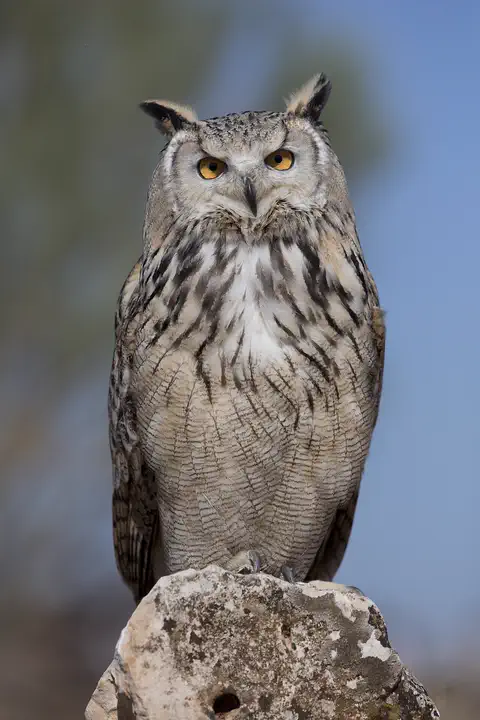
The Eurasian eagle-owl is one of the biggest owls in the world, with wings up to about 2 meters across, big orange eyes and two tall ear tufts. It lives across Europe and Asia, nests on rocky ledges and flies silently at night to catch rats, voles, hares and birds.
For parents & teachers
What children will learn
- Describe how the snowy owl's feathers, eyes and ears help it survive in the Arctic.
- Explain why lemmings matter so much to snowy owls.
- Describe the snowy owl's ground nest and how the chicks grow up.
- Understand why the snowy owl is Vulnerable and how people protect it.
Recommended ages: 3 to 17 · About 15 minutes
Talk about it
- Why might an owl that lives where the summer sun never sets hunt in the daytime?
- How could a bad year for lemmings affect snowy owls?
- Snowy owls choose wide, open places like fields and beaches in winter. Why might open land suit them?
Try at home or in class
- Fill two jars with warm water, wrap one in a fluffy scarf, and feel which stays warm longer, like an owl in its feathers.
- Sit very still for two minutes and watch a garden or park from a window, like a snowy owl watching from a perch. What did you notice moving?
Key vocabulary: tundra, diurnal, lemming, irruption, plumage, vulnerable
Where these facts come from
- The IUCN Red List of Threatened Species , International Union for Conservation of Nature (IUCN terms of use (no redistribution of Red List data or range maps))
- GBIF Backbone Taxonomy and GBIF Occurrence Search , Global Biodiversity Information Facility (CC0 1.0 (backbone); occurrence counts are facts derived from records under CC0, CC BY and CC BY-NC)
- Wikidata , Wikimedia Foundation (CC0 1.0)
- Bubo scandiacus (Snowy Owl), Red List global assessment 2021 , IUCN Red List of Threatened Species
- Snowy Owl overview , Cornell Lab of Ornithology, All About Birds
- Snowy Owl life history , Cornell Lab of Ornithology, All About Birds
- Snowy Owl identification , Cornell Lab of Ornithology, All About Birds
- Snowy Owl , Owl Research Institute
- Wikimedia Commons , Wikimedia Foundation (Per file: Public domain, CC0, CC BY or CC BY-SA only (credited on each page))
Checked, not yet human-reviewed. Last updated October 24, 2026. Spotted a mistake? Tell us.