
Animal
Kemp's ridley sea turtle
Kemp's ridley is a small sea turtle with a round, gray-green shell. It eats crabs. The mothers come onto the beach in the daytime to lay their eggs.
NOAA Fisheries calls Kemp's ridley the smallest sea turtle. It lives in the gulf between Mexico and the United States and along the US Atlantic coast, hunting crabs on sandy and muddy seafloors. Females often come ashore together in big groups, called arribadas, and nest in daylight. It is critically endangered, and Mexico and the United States work together to save it.
Lepidochelys kempii is a sea turtle (family Cheloniidae) with one of the most restricted distributions of any sea turtle: coastal waters of the gulf between Mexico and the United States and the Atlantic coast of the United States, with about 95% of nesting in Tamaulipas, Mexico. Wibbels and Bevan assessed it as Critically Endangered (A2bd) for the IUCN Red List (assessed 14 January 2019, published 2019), after a reduction of 82.6 to 88.3% over three generations; the population, about 22,341 mature individuals, recovered quickly from the mid-1990s to 2009 before nest numbers stopped rising in 2010.
Photo: uploaded by Johntex, public domain, via Wikimedia Commons
Meet Kemp's ridley
Kemp's ridley is a sea turtle.
It is small for a sea turtle.
Its shell is almost round.
Kemp's ridley is a sea turtle, a reptile that lives in the sea and must come to the surface to breathe. NOAA Fisheries calls it the smallest sea turtle in the world. An adult's upper shell is about 60 to 70 centimeters long, and it weighs about 32 to 45 kilograms.
Its top shell is grayish green and often as wide as it is long, and its bottom shell is pale yellow. It has a triangle-shaped head with a slightly hooked beak.
Lepidochelys kempii belongs to the hard-shelled sea turtle family, Cheloniidae; its genus, Lepidochelys, also includes the olive ridley (NOAA). Padre Island National Seashore (U.S. National Park Service) gives an adult carapace length of 60 to 70 centimeters (24 to 28 inches) and a weight of 32 to 45 kilograms (70 to 100 pounds), and NOAA Fisheries calls it the world's smallest sea turtle.
NOAA describes a triangular head with a slightly hooked beak, a grayish-green carapace that is often as wide as it is long, a pale yellowish plastron, one claw on each front flipper and one or two on each rear flipper. The species is named after Richard M. Kemp, a fisherman from Key West, Florida, who first submitted it for identification in 1906 (NOAA). The IUCN notes that its scientific name was misspelled kempi on earlier Red Lists.
Quick facts
- Group
- Reptile
- Length
- 0.6 to 0.7 m
- Weight
- 32 to 45 kg
Warm coastal waters
Kemp's ridleys live in the sea near Mexico and the United States.
They like shallow water with sandy or muddy bottoms.
Kemp's ridleys live mostly in the gulf between Mexico and the United States. Young turtles also live along the Atlantic coast of the United States, some as far north as Nova Scotia in Canada. Grown-up turtles stay mostly in shallow coastal water with sandy or muddy bottoms, where crabs live.
A few have turned up much farther away, near Europe and in the Mediterranean Sea, but that is rare.
The IUCN calls its distribution one of the most restricted of all sea turtles: coastal areas throughout the gulf between Mexico and the United States and along the US Atlantic coast, with rare occurrences off Atlantic Canada and Europe, Bermuda, the Azores, Madeira and in the Mediterranean Sea. Coastal waters of the gulf are developmental and foraging habitat and migratory corridors for adults, juveniles regularly use the US Atlantic coast, and offshore oceanic waters hold hatchlings, post-hatchlings and juveniles.
NOAA Fisheries adds that adults mainly use nearshore waters with muddy or sandy bottoms, that juveniles reach Nova Scotia, and that females migrate after nesting to foraging areas from the Yucatán Peninsula to southern Florida. In Texas, the National Park Service says they occur in nearshore waters, bays and passes.
Continent
Did you know?
The turtle is named after a fisherman.
It is named after Richard M. Kemp, a fisherman from Key West, Florida, who sent one to be identified in 1906.
Named for Richard M. Kemp of Key West, who first submitted the species for identification in 1906 (NOAA Fisheries).
Where can you find this animal?
- Lives here naturally · Countries and seas named by a scientific source
- Sightings recorded · Records of wild sightings (GBIF)
Lives here naturally · Countries and seas named by a scientific source
The IUCN lists Kemp's ridleys in the coastal waters of Mexico and the United States: the gulf between the two countries and the Atlantic coast of the United States. Nearly all nesting is on beaches in Tamaulipas, Mexico, with some in Veracruz and Texas. Shading is by country, so it covers far more land than the coastal seas the turtles use. Rare visitors reach Atlantic Canada, Europe, Bermuda, the
Places: Mexico and United States.
Source: iucn-red-list · checked October 2026
Sightings recorded · Records of wild sightings (GBIF)
Counts of GBIF records of wild observations (human and machine) and preserved specimens. Records include introduced populations, vagrants, escaped or released animals and misidentifications, so a country with records is not necessarily part of the native range.
Wild sightings have been recorded in United States, Mexico, France, UK, Ireland, Netherlands, Canada, Spain and 21 more places.
Source: gbif · checked October 2026
Range maps show where scientists say an animal lives, often country by country. An animal may live in only part of a country shown, and sightings records can include animals that wandered far from home.
Crab hunters
Kemp's ridleys love crabs.
They also eat fish, jellies and shellfish.
Grown-up Kemp's ridleys hunt mostly crabs on the seafloor. They also eat some fish, sea jellies and mollusks.
Baby turtles eat something different. For their first one or two years they drift among floating seaweed called sargassum far out at sea, where they rest, hide and feed on small animals and plants.
NOAA Fisheries says that once Kemp's ridleys settle in shallow coastal areas, crabs are their preferred food, and that adults use muddy or sandy bottoms where that prey is found. Padre Island National Seashore lists the diet as primarily crabs, with fish, sea jellies and mollusks (Shaver 1991; National Marine Fisheries Service 2020).
Hatchlings swim rapidly offshore; some stay in currents within the gulf while others are carried around Florida into the Atlantic by the Gulf Stream. Juveniles shelter and feed on small animals and plants in floating Sargassum algae for 1 to 2 years, or until they are about 8 inches (20 centimeters) long, before moving to nearshore waters (NOAA).
Did you know?
Kemp's ridley is the state turtle of Texas.
The Texas state legislature named Kemp's ridley the Texas State Turtle.
Designated the Texas State Turtle by the state legislature (National Park Service, Padre Island National Seashore).
A round shell and strong flippers
Its shell is gray-green on top and yellow underneath.
It swims with big front flippers.
It has a hooked beak for crunching crabs.
Kemp's ridley's top shell, the carapace, is almost round, often as wide as it is long. Adults are olive or grayish green on top and pale yellow underneath. Hatchlings are much darker, charcoal gray on both sides.
Its head is shaped like a triangle, with a slightly hooked beak. Each front flipper has one claw, and each back flipper has one or two. Like all sea turtles, it breathes air, so it must swim up to the surface.
NOAA Fisheries describes a triangular head with a slightly hooked beak, a grayish-green carapace often as wide as it is long, a pale yellowish plastron, dark hatchlings, one claw on each front flipper and one or two on each rear flipper. Padre Island National Seashore describes charcoal-gray hatchlings and adults olive green above and yellow below, and calls it the only sea turtle with an almost circular carapace.
Like all sea turtles, Kemp's ridleys are marine reptiles that must surface to breathe (NOAA). Males, the National Park Service notes, never come ashore again after entering the water as hatchlings, unless injured or sick.
Daytime nests and warm sand
The mother turtle crawls onto a sandy beach.
She digs a hole and lays about 100 eggs.
The babies hatch and run to the sea.
Kemp's ridleys nest from spring to summer. A female crawls up a sandy beach, digs a chamber in the sand and lays about 100 eggs. She may nest two or three times in one season, and comes back to nest every one to three years.
The eggs hatch after 50 to 60 days. The warmth of the sand decides whether each baby is a boy or a girl: warmer eggs become females and cooler eggs become males. The hatchlings head for the brightest horizon, which on a natural beach is over the ocean. They start to breed at about 13 years old.
NOAA Fisheries gives nesting from April to July, an average of 2 to 3 clutches a season, nesting every 1 to 3 years, about 100 eggs per clutch and incubation of 50 to 60 days; Padre Island National Seashore gives mid-March through August, 1 to 4 clutches and 6 to 8 weeks of incubation. Females usually return to nest near where they hatched decades earlier (NOAA).
Sex depends on incubation temperature: warmer eggs produce females and cooler eggs males, and eggs in the warmer center of a clutch are more likely to become females (LeBlanc et al. 2012, via the National Park Service). Hatchlings orient seaward by moving away from the dark silhouette of dunes or vegetation toward the brightest horizon. NOAA gives maturity at about 13 years and an estimated lifespan of at least 30 years; the Park Service gives maturity at 10 to 16 years. The IUCN uses a generation length of 18 years.
Arribadas in the daytime
Many mother turtles come to the beach together.
This big group is called an arribada.
They nest in the daytime!
Kemp's ridleys have a surprising way of nesting. Female turtles gather offshore, then crawl onto the beach together in big groups called arribadas, a Spanish word meaning "arrivals." Only one other turtle, the olive ridley, does this. Scientists still do not know for sure what starts an arribada.
Kemp's ridleys are also the only sea turtles that usually nest during the day. Scientists think that when so many babies hatch together, predators may not be able to catch them all, so more of them survive.
NOAA Fisheries describes arribada nesting, in which large groups of females gather offshore and come ashore together; it is found only in the genus Lepidochelys (Kemp's and olive ridleys). Proposed triggers include offshore winds, lunar cycles and female pheromones, but none is confirmed. Group nesting may defend against predators, or reflect environmental factors, and large numbers of hatchlings entering the sea together may overwhelm predators. NOAA calls Kemp's ridley the only sea turtle that routinely nests during the day; the National Park Service suggests daytime nesting may make it harder for nocturnal predators such as raccoons to find nests.
At sea, some males migrate each year between feeding and breeding grounds while others do not migrate at all, and some females return to the same foraging grounds year after year (NOAA).
Did you know?
Kemp's ridleys lay their eggs in the daytime.
NOAA Fisheries says Kemp's ridley is the only sea turtle that routinely nests during the day.
The only sea turtle that routinely nests in daylight (NOAA Fisheries).
Back from the brink
Kemp's ridleys almost disappeared.
People protected their nests and changed fishing nets.
Now there are more of them, but they still need help.
Kemp's ridley is critically endangered. In 1947, a film showed tens of thousands of females nesting on one beach at Rancho Nuevo, Mexico, in a single day. By 1985 only 702 nests were found all year. People had taken many eggs, and many turtles were caught by accident in fishing nets.
Mexico and the United States worked together: they guarded nests and required special escape hatches, called turtle excluder devices, in shrimp nets. Nest numbers rose about 15% a year until 2009, then stopped rising in 2010. Fishing gear, pollution, oil spills and cars driving on nesting beaches are still dangers.
Wibbels and Bevan assessed Lepidochelys kempii as Critically Endangered (A2bd) for the IUCN Red List (assessed 14 January 2019, published 2019): a single population, about 71.2% of nesting on 30.4 kilometers of beach at Rancho Nuevo, Tamaulipas, and a reduction of 82.6 to 88.3% over three generations from the numbers estimated from a 1947 film. Egg collection, fisheries bycatch and nest predation drove the 1947 to 1985 collapse; nest protection and turtle excluder devices in trawl gear brought exponential growth from about the mid-1990s to 2009, and whether the post-2010 slowdown is temporary is unknown. The IUCN estimates 22,341 mature individuals from 2016 to 2018 nest counts and lists threats led by fisheries, predation, cold stunning, pollution and debris, climate change and oil spills.
NOAA Fisheries records a low of 702 nests in 1985, about 15% annual growth through 2009, and bycatch as the biggest continuing threat; the species has been listed as endangered under US law since 2 December 1970 (IUCN).
IUCN Red List
How is the kemp's ridley sea turtle doing in the wild?
- Least Concern
- Near Threatened
- Vulnerable
- Endangered
- Critically Endangered (this animal)
- Extinct in the Wild
- Extinct
Critically Endangered
At extremely high risk of disappearing from the wild.
Amazing facts
-
Kemp's ridleys lay their eggs in the daytime.
NOAA Fisheries says Kemp's ridley is the only sea turtle that routinely nests during the day.
The only sea turtle that routinely nests in daylight (NOAA Fisheries).
-
Warm sand makes girl turtles.
Eggs in warmer sand become females, and eggs in cooler sand become males.
Temperature-dependent sex determination: warmer incubation produces females (LeBlanc et al. 2012, via the National Park Service).
-
The turtle is named after a fisherman.
It is named after Richard M. Kemp, a fisherman from Key West, Florida, who sent one to be identified in 1906.
Named for Richard M. Kemp of Key West, who first submitted the species for identification in 1906 (NOAA Fisheries).
-
A 1947 film showed thousands of turtles on one beach.
A film made in 1947 showed tens of thousands of Kemp's ridleys nesting near Rancho Nuevo, Mexico, in one day.
The 1947 Herrera film documented tens of thousands of nesting females at Rancho Nuevo in a single day (NOAA Fisheries; IUCN).
-
Kemp's ridley is the state turtle of Texas.
The Texas state legislature named Kemp's ridley the Texas State Turtle.
Designated the Texas State Turtle by the state legislature (National Park Service, Padre Island National Seashore).
Words to know
- carapace
- the top part of a turtle's shell
- arribada
- a Spanish word for "arrival": many sea turtles coming ashore to nest at the same time
- hatchling
- a baby animal that has just come out of its egg
- bycatch
- animals caught by accident in fishing gear meant for other catches
- sargassum
- a brown seaweed that floats in big mats at sea
- critically endangered
- at extremely high risk of dying out in the wild
Discovery challenge
-
When do Kemp's ridleys lay their eggs?
When do Kemp's ridley females usually come ashore to nest?
What makes Kemp's ridley's nesting time unusual among sea turtles?
- In the daytime
- Only at midnight
- Only in winter
Show the answer
In the daytime
In the daytime!
It is the only sea turtle that usually nests during the day.
It routinely nests during daylight, unlike other sea turtles (NOAA Fisheries).
-
What is a Kemp's ridley's favorite food?
What do grown-up Kemp's ridleys mostly eat?
What is the preferred prey of coastal Kemp's ridleys?
- Crabs
- Grass
- Seeds
Show the answer
Crabs
Crabs!
Mostly crabs, plus some fish, sea jellies and mollusks.
Crabs (NOAA Fisheries; National Park Service).
-
What is a big group of mother turtles called?
What is it called when many females come ashore to nest at once?
What is the term for the synchronized mass nesting of ridleys?
- An arribada
- A flock
- A herd
Show the answer
An arribada
An arribada!
Arribada means "arrival" in Spanish.
Arribada, found only in the genus Lepidochelys (NOAA Fisheries).
-
What helps turtles get out of fishing nets?
What did people add to shrimp nets to help Kemp's ridleys?
Which fishing-gear change helped the Kemp's ridley recover after 1990?
- An escape hatch for turtles
- Brighter lights
- Louder engines
Show the answer
An escape hatch for turtles
An escape door!
Turtle excluder devices let turtles escape from shrimp nets.
Turtle excluder devices in trawl gear, with nest protection (IUCN; NOAA).
Places where you might see it
-
 Watch
 Country
Mexico
Mexico is a large country in southern North America, between the Pacific Ocean and the Gulf of Mexico. It has smoking volcanoes, ancient cities built by the Maya and other peoples, and about 132 million people, many of them in and around Mexico City.
-
 Watch
 Country
United States
The United States is a large country in North America made of 50 states, from icy Alaska to the warm islands of Hawaii. It has the Grand Canyon, the Mississippi River and Yellowstone, and about 342 million people live there.
Explore next
-
 Watch
Animal
Loggerhead sea turtle
The loggerhead sea turtle is named for its huge head and powerful jaws, which crush crabs, conchs and other hard-shelled animals. Babies hatch on sandy beaches, ride the open ocean for years and may cross an entire ocean before coming home to nest.
-
 Watch
Animal
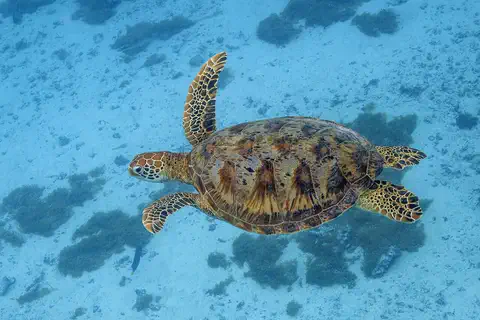
Green sea turtle
The green sea turtle is the largest sea turtle with a hard shell. It lives in warm seas around the world and, unlike other sea turtles, grown-ups eat mostly seagrass and algae. Females swim hundreds or even thousands of kilometers to lay their eggs on the beaches where they hatched long ago.
-
 Watch
3D
Animal
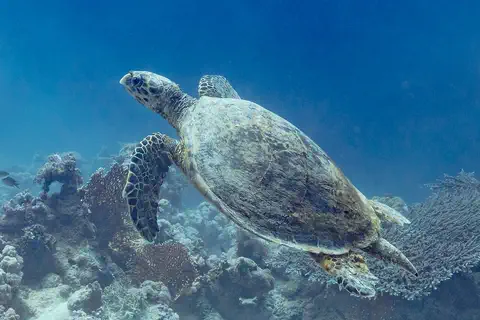
Hawksbill sea turtle
The hawksbill sea turtle lives in warm seas around the world, mostly near coral reefs. Its pointed, hawk-like beak reaches into cracks in the reef to find sponges, its favorite food. Its beautiful patterned shell once made it a target for hunters, and today it is critically endangered.
-
 Watch
Animal
Leatherback sea turtle
The leatherback sea turtle is the largest turtle on Earth. Instead of a hard shell it has tough, rubbery skin over a layer of tiny bones. It eats jellyfish, dives deeper than any other turtle and swims thousands of kilometers between feeding waters and the beaches where it lays its eggs.
-
 Watch
3D
Animal
Atlantic blue crab
The Atlantic blue crab is a swimming crab with bright blue claws and back legs shaped like paddles. It lives along the Atlantic coast of the Americas, especially in bays where rivers meet the sea, like the Chesapeake Bay. A mother crab carries up to two million eggs in a spongy orange mass under her body.
-
Watch
Country
Mexico
Mexico is a large country in southern North America, between the Pacific Ocean and the Gulf of Mexico. It has smoking volcanoes, ancient cities built by the Maya and other peoples, and about 132 million people, many of them in and around Mexico City.
-
Watch
Country
United States
The United States is a large country in North America made of 50 states, from icy Alaska to the warm islands of Hawaii. It has the Grand Canyon, the Mississippi River and Yellowstone, and about 342 million people live there.
-
 Watch
Animal
Aldabra giant tortoise
The Aldabra giant tortoise is one of the largest land tortoises on Earth. Wild ones live on Aldabra Atoll, a ring of coral islands in the Indian Ocean, where about 180,000 of them graze, browse and shape the land like elephants do in Africa. They can live for more than 100 years.
For parents & teachers
What children will learn
- Describe how a Kemp's ridley's life moves from beach to open sea to coast.
- Explain what an arribada is and why nesting together may help.
- Explain how sand temperature affects whether hatchlings are male or female.
- Name ways people helped Kemp's ridleys recover.
Recommended ages: 3 to 17 · About 15 minutes
Talk about it
- Why might nesting all at once help baby turtles survive?
- Why could bright lights near a beach confuse hatchlings?
- How can people who fish help sea turtles?
Try at home or in class
- Warm and cool: place two small cups of sand, one in a sunny window and one in the shade, and after an hour feel which is warmer; talk about how sand temperature decides whether turtle eggs hatch as males or females.
- Brightest horizon: in a dim room, with a grown-up, shine a flashlight at one wall and notice how your eyes are drawn to the brightest side, the way hatchlings head toward the bright sea.
Key vocabulary: carapace, arribada, hatchling, bycatch, sargassum, critically endangered
Where these facts come from
- GBIF Backbone Taxonomy and GBIF Occurrence Search , Global Biodiversity Information Facility (CC0 1.0 (backbone); occurrence counts are facts derived from records under CC0, CC BY and CC BY-NC)
- Wikidata , Wikimedia Foundation (CC0 1.0)
- The IUCN Red List of Threatened Species , International Union for Conservation of Nature (IUCN terms of use (no redistribution of Red List data or range maps))
- Lepidochelys kempii (Wibbels and Bevan, assessed 14 January 2019, published 2019) , IUCN Red List of Threatened Species
- Lepidochelys kempii: justification, range, population, habitat, threats and conservation text , IUCN Red List of Threatened Species
- Lepidochelys kempii: IUCN Red List global assessment record (Wibbels and Bevan 2019), IUCN checklist on GBIF , GBIF
- Kemp's Ridley Turtle , NOAA Fisheries
- Kemp's ridley sea turtles (Padre Island National Seashore) , U.S. National Park Service
- File:Padre Island National Seashore - Kemps Ridley Sea Turtle.jpg (U.S. Fish and Wildlife Service, public domain) , Wikimedia Commons
- Wikimedia Commons , Wikimedia Foundation (Per file: Public domain, CC0, CC BY or CC BY-SA only (credited on each page))
Checked, not yet human-reviewed. Last updated November 1, 2026. Spotted a mistake? Tell us.
Picture credits
- Photo: uploaded by Johntex, public domain, via Wikimedia Commons · source