
Animal
Spiny softshell turtle
The spiny softshell turtle has a flat, soft shell like a pancake and a nose like a snorkel. It hides in the sand under the water!
The spiny softshell turtle is a freshwater turtle of North America with a round, flat, leathery shell and a snorkel-like snout. It lives in rivers, lakes and creeks, where it buries itself in sand or mud and snatches crayfish and other prey. Females grow much bigger than males.
Apalone spinifera (family Trionychidae in the GBIF taxonomy) is a highly aquatic softshell turtle of southern Ontario and Quebec, most of the United States east of the Rocky Mountains and northern Mexico. Doody, Gillingwater, Mali, Forstner, van Dijk and Rhodin assessed it as Least Concern for the IUCN Red List (assessed 26 December 2023, published 2024), while noting declining peripheral populations, including endangered ones in Canada.
Photo: David Peden, CC0 1.0, via Wikimedia Commons
Meet the spiny softshell
The spiny softshell turtle has a soft shell.
Its shell is round and flat, like a pancake.
Its nose is long and thin, like a snorkel.
The spiny softshell turtle is easy to recognize. Its shell is round, rather flat and leathery instead of hard, and it is olive or tan with dark blotches. Along the front edge of the shell are tiny spines, which give the turtle its name. Its long, snorkel-like snout sticks out in front.
Females grow much bigger than males: a female's shell can reach 54 centimeters, but a male's is at most about 27.5 centimeters.
Apalone spinifera is a softshell turtle; the GBIF classification places the genus in the family Trionychidae. The Ontario government describes a medium-large freshwater turtle with a round, rather flat, leathery shell up to 54 centimeters long, olive or tan with dark blotches and tiny spine projections along the front edge, an olive, brown or gray body and a snorkel-like snout; it is sometimes called the 'pancake' or 'leatherback' turtle.
The IUCN gives strong size differences between the sexes: males mature at a small size (about 11 to 14 centimeters carapace length) and reach at most 27.5 centimeters, while females mature at over 28 centimeters and reach 54 centimeters (Webb 1962; Robinson and Murphy 1978). Its text lists six subspecies (though its opening line says seven), including A. s. atra of the Cuatro Ciénegas basin in Mexico.
Quick facts
- Group
- Reptile
- Length
- 0.11 to 0.54 m
- Lifespan in the wild
- 60 to 70 years
Rivers, lakes and sandbars
Spiny softshells live in rivers, lakes and creeks.
They like sandy and muddy places in the water.
Spiny softshells live in southern Ontario and Quebec in Canada, across most of the United States east of the Rocky Mountains, and in northern Mexico. People have also brought them to some other states, mostly in the West, and to parts of Mexico.
They stay close to water: mostly rivers and lakes, but also creeks, ponds and ditches. They need shallow, sandy or muddy places to bury themselves, deep pools for winter, places to bask and open sand or gravel for nesting.
The IUCN describes a native range in southernmost Ontario and Quebec, northern Mexico from Chihuahua to Tamaulipas, and most of the United States east of the Rocky Mountains, including nearly all the Mississippi-Missouri-Ohio system, the Great Lakes region and the Rio Grande system, recorded up to 1,320 meters in Wyoming; introduced populations live in Arizona, California, Nevada, Utah, Washington and other states and in Baja California and Sonora, Mexico. In the south it uses almost any wetland, from rivers and lakes to ditches, canals and desert springs; in the north it is limited to rivers, larger streams and lakes, likely because of oxygen needs during long winter brumation.
The Ontario government lists its key habitat needs: open sand or gravel nesting areas, shallow muddy or sandy areas to bury in, deep pools for hibernation, basking areas, and habitat for crayfish and other prey; some turtles travel up to 30 kilometers in a year between these places.
Continent
Its habitat

Where can you find this animal?
- Lives here naturally · Countries and seas named by a scientific source
- Sightings recorded · Records of wild sightings (GBIF)
Lives here naturally · Countries and seas named by a scientific source
Countries where the IUCN lists spiny softshells as resident: the United States east of the Rocky Mountains (plus introduced populations in some other states, mostly western), southernmost Ontario and Quebec in Canada, and northern Mexico (plus introduced populations in Baja California and Sonora). They live only in parts of each country shown.
Places: United States, Canada and Mexico.
Source: iucn-red-list · checked October 2026
Sightings recorded · Records of wild sightings (GBIF)
Counts of GBIF records of wild observations (human and machine) and preserved specimens. Records include introduced populations, vagrants, escaped or released animals and misidentifications, so a country with records is not necessarily part of the native range.
Wild sightings have been recorded in United States, Mexico, Canada, Argentina, Portugal, Italy and China.
Source: gbif · checked October 2026
Range maps show where scientists say an animal lives, often country by country. An animal may live in only part of a country shown, and sightings records can include animals that wandered far from home.
Ambush from the sand
Spiny softshells hide in the sand or mud.
When a crayfish comes near, snap! They grab it.
Spiny softshells eat mostly animals, especially crayfish, fish, insects and snails, and sometimes dead animals. They also eat some plants, such as acorns, leaves and fruits.
One way they hunt is by partly burying themselves in sand or mud under the water and snatching prey that comes close. They can also hunt actively, poking their snout into plants or under rocks.
The IUCN describes an omnivorous diet that tends toward carnivory: an Iowa study of 52 stomachs found, by volume, crayfish, large fish, small fish, plant material (including acorns and leaves) and aquatic insect larvae (Williams and Christiansen 1981), and Minnesota stomachs held insects, crayfish, sowbugs, snails, bivalves, earthworms, fish and vegetation (Cochran and McConville 1983). Carrion is taken, and plant eating appears deliberate. Foraging includes ambush with a gape-and-suck strike and active pursuit, thrusting the snout into vegetation or under rocks (Newman 1906). The Ontario government describes turtles partly burying themselves in sand or mud underwater to snatch crayfish and molluscs.
Did you know?
Some people call it the pancake turtle.
Because of its flat, round shell, the spiny softshell is sometimes called the 'pancake' turtle.
Sometimes called the 'pancake' or 'leatherback' turtle for its shell (Ontario).
A snorkel and a soft shell
Its long nose works like a snorkel.
It can breathe while its body stays under the water.
Its shell is covered with leathery skin.
The spiny softshell's long snout works like a snorkel: it lets the turtle take a breath of air without leaving the water.
In winter it hibernates buried in sand under the water. It can go the whole winter without breathing air, taking in small amounts of oxygen from the water through its mouth and the opening under its tail.
The Ontario government notes that the snorkel-like snout lets the turtle breathe while submerged, and that spiny softshells hibernate underwater in sand, going without breathing for the entire winter and absorbing small amounts of oxygen through the mouth and cloaca. The IUCN links the species' limited habitat in the north to dissolved-oxygen requirements during long winter brumation, and notes that males and females can use different microhabitats in some systems.
Nests on sunny sandbars
The mother lays her eggs in warm, sunny sand.
The babies hatch at the end of summer.
Females nest from May to July in open, sunny places with sandy or gravelly ground, often on sandbars. Many females may nest on the same beach; in Ontario, more than 100 nests have been found on a single sand or gravel bar. A clutch usually has 12 to 18 eggs, and females usually lay two clutches a year, though in the far north some lay only one.
The babies hatch in August and September. Females take years to grow up: in one study they matured at about 12 to 13 years, while males matured in their fourth or fifth year.
The IUCN summarizes nesting mainly from May to July (earliest 11 May, latest 28 July; Doody 1995), usually two clutches a year in the south and sometimes one at higher latitudes; clutches usually of 12 to 18 eggs (extremes 4 to 42, and from 1 to 43 confirmed in Ontario); communal nesting, with some Ontario bars holding over 100 nests; and open, sunny, sandy or gravelly sites, where Ontario nests in clay or organic soils failed. Softshells have a shorter incubation period than other turtles (Janzen 1993), and hatching occurs from August through September. Arkansas growth models put maturity in the 4th or 5th year for males and the 12th or 13th for females (Plummer and Mills 2015), and longevity is probably well over 30 years, estimated at about 60 to 70 (Iverson 2024).
Built for the water
Spiny softshells hardly ever go far from water.
They like sunny places to bask.
Spiny softshells are highly aquatic and rarely travel far from water. They bask in the sun, bury themselves in shallow sand and mud, and spend the winter in deep pools.
Softshells also often swim across the middle of lakes and bays, and because they hide in shallow water near shore, boats coming in to land can hit them.
The Ontario government describes a highly aquatic turtle that rarely travels far from water and whose home range depends on the spread of nesting, hibernation, feeding and basking sites, with some individuals moving up to 30 kilometers in a year; it notes that turtles hiding in shallow mud are at risk from boats coming in to shore, and that softshells often travel across the middle of lakes or bays. In Louisiana, J. S. Doody has regularly seen males foraging in groups of 2 to 10 with males of A. mutica on the bottom of shallow, still water at the ends of sandbars (IUCN).
Did you know?
In winter it can stay under the water without coming up to breathe.
During winter it can stay buried under water for the whole season, taking in small amounts of oxygen through its mouth.
Hibernates in sand underwater, absorbing small amounts of oxygen through the mouth and cloaca (Ontario).
Common in some places, rare in others
In most places spiny softshells are doing well.
In Canada they are in danger.
People protect their nesting beaches.
Across most of its range the spiny softshell is common, so it is listed as least concern. But some groups at the edges of its range are shrinking. In Ontario, Canada, it is endangered: only about 1,000 adults were left in 14 populations.
Threats include raccoons and foxes raiding nests, dams, changes to riverbanks, boat strikes and collection for food and the pet trade. In Canada it is protected by law, and in Vermont four nesting beaches have been protected.
Doody, Gillingwater, Mali, Forstner, van Dijk and Rhodin assessed Apalone spinifera as Least Concern for the IUCN Red List (assessed 26 December 2023, published 2024; previously LC in 2011): widespread and generally abundant in its core range and often resilient, even in urban streams, but with sparse and declining northern and disjunct populations; the subspecies A. s. atra remains Critically Endangered. Threats include habitat loss and fragmentation, subsidized nest predators (mainly raccoons), dams and water releases, climate effects on nests, harvest, boat strikes and pollution. 715,499 live animals were declared as exported from the USA between 2000 and 2019, peaking at nearly 130,000 in 2007 and falling below 1,000 a year from 2016.
In Ontario populations declined by up to 45% over 20 years, leaving about 1,000 mature individuals in 14 of 35 known populations (COSEWIC 2016); the species is Endangered under Canada's Species at Risk Act and Ontario's Endangered Species Act. Softshells (Apalone spp.) were listed on CITES Appendix II in 2023, and Minnesota banned harvest in 2022.
IUCN Red List
How is the spiny softshell turtle doing in the wild?
- Least Concern (this animal)
- Near Threatened
- Vulnerable
- Endangered
- Critically Endangered
- Extinct in the Wild
- Extinct
Least Concern
Not at risk of disappearing from the wild right now.
Amazing facts
-
Some people call it the pancake turtle.
Because of its flat, round shell, the spiny softshell is sometimes called the 'pancake' turtle.
Sometimes called the 'pancake' or 'leatherback' turtle for its shell (Ontario).
-
In winter it can stay under the water without coming up to breathe.
During winter it can stay buried under water for the whole season, taking in small amounts of oxygen through its mouth.
Hibernates in sand underwater, absorbing small amounts of oxygen through the mouth and cloaca (Ontario).
-
Lots of mother turtles can nest on the same sandy beach.
In Ontario, more than 100 nests have been found on a single sand or gravel bar.
Communal nesting is common; some Ontario bars held over 100 nests (Gillingwater, via IUCN).
-
Mother softshells grow much bigger than fathers.
A female's shell can be about twice as long as the biggest male's.
Maximum carapace length 54 cm in females and 27.5 cm in males (IUCN).
Words to know
- softshell
- a turtle whose shell is covered with leathery skin instead of hard plates
- snorkel
- a tube for breathing while most of the body stays underwater
- hibernate
- to spend the winter in a deep, inactive rest
- sandbar
- a raised bank of sand in a river or lake
- carapace
- the top part of a turtle's shell
- least concern
- not currently at serious risk of dying out in the wild
Discovery challenge
-
What is the spiny softshell's shell like?
How is a spiny softshell's shell different from most turtles' shells?
What texture does the Ontario description give the spiny softshell's carapace?
- Soft and leathery
- Hard and bumpy
- Covered in fur
Show the answer
Soft and leathery
Soft, like leather!
It is round, rather flat and leathery, not hard.
Round, rather flat and leathery (Ontario).
-
How does it breathe while hiding under water?
How can a buried spiny softshell breathe?
What lets Apalone spinifera breathe while submerged?
- It reaches up with its snorkel snout
- It has gills like a fish
- It never needs air
Show the answer
It reaches up with its snorkel snout
Its snorkel nose!
Its long snout lets it take a breath while staying underwater.
Its snorkel-like snout (Ontario).
-
Which softshell grows bigger?
Which spiny softshells grow bigger, males or females?
How do maximum carapace lengths compare between the sexes?
- The females
- The males
- They are always the same
Show the answer
The females
The mothers!
Females reach 54 centimeters; males at most about 27.5.
Females 54 cm, males 27.5 cm maximum (IUCN).
-
What does a spiny softshell like to eat?
Which food is especially important for spiny softshells?
Which prey ranked first by volume in the Iowa stomach study?
- Crayfish
- Grass
- Seeds only
Show the answer
Crayfish
Crayfish!
Crayfish, fish, insects and snails are among its main foods.
Crayfish, then large fish, small fish, plant material and insect larvae (Williams and Christiansen 1981, via IUCN).
Places where you might see it
-
 Watch
 Country
United States
The United States is a large country in North America made of 50 states, from icy Alaska to the warm islands of Hawaii. It has the Grand Canyon, the Mississippi River and Yellowstone, and about 342 million people live there.
-
 Watch
 Country
Canada
Canada is the second-largest country in the world, stretching across the north of North America from the Atlantic to the Pacific and up into the Arctic. It has the Rocky Mountains, thousands of islands and about 42 million people, who speak English, French and many other languages.
-
 Watch
 Country
Mexico
Mexico is a large country in southern North America, between the Pacific Ocean and the Gulf of Mexico. It has smoking volcanoes, ancient cities built by the Maya and other peoples, and about 132 million people, many of them in and around Mexico City.
Explore next
-
 Watch
Animal
Pig-nosed turtle
The pig-nosed turtle is a large freshwater turtle with a snout like a pig's, a soft, leathery shell and big flippers like a sea turtle's. It lives in rivers, lagoons and swamps of southern New Guinea and northern Australia and eats mostly fruits and plants. Heavy collection of its eggs and adults has made it endangered.
-
 Watch
3D
Animal
Common snapping turtle
The common snapping turtle is a big freshwater turtle of eastern North America. It hides in the mud of ponds and rivers with just its nose poking up, eats almost anything it finds, and can live for many decades. Each summer, mother turtles walk over land to dig nests in sand and gravel.
-
 Watch
Animal
Painted turtle
The painted turtle is one of the most common turtles in North America. Its dark shell and skin are decorated with bright red and yellow markings, and on sunny days dozens may pile onto one log to bask. It lives in ponds, marshes and slow streams from Canada to northern Mexico.
-
Watch
Country
United States
The United States is a large country in North America made of 50 states, from icy Alaska to the warm islands of Hawaii. It has the Grand Canyon, the Mississippi River and Yellowstone, and about 342 million people live there.
-
Watch
Country
Canada
Canada is the second-largest country in the world, stretching across the north of North America from the Atlantic to the Pacific and up into the Arctic. It has the Rocky Mountains, thousands of islands and about 42 million people, who speak English, French and many other languages.
-
Watch
Country
Mexico
Mexico is a large country in southern North America, between the Pacific Ocean and the Gulf of Mexico. It has smoking volcanoes, ancient cities built by the Maya and other peoples, and about 132 million people, many of them in and around Mexico City.
-
 Watch
Animal
Aldabra giant tortoise
The Aldabra giant tortoise is one of the largest land tortoises on Earth. Wild ones live on Aldabra Atoll, a ring of coral islands in the Indian Ocean, where about 180,000 of them graze, browse and shape the land like elephants do in Africa. They can live for more than 100 years.
-
 Watch
Animal
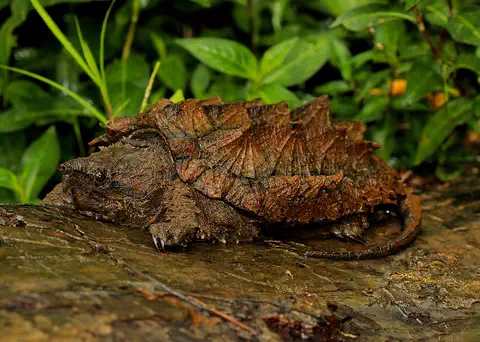
Alligator snapping turtle
The alligator snapping turtle is the largest freshwater turtle in the United States. It lies still on the bottom of rivers and lakes with its mouth open, wiggling a worm-like lure on its tongue to trick fish into swimming close. Its numbers have fallen, and it is now endangered.
For parents & teachers
What children will learn
- Describe how a softshell's shell differs from other turtles' shells.
- Explain how a snorkel snout helps a turtle that hides underwater.
- Explain why female and male spiny softshells differ so much in size.
- Explain why a species can be common in one country and endangered in another.
Recommended ages: 3 to 17 · About 15 minutes
Talk about it
- Why might a turtle that hides in sand be good at catching crayfish?
- Why could sandbars and beaches be important to a river turtle?
- Why might populations at the edge of a range be more at risk?
Try at home or in class
- Snorkel test: with a grown-up, lay a toy turtle under sand in a bowl of water with a straw for its snout reaching the surface, and see how little has to show.
- Size line: with a measuring tape, mark 27.5 centimeters for the biggest male and 54 centimeters for the biggest female, and compare them.
Key vocabulary: softshell, snorkel, hibernate, sandbar, carapace, least concern
Where these facts come from
- GBIF Backbone Taxonomy and GBIF Occurrence Search , Global Biodiversity Information Facility (CC0 1.0 (backbone); occurrence counts are facts derived from records under CC0, CC BY and CC BY-NC)
- Wikidata , Wikimedia Foundation (CC0 1.0)
- The IUCN Red List of Threatened Species , International Union for Conservation of Nature (IUCN terms of use (no redistribution of Red List data or range maps))
- Apalone spinifera (Doody, Gillingwater, Mali, Forstner, van Dijk and Rhodin, assessed 26 December 2023, published 2024) , IUCN Red List of Threatened Species
- Apalone spinifera: justification, range, population, habitat, threats, use and trade, and conservation text , IUCN Red List of Threatened Species
- Apalone spinifera: IUCN Red List global assessment record (Doody et al. 2024), IUCN checklist on GBIF , GBIF
- Spiny softshell (species at risk) , Government of Ontario
- File:Apalone spinifera 412346603.jpg (27 July 2024, David Peden, via iNaturalist) , Wikimedia Commons
- Wikimedia Commons , Wikimedia Foundation (Per file: Public domain, CC0, CC BY or CC BY-SA only (credited on each page))
Checked, not yet human-reviewed. Last updated November 1, 2026. Spotted a mistake? Tell us.