
City Europe
Gomel
Gomel is a big city in Belarus, beside the Sozh River. It has a palace park, a puppet theater and a circus!
Gomel is a city in the southeast of Belarus, on the Sozh River, a branch of the Dnieper. Store norske leksikon calls it the country's second-largest city. The 2009 census counted 492,136 people there.
Gomel (Belarusian Homieĺ), on the Sozh, a tributary of the Dnieper, 280 km southeast of Minsk (Store norske leksikon), had 492,136 inhabitants at the census of 14 October 2009 and an official estimate of 501,802 on 1 January 2023 (City Population, from Belstat). It is an industrial city, a river port and a railway junction, known for farm machinery and four universities.
Photo: Andrey Kukharenko, CC BY 2.0, via Wikimedia Commons
Discover Gomel
Gomel is a city in Belarus, a country in Europe.
A river called the Sozh flows past it.
Gomel is in the southeast of Belarus, on the Sozh River, says Larousse. Store norske leksikon, Norway's big encyclopedia, adds that the Sozh flows into the Dnieper, that Gomel is 280 kilometers southeast of Minsk and that it is the country's second-largest city.
The 2009 census counted 492,136 people in Gomel. The national statistics office's estimate for 1 January 2023 was 501,802.
Larousse: city in the southeast of Belarus, on the Sozh; 482,652 inhabitants (2009 census; City Population prints 492,136 for the city including Kascjukoŭka at the same census). Store norske leksikon (article by Sten Lundbo): on the Sozh, a tributary of the Dnieper, 280 km southeast of Minsk; 501,200 inhabitants (2025); the country's second-largest city. City Population (Belstat): 393,723 (1979 census), 511,706 (1989), 492,136 (14 October 2009); estimates 510,985 (1 January 2019) and 501,802 (1 January 2023); second after Minsk in 2023.
- Country
- Belarus; in the southeast, on the Sozh (Larousse)
- People in Gomel (census 2009)
- 492,136
- Distance from Minsk
- 280 km to the southeast (Store norske leksikon)
- Rank
- the country's second-largest city (Store norske leksikon)
A lake, a river and a palace park
Look at the lake and the river from high up in the sky!
Tall buildings stand on one side. Small buildings with colorful roofs fill the other.
Andrey Kukharenko took this photo from the air on the evening of 18 April 2021 and called it 'Gomel city, 5th area'. Tall buildings stand beside a calm lake, a wide area of small buildings with colorful roofs spreads across the other shore, a river curves away at the right, and the rest of the city reaches the horizon. On Commons, another user has filed it under Lyubenskoye Lake.
Store norske leksikon says Gomel has several museums. A palace built in 1777 is one of the most visited museums in Belarus, with some of the richest art collections in the country.
Commons: File:DJI 0123 Edit (51153515926).jpg, Andrey Kukharenko (Flickr, CC BY 2.0, FlickreviewR 2 passed), 18 April 2021 19:16; his description 'Gomel city, 5th area'; Commons categories (not the photographer's words) include '5 microraion "Lyubensky", Gomel' and 'Lyubenskoye Lake'; camera point 52.398° N, 30.986° E, 4.88 km S of the city's Wikidata point. Store norske leksikon: a city of culture with several museums; the Rumyantsev-Paskevich palace, built in 1777, one of the most visited museums in Belarus, with some of the richest art collections in the country, including handwritten books. Wikidata, from the city point (Q2678): Francisk Scorina Homiel State University (Q2630637) 1.21 km E; Gomel State Circus (Q1991356, 1972) 1.97 km ESE; Gomel State Puppet Theatre (Q12096735, 1968) 2.25 km ESE; Gomel Palace and Park Ensemble museum (Q63114704) 3.14 km SE; microdistrict 5 'Lyubensky' (Q17044653) 3.68 km S.
- In the photo
- 'Gomel city, 5th area', from the air on 18 April 2021 (the photographer's description)
- Palace museum
- a palace built in 1777, one of the most visited museums in Belarus (Store norske leksikon)
- Gomel State Circus
- about 2 km east-southeast of the city's point (Wikidata)
A city first named in 1142
Gomel is very old. People wrote about it almost 900 years ago!
Today it has four universities.
Store norske leksikon says Gomel is first mentioned in 1142. The palace that is now a museum was built in 1777.
The city's first university opened in 1929. A university for transport followed in 1953, a technical university in 1968 and a medical university in 1990, so Gomel now has four.
Store norske leksikon: first mentioned in 1142; the Rumyantsev-Paskevich palace built in 1777; four universities: the first opened in 1929 and has 12 faculties, a transport university opened in 1953, a technical university in 1968 and a medical university in 1990. City Population: 393,723 inhabitants at the 1979 census, 511,706 in 1989 and 492,136 in 2009. The panel's founding year is left empty: 1142 is a first mention, not a founding.
- First mentioned
- 1142 (Store norske leksikon)
- First university
- opened in 1929 (Store norske leksikon)
- More universities
- transport (1953), technical (1968) and medical (1990) (Store norske leksikon)
Rails, a river port and bridges
Trains come to Gomel from many directions.
Boats use the river port on the Sozh.
Store norske leksikon calls Gomel a railway junction, where several lines meet, and says the city has a river port. Larousse also calls it a river port and lists shipyards among its industries.
In the photo, bridges cross the river at the upper right, and a road with parked cars runs beside the tall buildings.
Store norske leksikon: an important industrial center with a river port and a railway junction. Larousse: river port; shipyards. In the photo (18 April 2021), bridges cross the river at the upper right (not named by any source opened).
- Railway
- a railway junction (Store norske leksikon)
- River port
- on the Sozh (Larousse, Store norske leksikon)
- Shipyards
- listed by Larousse
Cold winters, warm summers
Gomel has cold winters, below freezing.
Summers are warm, and July brings the most rain.
The Japan Meteorological Agency's averages for Gomel, for 1991 to 2020, show January as the coldest month, at about −4 °C, and July as the warmest, at about 20 °C. December, January and February average below freezing.
About 636 millimeters of rain and snow fall in a year. July is the wettest month, with 100.3 millimeters, and April the driest, with 35.5.
Japan Meteorological Agency, world normals (period 1991-2020 as stated on the normals index), station 'Homel' (52.40° N, 30.96° E; 4.90 km SSW of the city's Wikidata point): monthly mean temperature −4.2, −3.5, 1.3, 9.0, 15.0, 18.6, 20.4, 19.3, 13.7, 7.4, 1.6, −2.7 °C (Jan-Dec); precipitation 36.4, 36.8, 36.0, 35.5, 65.4, 70.7, 100.3, 59.7, 48.8, 56.0, 45.2, 44.9 mm; sum 635.7 mm. JMA gives means only (no daily highs and lows).
- Coldest month, average temperature (JMA, Gomel, 1991–2020)
- January, −4.2 °C
- Warmest month, average temperature (same table)
- July, 20.4 °C
- Rain and snow in a year (twelve months added up)
- about 636 mm
Farm machines, theaters and a circus
Gomel builds big farm machines that help farmers harvest grain.
The city has a circus and a puppet theater!
Store norske leksikon says Gomel's biggest factory is a large maker of farm machinery, whose combine harvesters are sold to many countries. Other work includes wood processing, food, fertilizer, metal goods and textiles.
Gomel has a state circus and a state puppet theater; on Wikidata they are about 2 kilometers east-southeast of the city's point. The Francisk Scorina Homiel State University is about 1.2 kilometers east.
Store norske leksikon: the city's largest industrial company is Gomselmash, a large producer of farm machinery whose combine harvesters are exported to many countries; other industry includes wood processing, food production, superphosphate, metal goods and textiles. Larousse: river port, shipyards, farm machinery, fertilizer (undated). Wikidata: Gomel State Circus (Q1991356), inception 1972, 1.97 km ESE; Gomel State Puppet Theatre (Q12096735), 1968, 2.25 km ESE; Francisk Scorina Homiel State University (Q2630637), 1929, 1.21 km E.
- Biggest factory
- a large maker of farm machinery; its combine harvesters are exported to many countries (Store norske leksikon)
- Other work
- wood processing, food, fertilizer, metal goods and textiles (Store norske leksikon)
- Gomel State Puppet Theatre
- about 2.3 km east-southeast of the city's point (Wikidata)
Gomel on the map
Find Belarus on the globe, in eastern Europe. Gomel is in its southeast corner.
Gomel lies at about 52.44° north and 30.98° east, in the southeast of Belarus, about 280 kilometers southeast of Minsk.
The Sozh River flows past the city on its way to the Dnieper, says Store norske leksikon. On Wikidata, the Lyubensky district, named in the photo's Commons categories, is about 3.7 kilometers south of the city's point.
Gomel lies at about 52.44° N, 30.98° E (Wikidata point of Gomel, Q2678; the sheet point is 1.72 km SE of it). Store norske leksikon: on the Sozh, a tributary of the Dnieper, 280 km SE of Minsk. Larousse: southeast Belarus.
- Latitude
- about 52.44° north
- Longitude
- about 30.98° east
- River
- the Sozh, a tributary of the Dnieper (Store norske leksikon)
Amazing facts
-
Big machines that harvest grain are made in Gomel!
Store norske leksikon says Gomel's biggest factory makes farm machinery, and its combine harvesters are sold to many countries.
Store norske leksikon: Gomselmash, a large producer of farm machinery; its combine harvesters are exported to many countries.
-
A palace in Gomel is now a museum full of art!
Store norske leksikon says a palace built in 1777 is one of the most visited museums in Belarus, with some of the country's richest art collections.
Store norske leksikon: the Rumyantsev-Paskevich palace (1777), one of the most visited museums in Belarus; rich art collections, including handwritten books.
-
In Gomel, July is both the warmest and the wettest month!
In the JMA averages for 1991 to 2020, July is Gomel's warmest month (20.4 °C) and its wettest (100.3 millimeters).
JMA 1991–2020, Homel: July mean 20.4 °C and 100.3 mm, the highest of the year for both.
Words to know
- tributary
- a river that flows into a bigger river
- river port
- a place on a river where boats load and unload
- railway junction
- a place where several railway lines meet
- combine harvester
- a big farm machine that cuts grain and separates the seeds
- estimate
- a careful guess based on the information available
- census
- an official count of all the people living in a place
Discovery challenge
-
Gomel is a city in which country?
Gomel, 280 kilometers southeast of Minsk, is in which country?
Gomel, its country's second-largest city, is in which country?
- Belarus
- Brazil
- Bolivia
Show the answer
Belarus
Belarus!
Belarus.
Belarus.
-
Which river flows past Gomel?
Gomel stands on which river, a branch of the Dnieper?
Which tributary of the Dnieper flows past Gomel?
- The Sozh
- The Thames
- The Nile
Show the answer
The Sozh
The Sozh!
The Sozh.
The Sozh.
-
What big machines does Gomel's biggest factory make?
What does Gomel's biggest factory make, says Store norske leksikon?
Which kind of machinery is Gomel's largest industrial company known for?
- Farm machines
- Airplanes
- Ships for the ocean
Show the answer
Farm machines
Farm machines!
Farm machinery, such as combine harvesters.
Farm machinery; its combine harvesters are exported to many countries.
-
In which year was Gomel first written about?
In which year is Gomel first mentioned, says Store norske leksikon?
Which year does Store norske leksikon give for Gomel's first mention?
- 1142
- 1777
- 1929
Show the answer
1142
1142!
1142.
1142.
Nearby places
-
 Watch
Landmark
Saint Sophia Cathedral
Saint Sophia Cathedral in Kyiv, Ukraine, was begun in the first half of the 1000s, probably in 1037, for the ruler Yaroslav the Wise. Local builders worked with masters from the Byzantine Empire. Inside, it keeps mosaics and wall paintings from the 11th century, and outside, its domes were reshaped in the Ukrainian Baroque style. It became a World Heritage Site in 1990.
-
Watch
City
Kyiv
Kyiv is the capital of Ukraine, on the high west bank of the Dnieper River. More than 1,000 years ago it was the center of Kyivan Rus, the first East Slavic state, and its 11th-century St. Sophia's Cathedral and Pechersk Lavra monastery are a UNESCO World Heritage Site. About 2.95 million people lived there in 2022.
-
 Watch
City
Minsk
Minsk, the capital of Belarus, lies on the Svislach River near the middle of the country. First written about in 1067, it was almost completely destroyed in World War II and rebuilt with wide avenues, parks and apartment blocks. About 2 million people lived there in 2026.
-
 Watch
City
Vilnius
Vilnius, the capital of Lithuania, grew where the Vilnia River flows into the Neris, below a castle on a hill. It was first written about in 1323, when it was already the capital of a huge state, and its old town of Gothic, Renaissance and Baroque buildings is a UNESCO World Heritage Site. About 618,000 people lived there in 2026.
-
 Watch
City
Kharkiv
Kharkiv is the second-largest city in Ukraine, in the northeast of the country, where three rivers meet. An official estimate put its population at about 1.42 million at the start of 2022. It is a city of universities, factories and railways.
-
 Watch
Natural wonder
Białowieża Forest
Białowieża Forest is a forest of conifers and broadleaved trees in Poland and Belarus. UNESCO calls it an immense range of primary forest, and it is home to the largest free-roaming population of European bison.
-
 Watch
Landmark
Luzhniki Stadium
Luzhniki Stadium is the main arena of the Luzhniki Olympic Complex in Moscow, Russia. It was built in just 450 days and opened in 1956. It was the center of the 1980 Summer Olympics, and after a rebuilding with 81,000 seats it hosted the final of the 2018 FIFA World Cup.
-
 Watch
Landmark
Novodevichy Convent
The Novodevichy Convent stands in southwest Moscow, near the Moscow River. Founded in the 1520s, it is surrounded by a high wall with 12 towers, and its 14 buildings are among the best examples of a style called Moscow Baroque. It became a UNESCO World Heritage Site in 2004.
Explore next
-
 Watch
 Country
Belarus
Belarus is a landlocked country in eastern Europe. Ice sheets of the last ice age shaped its low hills and wide plains, it has more than 10,000 lakes and one of Europe's largest wetlands, and about 9.1 million people lived there in 2025.
-
Watch
City
Minsk
Minsk, the capital of Belarus, lies on the Svislach River near the middle of the country. First written about in 1067, it was almost completely destroyed in World War II and rebuilt with wide avenues, parks and apartment blocks. About 2 million people lived there in 2026.
-
Watch
City
Kyiv
Kyiv is the capital of Ukraine, on the high west bank of the Dnieper River. More than 1,000 years ago it was the center of Kyivan Rus, the first East Slavic state, and its 11th-century St. Sophia's Cathedral and Pechersk Lavra monastery are a UNESCO World Heritage Site. About 2.95 million people lived there in 2022.
-
 Watch
City
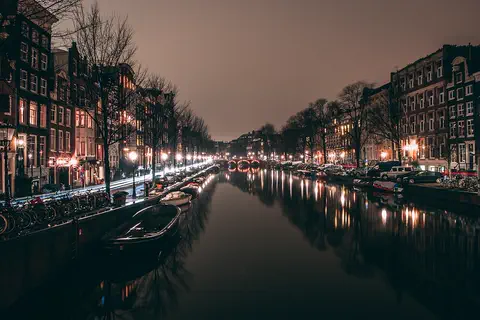
Amsterdam
Amsterdam is the capital of the Netherlands. It began as a fishing village beside a dam on the Amstel River, which gave the city its name. Today about 942,000 people live among its rings of canals, hundreds of bridges, houseboats and bicycles.
-
 Watch
City
Antwerp
Antwerp is a city in Belgium on the Scheldt river, and Universalis calls it the second port of continental Europe, after Rotterdam. Belgium's statistics office estimated 565,615 people in the city on 1 January 2026. In the 1500s it was one of Europe's great trading cities.
-
 Watch
City
Athens
Athens is the capital of Greece and one of the oldest cities in the world. Above it rises the Acropolis, a rocky hill crowned by the marble Parthenon, built about 2,500 years ago. Ancient Athens was home to early democracy, great thinkers and theater.
-
 Watch
City
Barcelona
Barcelona, the capital of Catalonia in northeastern Spain, lies on the Mediterranean between mountains and the sea. It is famous for the buildings of the architect Antoni Gaudí, including the Sagrada Família, a giant church begun in 1882. About 1.7 million people live in the city (2025).
-
 Watch
City
Belgrade
Belgrade, the capital of Serbia, stands where the Sava River flows into the Danube. Its name, Beograd, means "white city", probably because of the white limestone walls of its old fortress above the rivers. At the 2022 census, about 1.2 million people lived in the city itself and about 1.7 million in the wider City of Belgrade.
For parents & teachers
What children will learn
- Locate Gomel on the Sozh River in southeast Belarus.
- Describe what a river port and a railway junction do for a city.
- Explain the difference between a census and an estimate.
- Read a climate table with cold winters and a rainy summer.
Recommended ages: 3 to 17 · About 15 minutes
Talk about it
- Why might a city grow where a river and several railway lines meet?
- What would you like to see in a museum that used to be a palace?
- Why might a city's official estimate be different from its last census?
Try at home or in class
- River trace: on a map, follow the Sozh from Gomel until it joins the Dnieper.
- Puppet show: make a simple sock puppet and put on a short show, like a puppet theater.
- Two-line graph: plot Gomel's monthly temperature and rain on one chart and see that July is the top of both.
Key vocabulary: tributary, river port, railway junction, combine harvester, estimate, census
Where these facts come from
- Wikidata , Wikimedia Foundation (CC0 1.0)
- Natural Earth vector data , Natural Earth (NACIS) (Public domain)
- Gomel , Store norske leksikon
- Gomel , Larousse encyclopédie
- Belarus: Regions, Major Cities & Settlements , City Population (Thomas Brinkhoff), from the National Statistical Committee of the Republic of Belarus
- 平年値データ (Normals data): Homel , Japan Meteorological Agency
- File:DJI 0123 Edit (51153515926).jpg (Andrey Kukharenko) , Wikimedia Commons
- World station normals (search by region and country) , Japan Meteorological Agency
- Wikimedia Commons , Wikimedia Foundation (Per file (public domain, CC0, CC BY or CC BY-SA); see each media record)
Checked, not yet human-reviewed. Last updated November 1, 2026. Spotted a mistake? Tell us.