
City Europe
Kharkiv
Kharkiv is a big city in Ukraine. It has a university, a metro and wide streets, and its winters are freezing cold.
Kharkiv is the second-largest city in Ukraine, in the northeast of the country, where three rivers meet. An official estimate put its population at about 1.42 million at the start of 2022. It is a city of universities, factories and railways.
Kharkiv, center of the Kharkiv Oblast in northeastern Ukraine, grew from a fortress built around 1655 into a trading town, a rail and engineering hub and, until 1934, the first capital of Soviet Ukraine. Ukraine's statistics service estimated 1,421,125 residents on 1 January 2022, second only to Kyiv.
Photo: Ekaterina Polischuk, CC BY-SA 4.0, via Wikimedia Commons
Discover Kharkiv
Kharkiv is a big city in Ukraine, a country in eastern Europe. It is the second-biggest city in the country.
Three rivers meet in Kharkiv.
Kharkiv is in the northeast of Ukraine, Universalis says, where three rivers meet: the Udy, the Lopan and the Kharkiv. It is the main town of the Kharkiv Oblast, a region with the same name.
Ukraine's statistics service estimated that 1,421,125 people lived in Kharkiv on 1 January 2022. Only Kyiv, the capital, had more.
City Population's table of Ukrainian cities (State Statistics Service of Ukraine) shows Kharkiv at 1,443,754 at the 1979 census, 1,609,959 in 1989, 1,470,902 in 2001 and an estimated 1,421,125 on 1 January 2022, second after Kyiv (2,952,301). The Kharkiv Oblast had 2,598,961 people at the same date.
City Population notes that Russia's invasion of Ukraine since February 2022 has considerably affected the number and spread of people in the country, so these figures come from before it.
- Country
- Ukraine (center of the Kharkiv Oblast)
- People in Kharkiv (estimate, 1 January 2022)
- 1,421,125
- People in Kharkiv (census, 5 December 2001)
- 1,470,902
- Rivers
- the Udy, the Lopan and the Kharkiv meet here
A tall tower and golden domes
This photo was taken from high up on a snowy winter day. In the middle is a white building with a very tall tower. On top of the tower is a shiny golden dome.
Around it are streets, cars and snowy trees.
The photo, taken from the air on 20 January 2021, shows the Dormition Cathedral in Kharkiv. Its tall white tower is lined with columns and topped by a golden dome, and smaller golden domes rise from the building behind it. Snow covers the roofs, the trees and the park in front.
About 1.9 kilometers to the north, Wikidata places Derzhprom, a set of buildings on Freedom Square, 108 meters tall, built from 1925 and opened in 1928.
The Commons description names the building as the Dormition (Uspensky) Cathedral, 2 Kvitky-Osnovianenka Street, recorded as monument number 63-101-1004 in Ukraine. The photo, by Ekaterina Polischuk, won 7th prize worldwide in Wiki Loves Monuments 2021.
Universalis says Kharkiv kept many monuments of its past, such as the 17th-century Pokrovsky Cathedral. Wikidata dates Derzhprom on Freedom Square to 1925-1928 and gives it a height of 108 m.
- Dormition Cathedral
- in the photo; recorded on Commons as monument number 63-101-1004
- Derzhprom
- a set of buildings on Freedom Square, 108 m tall, opened 1928
- Derzhprom from the Dormition Cathedral
- about 1.9 km north
From fortress to big city
Long ago, people built a fort here. A town grew up around it.
Later, trains and factories came, and Kharkiv became a big city.
Universalis traces Kharkiv back to about 1655, when a fortress was built to guard the southern borders of Russia; traces of its walls can still be seen. Set in a region of fertile black earth, the town soon became an important center of trade and crafts.
In 1869 the first railway to the Donbas coalfield set out from Kharkiv, and its factories, especially those making machines, grew fast. Kharkiv was the first capital of Soviet Ukraine, until Kyiv took over in 1934.
Universalis: a fortress around 1655; quick settlement of the black-earth country in the 18th century; seat of the Kharkov (Sloboda Ukraine) government in 1732; the 1869 railway to the Donets coal basin (Donbas); fast growth of mechanical engineering; first capital of the Soviet Ukrainian republic set up in 1917, until 1934.
After heavy damage in the Second World War, rebuilding gave the city wide avenues, large housing estates, big office buildings and vast factories, Universalis says, while many older monuments survived.
- Fortress
- built around 1655
- University
- founded 1805
- First railway to the Donbas coalfield
- 1869
- Capital of Soviet Ukraine
- until 1934, when Kyiv took over
Railways, metro and airport
Kharkiv has lots of railway lines. Trains come to the city from many directions.
It also has a metro, with trains that carry people around the city.
Universalis calls Kharkiv Ukraine's leading railway junction, served by eight main lines and three main-line stations, and a major road hub too.
Wikidata dates the Kharkiv Metro to 23 August 1975 and Kharkiv International Airport to 1954. The airport lies about 8.4 kilometers south-southeast of the Dormition Cathedral.
Universalis: eight main railway lines, three main-line stations, the first rail junction of Ukraine, a major road center with links toward Kyiv, western Ukraine and Zaporizhzhia.
From the Dormition Cathedral (Wikidata points): the National University of Kharkiv 1.62 km north, Derzhprom 1.87 km north, Kharkiv International Airport (1954) 8.40 km south-southeast. Wikidata gives the metro's opening as 23 August 1975.
- Railway junction
- eight main lines and three main-line stations (Universalis)
- Kharkiv Metro
- opened 23 August 1975
- Kharkiv International Airport
- opened 1954, about 8.4 km south-southeast of the Dormition Cathedral
Freezing winters, warm summers
Winter in Kharkiv is cold. In January, even the days are below freezing on average.
Summer days are warm, and July is the wettest month.
The World Meteorological Organization's table for Kharkiv (1991–2020) gives January an average high of about -2 °C and an average low of about -7 °C, so the average January day stays below freezing. In July, days average about 27 °C.
About 522 millimeters of rain and snow fall in an average year. July is the wettest month, with 63 millimeters, and April the driest, with 32.
The WMO table for Kharkiv (1991–2020) gives average highs from -2.1 °C in January to 27.3 °C in July and average lows from -6.8 °C in January to 16.6 °C in July. December, January and February all have average highs below 0 °C.
The monthly precipitation averages add up to 522 mm; May to July bring 175 mm, a third of the year. The photo, taken on 20 January 2021, shows the city under snow.
- January, average high (WMO, 1991–2020)
- -2.1 °C
- July, average high (same table)
- 27.3 °C
- Precipitation in a year (sum of the monthly averages)
- about 522 mm
Universities and factories
Kharkiv has a university and many other colleges. There are theaters, museums and even a planetarium, where you can learn about the stars.
Factories in the city make big machines.
Universalis calls Kharkiv one of Ukraine's liveliest centers of culture and learning. Besides its university, founded in 1805, it has a polytechnic institute, universities of medicine and agriculture, and engineering schools. It also has a botanical garden, a philharmonic hall, theaters, a planetarium and many museums.
Universalis says its industry is led by machine building: diesel locomotives, machine tools, mining and farm machinery, bicycles, generators and turbines.
Universalis lists Kharkiv's higher education (the university of 1805, a polytechnic institute, universities of medicine and agriculture, engineering schools), research institutes, a sports park, a botanical garden, a philharmonic hall, theaters (the oldest from 1780), a planetarium and many museums.
It describes industry led by machine building (diesel locomotives, machine tools, mining equipment, farm machinery, bicycles, generators, steam turbines, electrical equipment) along with food and consumer goods, with natural gas an important source of heat and energy.
- National University of Kharkiv
- founded 1805
- Oldest theater
- dates from 1780 (Universalis)
- Main industry
- machine building
Kharkiv on the map
Find Ukraine on the globe, in eastern Europe. Kharkiv is in the northeast of the country.
Kharkiv lies at about 50° north, in northeastern Ukraine, where the Udy, the Lopan and the Kharkiv rivers meet.
Measured from the Dormition Cathedral, the National University of Kharkiv is about 1.6 kilometers to the north, Derzhprom about 1.9 kilometers to the north and the airport about 8.4 kilometers to the south-southeast.
Kharkiv lies at about 50.00° N and 36.25° E, at the confluence of the Udy, the Lopan and the Kharkiv (Universalis). From the Dormition Cathedral (Wikidata points): university 1.62 km N, Derzhprom 1.87 km N, airport 8.40 km SSE; the photo's camera point on Commons is 0.19 km southwest of the cathedral.
Universalis places the city in a region of fertile black earth and describes road links toward Kyiv, western Ukraine and Zaporizhzhia.
- Latitude
- about 50.0° north
- Longitude
- about 36.2° east
- Region
- northeastern Ukraine
Amazing facts
-
This photo of Kharkiv won a prize in a big photo contest!
This aerial photo of the Dormition Cathedral won 7th prize worldwide in Wiki Loves Monuments 2021.
Commons records Ekaterina Polischuk's aerial photo (20 January 2021) as 7th prize worldwide in Wiki Loves Monuments 2021.
-
Kharkiv's university is more than 200 years old.
Universalis says Kharkiv's university was founded in 1805.
Universalis: university founded in 1805; Wikidata gives the National University of Kharkiv's inception as 17 January 1805.
-
Derzhprom is a group of tall buildings that is almost 100 years old.
Wikidata says Derzhprom, on Freedom Square, was built from 1925 and opened in 1928.
Wikidata: Derzhprom, a set of buildings on Freedom Square, inception 1925, opened 1928, height 108 m.
-
In Kharkiv, the average January day stays below freezing!
In the WMO's Kharkiv table, January days average -2.1 °C, while July days average 27.3 °C.
WMO Kharkiv (1991–2020): average highs stay below 0 °C in December (-0.6), January (-2.1) and February (-0.8).
Words to know
- fortress
- a strong building or town with walls, built to protect people
- confluence
- the place where two or more rivers meet
- railway junction
- a place where several railway lines meet
- black earth
- very dark, rich soil that is good for growing crops
- dome
- a rounded roof shaped like half a ball
- estimate
- a careful best guess made from the numbers that are known
Discovery challenge
-
Kharkiv is a city in which country?
Kharkiv is the second-largest city in which country?
Kharkiv is the center of an oblast in which country?
- Poland
- Ukraine
- Romania
Show the answer
Ukraine
Ukraine!
Ukraine.
Ukraine.
-
How many rivers meet in Kharkiv?
How many rivers meet at Kharkiv?
Universalis places Kharkiv at the confluence of how many rivers?
- One
- Two
- Three
Show the answer
Three
Three!
Three: the Udy, the Lopan and the Kharkiv.
Three: the Udy, the Lopan and the Kharkiv.
-
What was built in Kharkiv long ago, around 1655?
What was built at Kharkiv around 1655?
According to Universalis, what was built around 1655 to guard the southern borders of Russia?
- A fortress
- A metro
- An airport
Show the answer
A fortress
A fortress!
A fortress.
A fortress; traces of its walls still show.
-
What is winter like in Kharkiv?
In the WMO's Kharkiv table, what is January's average high?
Which WMO average high does Kharkiv have in January (1991–2020)?
- Below freezing
- Hot
- Like summer
Show the answer
Below freezing
Cold, below freezing!
Below freezing: about -2 °C.
-2.1 °C, below freezing.
-
What do many factories in Kharkiv make?
Which industry does Universalis say leads Kharkiv's factories?
Universalis says Kharkiv's industry is dominated by what?
- Machines
- Seashells
- Chocolate
Show the answer
Machines
Big machines!
Machine building, such as locomotives and farm machinery.
Machine building: diesel locomotives, machine tools, mining and farm machinery, turbines.
Nearby places
-
 Watch
City
Kyiv
Kyiv is the capital of Ukraine, on the high west bank of the Dnieper River. More than 1,000 years ago it was the center of Kyivan Rus, the first East Slavic state, and its 11th-century St. Sophia's Cathedral and Pechersk Lavra monastery are a UNESCO World Heritage Site. About 2.95 million people lived there in 2022.
-
Watch
Landmark
Saint Sophia Cathedral
Saint Sophia Cathedral in Kyiv, Ukraine, was begun in the first half of the 1000s, probably in 1037, for the ruler Yaroslav the Wise. Local builders worked with masters from the Byzantine Empire. Inside, it keeps mosaics and wall paintings from the 11th century, and outside, its domes were reshaped in the Ukrainian Baroque style. It became a World Heritage Site in 1990.
-
 Watch
City
Gomel
Gomel is a city in the southeast of Belarus, on the Sozh River, a branch of the Dnieper. Store norske leksikon calls it the country's second-largest city. The 2009 census counted 492,136 people there.
-
 Watch
City
Chișinău
Chișinău is the capital of Moldova, a country in eastern Europe. It was first written about in 1436, and from 1817 a new part of the town was laid out on a grid of straight streets. It has many parks and lakes, and electric trolleybuses have carried its people since 1949. The 2024 census counted 567,038 people in the city.
-
 Watch
Landmark
Luzhniki Stadium
Luzhniki Stadium is the main arena of the Luzhniki Olympic Complex in Moscow, Russia. It was built in just 450 days and opened in 1956. It was the center of the 1980 Summer Olympics, and after a rebuilding with 81,000 seats it hosted the final of the 2018 FIFA World Cup.
-
 Watch
Landmark
Novodevichy Convent
The Novodevichy Convent stands in southwest Moscow, near the Moscow River. Founded in the 1520s, it is surrounded by a high wall with 12 towers, and its 14 buildings are among the best examples of a style called Moscow Baroque. It became a UNESCO World Heritage Site in 2004.
-
 Watch
Landmark
Moscow Kremlin
The Moscow Kremlin is the oldest part of Moscow. It began as a wooden fort on a hill by the Moskva River. Its present walls and towers were built from 1485 to 1516. Inside stand golden-domed cathedrals, palaces, a tall bell tower and museums.
-
 Watch
Landmark
St. Basil's Cathedral
St. Basil's Cathedral stands at the end of Red Square in Moscow. Tsar Ivan IV ordered it in 1555, and it was finished by 1561. It is really ten small churches in one building, each with its own colorful dome, and today it is a museum.
Explore next
-
 Watch
 Country
Ukraine
Ukraine is a large country in eastern Europe on the northern shore of the Black Sea. Most of it is level plain with some of the most fertile soil in the world, crossed by the Dnieper River. Its capital is Kyiv, and its official language is Ukrainian.
-
Watch
City
Kyiv
Kyiv is the capital of Ukraine, on the high west bank of the Dnieper River. More than 1,000 years ago it was the center of Kyivan Rus, the first East Slavic state, and its 11th-century St. Sophia's Cathedral and Pechersk Lavra monastery are a UNESCO World Heritage Site. About 2.95 million people lived there in 2022.
-
Watch
City
Lviv
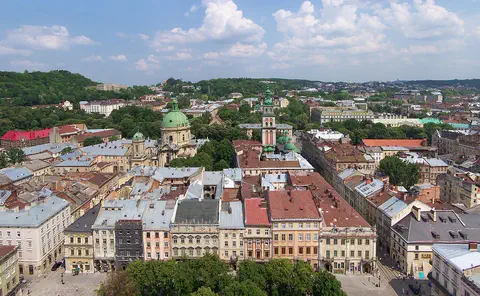
Lviv is a city in western Ukraine, founded in 1256 and named after Lev, a prince's son. Its old center, with a market square, castle hill and churches of many kinds, is on UNESCO's World Heritage List. Ukraine's statistics service estimated 717,273 people there at the start of 2022.
-
 Watch
City
Warsaw
Warsaw is the capital of Poland, on the Vistula River. Much of the city was destroyed in World War II, and afterward its people rebuilt the Old Town so carefully that UNESCO made it a World Heritage Site. About 1.86 million people lived there in 2024.
-
 Watch
City
Amsterdam
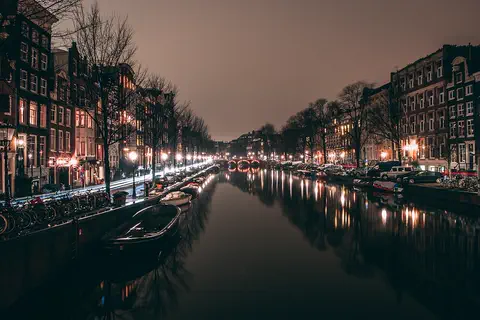
Amsterdam is the capital of the Netherlands. It began as a fishing village beside a dam on the Amstel River, which gave the city its name. Today about 942,000 people live among its rings of canals, hundreds of bridges, houseboats and bicycles.
-
 Watch
City
Antwerp
Antwerp is a city in Belgium on the Scheldt river, and Universalis calls it the second port of continental Europe, after Rotterdam. Belgium's statistics office estimated 565,615 people in the city on 1 January 2026. In the 1500s it was one of Europe's great trading cities.
-
 Watch
City
Athens
Athens is the capital of Greece and one of the oldest cities in the world. Above it rises the Acropolis, a rocky hill crowned by the marble Parthenon, built about 2,500 years ago. Ancient Athens was home to early democracy, great thinkers and theater.
-
 Watch
City
Barcelona
Barcelona, the capital of Catalonia in northeastern Spain, lies on the Mediterranean between mountains and the sea. It is famous for the buildings of the architect Antoni Gaudí, including the Sagrada Família, a giant church begun in 1882. About 1.7 million people live in the city (2025).
For parents & teachers
What children will learn
- Locate Kharkiv in northeastern Ukraine, where three rivers meet.
- Explain how a railway junction and nearby coal helped a city's factories grow.
- Read a climate table with winters below freezing and warm summers.
- Compare census and estimate figures from different years.
Recommended ages: 3 to 17 · About 15 minutes
Talk about it
- Kharkiv began as a fortress. Why might people build forts where rivers meet?
- Eight main railway lines meet at Kharkiv. How can railways help a city grow?
- Kharkiv has a university more than 200 years old. What makes a city a good place for students?
Try at home or in class
- Temperature chart: plot Kharkiv's monthly average highs and lows and mark where they cross 0 °C.
- River map: draw three rivers meeting and add a fortress where you would build it.
- Building sketch: draw the tall tower from the photo and label its columns, windows and golden dome.
Key vocabulary: fortress, confluence, railway junction, black earth, dome, estimate
Where these facts come from
- Wikidata , Wikimedia Foundation (CC0 1.0)
- Natural Earth vector data , Natural Earth (NACIS) (Public domain)
- Ukraine: Provinces and Major Cities , City Population (Thomas Brinkhoff), from the State Statistics Service of Ukraine
- Kharkiv , Encyclopaedia Universalis
- World Weather Information Service: Kharkiv climatological information , World Meteorological Organization
- File:Успенський собор взимку, аерофото.jpg (Ekaterina Polischuk, 20 January 2021) , Wikimedia Commons
- Wikimedia Commons , Wikimedia Foundation (Per file (public domain, CC0, CC BY or CC BY-SA); see each media record)
Checked, not yet human-reviewed. Last updated November 1, 2026. Spotted a mistake? Tell us.