City Europe
Lviv
Lviv is a city in the west of Ukraine. It has a big old square with colorful houses and a tall town hall tower.
Lviv is a city in western Ukraine, founded in 1256 and named after Lev, a prince's son. Its old center, with a market square, castle hill and churches of many kinds, is on UNESCO's World Heritage List. Ukraine's statistics service estimated 717,273 people there at the start of 2022.
Founded in 1256 by Prince Daniel Romanovich and named for his son Lev, Lviv lies on old east–west routes near the passes of the Carpathians and was long the main city of Galicia. Its historic center was listed by UNESCO in 1998. The official estimate for 1 January 2022 was 717,273 people, sixth in Ukraine.
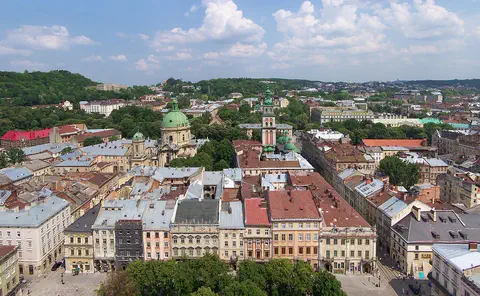
Photo: Lestat (Jan Mehlich), CC BY-SA 3.0, via Wikimedia Commons
Discover Lviv
Lviv is a city in the west of Ukraine. Its old center is full of pretty houses and old churches.
Lviv has had many names in different languages.
Lviv is a city in western Ukraine, some 470 kilometers west of the capital, Kyiv. It is the center of the Lviv region, and for centuries it was the main city of Galicia, a historic region now divided between Ukraine and Poland.
The city has had several names: Lwów in Polish, Lemberg in German and Lvov in Russian. Ukraine's statistics service estimated 717,273 people in Lviv on 1 January 2022.
City Population's table of Ukraine's State Statistics Service figures gives Lviv 717,273 people in the estimate of 1 January 2022, the sixth most in the country.
Universalis says Lviv's position on east–west routes beside a passage through the Carpathian Mountains gave it strategic importance, and that it stood at the meeting point of Polish, Austro-Hungarian, German, Russian and Ukrainian influences.
- Country
- Ukraine (center of Lviv Oblast)
- People in Lviv (estimate, 1 January 2022)
- 717,273
- Other names
- Lwów (Polish), Lemberg (German), Lvov (Russian)
- Distance from Kyiv
- some 470 km west
A market square and a castle hill
Lviv's central square is called the Market Square. A tall town hall tower stands in it.
From the top of the tower, you can see the whole old town!
UNESCO put Lviv's historic center on its World Heritage List in 1998. The oldest part is around the High Castle hill, and below it streets and squares grew up between the 1200s and 1600s. The city center, with many Renaissance and Baroque houses, developed in the 1300s.
Lviv's central square is the Market Square, with the Town Hall standing in it; Wikidata dates today's town hall building to 1835. The hero photo was taken from its tower. Since 2023 the historic center has also been on UNESCO's List of World Heritage in Danger.
UNESCO's entry (criteria ii and v; 120 ha, buffer zone 2,441 ha) describes the High Castle and the area around it as the main and oldest part of the town, keeping its original topography: a castle hill with lowlands where streets and squares developed between the 13th and 17th centuries. Buildings of many communities survive, including a mosque, a synagogue and Orthodox, Armenian and Catholic churches.
The Seredmistia, the city center, developed in the 14th century, with Renaissance and Baroque houses and parks on the site of the medieval walls. UNESCO lists the property as in danger from 2023.
- World Heritage List
- 1998 (L'viv – the Ensemble of the Historic Centre)
- Protected area
- 120 hectares
- Town Hall (today's building)
- 1835 (Wikidata)
A city of many rulers
Long ago, a prince started the city and named it after his son, Lev.
Over hundreds of years, many different countries ruled Lviv.
Universalis says Lviv was founded in 1256 by Prince Daniel Romanovich, king of Galicia–Volhynia, who named it after his son Lev. UNESCO adds that people had lived on the site since the 5th and 6th centuries.
Over the centuries the city belonged in turn to Poland, to Austria (when it was called Lemberg) and to the Soviet Union. In 1991 it became part of independent Ukraine.
Universalis says Poland took the city in 1349 and held it for centuries, Austria annexed it in 1772, and as Lemberg it was the capital of the Kingdom of Galicia and Lodomeria in Austria-Hungary from 1867 to 1914. After the First World War it was given to Poland. The Second World War brought occupation and great suffering, including the persecution of the city's large Jewish community.
From 1945 it was part of the Soviet Union, as the center of a region of Soviet Ukraine, until Ukraine became independent in 1991. Universalis notes that despite the damage of its history, Lviv kept a rich heritage, which led UNESCO to list its center in 1998.
- Founded
- 1256, by Prince Daniel Romanovich
- Named after
- the prince's son, Lev (Leo)
- Part of independent Ukraine
- since 1991
Trams through the old town
Lviv has trams that ride on rails through the streets.
The rails are 1 meter apart.
Lviv's trams run on narrow, 1-meter tracks. UrbanRail.Net lists a network of about 33.5 kilometers with 9 lines. A new line to the southern district of Sykhiv opened in two parts, in November 2016 and April 2017.
Lviv's airport, which Wikidata dates to 1929, lies about 6.3 kilometers west-southwest of the Town Hall.
UrbanRail.Net gives the Lviv tram network as about 33.5 km, 9 lines, 1,000 mm gauge, with Tatra and Electron trams; the 5.4 km southern extension from Akademiya Mistetstv to Sykhiv opened as far as Kinoteatr im. Dovzhenka (3.9 km) on 17 November 2016 and to Vernads'kogo on 15 April 2017.
Wikidata gives Lviv's international airport an opening year of 1929 and places it 6.31 km west-southwest of the Town Hall.
- Tram network
- about 33.5 km, 9 lines
- Sykhiv tram extension
- opened 2016–2017 (5.4 km)
- Airport
- opened 1929 (Wikidata)
Cold winters and mild summers
Winters in Lviv are cold. Summers are warm.
Rain or snow falls on many days of the year.
The World Meteorological Organization's averages for Lviv (1991–2020) show daytime highs of about 25 °C in July and August. In January, days hover around 0 °C and nights drop to about −6 °C.
About 764 millimeters of precipitation fall in an average year, spread over about 163 days. July is the wettest month and January the driest.
The WMO table for Lviv, 1991–2020, gives average highs from 0.2 °C in January to 24.7 °C in July (24.5 °C in August) and average lows from −5.7 °C in January to 13.7 °C in July. Lows stay below freezing from December to March.
The monthly averages add up to about 764 mm on about 163 days. July is the wettest month (96 mm), then May (93 mm) and June (86 mm); January is the driest (45 mm).
- July, average high (WMO, 1991–2020)
- 24.7 °C
- January, average low (same period)
- −5.7 °C
- Precipitation in a year (sum of the monthly averages)
- about 764 mm
Opera, squares and old streets
Lviv has an opera house where people watch music and dance shows.
People walk through old streets and busy squares in the center.
UNESCO says Lviv's buildings and art mix Eastern European traditions with ideas from Italy and Germany. The city grew as a center of government, religion and trade, thanks to its good position on trade routes.
The Lviv Theatre of Opera and Ballet, which Wikidata dates to 1900, stands about 0.4 kilometers west-northwest of the Town Hall.
UNESCO's synthesis says L'viv flourished as an administrative, religious and commercial center because of its favorable position for trade and political development, and that its surviving architecture and art reflect Eastern European traditions influenced by those of Italy and Germany.
Wikidata gives the Lviv Theatre of Opera and Ballet an inception of 1897 and an opening of 1900, 0.44 km west-northwest of the Town Hall.
- Lviv Theatre of Opera and Ballet
- opened 1900 (Wikidata)
- Historic region
- Galicia
- Art and buildings
- Eastern European traditions mixed with Italian and German ones
Lviv on the map
Find Ukraine on the globe. Look at the west, close to Poland. Lviv is there!
Lviv lies at about 49.8° north and 24.0° east, in western Ukraine, not far from the border with Poland.
Measured from the Town Hall, which stands in the Market Square, the opera house is about 0.4 kilometers to the west-northwest and the airport about 6.3 kilometers to the west-southwest. The hero photo was taken from the Town Hall's tower, looking out over the roofs of the old town.
Lviv lies at about 49.84° N and 24.03° E. Measured from Lviv Town Hall (Wikidata points): the Market Square's point 0.04 km south, the Lviv Theatre of Opera and Ballet 0.44 km west-northwest, and the international airport 6.31 km west-southwest.
The hero photo was taken on 25 May 2007 from the Town Hall tower (Commons: 'Widok z wieży ratuszowej', view from the town hall tower; camera position 49.841854° N, 24.031584° E).
- Latitude
- about 49.8° north
- Longitude
- about 24.0° east
- Town Hall to the opera house
- about 0.4 km west-northwest
Amazing facts
-
Lviv is named after a prince's son called Lev.
Universalis says Prince Daniel Romanovich named the city after his son Lev, or Leo.
Universalis: founded in 1256 by Daniel Romanovich, king of Galicia–Volhynia from 1253 to 1264, and named in honor of his son Leo (Lev in Ukrainian).
-
Lviv has had four different names!
Lviv has been called Lwów in Polish, Lemberg in German and Lvov in Russian.
Universalis lists the names Lvov (Russian), Lwów (Polish) and Lemberg (German); as Lemberg it was the capital of the Kingdom of Galicia and Lodomeria from 1867 to 1914.
-
People have lived where Lviv stands for about 1,500 years.
UNESCO says a settlement stood on Lviv's site in the 5th and 6th centuries, long before the city was founded.
UNESCO's synthesis: the city was founded in the late Middle Ages where a settlement had existed since the 5th and 6th centuries; the High Castle area is the oldest part.
-
Lviv's trams run on rails 1 meter apart.
The two rails of Lviv's tram tracks are 1 meter apart.
UrbanRail.Net gives the Lviv tram's gauge as 1,000 mm, with about 33.5 km of network and 9 lines.
Words to know
- town hall
- the building where a town's local government works
- market square
- an open space in the middle of an old town where markets were held
- gauge
- the distance between the two rails of a track
- Renaissance
- a period in Europe, from about the 1300s to the 1600s, known for new art and buildings
- region
- a large area of a country
- heritage
- old buildings, art and traditions passed down from the past
Discovery challenge
-
Lviv is in which country?
Lviv is a city in the west of which country?
Since 1991, Lviv has been part of which independent country?
- Poland
- Ukraine
- Austria
Show the answer
Ukraine
Ukraine!
Ukraine, some 470 km west of Kyiv.
Ukraine, independent since 1991.
-
Lviv is named after whom?
Prince Daniel named Lviv after whom?
In 1256 Prince Daniel Romanovich named the new city in honor of whom?
- His son Lev
- His horse
- A river
Show the answer
His son Lev
His son, Lev!
His son Lev (Leo).
His son Leo, Lev in Ukrainian.
-
What tall building stands in Lviv's big square?
What stands in Lviv's Market Square?
From which building's tower was the hero photo of Lviv's old town taken?
- The Town Hall
- An airport
- A stadium
Show the answer
The Town Hall
The town hall!
The Town Hall, with its tall tower.
The Town Hall, in the Market Square.
-
What was Lviv called in German?
Lviv was the capital of Galicia under which German name?
Under which name was Lviv the capital of the Kingdom of Galicia and Lodomeria (1867–1914)?
- Lemberg
- Hamburg
- Salzburg
Show the answer
Lemberg
Lemberg!
Lemberg.
Lemberg, within Austria-Hungary.
-
Which month is the coldest in Lviv?
Which month has Lviv's coldest average nights?
In the WMO's 1991–2020 averages, which month has Lviv's lowest average low (−5.7 °C)?
- January
- May
- August
Show the answer
January
January!
January, at about −6 °C.
January (−5.7 °C), then February (−4.8 °C).
Nearby places
-
 Watch
City
Košice
Košice is the second-largest city in Slovakia and the center of the country's east. It lies in the valley of the Hornád River, with hills and mountains around it. Slovakia's 2021 census counted 229,040 people in the city.
-
 Watch
City
Kraków
Kraków is a city in southern Poland on the Vistula River. For almost three centuries it was the capital of Poland, where kings were crowned and buried at Wawel Hill. Its historic center is a UNESCO World Heritage Site, and about 816,600 people lived in the city at the end of 2025.
-
 Watch
Natural wonder
Białowieża Forest
Białowieża Forest is a forest of conifers and broadleaved trees in Poland and Belarus. UNESCO calls it an immense range of primary forest, and it is home to the largest free-roaming population of European bison.
-
 Watch
Natural wonder
Carpathians
The Carpathians are a long mountain range in Europe, shared by seven countries that protect it together under the Carpathian Convention. They hold some of Europe's last untouched forests, nearly 4,000 kinds of plants and big populations of brown bears, wolves and lynxes.
-
 Watch
City
Warsaw
Warsaw is the capital of Poland, on the Vistula River. Much of the city was destroyed in World War II, and afterward its people rebuilt the Old Town so carefully that UNESCO made it a World Heritage Site. About 1.86 million people lived there in 2024.
-
 Watch
City
Ostrava
Ostrava is the third-largest city in Czechia and the capital of the Moravian-Silesian Region. Universalis says it was born of the industrial revolution, as a place for mining coal, and grew with a big iron and steel industry. Czechia's 2021 census counted 282,450 people.
-
 Watch
City
Budapest
Budapest, the capital of Hungary, was made in 1873 by joining three towns on the Danube River: hilly Buda and old Óbuda on one bank and flat Pest on the other. About 1.7 million people live there (2026), with hot springs under the ground and the first underground railway built on the European mainland.
-
 Watch
City
Kyiv
Kyiv is the capital of Ukraine, on the high west bank of the Dnieper River. More than 1,000 years ago it was the center of Kyivan Rus, the first East Slavic state, and its 11th-century St. Sophia's Cathedral and Pechersk Lavra monastery are a UNESCO World Heritage Site. About 2.95 million people lived there in 2022.
Explore next
-
Watch
 Country
Ukraine
Ukraine is a large country in eastern Europe on the northern shore of the Black Sea. Most of it is level plain with some of the most fertile soil in the world, crossed by the Dnieper River. Its capital is Kyiv, and its official language is Ukrainian.
-
Watch
City
Kyiv
Kyiv is the capital of Ukraine, on the high west bank of the Dnieper River. More than 1,000 years ago it was the center of Kyivan Rus, the first East Slavic state, and its 11th-century St. Sophia's Cathedral and Pechersk Lavra monastery are a UNESCO World Heritage Site. About 2.95 million people lived there in 2022.
-
Watch
City
Kraków
Kraków is a city in southern Poland on the Vistula River. For almost three centuries it was the capital of Poland, where kings were crowned and buried at Wawel Hill. Its historic center is a UNESCO World Heritage Site, and about 816,600 people lived in the city at the end of 2025.
-
Watch
City
Warsaw
Warsaw is the capital of Poland, on the Vistula River. Much of the city was destroyed in World War II, and afterward its people rebuilt the Old Town so carefully that UNESCO made it a World Heritage Site. About 1.86 million people lived there in 2024.
-
 Watch
City
Kharkiv
Kharkiv is the second-largest city in Ukraine, in the northeast of the country, where three rivers meet. An official estimate put its population at about 1.42 million at the start of 2022. It is a city of universities, factories and railways.
-
 Watch
City
Amsterdam
Amsterdam is the capital of the Netherlands. It began as a fishing village beside a dam on the Amstel River, which gave the city its name. Today about 942,000 people live among its rings of canals, hundreds of bridges, houseboats and bicycles.
-
 Watch
City
Antwerp
Antwerp is a city in Belgium on the Scheldt river, and Universalis calls it the second port of continental Europe, after Rotterdam. Belgium's statistics office estimated 565,615 people in the city on 1 January 2026. In the 1500s it was one of Europe's great trading cities.
-
 Watch
City
Athens
Athens is the capital of Greece and one of the oldest cities in the world. Above it rises the Acropolis, a rocky hill crowned by the marble Parthenon, built about 2,500 years ago. Ancient Athens was home to early democracy, great thinkers and theater.
For parents & teachers
What children will learn
- Locate Lviv in western Ukraine, near Poland and the Carpathian Mountains.
- Describe how a city's name and rulers changed over the centuries.
- Recognize what makes a historic center a World Heritage site.
- Read monthly temperature and precipitation averages for a city with cold winters.
Recommended ages: 3 to 17 · About 15 minutes
Talk about it
- Lviv has had names in Ukrainian, Polish, German and Russian. Why might one city have so many names?
- Lviv grew on trade routes between east and west. How do routes help a city grow?
- Why do people work to protect old town centers?
Try at home or in class
- Name map: draw Lviv on a map of Europe and label it with its four names.
- Climate chart: plot Lviv's monthly highs and lows and color the months when nights fall below freezing.
- Square plan: draw a market square with a town hall in the middle and houses around the edges.
Key vocabulary: town hall, market square, gauge, Renaissance, region, heritage
Where these facts come from
- Wikidata , Wikimedia Foundation (CC0 1.0)
- Natural Earth vector data , Natural Earth (NACIS) (Public domain)
- Ukraine: Provinces and Major Cities , City Population (Thomas Brinkhoff), from the State Statistics Service of Ukraine
- L'viv – the Ensemble of the Historic Centre (World Heritage List) , UNESCO World Heritage Centre
- Lviv , Encyclopaedia Universalis
- L'viv Tram , UrbanRail.Net (Robert Schwandl)
- World Weather Information Service: Lviv climatological information , World Meteorological Organization
- File:Lwów - Widok z wieży ratuszowej 01.jpg (Lestat (Jan Mehlich), 25 May 2007) , Wikimedia Commons
- Wikimedia Commons , Wikimedia Foundation (Per file (public domain, CC0, CC BY or CC BY-SA); see each media record)
Checked, not yet human-reviewed. Last updated November 1, 2026. Spotted a mistake? Tell us.