
Natural wonder Europe
Svalbard
Svalbard is a group of icy islands far in the north. They belong to Norway. Polar bears, reindeer and walruses live there.
Svalbard is a group of Arctic islands, part of Norway, far north of the Arctic Circle. Glaciers and snowfields cover nearly 60 percent of the land. Polar bears hunt seals on the sea ice, walruses rest on the beaches, and inside a mountain on Spitsbergen the world keeps a frozen store of seeds.
Svalbard is a Norwegian archipelago between 74° and 81° N, about 930 km north of Tromsø (Britannica). Folded and faulted rocks from many geological eras form its mountains, and glaciers and snowfields cover nearly 60 percent of it. A 1920 treaty gave Norway possession while granting other signatory countries equal mineral rights. About 2,500 people lived in Longyearbyen and Ny-Ålesund in 2026 (Statistics Norway), and the Global Seed Vault there held more than 1.4 million seed samples by June 2026.
Photo: Per Harald Olsen – User Perhols on no.wikipedia, CC BY 2.5, via Wikimedia Commons
Discover Svalbard
Svalbard is a group of islands near the North Pole.
The islands have tall mountains and lots of ice and snow. Polar bears walk on the ice. The islands are part of a country called Norway. A few thousand people live in small towns there.
Svalbard is an archipelago, a group of islands, in the Arctic Ocean. It lies far north of the Arctic Circle, about 930 kilometers north of the Norwegian city of Tromsø. Britannica lists nine main islands. The biggest by far is Spitsbergen.
Svalbard is part of Norway. Its landscape is wild: sharp mountains, long fjords cut into the coast, and glaciers and snowfields that cover nearly 60 percent of the land. Only a few thousand people live here. Statistics Norway counted 2,504 people in Longyearbyen and the research village of Ny-Ålesund in July 2026, and there are smaller settlements too.
Britannica places Svalbard between longitudes 10° and 35° E and latitudes 74° and 81° N, about 930 km north of Tromsø. Its nine main islands are Spitsbergen, North East Land (Nordaustlandet), Edge Island, Barents Island, Prins Karls Foreland, Kvit Island, Kong Karls Land, Bjørn (Bear) Island and Hopen. Britannica gives a total area of 62,700 km², with Spitsbergen alone covering 39,044 km²; Store norske leksikon, Norway's national encyclopedia, gives a land area of 61,022 km².
The western and northern coasts of Spitsbergen and Nordaustlandet are cut deeply by fjords, while the east coast of Nordaustlandet ends in a wall of inland ice. The highest point is Newtontoppen (Newton Peak) on Spitsbergen, 1,713 m in Natural Earth's data and 1,717 m by Britannica's figure. Statistics Norway recorded 2,504 residents in Longyearbyen and Ny-Ålesund on 1 July 2026; Britannica notes there are no indigenous inhabitants and that Longyearbyen is the administrative center.
- Part of
- Norway
- Total area (Britannica)
- 62,700 km²
- Largest island
- Spitsbergen, 39,044 km²
- Covered by glaciers and snowfields
- nearly 60 percent
- People in Longyearbyen and Ny-Ålesund (July 2026)
- 2,504
Rocks from many ages, carved by ice
The rocks of Svalbard are very, very old.
Some were made at the bottom of the sea. Some were made from melted rock deep underground. Over a long time the rocks were pushed and folded into mountains. Then ice carved them into sharp peaks.
Svalbard is like a giant library of rocks. The Norwegian Polar Institute says no other place in northern Europe shows so many ages of Earth's history in its rocks. Because there is little soil or plant cover, the bare rock is easy to see.
Some rocks are hard, ancient granite: the highest mountain, Newtontoppen, is made of it. Others are layers of sand, gravel and mud that piled up over millions of years, some of them on old sea floors. Over millions of years, the rocks were folded and broken by movements of Earth's crust, which Britannica says gave the islands their mountains. During the last ice age most of Svalbard was buried under ice, and glaciers still cover much of it today. Many of them reach all the way to the sea. Austfonna, on Nordaustlandet, is the largest ice cap in Scandinavia by area, according to the US National Snow and Ice Data Center.
The Norwegian Polar Institute's geological guide divides Svalbard's rocks into three units: an old basement (Precambrian to Silurian), unaltered sedimentary rocks (late Palaeozoic to Tertiary) and young Quaternary deposits. The basement was assembled from crustal blocks that came from places thousands of kilometers apart and were thrust together in several orogenies, ending with the Caledonian mountain-building about 410 million years ago, when Svalbard's rocks lay in a chain that ran through Scandinavia to Scotland. Granite intruded during that uplift forms Newtontoppen.
The institute stresses that the old idea that Svalbard drifted from the Equator is only partly correct: its Devonian rocks, deposited 410 to 360 million years ago in a tropical zone, formed before much of today's bedrock existed. Britannica attributes the mountainous relief to folding and faulting, and notes coastal plains formed when sea level was higher. Most of the archipelago was ice-covered in the last ice age, and glaciers and snowfields still cover nearly 60 percent of it, many ending in the sea.
Polar bears, walruses and reindeer
Polar bears live on Svalbard's ice and islands.
They hunt seals on the sea ice. Big walruses rest on the beaches. Small reindeer munch plants. Lots of seabirds come in summer to lay eggs.
Svalbard has no trees except tiny ones: the polar willow and the dwarf birch, which hug the ground. Mosses and lichens cover much of the land, and in summer flowers bloom in the valleys.
The Norwegian Polar Institute says only three kinds of land mammals live here: the Svalbard reindeer, which lives nowhere else, the Arctic fox and a small vole. Polar bears depend on the sea and sea ice, where they hunt ringed seals. Walruses were down to a few hundred when they were protected in 1952, and they have come back: scientists estimated about 3,900 in 2012. Polar bears, once heavily hunted, were protected in 1973. In summer, huge flocks of seabirds nest on cliffs, and their droppings feed the lush green plants below.
Britannica describes Arctic vegetation of lichens and mosses, with only two dwarf trees, the polar willow and the dwarf birch. The Norwegian Polar Institute counts only three land mammals: the Svalbard reindeer (Rangifer tarandus platyrhynchus), a subspecies found only in Svalbard and estimated at about 10,000 animals; the Arctic fox; and the sibling vole. Attempts to introduce muskox and hares failed. Marine mammals include polar bears, walruses, five seal species and 12 whale species.
Polar bears, protected since 1973, are strongly tied to the sea ice and its ringed seals; a joint Norwegian-Russian survey in 2004 estimated nearly 3,000 bears in the shared population of Svalbard and Franz Josef Land. Walruses were protected in 1952, when only a few hundred remained; estimates rose to about 2,500 in 2006 and 3,900 in 2012. Ringed seals number about 100,000. Seabirds move nutrients from sea to land: the institute notes a pair of little auks adds about 1 kg of droppings to the soil in a season, fertilizing the green slopes below the bird cliffs that reindeer, geese and ptarmigan graze.

Whalers, miners, scientists and seeds
Sailors found these islands long ago.
Later, people came to catch whales and dig for coal. Today scientists come to study the ice and animals. Seeds from all over the world are kept safe inside a mountain here.
Dutch explorers Willem Barents and Jacob van Heemskerck reached Svalbard in 1596. Whalers from many countries soon followed. When whaling faded, people came for coal. In 1920 countries signed a treaty that gave Norway the islands, while giving many other countries equal rights to its minerals.
Today Svalbard is a center for polar science, with a science center, a university center and the Svalbard Museum. And inside a mountain on Spitsbergen is the Svalbard Global Seed Vault, opened in 2008. Gene banks around the world send copies of their seeds there to be stored at minus 18 °C. In June 2026 it held more than 1.4 million seed samples.
Britannica notes the Icelandic Annals record a discovery in 1194, but the islands became widely known only after Willem Barents and Jacob van Heemskerck sighted them in June 1596. Dutch and English whalers arrived from 1611, followed by others whose quarrels led to the coast being divided; Russians came about 1715. After whaling declined, coal drew companies from several countries. The treaty of 9 February 1920 settled the islands' sovereignty, granting possession to Norway and mineral rights on an equal basis to various European and other countries. Norway and Russia agreed a maritime boundary in the Barents Sea in 2010.
The Svalbard Science Centre (2006) houses the Norwegian Polar Institute, the Svalbard Museum and the University Centre in Svalbard (1993). The Global Seed Vault, carved into solid rock and opened on 26 February 2008, stores duplicate seed samples free of charge more than 100 m inside the mountain, in permafrost at about minus 3 to 4 °C, cooled further to minus 18 °C. Its three halls can hold about 4.5 million samples; the June 2026 deposit brought the total to 1,401,285, and it is run by Norway's Ministry of Agriculture and Food with NordGen and the Crop Trust.

A fast-warming Arctic
Svalbard is getting warmer.
Some winters now bring rain instead of snow. Ice on the sea and on the land is melting. Scientists measure the changes every year.
Svalbard's climate is changing quickly. In 2019 a report called Climate in Svalbard 2100, made for Norway's Environment Agency, was presented in Longyearbyen. The Barents Observer, reporting on it, wrote that average temperatures were already about 4 °C warmer than in the early 1970s, and that winters had warmed by about 7 °C since 1971.
Warmer air brings rain instead of snow and thaws the frozen ground, called permafrost. That can cause landslides and floods. Polar bears and seals need sea ice, so less ice changes their world too. The report says that if greenhouse gas pollution stays medium to high, Svalbard could warm by another 7 to 10 °C by the year 2100.
The Climate in Svalbard 2100 report, commissioned by the Norwegian Environment Agency, was presented in Longyearbyen in February 2019. The Barents Observer's report on it gives average temperatures about 4 °C warmer than in the early 1970s and winter warming of about 7 °C since 1971. Co-author Lars Henrik Smedsrud said winter is warming four to five times as fast as summer and that roughly two months of winter have been lost since the 1970s. Under medium to high emission scenarios, the report projects a further rise in annual mean temperature of 7 to 10 °C by 2100.
The report expects more precipitation to fall as rain, more rain floods combined with snow and glacier melt, near-surface permafrost thawing in coastal and low-lying areas, and greater risks of landslides, avalanches and coastal erosion. The Norwegian Polar Institute notes that sea ice and the algae blooms at its edge are of utmost importance to seals, polar bears and seabirds. Researchers also stress that the worst outcomes can be reduced if emissions fall.
Visiting safely
Polar bears can be anywhere in Svalbard.
Outside the towns, grown-ups must carry tools to scare bears away. Stay far away from bears and walruses. Never leave food out, because bears can smell it.
The Norwegian Polar Institute says polar bears can turn up anywhere in Svalbard in summer: on beaches, in valleys and even on glaciers. Visitors must be ready to meet one at any time and must keep their distance. It is against the law to lure, chase or go looking for polar bears. Anyone going outside the settlements needs proper equipment to scare bears away.
Walruses need space too. The institute's advice is to watch them through binoculars, never to stand between a herd and the water, and to stay at least 30 meters from a group of males, or 150 meters if mothers and young are there. Svalbard's law asks every visitor to take care not to disturb animals, nesting birds or plants.
The Norwegian Polar Institute warns that polar bears may be met anywhere in Svalbard, on beaches, in valleys and on glaciers in summer and on the sea ice in winter, and that their curiosity and unpredictability cause most confrontations. Section 30 of the Svalbard Environmental Protection Act forbids luring, pursuing or otherwise seeking out polar bears in ways that disturb them or put people or bears at risk, and anyone traveling outside the settlements must carry means of scaring bears off. Camps should be away from beaches and glacier fronts, guarded or surrounded by warning systems, with food stored away from sleeping areas.
For walruses, the institute's cruise handbook advises observing herds with binoculars, landing small boats at least 300 m to the side and downwind, keeping groups small and quiet, never blocking a herd's retreat to the water, and keeping at least 30 m from all-male herds and 150 m from mixed herds with females and young. The act's duty of care requires visitors to avoid unnecessary damage or disturbance to nature and cultural heritage; tour groups should walk on dry, sparsely vegetated ground rather than trampling moss tundra.
Amazing facts
-
Seeds from all over the world are kept frozen inside a mountain in Svalbard.
The Svalbard Global Seed Vault is dug more than 100 meters into a mountain. The rock around it stays frozen, and machines cool the seeds to minus 18 °C.
The Seed Vault's storage halls lie more than 100 m inside the mountain under 40 to 60 m of rock; permafrost holds the rock at about minus 3 to 4 °C, and cooling brings the seeds to minus 18 °C.
-
Seabird droppings help plants grow green in Svalbard.
A pair of little auks, small seabirds, adds about 1 kilogram of droppings to the soil in one season. That is why the slopes below bird cliffs are so green.
The Norwegian Polar Institute notes that a pair of little auks adds about 1 kg of droppings a season, carrying nutrients from sea to land that feed the vegetation reindeer, geese and ptarmigan eat.
-
Svalbard has its very own kind of reindeer.
The Svalbard reindeer is a kind of reindeer that lives only in Svalbard. About 10,000 of them roam the islands.
Rangifer tarandus platyrhynchus is a subspecies found only in Svalbard, estimated at about 10,000 animals, densest in Nordenskiöld Land, Reindalen, Edgeøya and Barentsøya.
-
The highest mountain in Svalbard is made of granite.
Newtontoppen, Svalbard's highest mountain, is made of tough granite that formed when an ancient mountain chain was pushed up.
The Norwegian Polar Institute describes Newtontoppen as resistant granite that intruded the crust during the uplift of the Caledonian mountain chain.
Words to know
- archipelago
- a group of islands close together
- Arctic
- the very cold region around the North Pole
- glacier
- a huge mass of ice that moves slowly downhill
- sea ice
- ice that forms when the sea itself freezes
- permafrost
- ground that stays frozen all year round
- fjord
- a long, narrow arm of the sea between steep cliffs, carved by glaciers
- treaty
- a written agreement between countries
Discovery challenge
-
Which country do the Svalbard islands belong to?
Which country is Svalbard part of?
Under the 1920 treaty, which country was granted possession of Svalbard?
- Iceland
- Norway
- Canada
Show the answer
Norway
Norway! Svalbard is part of Norway.
Svalbard is part of Norway. A treaty signed in 1920 gave Norway the islands.
Norway, with mineral rights granted on an equal basis to various European and other countries.
-
What covers most of Svalbard's land?
What covers nearly 60 percent of Svalbard?
According to Britannica, what covers nearly 60 percent of the archipelago?
- Thick forests
- Glaciers and snowfields
- Sand dunes
Show the answer
Glaciers and snowfields
Ice and snow! Svalbard has many glaciers.
Glaciers and snowfields cover nearly 60 percent of the land, and many glaciers reach the sea.
Glaciers and snowfields; the only trees are the dwarf polar willow and dwarf birch.
-
Which big animal could you meet anywhere in Svalbard?
Which large animal does the Norwegian Polar Institute say visitors must be ready to meet anywhere in Svalbard?
Which animal does Svalbard law forbid people to lure, pursue or seek out?
- Polar bear
- Moose
- Gray wolf
Show the answer
Polar bear
The polar bear. Always stay far away from it.
Polar bears can turn up on beaches, in valleys and on glaciers, so visitors keep their distance and never go looking for them.
The polar bear: Section 30 of the Svalbard Environmental Protection Act forbids luring, pursuing or seeking it out.
-
What is kept safe inside a mountain in Svalbard?
What does the Svalbard Global Seed Vault store?
What does the Global Seed Vault store for gene banks around the world?
- Gold coins
- Copies of seeds
- Old ships
Show the answer
Copies of seeds
Seeds! They are kept cold and safe.
Gene banks send copies of their seeds to be stored at minus 18 °C. By June 2026 there were more than 1.4 million samples.
Duplicate seed samples, stored free of charge; the June 2026 deposit raised the total to 1,401,285.
-
How many kinds of land animals with fur live in Svalbard?
How many kinds of land mammals live in Svalbard?
How many terrestrial mammal species does the Norwegian Polar Institute list for Svalbard?
- 3
- 30
- 300
Show the answer
3
Just 3: reindeer, Arctic foxes and little voles.
Only three: the Svalbard reindeer, the Arctic fox and a small vole.
Three: Svalbard reindeer, Arctic fox and sibling vole; attempts to introduce muskox and hares failed.
Nearby places
-
 Watch
Natural wonder
Vatnajökull
Vatnajökull, in southeastern Iceland, is a huge ice cap covering about 7,500 square kilometers. It is Europe's largest ice cap by volume. Volcanoes lie hidden beneath the ice, and when they erupt, melting ice can burst out in sudden floods. The ice cap sits at the heart of Vatnajökull National Park, a World Heritage Site of "fire and ice".
-
 Watch
Natural wonder
Eyjafjallajökull
Eyjafjallajökull is an ice cap in southern Iceland that covers a volcano. In 2010 the volcano erupted for the first time since 1821. Melting ice and hot lava made very fine ash, and winds carried it over Europe. To keep passengers safe, more than 100,000 flights were canceled in one week of April.
-
 Watch
City
Helsinki
Helsinki is the capital of Finland, on a peninsula in the Gulf of Finland. Founded in 1550 and made the capital in 1812, it has white stone buildings, a sea fortress on islands, and the world's most northern metro. About 694,000 people lived there at the end of 2025.
-
 Watch
City
Oslo
Oslo, the capital of Norway, lies at the head of the Oslo Fjord. It was founded about 1050, burned down in 1624 and was rebuilt under a new name, Christiania, before taking back the name Oslo in 1925. About 729,000 people lived there in 2026.
-
 Watch
City
Saint Petersburg
Saint Petersburg, in northwestern Russia, was founded by Tsar Peter the Great in 1703 on the islands of the Neva River delta. It was Russia's capital from 1712 to 1918 and is famous for the Winter Palace and Hermitage museum, its canals and bridges and its 'White Nights'. About 5.65 million people lived there in 2025.
-
 Watch
Landmark
Hermitage Museum
The Hermitage in Saint Petersburg is one of the world's great art museums. Empress Catherine the Great started it in 1764 as her private collection, and it opened to the public in 1852. Today it fills five connected buildings, including the green and white Winter Palace, and holds nearly three million objects, from the Stone Age to today.
-
 Watch
City
Stockholm
Stockholm, the capital of Sweden, is built on islands and the mainland where Lake Mälaren meets an arm of the Baltic Sea. First mentioned as a town in 1252, it has a medieval Old Town, a royal palace, a 17th-century warship you can visit and subway stations full of art. About 985,000 people lived there in 2022.
-
 Watch
City
Tallinn
Tallinn, the capital of Estonia, lies on a bay of the Gulf of Finland. Its walled Old Town, with towers, church spires and a town hall finished in 1404, is, says UNESCO, an exceptionally complete and well-preserved medieval trading town, and today the city is also known for its technology companies.
Experiments to try
Explore next
-
 Watch
 Country
Norway
Norway stretches along the western side of the Scandinavian Peninsula, far into the Arctic. Deep, narrow inlets of the sea called fjords cut into its mountains, and about 5.6 million people live there, many of them near Oslo, the capital.
-
Watch
Animal
Polar bear
The polar bear is a huge bear that lives on the frozen sea of the Arctic. Thick fur and a layer of fat keep it warm, its amazing nose finds seals under the snow, and it can swim for many hours. It needs sea ice to hunt, so a warming Arctic is a big problem for it.
-
 Watch
3D
Animal
Walrus
The walrus is a huge Arctic sea mammal with long ivory tusks and a thick mustache of whiskers. It feels for clams on the sea floor, sucks out the soft part, and rests in big, noisy groups on sea ice and beaches.
-
 Watch
3D
Animal
Reindeer
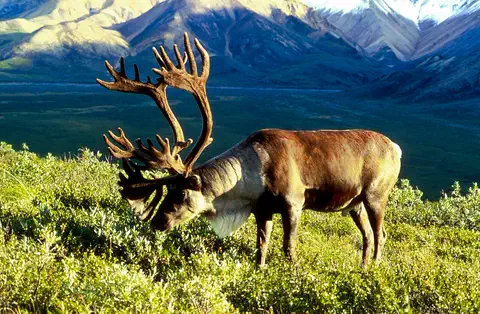
Reindeer, called caribou in North America, are deer of the Arctic tundra and northern forests. They are the only deer in which females grow antlers too. Some herds walk thousands of kilometers a year, and people in northern Europe and Asia have herded reindeer for a very long time.
-
 Watch
Animal
Arctic fox
The Arctic fox lives on the frozen tundra around the North Pole. Its coat changes color with the seasons, white or blue-gray in winter and brown or gray in summer, and it has short ears, a short nose and furry feet to keep the cold out. It eats lemmings, birds and leftovers from polar bears.
- Watch Geography Glaciers A glacier is a huge mass of ice and snow that slowly flows over land. It forms where more snow falls than melts, year after year, until the snow is squeezed into ice. Pulled by its own weight, it creeps downhill, carving wide valleys and carrying rocks along.
- Watch Geography The polar regions Earth has two polar regions, around the North and South Poles. They are mirror opposites. The Arctic is an ocean almost surrounded by land, and much of it is covered by floating sea ice. The Antarctic is a continent, Antarctica, covered by a thick ice sheet and surrounded by the Southern Ocean. Both are cold because the Sun's light reaches them weakly and, in winter, hardly at all.
- Watch Geography Midnight sun and polar night Because Earth is tilted, places near the poles lean toward the Sun for part of the year and away from it for another part. North of the Arctic Circle and south of the Antarctic Circle, that means days when the Sun never sets, called the midnight sun, and days when it never rises, called the polar night.
For parents & teachers
What children will learn
- Locate Svalbard in the Arctic Ocean and explain that it is part of Norway.
- Describe how folding, faulting and ice shaped the islands, and how much of the land is covered by glaciers.
- Name Svalbard's wildlife and explain why sea ice matters to polar bears and seals.
- Explain the purpose of the Global Seed Vault and how Svalbard's climate is changing.
Recommended ages: 3 to 17 · About 15 minutes
Talk about it
- Why might countries around the world want to keep copies of their seeds in one very cold, safe place?
- Walruses were nearly gone in 1952 and have come back. What do you think helped them?
- If winters in the Arctic get shorter, what might change for polar bears, seals and the people who live there?
Try at home or in class
- Sort a few kinds of dried seeds (beans, lentils, rice) into small labeled envelopes, like the boxes in the Seed Vault, and talk about why copies are kept safe.
- Freeze water in a shallow tray, break the ice into pieces in a bowl of water, and watch the pieces drift apart as they melt, like the sea ice polar bears need.
Key vocabulary: archipelago, Arctic, glacier, sea ice, permafrost, fjord, treaty
Where these facts come from
- Wikidata , Wikimedia Foundation (CC0 1.0)
- Natural Earth vector data , Natural Earth (NACIS) (Public domain)
- Svalbard , Encyclopaedia Britannica
- Svalbard , Store norske leksikon
- About the Seed Vault , Svalbard Global Seed Vault (Norwegian Ministry of Agriculture and Food)
- Glacier quick facts , National Snow and Ice Data Center (NSIDC)
- Population of Svalbard , Statistics Norway (SSB)
- Svalbard's geological development (Cruise Handbook for Svalbard) , Norwegian Polar Institute
- Svalbard's vegetation (Cruise Handbook for Svalbard) , Norwegian Polar Institute
- Wildlife in Svalbard (Cruise Handbook for Svalbard) , Norwegian Polar Institute
- Traffic and wildlife in Svalbard (Cruise Handbook for Svalbard) , Norwegian Polar Institute
- When humans meet polar bears in Svalbard , Norwegian Polar Institute
- The facility , Svalbard Global Seed Vault (Norwegian Ministry of Agriculture and Food)
- Svalbard Global Seed Vault crosses major milestone: 1.4 million seed samples secured , Svalbard Global Seed Vault (Norwegian Ministry of Agriculture and Food)
- Svalbard could become 10°C warmer , The Barents Observer (on the Climate in Svalbard 2100 report, February 2019)
- Wikimedia Commons , Wikimedia Foundation (Per file (public domain, CC0, CC BY or CC BY-SA); see each media record)
Checked, not yet human-reviewed. Last updated October 27, 2026. Spotted a mistake? Tell us.