
Landmark Australia and Oceania
Te Papa
Te Papa is New Zealand's national museum, in the city of Wellington. Its big building sits on special pads that help keep it safe in earthquakes!
Te Papa, the Museum of New Zealand, opened on Cable Street in Wellington on 14 February 1998. Its name means 'container of treasures'. The building stands on soft land near a major fault line, so it sits on 152 base isolators that let it move gently in an earthquake.
The Museum of New Zealand Te Papa Tongarewa grew from the Colonial Museum of 1865 and opened in its Cable Street building on 14 February 1998. The six-story, 50,000-tonne building, with 36,000 square meters of public floor space, rests on 152 lead-rubber base isolators, a New Zealand invention, to protect its people and collections.
Photo: Horst57, CC BY 3.0, via Wikimedia Commons
Discover Te Papa
Te Papa is a museum in Wellington, New Zealand.
It is full of New Zealand's treasures. Its name means 'container of treasures'.
Te Papa is New Zealand's national museum. It stands on Cable Street in Wellington and opened on 14 February 1998. It cares for more than two million objects, including the national art collection.
Its Māori name, Te Papa Tongarewa, means 'container of treasures'. Inside, it has 36,000 square meters of public floor space, about the size of three rugby fields.
Te Papa opened on Cable Street on 14 February 1998, on time and within budget, housing the national art collection among its taonga (treasures). The museum cares for more than two million objects and describes its approach as narrative-based, interdisciplinary and interactive, with a commitment to biculturalism.
Its Māori name, Te Papa Tongarewa, translates literally as 'container of treasures'. The museum's land covers 2.3019 hectares.
- Where
- Cable Street, Wellington, New Zealand
- Opened
- 14 February 1998
- Public floor space
- 36,000 m²
- Base isolators
- 152
From a tiny museum to Te Papa
Long ago, New Zealand had a tiny museum.
It grew and grew. In 1998 it moved into a big new building called Te Papa!
Te Papa began as the tiny Colonial Museum, which opened in Wellington in 1865. In 1907 it was renamed the Dominion Museum, and in 1936 it moved into a new building on Buckle Street with a new National Art Gallery.
By the 1980s that building was full. A law passed in 1992 joined the museum and the gallery together, and the new museum opened in 1998.
The Colonial Museum opened behind Parliament's buildings shortly after Parliament moved to Wellington in 1865. Renamed the Dominion Museum in 1907, it shared a new Buckle Street building with the National Art Gallery from 1936, and became the National Museum in 1972.
By the 1980s the Buckle Street building was full to bursting. In 1988 the government set up a Project Development Board, and the Museum of New Zealand Te Papa Tongarewa Act 1992 set out to unite the two institutions' collections and to make the museum a partnership between Tangata Whenua (Māori) and Tangata Tiriti (people in New Zealand by right of the Treaty of Waitangi).
A building that rolls with the shaking
Wellington has earthquakes.
Te Papa stands on 152 special pads made of rubber, steel and lead. When the ground shakes, the pads move, so the building rocks gently instead of being jolted.
Te Papa was built on soft, reclaimed land near a major fault line. Before building began, engineers made the ground firmer by dropping 30-tonne weights on it more than 50,000 times.
The building sits on 152 base isolators. Each is a sandwich of rubber and steel with a core of lead. In an earthquake they move and take much of the shock, so the building feels a longer, gentler motion.
The site was soft, reclaimed soil that could turn to liquid in a large earthquake, close to a major fault line. Engineers stabilized it by dropping 30-tonne weights more than 50,000 times over three months before building began.
The 152 base isolators sit between the building and a concrete slab. The rubber gives flexibility, the steel sheets add strength, and the lead core absorbs shock and turns some of the earthquake's energy into heat. A 400 mm seismic gap around the base allows the movement. The isolators were invented by the New Zealand scientist William Robinson and his team, and the idea is now used in buildings and bridges from Japan to California.
Concrete, steel and stone
The outside of Te Papa is covered with gray and yellow stone.
Inside, there are walls and handrails made of wood from New Zealand trees.
Te Papa is a six-story building that weighs about 50,000 tonnes. It took 80,000 cubic meters of concrete, and the museum says it has enough reinforcing steel to stretch from Wellington to Sydney.
The outside is covered in 14,500 gray and yellow stone panels. Inside, New Zealand-grown woods are used, such as mataī for wall panels and tawa for handrails.
Te Papa lists its building as 80,000 cubic meters of concrete, with enough reinforcing steel to stretch from Wellington to Sydney, clad in 14,500 gray and yellow stone panels. New Zealand-grown woods line the inside: native mataī (wall panels), tawa (handrails) and rewarewa (lift linings), and exotic macrocarpa (ceilings) and eucalyptus (some floors).
The museum says that in a major earthquake Te Papa would be among the safer places in Wellington.
- Concrete
- 80,000 m³
- Stone panels
- 14,500
- Weight
- 50,000 tonnes
- Stories
- 6
A view from outside
In this photo, people sit on benches beside a wide paved space.
Behind them stands Te Papa, with a curved roof and walls of pale stone.
This photo was taken on 26 February 2003. It shows Te Papa from a wide paved space beside it: a tall block of pale stone, a dark gray wall, a curved roof, a red awning over the doors, and trees and plants in front.
In the Kaikoura earthquake of 14 November 2016, the building slid about 15 to 20 millimeters on its isolators, damage was minimal, and Te Papa reopened two days later.
The photograph (Horst57, via Panoramio, 26 February 2003) looks across a wide paved area marked with white lines, past benches, to the museum's pale stone block with its rows of windows, the dark gray wall, the curved roof and a red awning above the glass doors, with trees and planting along the edge.
During the 7.8-magnitude Kaikoura earthquake on 14 November 2016, the building 'slid' about 15 to 20 mm and damage was minimal; Te Papa reopened on Wednesday 16 November.
Amazing facts
-
Before Te Papa was built, heavy weights were dropped on the ground thousands of times to make it firm!
To make the soft ground firm, engineers dropped 30-tonne weights on the site more than 50,000 times.
Stabilizing the reclaimed site took more than 50,000 drops of 30-tonne weights over three months, which, the museum says, rattled the nerves of the neighbors.
-
The special earthquake pads were invented in New Zealand!
Te Papa's base isolators are a New Zealand invention by the scientist William Robinson and his team.
William Robinson and his team combined a lead core with layers of steel and rubber; the idea is now used for buildings and bridges in earthquake-prone places from Japan to California.
-
Te Papa is as big inside as three rugby fields!
Te Papa has 36,000 square meters of public floor space, about the size of three rugby fields.
The museum gives its public floor space as 36,000 m², which it compares to three rugby fields.
Words to know
- museum
- a building where interesting objects are kept and shown to visitors
- base isolator
- a flexible pad under a building that lets it move gently in an earthquake
- fault line
- a crack in the Earth's crust where earthquakes can happen
- reclaimed land
- land made where there used to be water
- taonga
- a Māori word for treasures
- tonne
- a metric ton, 1,000 kilograms
Discovery challenge
-
Which country is Te Papa in?
Te Papa is the national museum of which country?
Te Papa, on Cable Street in Wellington, is the national museum of which country?
- New Zealand
- Australia
- Japan
Show the answer
New Zealand
New Zealand!
New Zealand.
New Zealand.
-
What do Te Papa's special pads help with?
What do Te Papa's base isolators protect the building from?
Te Papa's 152 lead-rubber base isolators protect it from what?
- Earthquakes
- Floods
- Snow
Show the answer
Earthquakes
Earthquakes!
Earthquake movement.
Earthquake movement: they take much of the impact.
-
What does the name Te Papa Tongarewa mean?
What does the Māori name Te Papa Tongarewa mean, word for word?
How does the museum translate 'Te Papa Tongarewa' literally?
- Container of treasures
- House of books
- Mountain of stone
Show the answer
Container of treasures
Container of treasures!
Container of treasures.
'Container of treasures'.
-
When did Te Papa open?
In which year did Te Papa open on Cable Street?
In which year did Te Papa open, on 14 February?
- 1998
- 1865
- 2016
Show the answer
1998
In 1998!
In 1998.
1998, on time and within budget.
-
How many special earthquake pads hold up Te Papa?
How many base isolators does Te Papa sit on?
How many base isolators sit between Te Papa and its concrete slab?
- 152
- 12
- 1,500
Show the answer
152
152!
152.
152.
Nearby places
-
 Watch
Natural wonder
Mount Ruapehu
Mount Ruapehu, at 2,797 meters, is the highest mountain in New Zealand's North Island and an active volcano. A crater lake fills its vent, and DOC says lahars, fast volcanic mudflows, are its main volcanic hazard.
-
 Watch
Natural wonder
Tongariro National Park
Tongariro National Park, in the middle of New Zealand's North Island, is the country's oldest national park. At its heart are three active volcanoes: Ruapehu, Tongariro and Ngāuruhoe. The mountains are important to the Māori people of the area, and UNESCO lists the park as a World Heritage Site for both its nature and its culture.
-
 Watch
Natural wonder
Lake Taupō
Lake Taupō, in the center of New Zealand's North Island, is the country's largest lake. It fills the caldera of Taupō volcano, which last erupted over 1,800 years ago.
-
 Watch
City
Christchurch
Christchurch is the main city of New Zealand's South Island. Universalis says English settlers founded it in 1850 on the wide Canterbury Plains, a few kilometers from the east coast. Its port, Lyttelton, lies beyond the Port Hills. About 407,800 people lived in the Christchurch urban area in mid-2025.
-
 Watch
Natural wonder
Southern Alps / Kā Tiritiri o te Moana
The Southern Alps / Kā Tiritiri o te Moana stretch hundreds of kilometers along New Zealand's South Island. Two of Earth's plates push together here, along the Alpine Fault, and NASA says the mountains should keep rising over time.
-
 Watch
Natural wonder
South Island
The South Island of New Zealand sits where two of Earth's tectonic plates meet. Their collision built the Southern Alps, which rise to nearly 4,000 meters close to the sea. Glaciers carved its fiords and lakes, and its southwest is a World Heritage area full of rare birds.
-
 Watch
Natural wonder
Aoraki / Mount Cook
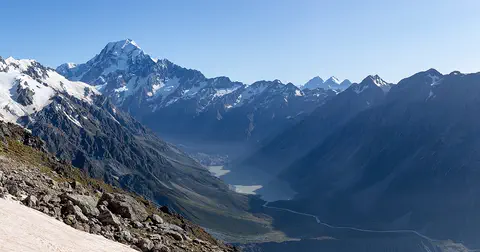
Aoraki / Mount Cook is New Zealand's highest mountain, in the Southern Alps of the South Island. Its name joins its Māori name, Aoraki, with its English name, Mount Cook. The mountain is being pushed up where two of Earth's plates meet, and glaciers carve the valleys around it. In 2013 surveyors measured it at 3,724 meters.
-
 Watch
Natural wonder
Milford Sound / Piopiotahi
Milford Sound / Piopiotahi is a fiord in Fiordland National Park, in the south-west of New Zealand's South Island. Glaciers carved its steep valley, and the sea filled it. It stretches 16 kilometers to the open sea, and Mitre Peak rises 1,692 meters straight from the water. It is one of the wettest places in New Zealand.
Explore next
-
Watch
 Country
New Zealand
New Zealand, also called Aotearoa, is an island country in the South Pacific. Its two main islands have snowy mountains, glaciers, volcanoes and deep fiords, and about 5.36 million people lived there in 2026.
-
 Watch
Landmark
National Gallery of Victoria
The National Gallery of Victoria is an art museum on St Kilda Road in Melbourne, Australia. Its building, designed by the architect Roy Grounds, opened in 1968. It has walls of bluestone, a water wall at the front and a Great Hall with a stained-glass ceiling by Leonard French.
-
 Watch
Landmark
British Museum
The British Museum in London was founded in 1753 and opened in 1759. It holds treasures from all over the world, like the Rosetta Stone, which helped people learn to read Egyptian hieroglyphs. Its grand building with columns was built from 1823 to 1847, and in 2025 it had more than 6.4 million visits.
-
 Watch
Landmark
Australian Museum
The Australian Museum in Sydney is the nation's first museum, set up in 1827. It stands opposite Hyde Park and holds more than 22 million specimens and objects, from animals and minerals to cultural collections. Its first permanent building opened in 1857, and more wings have been added ever since.
-
 Watch
Landmark
Kuk Swamp
Kuk Swamp is a wetland in the highlands of Papua New Guinea, about 1,500 meters above sea level. Digging there has shown that people have farmed it almost without a break for 7,000 years, and possibly for 10,000 years. It became a UNESCO World Heritage Site in 2008.
-
 Watch
Landmark
Melbourne Museum
Melbourne Museum opened on 21 October 2000 in the Carlton Gardens, Melbourne. Designed by the architects Denton Corker Marshall, it stands just north of the Royal Exhibition Building, a World Heritage Site, and it has welcomed more than 23 million visitors.
-
 Watch
Landmark
National Library of Australia
The National Library of Australia keeps about 10 million items for the whole country. Its main building in Canberra, on the shores of Lake Burley Griffin, opened on 15 August 1968. Tall columns surround it, and its walls are covered in pale marble.
-
 Watch
Landmark
Siding Spring Observatory
Siding Spring Observatory sits on Mount Woorut in New South Wales, Australia, next to Warrumbungle National Park. The Australian National University chose the site in 1962 for its dark, cloudless skies. Today it is home to many telescopes, including the Anglo-Australian Telescope, the largest optical telescope in Australia.
For parents & teachers
What children will learn
- Explain how base isolators protect a building in an earthquake.
- Describe what a national museum does.
- Explain why engineers firm up soft ground before building.
Recommended ages: 4 to 17 · About 15 minutes
Talk about it
- Why would a museum want to keep its building and treasures safe from earthquakes?
- What treasure from your own family would you put in a museum?
- Why might a museum have a name in two languages?
Try at home or in class
- Build a tower of blocks on a tray, then on a tray resting on a few marbles; gently shake each tray and compare.
- Find Wellington on a map of New Zealand.
Key vocabulary: museum, base isolator, fault line, reclaimed land, taonga, tonne
Where these facts come from
- Wikidata , Wikimedia Foundation (CC0 1.0)
- Our history , Museum of New Zealand Te Papa Tongarewa
- Te Papa's main building: engineering facts , Museum of New Zealand Te Papa Tongarewa
- Halting the jolts: How Te Papa resists earthquakes , Museum of New Zealand Te Papa Tongarewa
- File:Te Papa Museum, Wellington, New Zealand - panoramio.jpg , Wikimedia Commons
- Wikimedia Commons , Wikimedia Foundation (Per file (public domain, CC0, CC BY or CC BY-SA); see each media record)
Checked, not yet human-reviewed. Last updated November 1, 2026. Spotted a mistake? Tell us.