
Landmark Asia
Terracotta Army
The Terracotta Army is thousands of clay soldiers buried near Xi'an, in China. They were made more than 2,000 years ago for China's first emperor. Every soldier has a different face!
In 1974, farmers digging a well near Xi'an, China, found pieces of clay soldiers. Archaeologists uncovered an army of about 8,000 life-size soldiers and horses, made for the tomb of Qin Shi Huang, the first emperor of a united China, who died in 210 BCE. The figures were once brightly painted, and each has its own face.
Some 1.2 km east of the outer wall of Qin Shi Huang's tomb, begun in 246 BCE, pits hold about 8,000 life-size terracotta soldiers and horses, assembled from separately fired parts with individual faces and arranged in formation. Found by well-diggers in 1974, they lie within a 56 km² World Heritage property (1987) whose central tomb is still unexcavated.
Photo: xiquinhosilva, CC BY 2.0, via Wikimedia Commons
Discover the Terracotta Army
The Terracotta Army is in China, a big country in Asia.
It is a huge group of soldiers made of clay. They stand in long rows under the ground. They were made to stand near the tomb of China's first emperor.
The Terracotta Army lies at the foot of Lishan Mountain, about 35 kilometers northeast of the city of Xi'an, in China. Terracotta means 'baked earth': the soldiers are made of clay fired in a kiln, like a flowerpot.
There are about 8,000 life-size soldiers and horses, buried in long pits. They were made to stand guard near the tomb of Qin Shi Huang, the first emperor to unite China. Today, people visit the pits under huge roofs and watch archaeologists still at work.
The terracotta army belongs to the mausoleum of Qin Shi Huang (also called Shihuangdi), at the northern foot of Lishan, 35 km northeast of Xi'an in Shaanxi province. UNESCO describes nearly 200 accompanying pits of terracotta soldiers, horses, bronze chariots and weapons, with tombs and building remains, totaling more than 600 sites across a property of 56.25 km² (Britannica gives the funerary compound as about 50 km²).
Britannica counts about 8,000 life-size figures in the principal chamber. The army faces east, about three-quarters of a mile (some 1.2 km) from the outer wall of the tomb, which Britannica links to the direction from which the emperor's chief former rivals had come. UNESCO inscribed the mausoleum in 1987, calling it the largest preserved site in China.
- Where
- foot of Lishan Mountain, 35 km northeast of Xi'an
- Figures
- about 8,000 soldiers and horses
- Found
- March 1974
- World Heritage Site
- 1987
The first emperor and his tomb
Long ago, China was split into many kingdoms.
One king joined them all together and became the first emperor. He had a giant tomb built for himself. Clay soldiers were buried nearby. Farmers found them more than 2,000 years later!
In 221 BCE, Qin Shi Huang joined several rival kingdoms into one empire, the first united China. He made everyone use the same writing, money and measurements. Work on his tomb began in 246 BCE and went on until he died in 210 BCE. An ancient historian, Sima Qian, wrote that workers came from every province.
The soldiers stayed hidden underground for more than 2,000 years. In March 1974, farmers drilling a well broke into an underground chamber. Archaeologists came and found the clay army.
UNESCO links the mausoleum to the first unification of Chinese territory by a centralized state in 221 BCE; Qin Shi Huang imposed a single system of writing, money, weights and measures. Construction began in 246 BCE, and the historian Sima Qian (about 145 to 95 BCE) wrote that workers from every province labored until the emperor's death in 210 BCE to build a subterranean city within a gigantic mound.
Britannica notes remnants of timber roofing above and around many broken figures, perhaps collapsed in a fire shortly after the emperor's death. In March 1974 a work brigade of farmers drilling a well broke into a chamber; three more chambers were found in the 1970s. The pits are roofed over as an on-site museum, a new exhibition hall opened above one of them in 1994, and in 2009 the site museum became the Qinshihuang Mausoleum Museum, responsible for the whole mausoleum.
How the soldiers were made
Workers made each soldier in pieces.
They made legs, a body, arms and a head from clay. They baked the pieces until hard and joined them. Then they painted them in bright colors. Each soldier got his own face.
Each soldier was built from separate parts, such as legs, body, arms and head, that were made of clay, fired in a kiln and then put together. The makers gave every soldier his own detailed face, so no two look exactly alike.
The soldiers were once painted in bright colors made from minerals, but most of the paint has worn away. UNESCO says the figures are so lifelike that you can see details of their uniforms and even the horses' harnesses. They tell experts a lot about how potters and metal workers worked over 2,000 years ago.
Britannica describes the figures as assembled from separately fired sections yet given individually detailed faces, and once brightly painted with mineral colors. UNESCO calls them hyper-realistic, with no detail neglected, from uniforms and equipment to the horses' halters, and regards them, with the bronze carts, as major works of Chinese sculpture before the Han dynasty; it stresses their value for understanding the techniques of Qin potters and bronze-workers.
The pits also yielded richly decorated chariots of wood (now decayed) and bronze, iron farm tools, bronze and leather bridles, and objects of silk, linen, jade and bone. Britannica notes that bronze weapons cast from an unusual alloy of 13 elements are still shiny today.
An army in its pits
The soldiers stand in long rows.
Archers stand at the front. Other soldiers and horses with chariots stand behind. One small room holds 68 figures who may be the leaders. One room is empty!
The army stands in a planned order, the way armies were arranged at that time. Archers stand at the front, then rows of foot soldiers and chariots, with more soldiers at the back. They all face east.
The first pit holds most of the army. A second pit has more than 1,300 figures, with foot soldiers, chariots and horsemen. A third has just 68 figures, probably the army's commanders, and a fourth pit is empty. Each pit is now covered by a building so visitors can look down at the soldiers.
Britannica describes the main formation as following the military rules of the time: a vanguard of bowmen and crossbowmen, outer files of archers, groups of infantry and charioteers, and an armored rear guard. Of three nearby chambers found in the 1970s, one holds more than 1,300 figures forming a smaller force of infantry, chariots and cavalry; one holds 68 figures, probably an elite command unit; and one is empty.
UNESCO reads the ensemble as unique evidence of military organization in the Warring States period (475 to 221 BCE) and the Qin empire (221 to 210 BCE), and notes that the army watching over the emperor faces outward from the tomb. The four excavations are roofed over and serve as an on-site museum while archaeological work continues.
- Main chamber
- about 8,000 figures
- Second chamber
- more than 1,300 figures
- Command unit
- 68 figures
The emperor's hidden tomb
The emperor's own tomb is under a big hill of earth.
Nobody has opened it yet. Near it, archaeologists found a stable full of horse bones and even a zoo for unusual animals!
The emperor's own tomb lies under a huge mound of earth, still 51.3 meters high. It has never been opened. The ancient historian Sima Qian wrote that it held a whole underground city.
Around it, archaeologists have found nearly 200 pits. They hold an underground stable with horse skeletons, half-size bronze chariots and even a zoo for unusual animals. The whole area is so big that archaeologists expect it will take many more years to explore.
UNESCO records that the grave mound survives to 51.3 m inside a rectangular, double-walled enclosure oriented north to south, a layout that echoes the plan of the Qin capital, Xianyang, with the palace enclosed by walls within further walls. The tomb itself remains unexcavated; Britannica notes that it is said to be a vast underground palace.
Nearby pits have yielded a subterranean stable of horse skeletons, an assemblage of half-size bronze chariots, 70 individual burial sites and a zoo for exotic animals. Britannica reports that archaeologists expect it to take years to uncover the whole complex. Since 2010 a provincial conservation plan has limited building in nearby Lintong district to protect the setting from urban growth and tourism pressure.
Amazing facts
-
Farmers found the clay army while digging a well.
In March 1974, farmers drilling a well broke into an underground chamber and found the first pieces of the army.
The army came to light in March 1974, when a brigade of farmers drilling a well broke into a subterranean chamber.
-
The clay soldiers were once brightly painted.
The soldiers were once painted in bright colors made from minerals. Most of the paint has worn away.
The figures were once brightly painted with mineral colors.
-
Near the emperor's tomb was a zoo for unusual animals.
Pits near the tomb hold an underground stable with horse skeletons and even a zoo for unusual animals.
Nearby pits include a subterranean stable of horse skeletons and a zoo for exotic animals.
-
The emperor made everyone use the same writing and money.
Qin Shi Huang made one system of writing, money, weights and measures for his whole empire.
Qin Shi Huang imposed a single system of writing, money, weights and measures across the empire.
Words to know
- terracotta
- clay that has been baked hard; the word means 'baked earth'
- emperor
- a ruler of an empire, a group of lands under one ruler
- kiln
- a very hot oven for baking clay
- life-size
- the same size as the real thing
- excavate
- to dig carefully to uncover old things
- mausoleum
- a large, grand building or place that is a tomb
Discovery challenge
-
What are the soldiers made of?
What are the soldiers of the Terracotta Army made of?
What material are the figures of the Terracotta Army made from?
- Gold
- Baked clay
- Wood
Show the answer
Baked clay
Baked clay! Terracotta means 'baked earth'.
They are terracotta, clay fired hard in a kiln, then painted.
Terracotta: separately fired clay sections, assembled and painted with mineral colors.
-
Who found the clay soldiers?
Who found the Terracotta Army in 1974?
How did the army come to light in March 1974?
- Farmers digging a well
- Children playing a game
- Astronauts in space
Show the answer
Farmers digging a well
Farmers! They were digging a well.
Farmers drilling a well broke into an underground chamber.
A work brigade of farmers drilling a well broke into a subterranean chamber.
-
Which emperor were the soldiers made for?
For whose tomb was the Terracotta Army made?
Whose mausoleum, begun in 246 BCE, do the figures accompany?
- Qin Shi Huang
- Julius Caesar
- Napoleon
Show the answer
Qin Shi Huang
Qin Shi Huang, China's first emperor!
Qin Shi Huang, who united China in 221 BCE.
Qin Shi Huang, founder of the first unified Chinese empire, who died in 210 BCE.
-
Which way do the clay soldiers face?
In which direction does the Terracotta Army face?
According to Britannica, in which direction is the buried army arrayed?
- North
- East
- West
Show the answer
East
East! Toward the morning sun.
East, away from the emperor's tomb.
East, about three-quarters of a mile from the tomb's outer wall, outward from the tomb.
Nearby places
-
 Watch
Landmark
Three Gorges Dam
The Three Gorges Dam crosses the Yangtze River in central China. It is 2,335 meters long and 185 meters high, and it can make more electricity than any other hydroelectric dam in the world. It also lets big ships travel far up the river, but building it meant that more than a million people had to move.
-
 Watch
Landmark
Forbidden City
The Forbidden City in Beijing was built between 1406 and 1420 as the palace of China's emperors. Over about 500 years, 24 emperors came to the throne there. High walls and a wide moat surround it. Since 1925 it has been the Palace Museum, and it became a World Heritage Site in 1987.
-
Watch
City
Beijing
Beijing, the capital of China, has been the country's capital for most of the last 600 years. At its heart is the Forbidden City, the emperors' palace. About 21.8 million people lived in the Beijing municipality at the end of 2024.
-
 Watch
Landmark
Great Wall of China
The Great Wall is not one wall but many walls, built over about 2,000 years across northern China. The best-kept part, built under the Ming emperors, runs about 8,850 kilometers, with watchtowers, gates and signal towers along the way.
-
 Watch
Natural wonder
Gobi Desert
The Gobi is a giant desert stretching across Mongolia and China. Britannica says its name comes from a Mongolian word meaning waterless place. Much of it is bare rock and gravel rather than sand, winters are bitterly cold and summers hot, and its rocks hold remarkable dinosaur fossils, including the first dinosaur eggs known to science.
-
 Watch
City
Shanghai
Shanghai is China's most populous city, on the coast where the great Yangtze River meets the East China Sea. Once a small fishing village, it grew into one of the world's busiest seaports. About 24.9 million people lived in Shanghai in 2020, and the towers of Pudong rise across the Huangpu River.
-
 Watch
City
Hong Kong
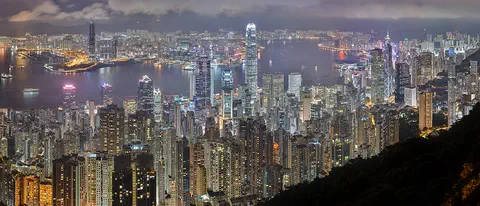
Hong Kong, on the south coast of China, grew around one of the world's great natural harbors. It was a British colony for 156 years and has been a special administrative region of China since 1997. About 7.5 million people lived there in mid-2026.
-
 Watch
Natural wonder
Ha Long Bay
Ha Long Bay is a bay in northeast Vietnam where more than a thousand limestone islands rise straight out of the sea. Over millions of years, water dissolved the limestone into towers and caves, and then the sea flooded in around them. Together with the nearby Cat Ba Archipelago it is a World Heritage site.
Explore next
-
 Watch
 Country
China
China is the largest country in Asia, almost as big as all of Europe. The land steps down from the high, cold Plateau of Tibet in the west to plains and coasts in the east, and about 1.4 billion people live there, along with giant pandas in the mountains of south-central China.
-
Watch
Landmark
Great Wall of China
The Great Wall is not one wall but many walls, built over about 2,000 years across northern China. The best-kept part, built under the Ming emperors, runs about 8,850 kilometers, with watchtowers, gates and signal towers along the way.
-
Watch
Landmark
Forbidden City
The Forbidden City in Beijing was built between 1406 and 1420 as the palace of China's emperors. Over about 500 years, 24 emperors came to the throne there. High walls and a wide moat surround it. Since 1925 it has been the Palace Museum, and it became a World Heritage Site in 1987.
-
 Watch
Landmark
Giza pyramid complex
The Giza pyramid complex is a group of ancient tombs on a rocky plateau beside the Nile River in Egypt. Three kings from one family, Khufu, his son Khafre and his grandson Menkaure, built huge pyramids there about 4,500 years ago. Around them are temples, small pyramids for queens, rows of tombs for nobles, the Great Sphinx and even the town where the builders lived.
-
Watch
Journey
The Silk Road
The Silk Road was not one road but a web of trade routes, about 6,400 kilometers long, linking China with Central Asia and the Mediterranean. For more than 1,500 years, caravans carried silk, tea, spices and glass, and travelers shared ideas, beliefs and inventions.
- Watch Geography What is a World Heritage Site? World Heritage Sites are places so important that they belong, in a way, to everyone. Under a 1972 agreement, countries nominate their most outstanding places, experts check them, and a UNESCO committee decides. By 2026 the list held 1,273 sites: cultural places like the Taj Mahal, natural places like the Galápagos, and mixed ones like Machu Picchu.
-
 Watch
Natural wonder
Ajanta Caves
The Ajanta Caves are about 30 halls and rooms carved by hand into a curving cliff above the Waghora River in western India. Buddhist communities made them in two big phases, starting more than 2,000 years ago. Their wall paintings and stone carvings are some of the most famous ancient art in India, and they have been a UNESCO World Heritage Site since 1983.
-
 Watch
Landmark
Agra Fort
Agra Fort is a huge red sandstone fortress beside the Yamuna River in Agra, India. The Mughal emperor Akbar began it in 1565. Its walls, about 2.5 kilometers around, protect palaces, halls and mosques added by later emperors. It was both an army base and a royal home.
For parents & teachers
What children will learn
- Locate Xi'an in China and explain that the Terracotta Army was made for the tomb of China's first emperor.
- Describe how the figures were made from clay parts, fired, given individual faces and painted.
- Explain how archaeologists learn about the past from a site that is still being excavated.
Recommended ages: 3 to 17 · About 15 minutes
Talk about it
- Every clay soldier has a different face. Why do you think the makers took so much care?
- The emperor's own tomb has never been opened. Should archaeologists open it, or leave it closed? Why?
- Farmers found the army by accident. What other discoveries might be hidden under fields and towns?
Try at home or in class
- Make a small figure from modeling clay in separate parts (legs, body, arms, head), join them, and give it a face of your own design.
- Line up toy figures in rows and decide who stands at the front, middle and back; talk about why order matters in a big group.
Key vocabulary: terracotta, emperor, kiln, life-size, excavate, mausoleum
Where these facts come from
- Wikidata , Wikimedia Foundation (CC0 1.0)
- Mausoleum of the First Qin Emperor , UNESCO World Heritage Centre
- Terra-cotta army , Encyclopaedia Britannica
- Qin tomb , Encyclopaedia Britannica
- Wikimedia Commons , Wikimedia Foundation (Per file (public domain, CC0, CC BY or CC BY-SA); see each media record)
Checked, not yet human-reviewed. Last updated October 27, 2026. Spotted a mistake? Tell us.