
Landmark Africa
Tsodilo
Tsodilo is a group of rocky hills in a sandy desert in Botswana. People painted more than 4,500 pictures on its rocks!
Tsodilo is a small group of rocky hills in the Kalahari Desert of Botswana. With more than 4,500 rock paintings in an area of only 10 square kilometers, it has been called the 'Louvre of the Desert'. People have used these hills for at least 100,000 years.
The Tsodilo Hills, quartzite outcrops rising from the Kalahari near Botswana's border with Namibia, hold one of the highest concentrations of rock art in the world: over 4,500 paintings in only 10 km². Their archaeology records human activity and environmental change over at least 100,000 years. Tsodilo became a National Monument in 1927 and a World Heritage Site in 2001.
Photo: Oliver Vass, CC BY-SA 3.0, via Wikimedia Commons
Discover Tsodilo
Tsodilo is in Botswana, a country in southern Africa. It is a group of big rocky hills that rise out of the flat, sandy Kalahari Desert.
People painted lots of animals on its rocks.
The Tsodilo Hills are in the north-west of Botswana, near the border with Namibia. They are made of a hard rock called quartzite, and they rise out of the Kalahari Desert, with old sand dunes to the east and a dried-up lake bed to the west.
More than 4,500 rock paintings are packed into an area of only 10 square kilometers. That is why Tsodilo has been called the 'Louvre of the Desert'.
UNESCO describes the Tsodilo Hills as a small area of massive quartzite rock formations rising from ancient sand dunes to the east and a dry fossil lake bed to the west, in the Kalahari Desert of north-west Botswana. ICOMOS notes that three of the hills form a cluster within a rectangle of about 3 by 10 km, with a fourth, the smallest, 2.1 km to the north-west.
With one of the highest concentrations of rock art in the world, over 4,500 paintings in only 10 km², Tsodilo has been called the 'Louvre of the Desert'. It was inscribed on the World Heritage List in 2001, on a property of 4,800 hectares.
- Where
- Kalahari Desert, north-west Botswana, near the border with Namibia
- Rock paintings
- more than 4,500
- People here for
- at least 100,000 years
- World Heritage
- inscribed 2001
100,000 years of people
People have come to these hills for a very, very long time. They found shelter under the rocks.
Long ago, people also dug into the hills for shiny and colorful stones.
UNESCO says the hills have given people shelter and other resources for more than 100,000 years. At one rock shelter, archaeologists dug down through 7 meters of layers left by people over that time.
In the first thousand years CE, two villages stood at Tsodilo, called Divuyu and Nqoma. Copper and iron beads, bracelets and other ornaments became common there, made from metal brought from far away. People also mined the hills for colorful minerals used for decoration.
The archaeological record gives a chronological account of human activities and environmental changes over at least 100,000 years, though not continuously. ICOMOS reports that at White Painting Shelter, excavation exposed a 7-meter-deep sequence of layers showing use over that whole span.
Two excavated settlements of the 1st millennium AD, Divuyu and Nqoma, are of particular significance: copper and iron ornaments became common, and all the metal was imported. Mining on the hills for ochre, specularite and a green stone, used for decoration, was extensive; ICOMOS calls its extent and intensity impressive.
Painted in red and white
Most of the paintings are red. The painters made their red paint from a rock found right here!
They painted animals like giraffes and rhinos, and shapes like lines and circles.
Most of Tsodilo's paintings are red. ICOMOS says the red paint was made from ochre that comes from hematite, a mineral in the local rock. Many paintings are large and can be seen from far away.
The red paintings show big wild animals such as giraffes and rhinoceroses, and many geometric shapes: lines and grids inside circles, ovals and rectangles. A different group of white paintings is found at only twelve places.
ICOMOS describes paintings that are often large and imposing and can be seen from a distance. Most are in red ochre derived from hematite in the local rock; the red art is naturalistic in subject but schematic in style, and its wild animals are characteristically big game, such as giraffe and rhinoceros, until domestic cattle appear relatively late. Geometric designs, often lines and grids enclosed in circles, ovals and rectangles, are frequent and rare elsewhere in southern African Stone Age art.
A distinctive series of white paintings occurs at only twelve sites, sometimes painted over the red ones but never the other way around. The white art includes more domestic animals than the red.
How old are the paintings?
Some of the paintings are very, very old. Others were painted not so long ago.
Visitors must go with a guide, to help keep the paintings safe.
The paintings are hard to date exactly. UNESCO says they seem to span from the Stone Age right up to the 1800s. Paintings of cattle are thought to date from about 600 to 1200 CE, after cattle were brought to Tsodilo.
Some white paintings seem to show people riding horses. Horses were unknown at Tsodilo until the 1850s, so those paintings are probably among the newest.
UNESCO notes that the paintings, though not accurately dated, appear to span from the Stone Age through to the 19th century. ICOMOS adds that some of the art could be two thousand years old or more, that pictures with cattle are regarded as about 600–1200 CE, after cattle reached Tsodilo, and that the latest paintings date to the 19th century on oral evidence.
Some white paintings appear to show riders on horses, unknown at Tsodilo until the 1850s, which possibly gives a date for the last paintings. UNESCO says visitors may only tour with guides, which has helped limit vandalism and graffiti.
- Area with the paintings
- about 10 km²
- Sites with white paintings
- 12
- National Monument
- since 1927
Long necks on the rock
In this photo, reddish-brown animals are painted on blue-gray rock. Can you find the animals with very long necks?
This photo was taken at Tsodilo on 30 September 2012. Reddish-brown animals are painted on a pale blue-gray rock face. The biggest has a very long neck, and two smaller long-necked animals stand below it, like giraffes.
On the left are more painted animals, partly faded, and a long crack runs down the rock between them.
The photograph (30 September 2012, by Oliver Vass) shows a panel of red-brown paintings on a pale, blue-gray rock surface: one large long-necked animal and two smaller ones below it, in the form of giraffes, with fainter animals to the left beyond a natural crack in the rock.
It matches ICOMOS's description of Tsodilo's red art: naturalistic subjects in a schematic style, with big game such as giraffe prominent.
Amazing facts
-
More than 4,500 paintings are on the rocks at Tsodilo!
Tsodilo has more than 4,500 rock paintings in only 10 square kilometers, so it has been called the 'Louvre of the Desert'.
With over 4,500 paintings in only 10 km², Tsodilo has one of the highest concentrations of rock art in the world.
-
Some paintings show people riding horses, and horses only came here about 170 years ago!
Some white paintings seem to show riders on horses. Horses were unknown at Tsodilo until the 1850s, so these are probably among the last paintings made.
Some white paintings appear to show riders on horses, unknown at Tsodilo until the 1850s, which possibly dates the last paintings.
-
Scientists dug down 7 meters into one rock shelter and found signs of people from very long ago!
At White Painting Shelter, archaeologists dug through 7 meters of layers that show people used it over at least 100,000 years.
Excavation at White Painting Shelter exposed a 7 m deep stratigraphy demonstrating use over at least 100,000 years.
Words to know
- rock art
- pictures painted or carved on rock by people long ago
- ochre
- a natural earth pigment, often red or yellow, used to make paint
- hematite
- a mineral that contains iron and gives a red color when ground up
- quartzite
- a very hard rock made from sandstone that has been squeezed and heated deep underground
- archaeologist
- a scientist who learns about people of the past by studying what they left behind
- rock shelter
- a shallow cave or overhang in a rock where people can find shelter
Discovery challenge
-
What did people paint on the rocks at Tsodilo?
Which big wild animals with long necks appear in Tsodilo's red paintings?
ICOMOS names which long-necked big-game animal, with the rhinoceros, as typical of Tsodilo's red art?
- Giraffes
- Penguins
- Kangaroos
Show the answer
Giraffes
Giraffes, and other animals too!
Giraffes.
The giraffe.
-
In which desert are the Tsodilo Hills?
In which desert do the Tsodilo Hills rise?
The Tsodilo quartzite outcrops rise from which southern African desert?
- The Kalahari
- The Sahara
- The Gobi
Show the answer
The Kalahari
The Kalahari Desert!
The Kalahari.
The Kalahari.
-
What color are most of the paintings at Tsodilo?
Most of Tsodilo's paintings are which color, made with ochre?
Most of Tsodilo's art uses which color of ochre, derived from hematite in the local rock?
- Red
- Blue
- Green
Show the answer
Red
Red!
Red.
Red.
-
Tsodilo has so many paintings that it is called the 'Louvre of the' what?
Because of its many paintings, Tsodilo has been called the 'Louvre of the' what?
Complete UNESCO's nickname for Tsodilo: the 'Louvre of the ...'.
- Desert
- Ocean
- Moon
Show the answer
Desert
The Louvre of the Desert!
The 'Louvre of the Desert'.
Desert.
-
In which country is Tsodilo?
In which country are the Tsodilo Hills?
The Tsodilo Hills lie in the north-west of which country, near Namibia?
- Botswana
- Mexico
- Norway
Show the answer
Botswana
Botswana!
Botswana.
Botswana.
Nearby places
-
 Watch
Natural wonder
Okavango Delta
The Okavango Delta, in northwestern Botswana, is a huge wetland in the middle of a dry land. The Okavango River flows in from Angola, spreads out into channels, lagoons and grassy plains, and then soaks away into the sands of the Kalahari instead of reaching the sea. Its flood arrives in the dry season, drawing elephants, buffalo, zebras and many other animals.
-
 Watch
Natural wonder
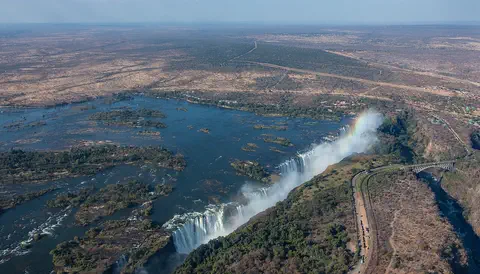
Victoria Falls
Victoria Falls, on the Zambezi River between Zambia and Zimbabwe, is about 1,708 meters wide and up to 108 meters deep. UNESCO calls it the largest curtain of falling water in the world, and its spray can be seen from tens of kilometers away.
-
 Watch
Natural wonder
Kalahari Desert
The Kalahari is a giant sandy plain in southern Africa, covering almost all of Botswana and parts of Namibia and South Africa. It stretches about 1,600 kilometers from north to south. Its southwest is a true desert, with long red dunes, while its north is green with woodlands and even has a huge swamp, the Okavango Delta.
-
 Watch
City
Windhoek
Windhoek is the capital of Namibia. It lies about 1,700 meters above the sea in a dry, hilly land. Namibia's 2023 census counted 486,186 people in Windhoek, about four times as many as in Rundu, the next-largest town.
-
 Watch
City
Gaborone
Gaborone is the capital of Botswana, in southern Africa. It was built as a new capital in the 1960s, almost ready when Botswana became independent in 1966. Planned for 20,000 people, it counted 246,325 in the 2022 census.
-
 Watch
Landmark
Kariba Dam
The Kariba Dam is a curved concrete dam across the Zambezi River, between Zambia and Zimbabwe. It is 128 meters high. It was built between 1956 and 1960, and its lake, Lake Kariba, is 280 kilometers long. Two power stations use the water to make electricity.
-
 Watch
City
Lusaka
Lusaka is the capital of Zambia, an African country with no coast. Zambia's 2022 census counted 2,212,301 people in the city, by far the most in the country. Lusaka was planned in the 1930s as a new capital and officially opened in 1935.
-
 Watch
Natural wonder
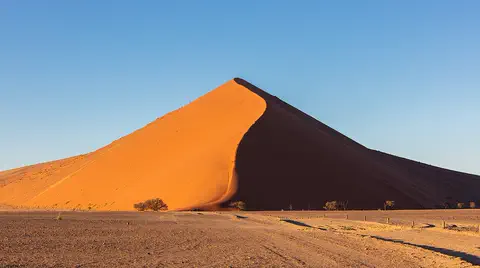
Namib
The Namib is a cool desert that runs for about 1,900 kilometers along Africa's Atlantic coast, from Angola through Namibia into South Africa. It gets almost no rain, but cold ocean water makes thick fog that drifts inland. UNESCO says its Namib Sand Sea is the only coastal desert in the world with huge dune fields influenced by fog.
Explore next
-
Watch
 Country
Botswana
Botswana is a landlocked country in the middle of southern Africa. Deep Kalahari sand covers most of it, but in the north the Okavango River spreads into a huge green delta full of wildlife. Botswana became independent in 1966 and has grown more prosperous, helped by diamonds.
-
Watch
Natural wonder
Kalahari Desert
The Kalahari is a giant sandy plain in southern Africa, covering almost all of Botswana and parts of Namibia and South Africa. It stretches about 1,600 kilometers from north to south. Its southwest is a true desert, with long red dunes, while its north is green with woodlands and even has a huge swamp, the Okavango Delta.
-
 Watch
Natural wonder
Uluru
Uluru is a huge sandstone rock in the desert of central Australia, rising 348 meters above the plain, with a base 9.4 kilometers around. The Anangu are its Traditional Owners, and the national park around it is run by Anangu and Parks Australia together.
-
 Watch
3D
Animal
Giraffe
Giraffes are the tallest animals on Earth. A long neck and a long dark tongue let them eat leaves from treetops that other animals cannot reach, and their patchy coats help them blend into the shade of the trees.
-
 Watch
Landmark
Abu Simbel
Abu Simbel is two temples cut into the rock by King Ramesses II of Egypt, around 1264 BCE. Four seated statues of the king, each 21 meters tall, guard the Great Temple. In the 1960s, a new dam was about to flood them, so workers cut them into more than a thousand blocks and rebuilt them higher up.
-
 Watch
Landmark
Aït Benhaddou
Aït Benhaddou is a ksar, a village of earthen buildings inside high walls, on the southern slopes of the High Atlas mountains in Morocco. Its oldest buildings probably date from no earlier than the 1600s. It was a stop on an old trade route to Marrakesh, and it became a UNESCO World Heritage Site in 1987.
-
 Watch
Landmark
Amphitheater of El Jem
The Amphitheater of El Jem is a Roman arena in Tunisia, built around the year 238. It stands on flat ground and is made entirely of stone blocks. UNESCO says it could hold about 35,000 spectators, which makes it one of the largest amphitheaters in the world.
-
 Watch
Landmark
Aswan High Dam
The Aswan High Dam crosses the Nile River in southern Egypt. Finished in 1970, it is 111 meters high and 3,830 meters long. It controls the Nile's yearly flood, stores water for farms, makes electricity and created a huge reservoir, Lake Nasser. Ancient temples had to be moved to save them from the rising water.
For parents & teachers
What children will learn
- Describe rock art and how archaeologists try to work out its age.
- Explain how people made paint from minerals found in rocks.
- Explain how layers in the ground can record thousands of years of human life.
Recommended ages: 4 to 17 · About 15 minutes
Talk about it
- Paintings of horses helped date some of Tsodilo's art. What clues in a picture could tell you when it was made?
- Why might people return to the same hills again and again for thousands of years?
- Visitors to Tsodilo must go with a guide. Why might that help protect the paintings?
Try at home or in class
- Make a 'rock art' picture: paint animals in one reddish-brown color on a gray stone or a piece of cardboard.
- Fill a clear jar with layers of sand, soil and pebbles, then talk about which layer went in first and how archaeologists read layers.
Key vocabulary: rock art, ochre, hematite, quartzite, archaeologist, rock shelter
Where these facts come from
- Wikidata , Wikimedia Foundation (CC0 1.0)
- Tsodilo , UNESCO World Heritage Centre
- Tsodilo (Botswana), No 1021 (Advisory Body Evaluation) , ICOMOS
- File:Animals Rock Art Tsodilo.jpg , Wikimedia Commons
- UNESCO World Heritage List , UNESCO World Heritage Centre (Linked as a reference; site facts come from Wikidata)
- Wikimedia Commons , Wikimedia Foundation (Per file (public domain, CC0, CC BY or CC BY-SA); see each media record)
Checked, not yet human-reviewed. Last updated November 1, 2026. Spotted a mistake? Tell us.