
Natural wonder Europe
Carpathians
The Carpathians are long mountains in Europe. Big old forests grow there. Bears, wolves and lynxes live in them.
The Carpathians are a long mountain range in Europe, shared by seven countries that protect it together under the Carpathian Convention. They hold some of Europe's last untouched forests, nearly 4,000 kinds of plants and big populations of brown bears, wolves and lynxes.
UNEP describes the Carpathians as the second-largest mountain range in Europe, home to nearly 4,000 plant species, Europe's largest pristine forests and its richest population of large carnivores, and the headwaters of major rivers. UNESCO's Ancient and Primeval Beech Forests site shows how European beech spread from Ice Age refuges, including the Carpathians, across the continent.
Photo: Brainw0rker, CC BY-SA 4.0, via Wikimedia Commons
Discover the Carpathians
The Carpathians are a long chain of mountains in Europe. Big forests cover many of their slopes.
In this photo, a clear lake lies at the foot of tall, rocky mountains with patches of snow.
The Carpathian Mountains are a mountain range in Europe. Seven countries, the Czech Republic, Hungary, Poland, Romania, Serbia, Slovakia and Ukraine, work together to protect them under the Carpathian Convention, set up in 2003. The United Nations Environment Programme (UNEP) calls the range the second largest in Europe.
The photo shows Morskie Oko, a lake in the Tatra Mountains of Poland, in August 2008: clear water and boulders in front, a wooden railing, and steep gray peaks with patches of snow and green slopes.
The Carpathian Convention, established in 2003 and serviced by a UNEP-hosted secretariat, brings together the Czech Republic, Hungary, Poland, Romania, Serbia, Slovakia and Ukraine to protect what UNEP calls the second largest mountain range in Europe. Its parties adopted a Carpathian Biodiversity Framework at their seventh Conference of the Parties in Belgrade in October 2023.
The hero photo, by the Commons user Brainw0rker (12 August 2008, EXIF), shows Morskie Oko, which Commons files among the lakes of the High Tatra Mountains in Poland: a boulder-lined shore and wooden railing below steep rock faces, snow gullies, scree and conifer-covered slopes.
- Carpathian Convention countries
- Czech Republic, Hungary, Poland, Romania, Serbia, Slovakia, Ukraine
- Plant species
- nearly 4,000
- Large carnivores
- lynxes, brown bears and wolves
- Convention set up
- 2003
Forests that spread after the Ice Age
Long ago, in the Ice Age, it was very cold. Beech trees survived in only a few safe places, like the Carpathians.
When the ice melted, the beech trees spread out across Europe.
During the last Ice Age, European beech trees survived only in a few separate refuges, including the Alps, the Carpathians, the Dinarides, the Mediterranean and the Pyrenees.
When the Ice Age ended, beech spread out from these places across a whole continent in just a few thousand years, and it is still spreading today. UNESCO protects old and untouched beech forests in 93 places across 18 countries.
UNESCO's serial property, Ancient and Primeval Beech Forests of the Carpathians and Other Regions of Europe, now includes 93 component parts in 18 countries. Since the end of the last Ice Age, European beech has spread from a few isolated refuge areas in the Alps, Carpathians, Dinarides, Mediterranean and Pyrenees over a few thousand years, a process that is still ongoing; UNESCO links this success to the tree's adaptability and tolerance of different climatic, geographical and physical conditions.
The expanded property is an outstanding example of relatively undisturbed, complex temperate forests, showing a wide range of ecological patterns in pure and mixed beech stands under varied conditions.
Bears, wolves and lynxes
Brown bears, wolves and lynxes live in the Carpathian forests.
There are thousands of kinds of plants there too.
UNEP calls the Carpathians a biodiversity hotspot in Europe. The mountains have nearly 4,000 kinds of plants and the largest populations of large carnivores in Europe: lynxes, brown bears and wolves.
They also hold some of Europe's last remaining virgin forests, forests that people have hardly changed. In 2023 the Carpathian countries set up an inventory, a careful list, of these virgin forests to help protect them.
According to UNEP, the region harbors nearly 4,000 plant species, Europe's largest pristine forests, and the richest population of large carnivores on the continent, with the largest populations of lynxes, brown bears and wolves. Ministers at COP7 (2023) established an Inventory of Virgin Forests of the Carpathians, calling it a critical step towards protecting some of Europe's few remaining primary forests.
They also heard an assessment of climate-change risks for Carpathian forest ecosystems; UNEP's deputy director warned that climate change, nature loss and pollution together are putting new pressure on the region.
Where rivers begin
Many big rivers start high in the Carpathians.
Millions of people depend on these mountains.
The Carpathians are home to the headwaters of major rivers, the places where those rivers begin. UNEP says the mountains provide essential services to millions of people who live in and around them.
In 2023 Serbia and Romania created a shared protected wetland in the Đerdap gorge, also called the Iron Gate, along the Danube River.
UNEP notes that the Carpathians provide essential ecosystem services to millions of people in and beyond the region and are home to the headwaters of major rivers. At COP7, the environment ministers of Serbia and Romania established a transboundary Ramsar wetland in Đerdap (Iron Gate) National Park, along the Danube, spanning both sides of the river.
The Carpathian countries also recognized the need to tackle air, water and soil pollution, with a specific focus on plastic pollution in the region's watercourses.
Visiting safely
Bears and wolves live in these mountains. Visitors stay on paths with a grown-up.
Everyone takes their trash home. Then plastic stays out of the streams.
The Carpathians are home to Europe's largest populations of brown bears, wolves and lynxes, so it makes sense to follow local park rules, stay on marked trails and keep a respectful distance from wildlife. That is PlayOwl's tip, built on UNEP's description.
The Carpathian countries are working to reduce plastic pollution in the region's streams and rivers. Visitors can help by carrying all their trash back out.
Because the region hosts the largest European populations of lynxes, brown bears and wolves (UNEP), PlayOwl recommends following each protected area's rules, staying on marked trails and keeping well away from wildlife.
The parties to the Carpathian Convention have singled out plastic pollution in the region's watercourses as a priority, so carrying all waste back out is a simple way for visitors to support that goal.
Amazing facts
-
Beech trees spread across all of Europe from a few safe places, and they are still spreading!
After the last Ice Age, European beech spread across a whole continent in a few thousand years, and the process is still going on.
Post-glacial expansion of European beech from a few refuges, including the Carpathians, is still ongoing (UNESCO).
-
Nearly 4,000 kinds of plants grow in the Carpathians.
The Carpathians are home to nearly 4,000 plant species.
UNEP counts nearly 4,000 plant species in the Carpathians.
-
Two countries made a shared wetland park along the Danube River.
In 2023, Serbia and Romania created a shared protected wetland in the Iron Gate gorge on the Danube.
COP7 (2023) sealed a transboundary Ramsar site in Đerdap (Iron Gate) National Park on the Danube, spanning Serbia and Romania.
Words to know
- refuge
- a safe place where plants or animals survive when conditions elsewhere are too harsh
- virgin forest
- a forest that people have hardly changed
- large carnivore
- a big meat-eating animal, such as a bear, wolf or lynx
- headwaters
- the place where a river begins
- convention
- an agreement between countries to work together
- biodiversity
- the variety of living things in a place
Discovery challenge
-
Which big animals live in the Carpathian forests?
Which large carnivores have their biggest European populations in the Carpathians?
Which three large carnivores does UNEP name for the Carpathians?
- Brown bears, wolves and lynxes
- Lions, tigers and leopards
- Polar bears, seals and walruses
Show the answer
Brown bears, wolves and lynxes
Brown bears, wolves and lynxes.
Brown bears, wolves and lynxes.
Lynxes, brown bears and wolves.
-
Which trees spread out across Europe after the Ice Age?
Which tree spread across Europe from Ice Age refuges such as the Carpathians?
Which species does UNESCO's serial forest site protect?
- Beech
- Palm
- Baobab
Show the answer
Beech
Beech trees.
European beech.
European beech, in ancient and primeval forests.
-
How many countries work together to protect the Carpathians?
How many countries belong to the Carpathian Convention?
How many countries are parties to the 2003 Carpathian Convention?
- Seven
- Two
- Twenty
Show the answer
Seven
Seven countries.
Seven: the Czech Republic, Hungary, Poland, Romania, Serbia, Slovakia and Ukraine.
Seven.
-
About how many kinds of plants grow in the Carpathians?
About how many plant species live in the Carpathians?
How many plant species does UNEP give for the Carpathians?
- Nearly 4,000
- About 40
- About 4 million
Show the answer
Nearly 4,000
Nearly 4,000.
-
What should visitors do with their trash?
How can visitors help with the region's plastic problem?
The Carpathian countries singled out plastic pollution in the region's watercourses. What can visitors do about it?
- Carry it all back out
- Leave it by a stream
- Bury it in the forest
Show the answer
Carry it all back out
Take it home.
Carry all trash back out, so plastic does not reach the streams.
Carry all waste back out; the countries' focus is plastic pollution in the region's watercourses (UNEP).
Nearby places
-
 Watch
City
Chișinău
Chișinău is the capital of Moldova, a country in eastern Europe. It was first written about in 1436, and from 1817 a new part of the town was laid out on a grid of straight streets. It has many parks and lakes, and electric trolleybuses have carried its people since 1949. The 2024 census counted 567,038 people in the city.
-
 Watch
City
Bucharest
Bucharest, the capital of Romania, lies on a wide plain beside the Dâmbovița River. First written about in 1459, it became the capital of Walachia in 1659 and of Romania in 1862. Today it is a city of broad boulevards, a huge parliament palace, the Romanian Athenaeum concert hall and an open-air Village Museum.
-
 Watch
City
Lviv
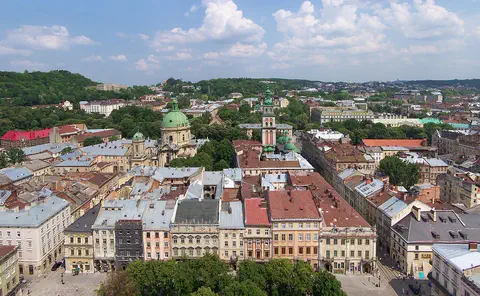
Lviv is a city in western Ukraine, founded in 1256 and named after Lev, a prince's son. Its old center, with a market square, castle hill and churches of many kinds, is on UNESCO's World Heritage List. Ukraine's statistics service estimated 717,273 people there at the start of 2022.
-
 Watch
City
Košice
Košice is the second-largest city in Slovakia and the center of the country's east. It lies in the valley of the Hornád River, with hills and mountains around it. Slovakia's 2021 census counted 229,040 people in the city.
-
 Watch
City
Belgrade
Belgrade, the capital of Serbia, stands where the Sava River flows into the Danube. Its name, Beograd, means "white city", probably because of the white limestone walls of its old fortress above the rivers. At the 2022 census, about 1.2 million people lived in the city itself and about 1.7 million in the wider City of Belgrade.
-
 Watch
City
Budapest
Budapest, the capital of Hungary, was made in 1873 by joining three towns on the Danube River: hilly Buda and old Óbuda on one bank and flat Pest on the other. About 1.7 million people live there (2026), with hot springs under the ground and the first underground railway built on the European mainland.
-
 Watch
City
Sofia
Sofia, the capital of Bulgaria, lies in a valley near the middle of the Balkans, at the foot of Vitosha Mountain. The Romans called it Serdica, and an old church of St. Sofia later gave the city its name. About 1.2 million people lived there in 2025.
-
 Watch
City
Kyiv
Kyiv is the capital of Ukraine, on the high west bank of the Dnieper River. More than 1,000 years ago it was the center of Kyivan Rus, the first East Slavic state, and its 11th-century St. Sophia's Cathedral and Pechersk Lavra monastery are a UNESCO World Heritage Site. About 2.95 million people lived there in 2022.
Explore next
-
 Watch
Natural wonder
Danube
The Danube is Europe's second-longest river, after the Volga. It begins as two small streams in Germany's Black Forest and flows about 2,850 kilometers east to the Black Sea, passing through 10 countries and four capital cities. For more than 2,000 years it has been a border, a highway for boats and a home for wildlife, and it ends in a giant delta of reeds, lakes and birds.
-
 Watch
Natural wonder
Alps
The Alps are Europe's great mountain range, an arc about 1,200 kilometers long that runs from the Mediterranean coast near Nice, in France, to Vienna, in Austria. Their highest peak is Mont Blanc, which Britannica gives as 4,807 meters. The Alps rose when the plate carrying Africa pushed north into Europe, and Ice Age glaciers carved their sharp peaks and deep valleys.
-
Watch
 Country
Romania
Romania is a country in southeastern Europe. The Carpathian Mountains curve around its middle, the Danube River runs along its southern edge to a huge delta on the Black Sea, and about 19 million people lived there at the start of 2026.
-
 Watch
 Country
Poland
Poland lies near the center of Europe, between the Baltic Sea and the Carpathian Mountains. Most of it is low, flat land shaped by Ice Age glaciers, and about 37 million people live there. Its capital, Warsaw, stands on the Vistula River.
- Watch Geography How mountains form Most mountains are built by moving tectonic plates. When continents collide, rock crumples and folds into ranges like the Himalayas. Where the crust stretches and cracks, blocks of rock tilt up along faults. Volcanoes build mountains from lava and ash. Then erosion slowly wears them all down.
-
Watch
City
Bucharest
Bucharest, the capital of Romania, lies on a wide plain beside the Dâmbovița River. First written about in 1459, it became the capital of Walachia in 1659 and of Romania in 1862. Today it is a city of broad boulevards, a huge parliament palace, the Romanian Athenaeum concert hall and an open-air Village Museum.
-
 Watch
 Country
Slovakia
Slovakia is a landlocked country in central Europe. The Carpathian Mountains cover much of it, with the High Tatras in the north, and about 5.4 million people lived there at the end of 2025. Its capital, Bratislava, sits on the Danube River.
-
Watch
 Country
Ukraine
Ukraine is a large country in eastern Europe on the northern shore of the Black Sea. Most of it is level plain with some of the most fertile soil in the world, crossed by the Dnieper River. Its capital is Kyiv, and its official language is Ukrainian.
For parents & teachers
What children will learn
- Locate the Carpathians and name countries that protect them.
- Explain how beech forests spread across Europe after the last Ice Age.
- Name the large carnivores of the Carpathians.
- Explain why mountain headwaters matter to people far away.
Recommended ages: 3 to 17 · About 15 minutes
Talk about it
- Why might trees survive an ice age in a few places but not others?
- Why might countries need to work together to protect one mountain range?
- How can people and large carnivores share the same mountains?
Try at home or in class
- Collect a few different leaves on a walk, sort them by shape, and look up which trees they come from.
- On a map of Europe, trace the arc of the Carpathians and find the countries it crosses.
Key vocabulary: refuge, virgin forest, large carnivore, headwaters, convention, biodiversity
Where these facts come from
- Wikidata , Wikimedia Foundation (CC0 1.0)
- The Carpathian Convention marks its 20th anniversary with a new Biodiversity Framework and a transboundary protected wetland (12 October 2023) , UN Environment Programme (UNEP)
- Ancient and Primeval Beech Forests of the Carpathians and Other Regions of Europe , UNESCO World Heritage Centre
- File:Morskie oko o swicie.jpg , Wikimedia Commons
- Natural Earth vector data , Natural Earth (NACIS) (Public domain)
- Wikimedia Commons , Wikimedia Foundation (Per file (public domain, CC0, CC BY or CC BY-SA); see each media record)
Checked, not yet human-reviewed. Last updated November 1, 2026. Spotted a mistake? Tell us.