
Natural wonder Asia
Krakatoa
Krakatoa is a volcano in the sea in Indonesia. A new island called Anak Krakatau grew out of the water. It still puffs out steam and ash.
Krakatoa, also called Krakatau, is a volcano between the Indonesian islands of Java and Sumatra. After an enormous eruption in 1883 destroyed the old island, a new volcano, Anak Krakatau, meaning 'child of Krakatau', rose from the sea about fifty years later. It still erupts often.
Krakatau, in the strait between Java and Sumatra, has had 57 eruptive periods since the start of the Holocene. Its 1883 eruption obliterated the island of Krakatau; Anak Krakatau emerged in its place about fifty years later and has erupted frequently since, including a partial flank collapse in December 2018. The islands belong to the Ujung Kulon World Heritage site.
Photo: Tyke, CC BY-SA 4.0, via Wikimedia Commons
Discover Krakatoa
Krakatoa is a volcano in the sea in Indonesia.
In this photo, a dark volcano rises from the blue water. Steam drifts from its top.
Krakatoa, also spelled Krakatau, lies between the Indonesian islands of Java and Sumatra. The volcano you can see today is Anak Krakatau, which means 'child of Krakatau' in Indonesian. It grew out of the sea where an older island once stood.
This photo was taken on 3 January 2016. The dark cone of Anak Krakatau rises from the sea with steam drifting from its top, and green forest grows on the lower land to the right.
NASA's Earth Observatory describes Anak Krakatau as a small volcanic island between Java and Sumatra whose frequent blasts recall its parent volcano's power; geologists have tallied 57 eruptive periods at the site since the beginning of the Holocene, about 11,700 years ago. UNESCO calls Krakatau one of the natural world's best-known examples of recent island volcanism, and the Krakatau islands are part of the Ujung Kulon National Park World Heritage site, inscribed in 1991.
The hero photo, taken on 3 January 2016, shows the cone as it looked before the flank collapse of December 2018.
- Where
- between Java and Sumatra, Indonesia
- Eruptive periods since the Holocene began
- 57
- World Heritage
- part of Ujung Kulon National Park (1991)
A child of Krakatau
Long ago, a giant eruption broke up the old island.
Later, a new volcano grew out of the sea. It is called Anak Krakatau.
Krakatau has erupted again and again for thousands of years: geologists count 57 eruptive periods in the last 11,700 years. In 1883, an enormous eruption destroyed the island.
About fifty years later, a new island pushed up out of the sea in the same place. It is called Anak Krakatau, 'child of Krakatau'.
According to NASA's Earth Observatory, geologists recognize 57 eruptive periods at Krakatau since the beginning of the Holocene. The explosive eruption of 1883, one of the most destructive volcanic events in modern history, obliterated the island; about fifty years later Anak Krakatau emerged from the sea in its place.
UNESCO describes the islands as a showcase of ongoing geological processes since 1883, where volcanic activity, the surrounding sea and the succession of vegetation together form the landscape.
A volcano that keeps erupting
Anak Krakatau still erupts often.
Sometimes it sends up clouds of ash and steam.
Anak Krakatau is one of the volcanoes NASA watched closely with its Earth Observing-1 satellite. In the summer and fall of 2010, it erupted hundreds of times a day.
In December 2018, during a strong eruption, part of the volcano's southwest side collapsed, and NASA's satellite images later showed that its crater area had become a lake. From May 2021, it had many small eruptions, and in late November 2023 its ash plumes rose up to 1,000 meters above the vent.
In 2010, Krakatau erupted hundreds of times a day through the summer and fall, and it was one of 100 volcanoes that NASA's Earth Observing-1 satellite monitored automatically through the Volcano SensorWeb. On 22 December 2018 it erupted and partially collapsed; NASA's ASTER instrument showed on 13 January 2019 that the crater area had closed to become a lake and that ash falls had destroyed the island's forest.
The eruptive period that began in May 2021 brought frequent but generally mild Strombolian blasts, with material lofted a few hundred meters and small lava flows occasionally reaching the sea; from 26 November 2023, Indonesia's Center for Volcanology and Geological Hazard Mitigation reported stronger explosions with plumes up to 1,000 m.
Life returns to the islands
After eruptions, plants slowly grow back on the islands.
In this photo, green trees grow beside the dark volcano.
UNESCO says the Krakatau islands show how plants come back step by step after volcanic eruptions. The island, the sea around it, its plants and its eruptions together make a landscape UNESCO calls one of exceptional beauty.
The islands are part of Ujung Kulon National Park, a World Heritage site that also protects the last important home of the critically endangered Javan rhinoceros on nearby Java.
UNESCO's criterion (vii) for Ujung Kulon highlights the combination of Krakatau's physical features with the surrounding sea, natural vegetation, the succession of vegetation and volcanic activity. The World Heritage property (78,525 ha, inscribed 1991 under criteria vii and x) also includes the Ujung Kulon peninsula, the best and most extensive lowland forest remaining on Java, and is the last and most important natural habitat of the critically endangered Javan rhinoceros (Rhinoceros sondaicus).
After the December 2018 eruption, NASA's satellite images showed the forest on Anak Krakatau destroyed by ash falls.
Visiting safely
An active volcano can be dangerous. Stay far away when it erupts.
Always do what the volcano experts say.
When Anak Krakatau grew more restless in late 2023, Indonesia's volcano center warned people to stay at least 5 kilometers from the crater. Volcano experts set these safe distances, and visitors should always follow them.
Ash from the volcano can also be a danger to airplanes, so an ash advisory center in Darwin, Australia, sends warnings to pilots.
During the heightened unrest of late 2023, Indonesia's Center for Volcanology and Geological Hazard Mitigation warned the public to stay at least 5 km (3 miles) from the crater, and the Volcanic Ash Advisory Center in Darwin, Australia, issued multiple warnings to aviation about ash in the area.
PlayOwl's own advice: before any visit near an active volcano, check the current official alert level and exclusion zone, and never go closer than the authorities allow.
Amazing facts
-
Anak Krakatau means child of Krakatau.
In Indonesian, Anak Krakatau means 'child of Krakatau'.
Anak Krakatau ('child of Krakatau' in Indonesian) emerged from the sea about fifty years after the 1883 eruption.
-
In 2010, the volcano erupted again and again, all day long.
In the summer and fall of 2010, Krakatau erupted hundreds of times a day.
Through summer and fall 2010, Krakatau erupted hundreds of times a day; NASA's EO-1 imaged it automatically through the Volcano SensorWeb.
-
After a big eruption, the volcano's crater area turned into a lake.
After the December 2018 eruption, Anak Krakatau's crater area became a lake.
NASA's ASTER image of 13 January 2019 showed the crater area closed off to form a lake.
Words to know
- volcano
- an opening in the Earth's surface where molten rock, ash and gas come out
- eruption
- when a volcano throws out lava, ash or gas
- plume
- a column of ash, steam and gas rising from a volcano
- Holocene
- the period of Earth's history from about 11,700 years ago to today
- succession
- the step-by-step return of plants and animals to bare ground
- exclusion zone
- an area people are told not to enter because it is dangerous
Discovery challenge
-
What does Anak Krakatau mean?
What does the Indonesian name Anak Krakatau mean?
What is the meaning of the name Anak Krakatau?
- Child of Krakatau
- Mountain of fire
- Island of birds
Show the answer
Child of Krakatau
Child of Krakatau.
'Child of Krakatau', because it grew where the old island stood.
'Child of Krakatau' in Indonesian.
-
Between which two islands is Krakatoa?
Krakatoa lies between which two Indonesian islands?
Between which two islands does Krakatau lie?
- Java and Sumatra
- Bali and Lombok
- Borneo and Sulawesi
Show the answer
Java and Sumatra
Java and Sumatra.
Java and Sumatra.
Java and Sumatra, Indonesia.
-
When did the new island rise from the sea?
About how long after the 1883 eruption did Anak Krakatau rise from the sea?
How long after 1883 did Anak Krakatau emerge, according to NASA?
- About fifty years later
- The next day
- Five hundred years later
Show the answer
About fifty years later
About fifty years later.
About fifty years later.
About fifty years after the 1883 eruption.
-
What did the crater turn into after the 2018 eruption?
What did NASA's images show in Anak Krakatau's crater after the December 2018 eruption?
What did the ASTER image of 13 January 2019 show in the crater area?
- A lake
- A glacier
- A sand dune
Show the answer
A lake
A lake.
The crater area had become a lake.
The crater area had closed to become a lake.
-
What should you do near an erupting volcano?
How far from the crater did Indonesia's volcano center tell people to stay in late 2023?
What exclusion distance did Indonesia's volcano center set during the 2023 unrest?
- Stay at least 5 kilometers away
- Walk right up to the crater
- Swim around the island
Show the answer
Stay at least 5 kilometers away
Stay far away, at least 5 kilometers.
At least 5 kilometers from the crater.
At least 5 km (3 miles) from the crater.
Nearby places
-
 Watch
City
Jakarta
Jakarta, Indonesia's largest city and its capital, lies on the northwest coast of the island of Java, where the Ciliwung River meets the Java Sea. About 11 million people live there (2025). Indonesia is building a new capital called Nusantara, but under the law Jakarta stays the capital until the president signs a decree moving it.
-
 Watch
City
Palembang
Palembang is a city on the Musi River, in the south of the island of Sumatra, in Indonesia. The encyclopedia Larousse says it was once the capital of the kingdom of Srivijaya. Indonesia's 2020 census counted 1,668,848 people in the city.
-
 Watch
Natural wonder
Java
Java is an island of Indonesia on the Pacific Ring of Fire, and it has many active volcanoes. Its tallest, Mount Semeru, is also its most active. At its western tip, Ujung Kulon National Park protects the island's largest remaining lowland rainforest and the endangered Javan rhinoceros.
-
 Watch
Landmark
Borobudur
Borobudur is a huge Buddhist monument in central Java, Indonesia, built about 1,200 years ago. It is shaped like a stepped pyramid around a small hill, with carved walls and 72 bell-shaped stupas on its round top terraces. For centuries it lay hidden under volcanic ash and plants, and today it is a UNESCO World Heritage Site.
-
 Watch
Landmark
Prambanan Temple
Prambanan Temple is a huge group of Hindu temples on the island of Java in Indonesia, about 17 kilometers east of the city of Yogyakarta. Its tall, pointed stone towers date from the 9th century AD. Together with nearby Buddhist temples, it forms a UNESCO World Heritage Site.
-
 Watch
Natural wonder
Semeru
Semeru is a stratovolcano on the island of Java, in Indonesia. NASA calls it Java's highest volcano, rising 3,676 meters above the nearby coastal plains, and one of Indonesia's most active volcanoes.
-
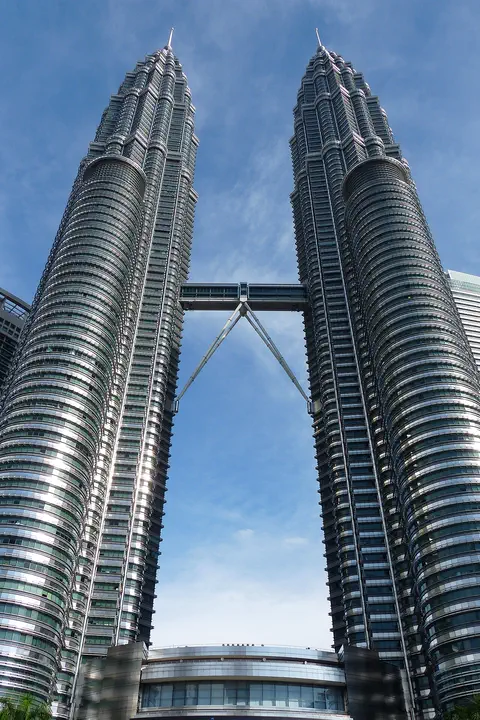 Watch
Landmark
Petronas Towers
The Petronas Twin Towers in Kuala Lumpur, Malaysia, are two matching skyscrapers 452 meters tall, finished in 1998. Seen from above, each floor is shaped like an eight-pointed star, a pattern from Islamic art. A two-story skybridge joins them 170 meters above the ground, and from 1996 to 2003 they were counted as the tallest buildings in the world.
-
 Watch
City
Kuala Lumpur
Kuala Lumpur is the capital and largest city of Malaysia, in Southeast Asia. It began in 1857 as a settlement of Chinese tin miners where two rivers meet, and its name means "muddy estuary" in Malay. Today about 2.08 million people live there (2026 estimate), among skyscrapers, mosques and old shop-houses.
Explore next
-
Watch
Natural wonder
Java
Java is an island of Indonesia on the Pacific Ring of Fire, and it has many active volcanoes. Its tallest, Mount Semeru, is also its most active. At its western tip, Ujung Kulon National Park protects the island's largest remaining lowland rainforest and the endangered Javan rhinoceros.
-
 Watch
Natural wonder
Mount Agung
Mount Agung is a cone-shaped volcano on the eastern end of Bali, in Indonesia, and the island's highest point at about 3,000 meters. It erupted strongly in 1963 and 1964, and again with explosions, ash clouds and lava in its crater from 2017 to 2019. Scientists watch it all the time and set safety zones around it when it is restless.
-
 Watch
Natural wonder
Mount Etna
Mount Etna is a huge, active volcano on the east coast of Sicily, in Italy. UNESCO calls it the most active stratovolcano in the world, and people have written about its eruptions for at least 2,700 years. Its height changes as eruptions build it up and crater rims collapse. Vineyards and orchards grow on its rich lower slopes, and scientists watch it every day.
-
Watch
 Country
Indonesia
Indonesia is a country of about 17,500 islands in Southeast Asia, spread across the Equator between the Indian and Pacific oceans. It has more than 100 active volcanoes, rainforests full of wildlife, and about 286 million people (2025).
- Watch Geography Types of volcanoes Volcanoes come in different shapes. Runny lava builds wide, gentle shield volcanoes like Mauna Loa. Sticky lava and ash build tall, steep stratovolcanoes like Mount Fuji. Small cinder cones grow from bits of lava thrown into the air. Whether lava is runny or sticky, and how much gas it holds, decides the shape and how explosive the eruptions are.
- Watch Geography Why the Ring of Fire exists The Ring of Fire is a horseshoe-shaped path about 40,000 kilometers long around the edges of the Pacific Ocean, with more than 450 volcanoes. It exists because around most of the Pacific, ocean plates are sinking under other plates, which makes magma, deep trenches and earthquakes.
-
 Watch
Natural wonder
Mount Sinabung
Mount Sinabung is a 2,460-meter stratovolcano in North Sumatra, Indonesia. It had no eruption for about 1,200 years until 2010, and since 2013 scientists have watched it closely as it builds and loses lava domes.
-
Watch
City
Jakarta
Jakarta, Indonesia's largest city and its capital, lies on the northwest coast of the island of Java, where the Ciliwung River meets the Java Sea. About 11 million people live there (2025). Indonesia is building a new capital called Nusantara, but under the law Jakarta stays the capital until the president signs a decree moving it.
For parents & teachers
What children will learn
- Locate Krakatoa between Java and Sumatra.
- Explain how a new volcanic island can grow from the sea.
- Describe how plants return to land after eruptions.
- Know why people must follow official exclusion zones near volcanoes.
Recommended ages: 3 to 17 · About 15 minutes
Talk about it
- Why might scientists watch a volcano from space?
- What would plants need to start growing on bare volcanic rock?
- Why do volcano experts set safe distances, and why should everyone follow them?
Try at home or in class
- Pour layers of sand and then gravel into a pile in a tray of water to see how a cone can build up until its top rises above the surface.
- Sprinkle a few seeds on a tray of bare sand and another of potting soil, water both and compare which sprouts first.
Key vocabulary: volcano, eruption, plume, Holocene, succession, exclusion zone
Where these facts come from
- Wikidata , Wikimedia Foundation (CC0 1.0)
- Unrest at Anak Krakatau , NASA Earth Observatory
- Krakatau, Indonesia , NASA Earth Observatory
- ASTER Images Post-eruption Anak Krakatau Volcano , NASA Photojournal
- Ujung Kulon National Park , UNESCO World Heritage Centre
- File:Anak Krakatau, january 2016.jpg , Wikimedia Commons
- Natural Earth vector data , Natural Earth (NACIS) (Public domain)
- Wikimedia Commons , Wikimedia Foundation (Per file (public domain, CC0, CC BY or CC BY-SA); see each media record)
Checked, not yet human-reviewed. Last updated November 1, 2026. Spotted a mistake? Tell us.